
 Worksheets
PSH Q4 Mini 1 Review
Total questions: 105
Worksheet time: 2hrs 13mins
Name
Class
Date
1.
Weight is measured in ____ and is a _____
a)
Newtons, Force
b)
Kg, Force
c)
Newtons, Mass
d)
Kg, Mass
2.
The four fundamental forces of nature are:
a)
Electromagnetism, Gravity, Strong Nuclear, Weak Nuclear
b)
Gravity, Strong Nuclear, Weak Nuclear, Medium Nuclear
c)
Normal Force, Force due to gravity, Magnetism, Nuclear
d)
Nuclear, Electricity, Gravity, Atomic
3.
Rank the four fundamental forces of nature in order from weakest to strongest:
a)
Electromagnetism, Gravity, Strong Nuclear, Weak Nuclear
b)
Weak Nuclear, Gravity, Electromagnetism, Strong Nuclear
c)
Gravity, Weak Nuclear, Electromagnetism, Strong Nuclear
d)
Weak Nuclear, Electromagnetism, Gravity, Strong Nuclear
4.
Gravity is due to:
a)
the pull between Earth and the moon.
b)
the pull between the Sun and Earth.
c)
the pull between any objects with mass.
d)
the pull between atomic nuclei.
5.
The weakest of the four fundamental forces is:
a)
Gravity
b)
Electromagnetism
c)
Strong Nuclear
d)
Weak Nuclear
6.
The strongest of the four fundamental forces is:
a)
Gravity
b)
Electromagnetism
c)
Strong Nuclear
d)
Weak Nuclear
7.
________ can be either a force of attraction or repulsion while ____________ is only a force of attraction.
a)
Gravity; Electromagnetism
b)
Electromagnetism; Gravity
c)
Gravity; Strong nuclear force
d)
Magnetism; Electricity
8.
____________ and ____________ are short range forces.
a)
Gravity, Electromagnetism
b)
Strong Nuclear, Weak Nuclear
c)
Electromagnetism, Strong Nuclear
d)
Gravity, Weak Nuclear
9.
Gravity has a range that is ____________.
a)
Short
b)
Long
c)
Infinite
d)
Variable
10.

When an atom undergoes radioactive decay, the energy that is released is due to:
a)
Gravity
b)
Electromagnetism
c)
Strong Nuclear
d)
Weak Nuclear
11.

An apple falling from a tree is an example of the force of ____________.
a)
Gravity
b)
Electromagnetism
c)
Strong Nuclear
d)
Weak Nuclear
12.

An electron moving in wire is an example of ____________.
a)
Gravity
b)
Electromagnetism
c)
Strong Nuclear
d)
Weak Nuclear
13.
_____________ is the force that binds protons together in the nucleus of an atom.
a)
Gravity
b)
Electromagnetism
c)
Strong Nuclear
d)
Weak Nuclear
14.
After the nucleus of a radioactive element undergoes changes, the element can transform into ...
a)
(a) a different isotope of the same element.
b)
(b) an entirely different element.
c)
Both (a) and (b)
d)
Neither (a) nor (b)
15.
Alpha particles.....
a)
a) are positively charged.
b)
b) consist of two protons and four neutrons.
c)
c) can penetrate any thickness of matter
d)
d) All of the above
16.
The process of nuclear change in an atom of radioactive material is called...
a)
nuclear decay
b)
nuclear mass
c)
isotopes
d)
radon
17.
During beta decay, a nucleus ....
a)
gives up two protons and two neutrons.
b)
maintains the same number of protons and neutrons.
c)
loses a proton and gains a neutron.
d)
gains a proton and loses a neutron.
18.
When a nucleus undergoes nuclear decay by gamma rays, the atomic number of the element....
a)
remains the same
b)
decreases by one.
c)
increases by one.
d)
increases by two.
19.
The process of the production of lighter nuclei from heavier nuclei is called
a)
mass energy
b)
magneticism
c)
fusion
d)
fission
20.
Radioactive materials have unstable...
a)
electrons
b)
protons
c)
nuclei
d)
neutrons
21.
The type of radioactive particle that can be stopped by a sheet of paper is the ____.
a)
alpha particle
b)
beta particle
c)
gamma ray
d)
uranium
22.
The most penetrating type of radiation is the ____.
a)
alpha particle
b)
gamma ray
c)
beta particle
d)
uranium
23.
A helium nucleus with two protons and two neutrons is called a(n) ____.
a)
alpha particle
b)
electroscope
c)
beta particle
d)
gamma ray
24.
Negatively charged particles emitted from a nucleus at a high speed are ____.
a)
alpha particle
b)
gamma rays
c)
beta particles
d)
X rays
25.
The three types of nuclear radiation in increasing order of penetrating power are ____.
a)
alpha, beta, gamma
b)
X ray, beta, gamma
c)
alpha, gamma, beta
d)
X ray, gamma, beta
26.
The process by which nuclei having low masses are united to form nuclei with larger masses is ____.
a)
a chain reaction
b)
fission
c)
a chemical reaction
d)
fusion
27.

Radon-222 has 86 protons and 136 neutrons. What daughter product will form from alpha decay?
a)
Francium-222 (87 protons)
b)
Polonium-218 (84 protons)
c)
Radium-226 (88 protons)
d)
Lead-220 (82 protons)
28.

What type of decay is illustrated by the equation?
a)
alpha decay
b)
beta decay
c)
positron emission
d)
electron capture
29.

An electron that is emitted during radioactive decay is a
a)
neutron
b)
gamma ray
c)
alpha particle
d)
beta particle
30.
What is Half-life?
a)
The amount of time it takes for some of the nuclei in a sample of the isotope to decay
b)
The amount of time it takes for half the electrons in a sample of the isotope to decay
c)
The amount of time it takes for half the nuclei in a sample of the isotope to decay
d)
the amount of time it takes to double the nuclei in a sample of the isotope to decay
31.

What percent of carbon-14 would be left after 5730 years?
a)
100%
b)
75%
c)
50%
d)
25%
32.
The half-life of strontium-90 is 25 years. How much strontium-90 will remain after 75 years if the initial amount is 100 grams?
a)
75
b)
50
c)
25
d)
12.5
33.
The least penetrating type of radiation
a)
Alpha particle
b)
Beta particle
c)
gamma ray
34.
A form of radiation that carries energy and has no mass and no charge.
a)
Alpha particles
b)
Beta Particles
c)
Gamma Rays
d)
Daughter nucleus
35.
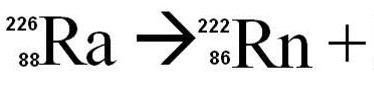
Complete the nuclear equation and determine the type of decay that is occurring in this reaction.
a)
alpha
b)
beta
c)
gamma
d)
none
36.

Which radioactive isotope decays quicker?
a)
Carbon-14
b)
Plutonium-239
c)
Same
37.
If the radioactive isotope of Iodine-131 has a half live of 8 days and we start with 400g, how many grams of would remain after 24 days?
a)
400g
b)
200g
c)
50g
d)
100g
38.

Which type of nuclear radiation is being emitted here?
a)
alpha
b)
beta
c)
gamma
d)
none
39.

Has the symbol
a)
Alpha
b)
Beta
c)
Gamma
40.
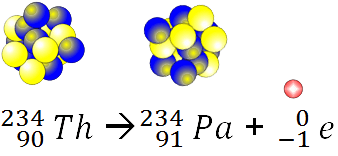
Which type of nuclear radiation is being emitted here?
a)
Alpha
b)
beta
c)
gamma
d)
none
41.

Which type of nuclear radiation is being emitted here?
a)
Alpha
b)
beta
c)
gamma
d)
none
42.
In the equation, 146C --> 147N + 0-1B, the _______ decay of radioactive carbon-14 results in the creation of a new nitrogen-14 atom.
a)
Radioactive
b)
Beta
c)
Alpha
43.

What particle completes this reaction?
a)
alpha particle
b)
beta particle
c)
gamma particle
d)
neutron
44.
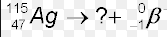
What element is the ?
a)
Ag-115
b)
Cd-115
c)
Pd-115
d)
Not Listed
45.
Which of the following is not a term used in creating power from nuclear power plants?
a)
Fission
b)
Fusion
c)
Steam
d)
Turbine
46.
In the symbol 20682Pb what does 206 stand for?
a)
Mass number
b)
Atomic number
c)
Atomic mass
d)
Number of protons
47.
If Gadolinium-150 goes through alpha decay, the resulting element has a new atomic mass of _____.
a)
150
b)
148
c)
146
48.
What is the symbol for an alpha particle?
a)
42He
b)
0-1e
c)
0+1 e
d)
10n
49.
Balance the following equation:
146C --> 0-1e + ________
146C --> 0-1e + ________
a)
145B
b)
146C
c)
147N
d)
42He
50.
Type of radiation that requires thick layers of concrete or lead in order to be stopped
a)
Gamma
b)
They are equal
c)
Beta
d)
Alpha
51.
The splitting of a nucleus into smaller nuclei is
a)
fusion
b)
fission
c)
decay
d)
gamma radiation
52.
Gamma rays have a _____ charge
a)
0
b)
+1
c)
-1
d)
+2
53.
Two or more nuclei combine to form one larger nucleus in the process of nuclear _____.
a)
Fusion
b)
Fission
c)
Tracing
d)
Decay
54.

Gamma rays damage human cells/tissue.
a)
True
b)
False
55.
Solve this equation for alpha decay.
88226Ra = ___ + 24He
88226Ra = ___ + 24He
a)
86222Rn
b)
89226Ac
c)
84224Po
d)
88225Ra
56.
Solve this equation for alpha decay.
85209At = ___ + 24He
85209At = ___ + 24He
a)
83205Bi
b)
86209Rn
c)
81207Tl
d)
85208At
57.
Solve this equation for beta decay.
614C = ___ + -10e
614C = ___ + -10e
a)
410Be
b)
714N
c)
210He
d)
613C
58.
Solve this equation for beta decay.
2760Co = ___ + -10e
2760Co = ___ + -10e
a)
2556Mn
b)
2860Ni
c)
2358V
d)
2759Co
59.
Materials giving off penetrating rays and particles.
a)
Radioactivity
b)
Radio music
c)
mutants
d)
transformers
60.
An unstable nucleus that looses energy by emitting radiation is called ____________.
a)
mutation
b)
germination
c)
pollination
d)
radioactive decay
61.
An alpha particle is a _____________ nucleus.
a)
H (hydrogen)
b)
He (helium)
c)
U (uranium)
d)
Na (sodium)
62.
With respect to penetrating power, an alpha particle is considered the _________________ and can be stopped by a piece of paper.
a)
weakest
b)
strongest
c)
hard to say
d)
all forms of radiation are equal
63.
This radioactive particle is also known as an electron and has a charge of -1
a)
alpha
b)
beta
c)
gamma
d)
kryptonite
64.
With respect to penetrating power, a beta particle typically is stopped by _________, but penetrates through the __________.
a)
foil, skin
b)
paper, skin
c)
concrete, skin
d)
skin, foil
65.
High energy electromagnetic radiation is also known as
a)
alpha radiation
b)
beta radiation
c)
gamma radiation
66.
Has no mass and no charge
a)
alpha particle
b)
beta particle
c)
gamma particle
67.
What type of particle is released during beta decay?
a)
Nucleus
b)
Neutron
c)
Proton
d)
Electron
68.
What type of radioactive decay increases the atomic number of a radioactive atom?
a)
gamma emission
b)
beta emission
c)
alpha emission
d)
fusion
69.
Which of the following correctly describes the charge of beta particles and alpha particles?
a)
Alpha particles are positively charged, and beta particles are negatively charged.
b)
Alpha particles and beta particles are both negatively charged.
c)
Alpha particles are negatively charged, and beta particles are positively charged.
d)
Alpha particles and beta particles are both positively charged
70.
For the following nuclear reaction, what was the starting substance (X)?
X → 86Rn222 + 2He4
X → 86Rn222 + 2He4
a)
Radium-222
b)
Radon-222
c)
Radon-226
d)
Radium-226
71.
This type of reaction occurs on the sun and in stars.
a)
Fission
b)
Fusion
c)
synthesis
d)
decomposition
72.
Fusion produces ____ nuclei.
a)
same-sized
b)
smaller
c)
larger
d)
all of the above
73.
Fission produces ____ nuclei.
a)
same-sized
b)
smaller
c)
larger
d)
all of the above
74.
Which of the following is an advantage of nuclear energy as a power source?
a)
Nuclear waste is not radioactive
b)
Nuclear plants are low in cost
c)
Nuclear energy does not produce air pollution
d)
Waste can be stored anywhere
75.
Which of the following is a disadvantage of nuclear energy as a power source?
a)
Nuclear energy produces less energy than the burning coal
b)
Nuclear energy produces air pollution
c)
Nuclear waste must be safely stored
d)
The fuel source is very limited
76.
Where does fusion occur naturally?
a)
Underwater
b)
All around us
c)
On the moon
d)
On the sun
77.
All of the following are problems of nuclear energy except ---
a)
storage of radioactive fuel
b)
pollution
c)
security concerns
d)
natural disasters (tsunamis, earthquakes, etc.)
78.
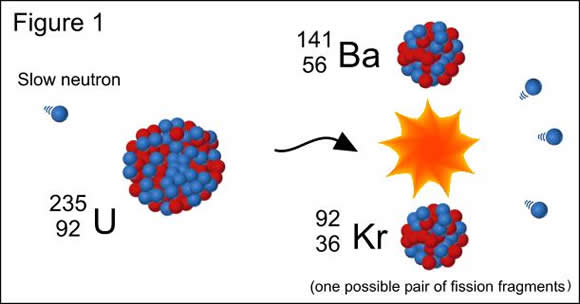
Which nuclear process is shown in the picture?
a)
fission
b)
fusion
c)
alpha decay
d)
beta decay
79.
Which part of the atom is used primarily in nuclear reactions?
a)
proton
b)
nucleus
c)
electron cloud
80.
an atom that has a different number of neutrons than protons is called?
a)
valence electron
b)
isotope
c)
different element
d)
ion
81.
What are the two types of nuclear reactions?
a)
addition and reduction
b)
fusion and fission
c)
reduction and fission
d)
fusion and addition
82.
What element is being joined in the Sun?
a)
helium
b)
hydrogen
c)
phosphorous
d)
plutonium
83.
Two reactions occur that do not obey the Law of Conservation of Mass. The first reaction involves light elements forming heavier ones. The second reaction has heavy elements forming lighter ones. Which statement describes these reactions?
a)
Both reactions may be nuclear fusion
b)
Both reactions may be nuclear fission
c)
The first reaction is nuclear fusion, and the second is nuclear fission
d)
The first reaction is nuclear fission, and the second is nuclear fusion
84.
In nuclear fusion, two positively charged nuclei must touch and bind together. This requires that the nuclei approach each other at.....
a)
low temperatures and low velocity
b)
low temperatures and high velocity
c)
high temperatures and high velocity
d)
high temperatures and low velocity
85.
Which of the following statements BEST describes nuclear fission?
a)
Nuclear fission inside stars can absorb or release energy
b)
Nuclear fission causes the reaction inside an atomic bomb
c)
Nuclear fission is usually present in endothermic reactions
d)
Nuclear fission cannot be used to produce power in nuclear energy plants
86.
Which of the following statements BEST describes nuclear fusion?
a)
Nuclear fusion is a common source of energy
b)
Nuclear fusion usually requires freezing temperatures
c)
Nuclear fusion usually requires a high-temperature environment
d)
Nuclear fusion releases a small amount of energy compared to most
chemical reactions
87.
The half life of iodine-131 is 8.040 days. What percentage of an iodine-131 sample will remain after 40.20 days?
a)
312.5%
b)
31.25%
c)
.3125%
d)
3.125%
88.
Has a mass of 4 and a charge of +2
a)
Alpha
b)
Beta
c)
Gamma
89.
What is Half-life?
a)
The amount of time it takes for some of the nuclei in a sample of the isotope to decay
b)
The amount of time it takes for half the electrons in a sample of the isotope to decay
c)
The amount of time it takes for half the nuclei in a sample of the isotope to decay
d)
the amount of time it takes to double the nuclei in a sample of the isotope to decay
90.
The half-life of Zn-71 is 2.4 minutes. If one had 100.0 g at the beginning, how many grams would be left after 7.2 minutes has elapsed?
a)
100.0g
b)
50.0g
c)
12.5g
d)
8.5g
91.
After the third half-life, how much of the sample is left?
a)
1/2
b)
1/3
c)
1/16
d)
1/8
92.
Barium-122 has a half-life of 2 minutes. A fresh sample weighing 80 g was obtained. If it takes 10 minutes to set up an experiment using barium-122, how much barium-122 will be left when the experiment begins?
a)
0.25g
b)
2.5g
c)
25g
d)
80g
93.
The half-life of strontium-90 is 25 years. How much strontium-90 will remain after 100 years if the initial amount is 4.0 g?
a)
3.0g
b)
0.25mg
c)
0.3g
d)
0.25g
94.

How many protons does U 235 atom have ?
a)
235
b)
92
c)
143
d)
67
95.

Uranium-238 decays into Thorium-234 by emitting .........
a)
an alpha particle
b)
a beta particle
c)
gamma rays
d)
visible light
96.
When nuclei decay, massive amounts of __________ is released.
a)
energy
b)
jello
c)
protons
d)
neutrons
97.
When an element loses protons, its __________changes.
a)
protonic number
b)
electronic number
c)
neutronic number
d)
atomic number
98.
What makes an element radioactive?
a)
When it's nuclei expands
b)
When it's electrons explode
c)
When it's nuclei behave
d)
When it's nuclei decay
99.
This is when scientists split the nuclei of atoms with neutrons.
a)
Nuclear fission
b)
Nuclear fusion
c)
Nuclear power
d)
Nuclear weapon
100.
As a sample of Neon-19 undergoes radioactive decay, its half-life will
a)
decrease
b)
increase
c)
remain the same
d)
start over
101.
If 10 mg of iodine 131 is given to a patient, how much is left after 24 days? The half-life of iodine-131 is 8 days.
a)
1.25mg
b)
1.25g
c)
10g
d)
10mg
102.
If the half-life of uranium-232 is 70 years, how many half-lives will it take for 10 g of it to be reduced to 1.25 g?
a)
1 half-life
b)
2 half-lives
c)
3 half-lives
d)
4 half-lives
103.
The half-life of Zn-71 is 2.4 minutes. If one had 100.0 g at the beginning, how many grams would be left after 7.2 minutes has elapsed?
a)
100.0g
b)
50.0g
c)
12.5g
d)
8.5g
104.
The half-life of a radioactive isotope is not effected by which of the following?
a)
Temperature
b)
Pressure
c)
Concentration
d)
None of these will effect the rate of a nuclear reaction
105.
After 4 half-lives, 1g of a sample of Krypton-85 remains unchanged. What was the original mass of the sample?
a)
16g
b)
32g
c)
0.0625g
d)
4g
100 %

