wayground logo

Free Printable Worksheets

Font size

S
M
L
XL
Worksheets

Berner Quarterly 2 Review

Total questions: 136

Worksheet time: 2hrs 16mins
Name
Class
Date
1.
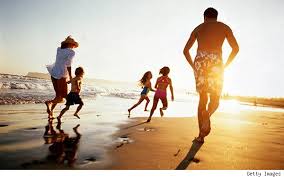
The sun shines down on this family as the play on the beach.
a)
conduction
b)
convection
c)
radiation
2.
Walking on the warm sand sand with your bare feet.
a)
conduction
b)
convection
c)
radiation
3.
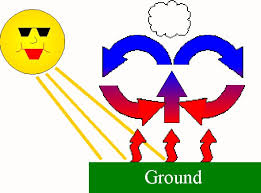
Warm air rises and the cool air sinks.
a)
conduction
b)
convection
c)
radiation
4.
Heat transfers from an area of ____temperature to an area of ___ temperature.
a)
high to low
b)
low to high
c)
high to high
5.
What happens when ice cubes melt in a glass?
a)
Heat travels from the ice to the warmer water.
b)
No energy is transferred.
c)
Heat is transferred from the warmer water to the ice cubes.
d)
The water warms up due to the humidity
6.
At higher temperatures
a)
particles in an object have less energy
b)
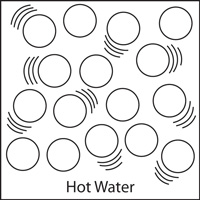
particles in an object move faster
c)
a gas contracts
7.
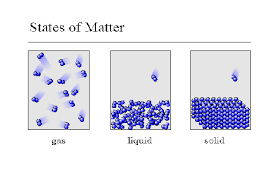
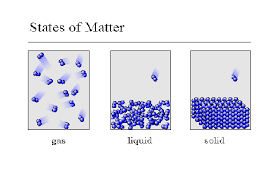
A gas
a)
has a definite shape but no definite volume
b)
has a definite volume but no definite shape
c)
has fast-moving particles
8.
The speed of the molecules determines the _____.
a)
volume
b)
density
c)
pressure
d)
temperature
9.
Particles (molecules) in a ______________________ have more energy than the other states of matter.
a)
gas
b)
solid
c)
liquid
10.
The state of matter that has no definite size or shape is
a)
Solid
b)
Liquid
c)
Gas
11.
Define a liquid.
a)
Indefinite shape, indefinite volume
b)
Definite shape, definite volume
c)
Found in stars
d)
Definite volume, indefinite shape
12.
Which state of matter has a definite shape?
a)
solid
b)
liquid
c)
gas
13.
Boiling
a)
liquid to gas
b)
gas to solid
c)
gas to liquid
d)
solid to liquid
14.
Freezing
a)
Solid to gas
b)
Liquid to solid
c)
Gas to solid
d)
Liquid to gas
15.
The state of matter that has no definite size or shape is
a)
Solid
b)
Liquid
c)
Gas
16.
the central region of an atom where its neutrons and protons are is its 
a)
nucleus 
b)
electron cloud
c)
core 
d)
center 
17.
an atom with atomic number 6 would have how many protons 
a)
6
b)
12
c)
3
d)
cannot be determined 
18.
Particles in an atom that are neutral and have no charge are 
a)
negatrons 
b)
electrons 
c)
neutrons 
d)
protons 
19.
What is the atomic number for an element with three protons?
a)
2
b)
1
c)
3
d)
6
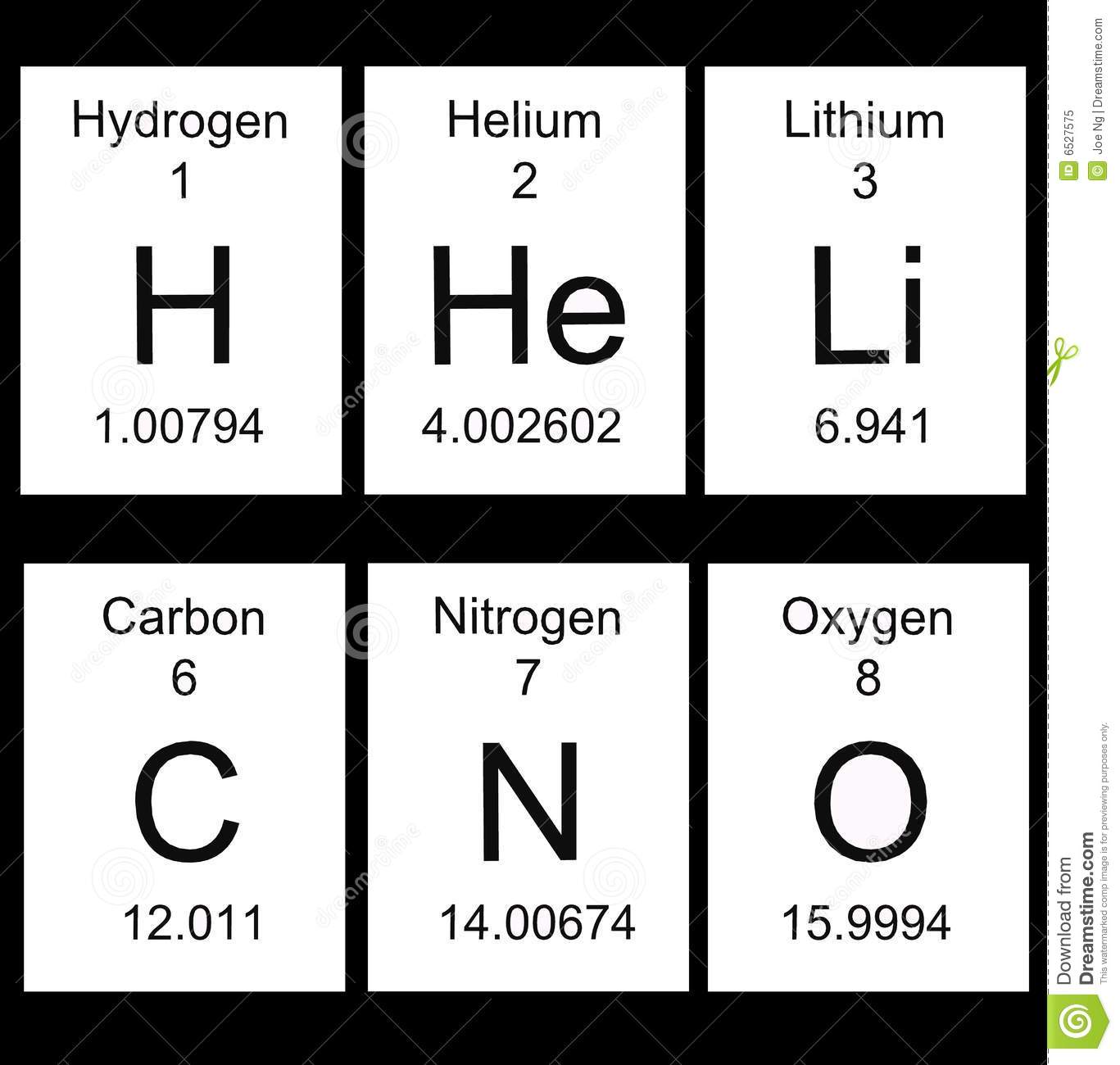
20.
What does the 1.00794 stand for?
a)
Hydrogen
b)
atomic number
c)
atomic mass
d)
atomic explosion
21.
What is the atomic mass of "F"
a)
9
b)
18
c)
17
d)
19
22.
The positive particles of an atom are 
a)
electrons 
b)
positrons 
c)
neutrons 
d)
protons 
23.
A particle that moves around the nucleus is a(n)...
a)
Proton
b)
Neutron
c)
Electron
d)
Quark
24.
Most of the mass in an atom is concentrated in the...
a)
electrons
b)
nucleus
c)
protons
d)
empty space
25.
True or False:  The density of a specific type of material never changes.  
a)
True
b)
False
26.
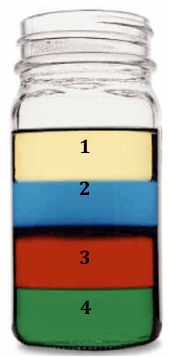
Put the liquids in order from most dense to least dense?
a)
4, 3, 2, 1
b)
1, 2, 3, 4
c)
3, 4, 2, 1, 
d)
4, 3, 1, 2
27.
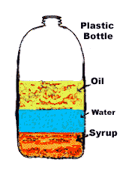
Which liquid is the least dense?
a)
oil
b)
water
c)
syrup 
d)
plastic bottle
28.
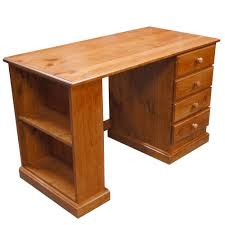
Which box has a higher density?  
a)
Box A
b)
Box B
c)
cannot be determined
d)
they are the same
29.
In general what is the most dense form of matter?
a)
solid
b)
liquid
c)
gas
d)
plasmas
30.
Why do ice cubes float in a  glass of water?
a)
the ice cubes are more dense than the water
b)
the water is more dense than the ice cubes
c)
the water is more dense than the glass
d)
the ice is more dense than the glass
31.
A brick sinks in water while a wooden block of the same size floats.  This is because the brick has a
a)
lower volume than the wooden block
b)
lower density than the wooden block
c)
higher volume than the wooden block
d)
higher density than the wooden block
32.
Why do some substances float on water?
a)
they are warmer than water
b)
they are cooler than water
c)
they are more dense than water
d)
they are less dense than water
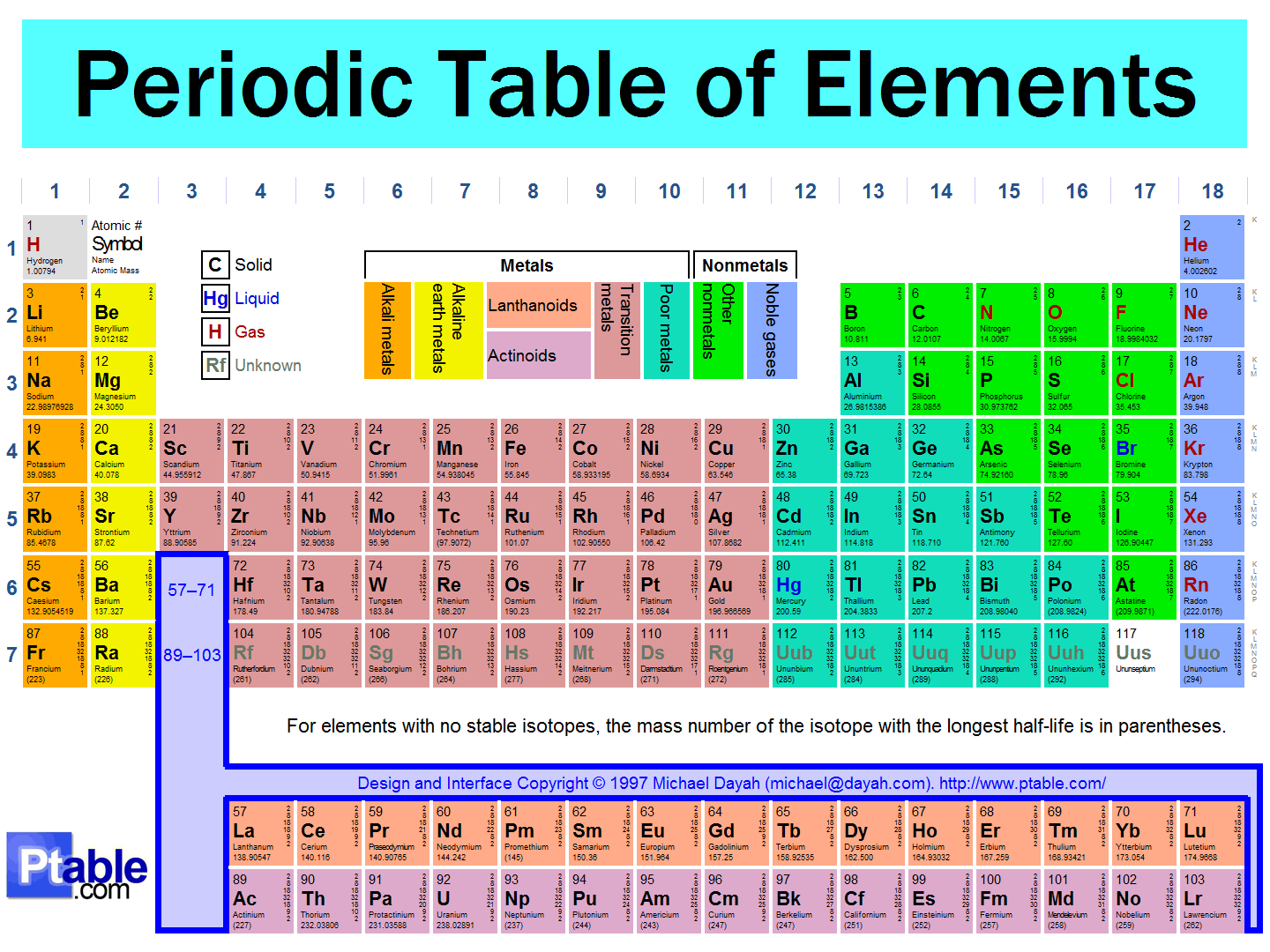
33.
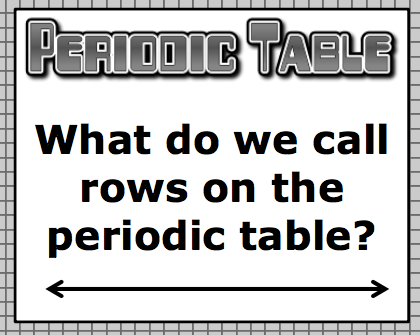
a)
Periods
b)
Groups
34.
a)
Periods
b)
Groups
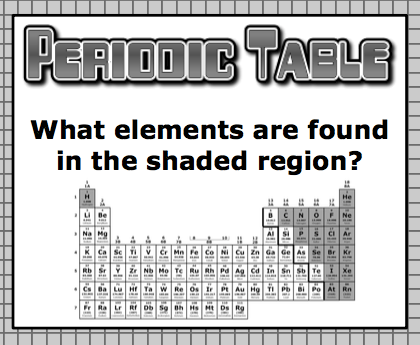
35.
a)
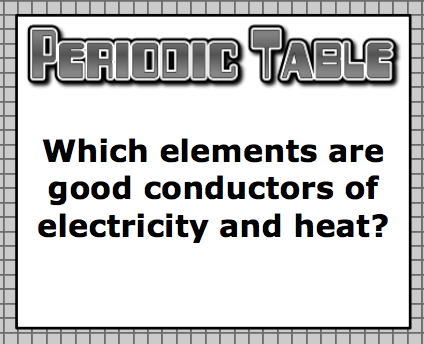
Metals
b)
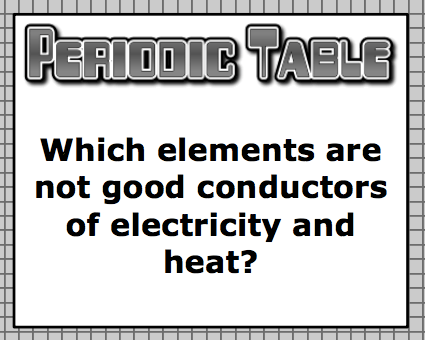
Nonmetals
c)
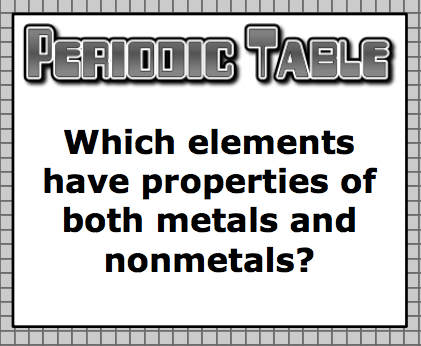
Metalloids
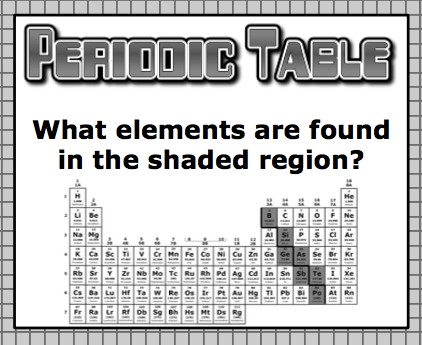
36.
a)
Metals
b)
Nonmetals
c)
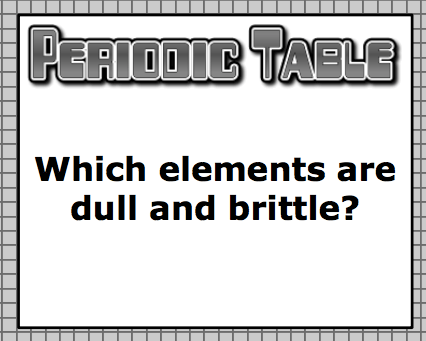
Metalloids
37.
a)
Metals
b)
Nonmetals
c)
Metalloids
38.
a)
Metals
b)
Nonmetals
c)
Metalloids
39.
a)
Metals
b)
Nonmetals
c)
Metalloids
40.
a)
Metals
b)
Nonmetals
c)
Metalloids
41.
a)
Metals
b)
Nonmetals
c)
Metalloids
42.
The horizontal row on the periodic table is called a
a)
group
b)
family
c)
period
d)
atomic number
43.
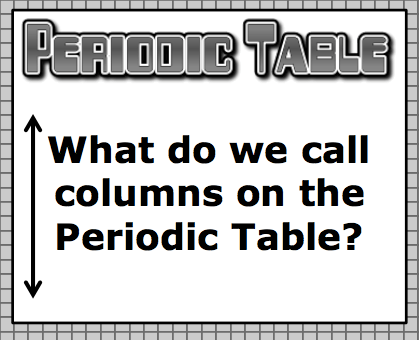
A vertical column is called...
a)
group
b)
tower
c)
period
d)
crew
44.
The number at the bottom of each square on the periodic table is the ...
a)
atomic number
b)
atomic mass
c)
chemical symbol
d)
element name
45.
The number at the top of each square on the periodic table is the ...
a)
atomic number
b)
atomic mass
c)
Chemical Symbol
d)
Element Name
46.
What is the chemical symbol for Lithium?
a)
H
b)
He
c)
Li
d)
N
47.
Most of the elements on the periodic table are classified as _____.
a)
Metals
b)
Nonmetals
c)
Metalloids
d)
Periods
48.
The atomic number tells you what?
a)
number of electrons
b)
number of protons
c)
number of neutrons
d)
both electrons and protons in an atom.
49.
Gloves help keep your hands warm in winter because:
a)
They are conductors of heat.
b)
They are fuzzy.
c)
They are conductors of electrical energy.
d)
They are insulators.
50.
True or False: An insulator is a type of material that allows heat to escape from an object quickly.
a)
True
b)
False
51.
What is a conductor?
a)
Material that does NOT transfer energy.
b)
Materials that are connected to circuits.
c)
Materials that transfer energy.
d)
Materials that
52.
An insulator is a material that:
a)
Transfers thermal and electrical energy
b)
Transfers electrical energy and slows thermal energy
c)
Slows electrical energy and allows thermal energy to pass
d)
Slows thermal and electrical energy from transfering
53.
Which is NOT an insulator.
a)
Wool
b)
Plastic
c)
Copper
d)
Glass
54.
The handle of a frying pan is often coated in rubber because rubber provides...
a)
Heat insulation
b)
Heat conduction
c)
A low melting point
d)
A nonstick surface
55.
Which of these is the correct term for turning a gas into a liquid?
a)
Evaporating
b)
Boiling
c)
Condensing
d)
Freezing
56.
Which of these is the right word for the process of turning a solid into a liquid?
a)
Boiling
b)
Melting
c)
Condensing
d)
Evaporating
57.
How could you turn solid metal into a liquid?
a)
You could freeze it
b)
By condensing it
c)
You could rub it with sandpaper
d)
You could heat it
58.
Which of these is true?
a)
Solids hold their shape.
b)
Liquids hold their shape.
c)
Gases hold their shape.
d)
Penguins eat pineapples.
59.
You blow up a balloon. Is it heavier or lighter than the uninflated balloon?
a)
Heavier
b)
Lighter
c)
They weigh the same
60.
Which state of matter has neither a definite shape nor a definite volume?
a)
solid
b)
liquid
c)
gas
61.
Which state of matter has a definite volume but no real shape of its own?
a)
solid
b)
liquid
c)
gas
62.
What is the amount of space that matter fills?
a)
area
b)
space
c)
pressure
d)
volume
63.
True or false. All solids have a closely packed, fixed arrangement of molecules?
a)
true
b)
false
64.
What is the change of state from a liquid to a solid?
a)
freezing
b)
condensation
c)
melting
d)
evaporation
65.
Name the three states of matter:
a)
crystalline, amorphous, solid
b)
solid, liquid, gas
c)
energy, matter, mass
d)
solid, fluid, liquid
66.
The opposite of freezing is: 
a)
melting
b)
vaporization
c)
condensation
67.
Objects gain heat and _________. 
a)
expand
b)
contract
68.
When an object expands, its _________ increases.
a)
mass
b)
volume
c)
shape
d)
size 
69.
A change in the volume of a substance due to a change it its temperature is called?
a)
Thermal expansion
b)
Heat
c)
Thermal conductivity
d)
Insulator
70.
3. If the atoms of an object are moving or vibrating fast, the temperature would be...
a)
Hot
b)
Cold
c)
Unknown
71.
4. If the atoms of an object are moving or vibrating slow, the object would feel...
a)
Cold
b)
Hot
c)
Unknown
72.
What is Thermal Contraction 
a)
A Potato
b)
A decrease in a materials  volume when its temperature decreases 
c)
The movement of fluids in a cycle because of convection 
d)
A material through which  thermal energy does not flow easily.
73.
What is Thermal expansion?
a)
The transfer of thermal energy between materials by the collisions of particles 
b)
Is a decrease in a materials volume when temperature decreases 
c)
An increase in a materials volume when temperature increases
d)
Chicken fried rice
74.
Objects gain heat and _________. 
a)
expand
b)
contract
75.
The liquid in the thermometer rises when it is placed in the hot water because ___________. 
a)
it gains heat from the hot water and expands.
b)
loses heat from the hot water and contracts. 
c)
the surrounding air is too warm. 
d)
the liquid is boiling. 
76.

Is the temperature, 0 degrees Celsius, show the melting, freezing, or boiling point of water?

a)

freezing point

b)

melting point

c)

boiling point

d)

both freezing point and melting point

77.
What is happening at water melting point?
a)
liquid to gas
b)
solid to liquid
c)
gas to liquid
d)
liquid to soild
78.
What is happening at freezing point?
a)
gas to liquid
b)
solid to liquid
c)
liquid to solid
d)
liquid to gas
79.

What is water's melting point?

a)

32 C

b)

0 C

c)

30 F

d)

0 F

80.
What is happening at the boiling point?
a)
liquid to gas
b)
gas to liquid
c)
solid to liquid
d)
liquid to solid
81.
What is the boiling point of water
a)
0 C
b)
100 F
c)
50 C
d)
100 C
82.

Boiling a pot of noodles will cause steam, which will turn into water droplets on the pot's lid. This is an example of...

a)

melting

b)

freezing

c)

condensation

83.
When the temperature of matter increases the particles...
a)
speed up and move closer
b)
speed up and move farther apart
c)
slow down and move closer together
d)
slow down and move farther apart
84.
When the temperature of matter decreases the particles ...
a)
speed up and move farther apart
b)
speed up and move closer together
c)
slow down and move farther apart
d)
slow down and move closer together
85.
If the tops were removed from the cylinders, the following would happen:
a)
The solid would fly out of the container
b)
The liquid would fly out of the container.
c)
The gas would fly out of the container.
d)
They ALL would fly out of the container.
86.
Molecules move quickest in which state of matter
a)
solid
b)
liquid
c)
gas
d)
solid, liquid and gas
87.
If an acid is combined with a base of equal strength, the result will most likely be
a)
a neutral solution.
b)
a stronger acid.
c)
impossible to tell without testing the pH.
d)
a stronger base
88.
Which of the following is a base?
a)
orange juice
b)
water
c)
vinegar
d)
dishwashing detergent
89.
The pH of a solution is tested, and it is found to be a basic solution. Of the following choices, what could the pH have been?
a)
3
b)
9
c)
7
d)
5
90.
Many cleaning solutions are bases. Which of the following is a property of most bases?
a)
feels slippery
b)
white color
c)
can only be liquid
d)
tastes sour
91.
Tastes bitter.
a)
Acids
b)
Bases
c)
Salts
d)
All
92.
Which of the following is true about acids and bases?
a)
The lower the pH, the stronger the acid
b)
the higher the pH, the stronger the acid
c)
The lower the pH, the more neutral the acid
d)
The higher the pH, the weaker the base
93.
Which food is the most acidic?
a)
bananas
b)
lemon juice
c)
orange juice
94.
A compound that changes color when it is in contact with an acid or base is called______________
a)
Acid
b)
Base 
c)
Neutral
d)
Indicator
95.
Pollution causes the pH of rain water fall below 6. What is such type of rain called?
a)
Acid rain
b)
polluted rain
c)
low pH rain
96.
Is this equation balanced?
a)
yes
b)
no
c)
Not enough information
97.
Is the equation balanced?: 2H2O + O2 --> 4MgO + 3Fe
a)
Yes
b)
No
98.
Is this equation balanced?
a)
yes
b)
no
c)
Not enough information
99.
What goes in the missing blanks?
SnO2 + __ H2 → Sn + __ H2O
a)
5
b)
1
c)
3
d)
2
100.
What is the part of the chemical equation in green called? 
Fe + S --> FeS
a)
products
b)
reactants
c)
yield
d)
chemical formula
101.
In this image, what are the information to the right of the arrow (in black) is called the_______.
a)
Product
b)
Reactant
c)
Chemical Subscript
102.
Which of the following is the general formula for a decomposition reaction?
a)
A + B  → AB
b)
AB → A + B
c)
AB + C → AC + B
d)
AB + CD → AC + BD
103.
Identify the type of reaction:  
Ca + O2 --> CaO
a)
Decomposition
b)
Synthesis
c)
Double Replacement
d)
Combustion
104.
How many atoms of carbon (C) are in C6H12O6?
a)
3
b)
6
c)
12
d)
24
105.
How many atoms of carbon (C) are in C6H12O6?
a)
3
b)
6
c)
12
d)
24
106.
How many Hydrogen are in 4H2O?
a)
6
b)
8
c)
2
d)
4
107.
Number of H in 3(NH₄)₂CrO₄
a)
4
b)
2
c)
8
d)
24
108.
Balance this equation...
HgO --> Hg + O2
a)
It is balanced 
b)
2HgO --> Hg + O2
c)
2HgO --> 2Hg + O2
d)
I don't know...Oh well!
109.
Element or compound?
H2O
a)
element
b)
compound
110.
Which of the following is a compound?
a)
Co
b)
O2
c)
C
d)
CO2
111.
How many elements are in H2O?
a)
1
b)
2
c)
3
d)
4
112.
This appears on the left side of a chemical formula, and represents how many molecules there are.... What is highlighted in yellow?
a)
Atom
b)
Subscript
c)
Molecule
d)
Coefficient
113.
This is used to represent the amount of each atom in a molecule. What is the arrow pointing to?
a)
Exponent
b)
Coefficient
c)
Molecule
d)
Subscript
114.

The law that states the total amount of matter cannot be created nor destroyed?

a)

law of electricity

b)

law of destruction of mass

c)

Law of conservation of matter

d)

law of relative matter

115.
Which of the following is an unbalanced equation?
a)
CaCO--> CaO + CO2
b)
PbO+ 2H2-->2Pb + H2O
c)
2Na+ 2H2O-->2NaOH + H2
d)
CS+ 2O--> CO+ 2SO2
116.
What are the 3 particles that make-up the atom?
a)
protons, neutrons, and isotopes
b)
neutrons, isotopes, and electrons
c)
positives, negatives, and electrons
d)
protons, neutrons, and electrons
117.

a row on the Periodic Table of Elements

a)

family

b)

period

c)

row

d)

isotope

118.

A grouping of elements based on similar properties, arranged by columns in the periodic table; also known as a group.

a)

family

b)

period

c)

row

d)

isotope

119.
In an exothermic reaction, heat is ...
a)
taken in or absorbed
b)
given out or released
120.
In an endothermic reaction, heat is ...
a)
taken in or absorbed
b)
given out or released 
121.
A series of organized steps that scientists use as a guide for answering a question.
a)
Scientific Method
b)
Hypothesis
c)
Observation
d)
Inference
122.
the "effect" of the experiment....what is MEASURED in an experiment
a)
independent variable
b)
dependent variable 
123.
What is independent variable?
a)
the variable that you purposely manipulate
b)
the variable that is being observed
c)
the variable that is not changed.
124.
What is the controlled variable?
a)
the variable that you purposely manipulate
b)
the variable that is being observed
c)
the variable that is not changed
d)
the variable that does not exist
125.
Something that can be changed in an experiment that may affect the outcome
a)
variable
b)
experiment
c)
evidence
126.
Ramone wants to know: does the distance a person kicks a soccer ball effect how well they will do on their math test.  What is the dependent variable?
a)
How far they kick the soccer ball
b)
who the person is
c)
how well they do on the math test
d)
Type of soccer ball.
127.
How does increasing the slope of a ramp affect how far a marble travels?
a)
independent
b)
dependent
128.
Mrs. Goodwyn wants to see if studying time affects test scores...She gives all 6 classes the same assignment but assigns different study times. What is the dependent variable?
a)
Study  time
b)
Test Score
c)
Same Assignment
129.

The substance that does the dissolving

a)

Solute

b)

Solvent

c)

Solution

d)

Miscibility

130.

The substance getting dissolved

a)

Solvent

b)

Solute

c)

Solution

d)

Mixture

131.

This is an example of a

a)

Solution

b)

Mixture

132.

This is an example of a

a)

Solution

b)

Mixture

133.

What are mixtures?

a)

different materials placed together but keeping their own properties

b)

a mixture in which substances spread out evenly and will not settle

c)

the degree to which a material will dissolve in another substance

d)

the substance in a solution that has the greatest amount

e)

the substance in a solution that has the least amount

134.

What is a solution?

a)

different materials placed together but keeping their own properties

b)

a mixture in which substances spread out evenly and will not settle

c)

the degree to which a material will dissolve in another substance

d)

the substance in a solution that has the greatest amount

e)

the substance in a solution that has the least amount

135.

What is a solute?

a)

different materials placed together but keeping their own properties

b)

a mixture in which substances spread out evenly and will not settle

c)

the degree to which a material will dissolve in another substance

d)

the substance in a solution that has the greatest amount

e)

the substance in a solution that has the least amount

136.

What is a solvent?

a)

different materials placed together but keeping their own properties

b)

a mixture in which substances spread out evenly and will not settle

c)

the degree to which a material will dissolve in another substance

d)

the substance in a solution that has the greatest amount

e)

the substance in a solution that has the least amount