
 Worksheets
Windsor Life Science Review
Total questions: 136
Worksheet time: 2hrs 51mins
Name
Class
Date
1.

What process is being described by this diagram?
a)
adaptation
b)
digestion
c)
respiration
d)
photosynthesis
2.
Why are decomposers necessary in the food chain?
a)
They provide nutrients for plants.
b)
They photosynthesize.
c)
They are food for carnivores.
d)
They prey on herbivores.
3.
Which of the following directly use the Sun's energy to produce their own food?
a)
decomposers
b)
carnivores
c)
consumers
d)
producers
4.
If a population of grizzly bears gradually increases over time, which of the following will most likely occur?
a)
The number of prey species will decrease.
b)
The size of the bear population will continue to increase.
c)
The bear population in that area will eventually die out.
d)
The number of prey species will increase.
5.

According to the energy pyramid, which of the following will most likely happen to the other organisms if all the harvest mice died?
a)
The number of hawks would decrease, and the number of insects would increase.
b)
The number of hawks would increase, and the number of insects would increase.
c)
The number of hawks would increase, and the number of insects would decrease.
d)
There would be no change in the rest of the chain.
6.
Which of the following food chains shows the correct energy flow from left to right?
a)
rabbit > owl > grass
b)
grass > rabbit > owl
c)
owl > rabbit > grass
d)
grass > owl > rabbit
7.
Which of the following is not an adaptation that would help a plant survive in the desert?
a)
very long root systems
b)
the ability to store water in stems
c)
tiny or no leaves
d)
large leaves to absorb sunlight
8.

Look at the following table and picture.
These teeth most likely belong to a:
These teeth most likely belong to a:
a)
deer.
b)
tiger.
c)
chimpanzee.
d)
panda bear.
9.

What can be said about all cells?
a)
All cells contain chloroplasts
b)
All cells contain the same basic organelles, but are specialized for their function
c)
All cells contain cell walls
d)
All cells have different organelles, but can complete the same function
10.

All of the nonliving factors in an ecosystem are _____________ factors.
a)
biotic
b)
abiotic
11.

What is the most basic unit of life?
a)
Tissue
b)
Cell
c)
Organ
d)
Organ System
12.

Besides energy from the sun, what else does a plant require to complete photosynthesis?
a)
Wind energy
b)
Oxygen and carbon dioxide
c)
Oxygen and water
d)
Water, carbon dioxide, and chlorophyll
13.
Scientists observe that cutting down trees to gather wood for houses destroys animal habitats. Which of the following animals would be most likely affected by the cutting down of trees?
a)
owls
b)
seals
c)
sharks
d)
buffalo
14.

The study of how all living things on Earth depend on each other is
a)
ecology
b)
biology
15.

Directs all cell activities "Brain or Control Center of cell"
a)
Lysosomes
b)
Nucleus
c)
ribosomes
d)
Mitochondria
16.
Jelly-like substance found inside cell that acts as a medium for chemical reactions within the cell
a)
Nuclear Membrane
b)
Golgi Body
c)
Cytoplasm
d)
Ribosome
17.
"powerhouse of the cell" breaks down sugar molecules to release energy, site of cellular respiration, double membrane, self-replicating, contains own DNA, cristae
a)
Mitochondria
b)
Chloroplast
c)
Cell Wall
d)
Vesicle
18.
"Gatekeeper" Separates the cell from the rest of the environment and helps control what passes in and out of the cell. Semi-permeable: allows some materials to pass through but not all
a)
Cell Wall
b)
Cytoplasm
c)
Mitochondria
d)
Cell Membrane
19.
Rigid outer layer made of cellulose that supports and protects the cell (plant, fungi, and bacterial cells)
a)
Nucleolus
b)
Golgi Body
c)
Cell Wall
d)
Cytoskeleton
20.

The organelle that uses the energy of sunlight to make food for the cell.
a)
Chloroplast
b)
Ribosome
c)
Mitochondria
d)
Nucleus
21.
Organelles that convert food into energy that a cell can use
a)
Nucleus
b)
Mitochondria
c)
Chloroplast
d)
Stomach
22.
A group of tissues that work together
a)
Organ
b)
Tissue
c)
Cell
d)
Steak
23.
An organelle that stores food, water, and wastes
a)
Cell Wall
b)
Endoplasmic Reticulum
c)
Vacuole
d)
Trash can
24.
A group of similar cells that work together
a)
Molecule
b)
Tissue
c)
Organ
d)
Cell
25.

#3 is which organelle?
a)
chloroplast
b)
cytoplasm
c)
mitochondria
d)
golgi apparatus
26.

"I" is which organelle?
a)
chloroplast
b)
cytoplasm
c)
mitochondria
d)
golgi
27.
Which organelle is found in a plant cell and NOT an animal cell?
a)
vacuole
b)
lysosome
c)
cell wall
d)
cell membrane
28.
Which organelle is found in a plant cell and NOT an animal cell?
a)
vacuole
b)
lysosome
c)
cell wall
d)
cell membrane
29.

Which of the following graphs best illustrates the relationship between the heat released by the foods listed in Table 1 and the change in water temperature?
a)
A
b)
B
c)
C
d)
D
30.
T8 - The Independent Variable is represented on which Axis?
a)
A
b)
X
c)
B
d)
Y
31.
T7 - Jacob wants to record his results for the temperature of each day in the past week. What graph or table should he use?
a)
Data table
b)
Bar graph
c)
histogram
d)
Line graph
32.

T11 - What can you infer about the temperature for E.coli bacterial growth?
a)
E. coli does not grow well at low and high temperatures.
b)
E coli will continue to grow at very high temperatures.
c)
E.coli grows best at very low temperatures
d)
E.coli grows best at very high temperatures.
33.
You want to make a graph for an experiment you did about plant growth over a two week period of time. What type of graph would you use?
a)
bar graph
b)
line graph
c)
pictograph
d)
pie chart
34.

What is this graph showing you?
a)
The worlds population is staying the same.
b)
The worlds population is going down (decreasing).
c)
The worlds population was growing but now is decreasing.
d)
The worlds population has been growing and will continue to grow.
35.
What is evaporation?
a)
The part of the water cycle when the sun heats up water, turning it from a liquid into water vapor or steam. It rises from the ground into the air.
b)
The part of the water cycle when the water vapor in the air gets cold. The water turns back into a liquid and forms clouds.
c)
The part of the water cycle when clouds get heavy and can no longer hold the liquid water. This causes the water to fall from the sky to the earth as rain, snow, sleet, or hail.
36.
What is condensation?
a)
The part of the water cycle when the sun heats up water, turning it from a liquid into water vapor or steam. It rises from the ground into the air.
b)
The part of the water cycle when the water vapor in the air gets cold. The water turns back into a liquid and forms clouds.
c)
The part of the water cycle when clouds get heavy and can no longer hold the liquid water. This causes the water to fall from the sky to the earth as rain, snow, sleet, or hail.
37.
What is precipitation?
a)
The part of the water cycle when the sun heats up water, turning it from a liquid into water vapor or steam. It rises from the ground into the air.
b)
The part of the water cycle when the water vapor in the air gets cold. The water turns back into a liquid and forms clouds.
c)
The part of the water cycle when clouds get heavy and can no longer hold the liquid water. This causes the water to fall from the sky to the earth as rain, snow, sleet, or hail.
38.
process of rock breaking down into smaller pieces due to wind or moving water
a)
erosion
b)
melting
c)
weathering
d)
compaction
39.
the process of sediment being glued together
a)
compaction
b)
weathering
c)
erosion
d)
cementation
40.
the rock type formed when sediment is pressed and glued together
a)
rock formation
b)
igneous rock
c)
sedimentary rock
d)
sample
41.
the movement of sediment from one place to another, often caused by wind or flowing water
a)
weathering
b)
compaction
c)
erosion
d)
cementation
42.
hot liquid rock below the surface of Earth
a)
energy
b)
magma
c)
minera
d)
cementation
43.
the rock type formed when magma cools and becomes a solid
a)
sedimentary rock
b)
metamorphic rock
c)
igneous rock
d)
sandstone
44.

How did Mendeleev arrange the elements?
a)
alphabetical
b)
density
c)
melting point
d)
atomic mass
45.
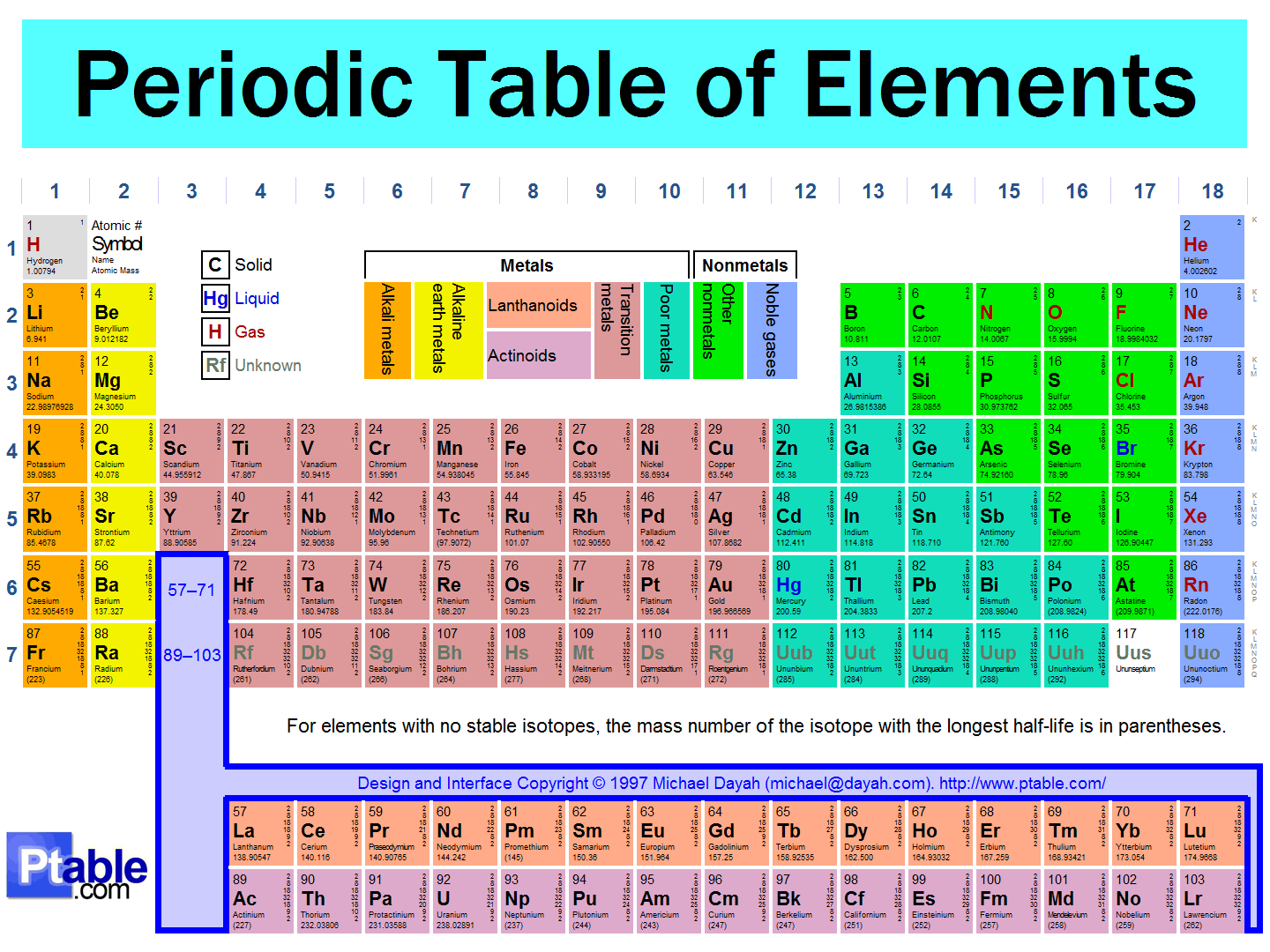
The horizontal row on the periodic table is called a
a)
group
b)
family
c)
period
d)
atomic number
46.
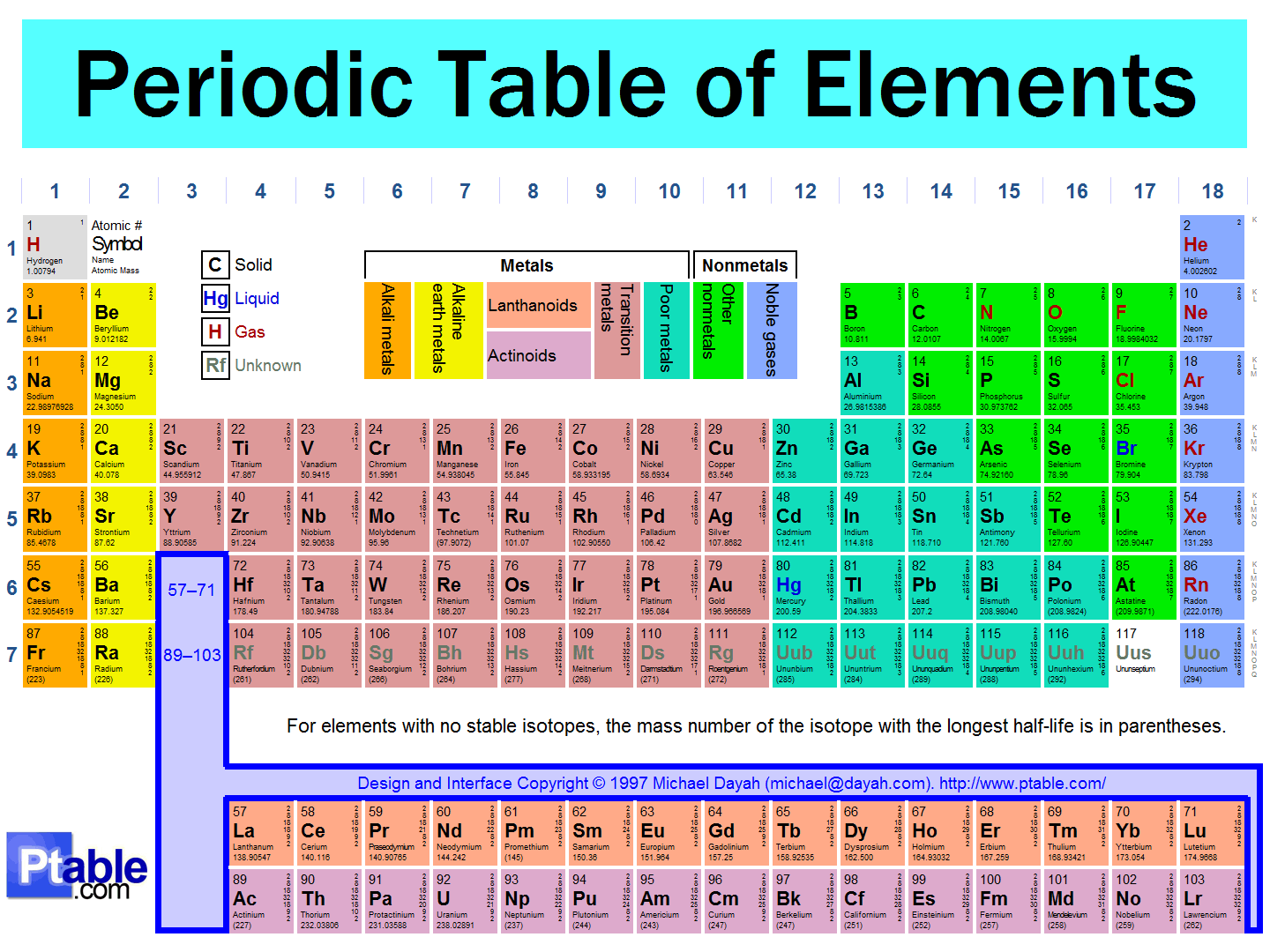
A vertical column is called...
a)
group
b)
tower
c)
period
d)
crew
47.
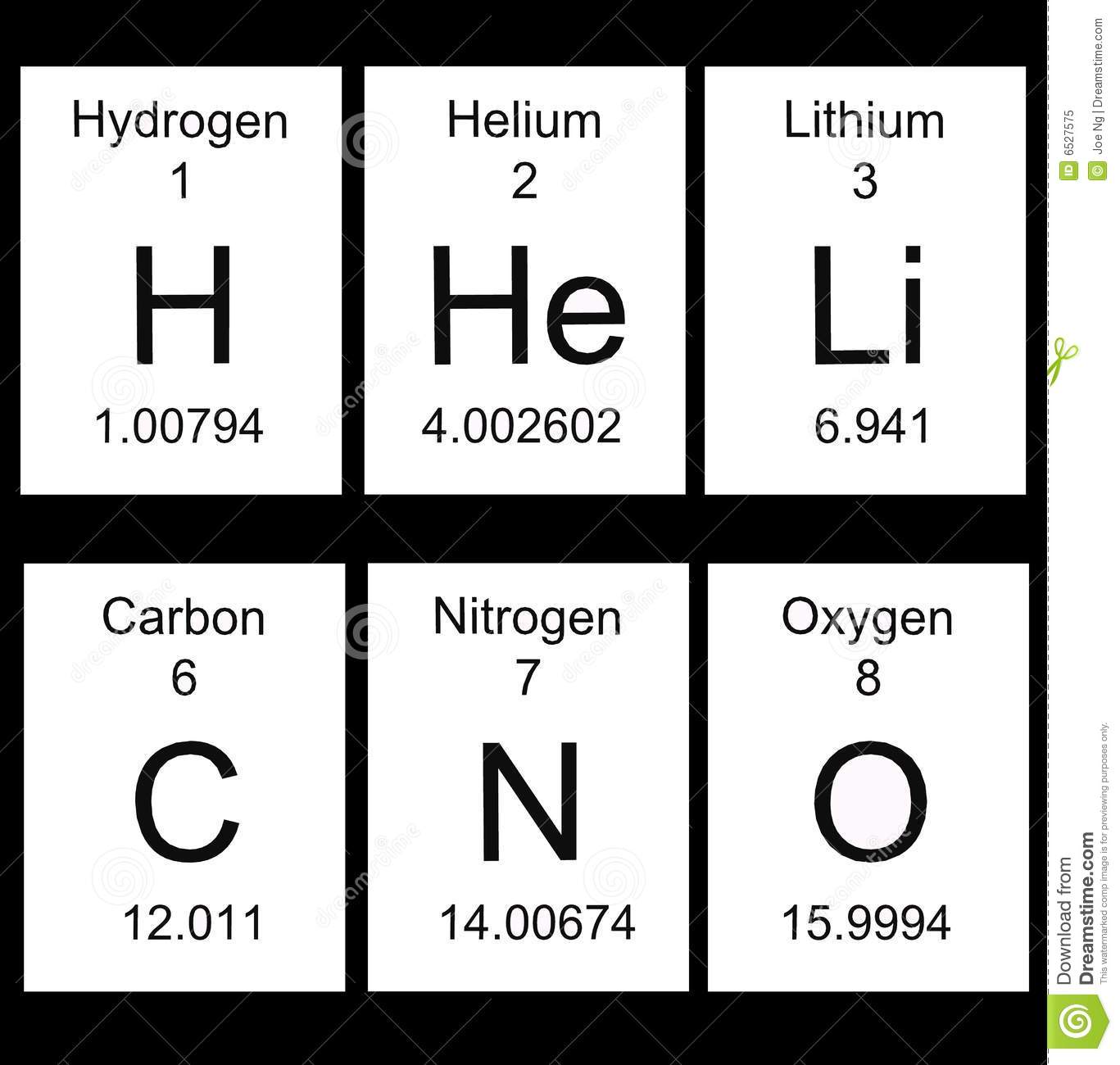
The number at the bottom of each square on the periodic table is the ...
a)
atomic number
b)
atomic mass
c)
chemical symbol
d)
element name
48.
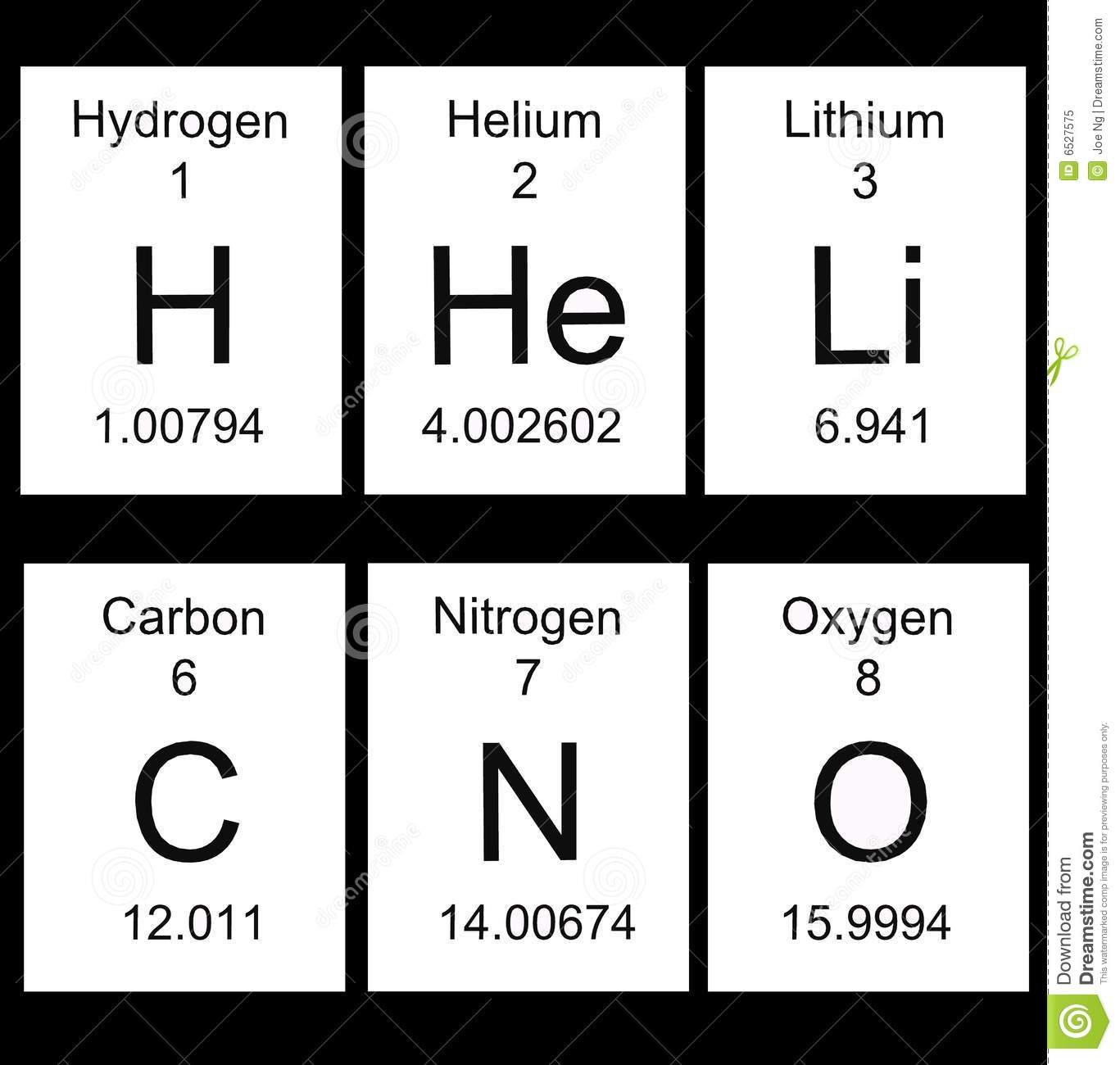
The number at the top of each square on the periodic table is the ...
a)
atomic number
b)
atomic mass
c)
Chemical Symbol
d)
Element Name
49.
The atomic number tells you what?
a)
number of electrons
b)
number of protons
c)
number of neutrons
d)
both electrons and protons in an atom.
50.
Which group of the periodic table is composed of inert (not reactive) gases?
a)
alkali metals
b)
alkaline earth metals
c)
halogens
d)
noble gases
51.
Elements which are shiny, conduct electricity and heat are called
a)
metal
b)
nonmetal
c)
metalloid
d)
nonexistent
52.
An object with which of the following densities will float on water?
a)
0.7 g/cm3
b)
1.2 g/cm3
c)
3.5 g/cm3
d)
11.4 g/cm3
53.
A block has a mass of 54g and a volume of 20cm3. What is the density of the block?
a)
74 g/cm3
b)
1080 g/cm3
c)
34 g/cm3
d)
2.7 g/cm3
54.
A can of Coke will sink in a bowl of water. A can of Diet Coke will float in a bowl of water. What does this tell you about the density of the Diet Coke?
a)
it is bigger than 1
b)
it is smaller than 1
c)
it is equal to 1
d)
it is equal to -1
55.
Why do ice cubes float in a glass of water?
a)
the ice cubes are more dense than the water
b)
the water is more dense than the ice cubes
c)
the water is more dense than the glass
d)
the ice is more dense than the glass
56.
Which property of matter is determined by dividing its mass by its volume?
a)
elasticity
b)
buoyancy
c)
density
d)
viscosity
57.
Will an object with a density of 0.999 sink or float in water?
a)
sink
b)
float
58.
A piece of copper has a mass of 89g and a volume of 10 cm3. What would be the density of the copper?
a)
0.89 g/cm3
b)
89 g/cm3
c)
8.9 g/cm3
d)
890 g/cm3
59.
Which of the following is the correct equation for PHOTOSYNTHESIS?
a)
CO2 + light + H2O --> O2 + Sugar
b)
CO2 + sugar + H2O --> O2 + light
c)
O2 + light + H2O --> CO2 + Sugar
d)
CO2 + O2 + H2O --> Light+ Sugar
60.
What process occurs when light energy is captured in autotrophs and converted into sugar?
a)
Photosynthesis
b)
Cellular Respiration
61.
Which organisms perform Photosynthesis?
a)
Only Autotrophs
b)
Only Heterotrophs
c)
Autotrophs and Heterotrophs
62.
Which gas is removed from the atmosphere during photosynthesis?
a)
hydrogen
b)
oxygen
c)
nitrogen
d)
carbon dioxide
63.
What are the products of photosynthesis?
a)
water and carbon dioxide
b)
oxygen and glucose
c)
oxygen and carbon dioxide
d)
oxygen and water
64.
The main purpose of the ____________ system is to break food particles into pieces that can be used.
a)
circulatory
b)
respiratory
c)
digestive
d)
skeletal
65.
What is responsible for delivering oxygen and removing carbon dioxide from the body?
a)
cell nucleus
b)
excretory system
c)
nervous tissue
d)
respiratory system
66.
The circulatory system uses _________ to deliver oxygen to the rest of the body.
a)
blood cells
b)
lungs and nose
c)
blood vessels
d)
brain and spinal cord
67.
In multicellular organisms, tissues are comprised of _______.
a)
organs
b)
systems
c)
cells
d)
blood
68.
Which of the following body systems work together for support, protection, and movement?
a)
respiratory and cardiovascular
b)
skeletal and muscular
c)
skeletal and integumentary
d)
digestive and respiratory
69.
Which of the following shows the levels of organization of an organism from LEAST to MOST complex.
a)
cells-tissues-systems-organs
b)
organs-cells-systems-tissues
c)
systems-organs-tissues-cells
d)
cells-tissues-organs-systems
70.
AA and Aa always show up as
a)
dominant
b)
recessive
71.
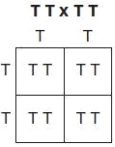
What ratio of the offspring from the cross shown will be homozygous recessive for the trait of tallness?
a)
0 in 4
b)
1 in 4
c)
2 in 4
d)
4 in 4
72.
Which of the following genotypes is homozygous dominant?
a)
A
b)
Aa
c)
AA
d)
aa
73.
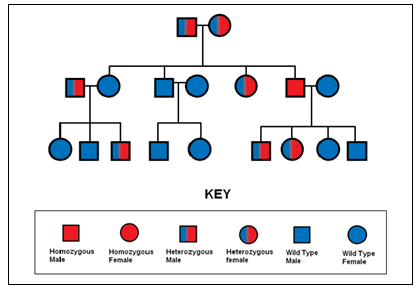
In a pedigree, what shape represents a male?
a)
circle
b)
square
c)
triangle
d)
diamond
74.
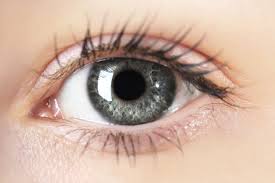
What you see, or the physical appearance.
a)
Genotype
b)
Phenotype
c)
Homozygous
d)
Heterozygous
75.
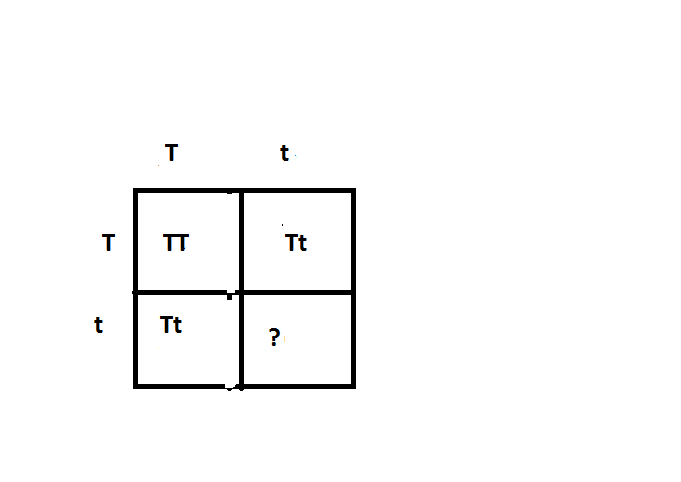
T - tall and t = short
In the punnett square below, what belongs in the missing square
In the punnett square below, what belongs in the missing square
a)
tt
b)
Tt
c)
Bb
d)
TT
76.
What does every food chain start with? (Even if it's not drawn or written there!)
a)
producers
b)
sun
c)
consumer
d)
decomposers
77.

What does a food web represent?
a)
All connections of energy flow throughout all organisms in a habitat.
b)
The specific ways that mutualism is carried out.
c)
A single pathway or energy flow between organisms.
d)
How carnivores get their food.
78.

The rabbit in this food web would be considered a:
a)
Decomposer
b)
Producer
c)
Secondary Consumer
d)
Primary Consumer
79.

In this Food Web Pyramid Which type of consumer gets only 10% of the energy stored in plants?
a)
Herbivore
b)
Carnivore
c)
Omnivore
d)
Secondary Consumer
80.
The amount of energy that usually transfers from one trophic level to the next...
a)
10%
b)
20%
c)
80%
d)
50%
81.
An illustration that uses arrows to show the MANY possible directions in which matter and energy can pass through the organisms in an ecosystem.
a)
Food chain
b)
Food web
c)
Energy Pyramid
d)
Succession Map
82.
The nonliving aspects of an ecosystem.
a)
Abiotic factors
b)
Biotic factors
83.
The living portions of the ecosystem.
a)
Biotic factors
b)
Abiotic factors
84.
Coal, oil and gas are examples of
a)
Shell Fuels
b)
Bone fuels
c)
Fossil fuels
d)
Sea fulels
85.
What human activity is the primary source of acid rain?
a)
Cars
b)
Deforastation
c)
Coal powerplants
d)
Volcanoes
86.
Which of these is a MAJOR cause of acid rain?
a)
spraying pesticides on crops
b)
burning fossil fuels for energy
c)
dumping sewage in river systems
d)
using uranium to generate electricity
87.
What is a species?
a)
A group of organisms that can mate with each other and produce fertile offspring.
b)
A group of organisms that genetically are very different from each other.
c)
A group of organisms that can mate and produce offspring even if those offspring are infertile.
d)
Indivual organisms that live in the same environment.
88.

What Moon phase is this?
a)
Old Moon
b)
Far Side of the Moon
c)
New Moon
d)
Waxing Gibbous
89.

What happens when the area in which you live tilts away from the sun?
a)
It is summer.
b)
It is spring.
c)
It is winter.
d)
It is fall.
90.
What are the reasons for the seasons?
a)
Earth's tilt and rotation.
b)
Earth's rotation and revolution.
c)
Earth's tilt and revolution.
d)
Earth's tilt and resolution
91.
The moon cycle (lunar cycle) takes approximately _______________ to complete.
a)
14 days
b)
28 days/approximately one month
c)
58 days
d)
1 week
92.

What season is it in the Southern Hemisphere when it is fall in the Northern Hemisphere?
a)
winter
b)
spring
c)
summer
d)
fall
93.
A severe storm which involves a funnel cloud forming over land is:
a)
hurricane
b)
tornado
c)
thunderstorm
d)
blizzard
94.

What part of the illustration shows Evaporation?
a)
1
b)
2
c)
3
d)
4
95.

Which number illustrates Condensation?
a)
1
b)
2
c)
3
d)
4
96.

What type of storm front is this?
a)
warm front
b)
cold front
c)
stationary front
d)
occluded front
97.
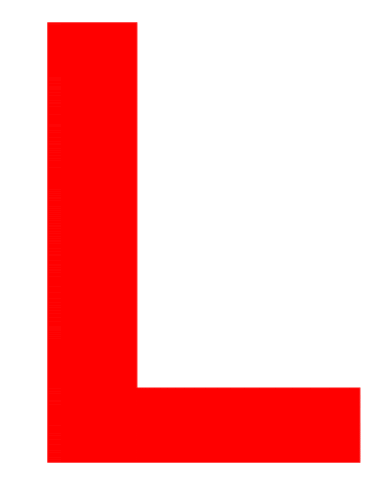
What does this symbol on a weather map indicate?
a)
High pressure system
b)
Low pressure system
c)
Cold front
d)
Warm front
98.
Which weather tool measures air pressure?
a)
thermometer
b)
barometer
c)
anemometer
d)
psychrometer
99.

What does this symbol on a weather map indicate?
a)
High pressure system
b)
Low pressure system
c)
Cold front
d)
Warm front
100.
The blanket of gases that surrounds the Earth
a)
Lithosphere
b)
Atmosphere
c)
Hydrosphere
d)
Green House Effect
101.
What kind of weather is usually associated with a high pressure system?
a)
Sunny weather
b)
Precipitation (rain, snow, etc.)
102.
What kind of weather is usually associated with a low pressure system?
a)
Sunny weather
b)
Precipitation (rain, snow, etc.)
103.

a)
beaker
b)
graduate
104.

a)
beaker
b)
flask
105.

If you were on the moon, there would be a change in your
a)
Weight and mass
b)
weight
c)
Mass
d)
volume
106.
International System of Measurement
a)
a system of measurement based on multiples of 10 and on established measures of mass, length, and time
b)
a system of measurement that uses fractions
107.
weight
a)
a measure of the force of gravity acting on an object
b)
a measure that is constant and does not change
108.
density
a)
measured using the formula mass times volume
b)
measurement of how much mass of a substance is contained in a given volume
109.
volume
a)
the amount of space that matter occupies
b)
the distance between two points
110.
What tool is used to measure temperature?
a)
meter stick
b)
thermometer
c)
balance
d)
spring scale
111.
What tool is used to measure the volume of a liquid?
a)
thermometer
b)
hand lens
c)
graduated cylinder
d)
ruler
112.
What tool is used to measure the mass of an object?
a)
meter stick
b)
graduated cylinder
c)
spring scale
d)
balance
113.
What tool is used to measure weight or force?
a)
spring scale
b)
balance
c)
hand lens
d)
tape measure
114.
The type of plate boundary where two plates come together is a .....
a)
Convergent Boundary
b)
Divergent Boundary
c)
Transform Boundary
d)
Plate Boundary
115.
Which of the following causes Earth's tectonic plates to move?
a)
Energy from the Sun
b)
Magnetic Pole Reversal
c)
Convection currents in the mantle
d)
Faults in Mountain Ranges
116.

What type of event will occur at this boundary?
a)
Earthquake
b)
Volcano Eruption
c)
Tornado
d)
Mountain Building
117.
A divergent boundary occurs when plates ....
a)
Pull apart
b)
Come together
c)
Slide past each other
d)
subducting
118.

Which weather system is characterized by counter-clockwise movement of air and generally poor weather?
a)
cold front
b)
low pressure
c)
high pressure
d)
warm front
119.

When an air mass moves into a new location it brings
a)
changes in temperature and altitude.
b)
changes in temperature and humidity
c)
A changes in altitude and air pressure.
d)
A changes in humidity and energy.
120.
Where can the oldest layer be found?
a)
The top layer
b)
The middle layer
c)
They are all the same age
d)
The bottom layer
121.
A unicellular organism has how many cells?
a)
one
b)
two
c)
three
d)
many
122.
Which of the following is an advantage for a single-celled organism?
a)
It can become very large.
b)
It can reproduce quickly.
c)
It does not have to maintain its structure.
d)
It can tolerate all environmental conditions.
123.
How do single-celled decomposers get energy?
a)
They make their own food.
b)
They use a process called budding.They use a process called budding.
c)
They feed on living organisms.
d)
They break down dead organisms.
124.
Identify one way in which bacteria differ from humans.
a)
Bacteria are single-celled.
b)
Bacteria do not reproduce.
c)
Only humans take in energy.
d)
Humans have the ability to move around.
125.
How does a cell of a unicellular organism differ from a cell of a multicellular organism?
a)
It performs all functions.
b)
It is specialized.
c)
It is large.
d)
It never replicates.
126.
Which organisms can cause contagious diseases?
a)
microorganisms
b)
multicellular organisms
c)
both
d)
neither
127.
In asexual reproduction, all of the offspring are:
a)
Physically Identical
b)
Genetically Identical
c)
Physically and Genetically Identical
d)
Not Identical
128.

a)
budding
b)
sporulation
c)
vegetative propagation
d)
binary fission
129.
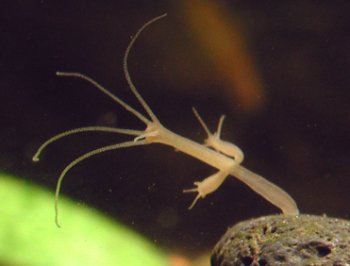
This is when a new organism grows by cell division on the body of its parent. The bud, or offspring is identical to the parent. The bud, when large enough, can break off of the parent and live on its own. Examples of this include yeast, hydra and potatoes.
a)
Regeneration
b)
Vegetative propagation
c)
Fission
d)
Budding
130.

a)
budding
b)
binary fission
c)
sporulation
d)
regeneration
131.
How many parent(s)are needed for asexual?
a)
4
b)
1
c)
9
d)
100
132.
When a starfish grows a new body off a broken arm, what kind of reproduction is this?
a)
Sexual
b)
Differentiation
c)
Asexual
d)
Specialization
133.
This produces 2 identical cells.
a)
mitosis
b)
meiosis
134.
What is organized DNA called?
a)
Genes
b)
Deoxyribonucleic Acid
c)
Chromosomes
d)
Nucleus
135.
What parts of the chromosomes code for traits?
a)
Genes
b)
Deoxyribonucleic Acid
c)
Chromosomes
d)
Nucleus
136.
What does heredity mean?
a)
DNA being passed down from one generation to the next.
b)
Passing down acquired characteristics to your offspring.
c)
Leaving money in a will to your children
d)
all DNA is kept in the nucleus
100 %

