wayground logo

Free Printable Worksheets

NEW

Font size

S
M
L
XL
Worksheets

Waves & Sound

Total questions: 44

Worksheet time: 24mins
Name
Class
Date
1.

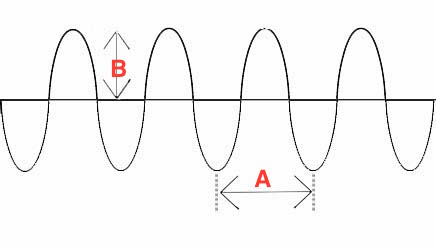
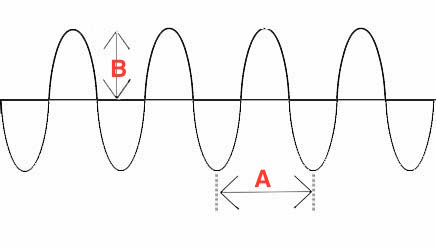
What property of this wave is represented by the letter "A"

a)

amplitude

b)

crest

c)

trough

d)

wavelength

2.
What property of the wave is represented by the letter "B"?
a)
amplitude
b)
crest
c)
trough
d)
wavelength
3.

A sound wave cannot travel through...

a)

a vacuum(empty space).

b)

water.

c)

air.

d)

glass.

4.
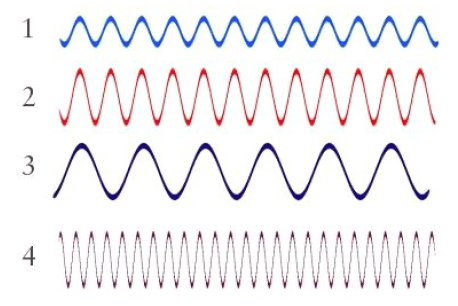
Which wave in the diagram has the greatest wavelength?
a)
1
b)
2
c)
3
d)
4
5.
Which of the following can sound travel through?
a)
solid
b)
liquid
c)
gas
d)
all of the above
6.

In which material does sound travel the fastest?

a)

solid

b)

liquid

c)

gases

7.
What is the measure of how many waves pass a point in a certain amount of time?
a)
frequency
b)
wavelength
c)
midpoint
d)
crest and trough
8.
Sound is caused by? 
a)
force
b)
vibrations
c)
instruments
d)
medium
9.
The units for frequency are measured in _____________.
a)
hertz
b)
seconds
c)
m/s
d)
m
10.
What kind of wave is pictured below?
a)
compressional wave
b)
transverse wave
c)
sound wave
d)
mechanical wave
11.

What kind of wave moves the medium perpendicular to the direction of the wave?

a)

compressional waves

b)

mechanical waves

c)

transverse waves

d)

ultraviolet rays

12.

What do we call the part of a compressional wave that is when the waves are squeezed together?

a)

compression

b)

rarefaction

c)

crest

d)

trough

13.

What do we call the part of a compressional wave that is spread a part?

a)

compression

b)

rarefaction

c)

crest

d)

trough

14.
A compressional wave is another name for a 
a)
longitudinal wave
b)
electromagnetic wave
c)
radio wave
d)
hair wave
15.
A periodic disturbance in a solid, liquid, or gas as energy is transmitted through a medium
a)
A. surface wave
b)
B. transverse wave
c)
C. wave
d)
D. mechanical wave
16.
A pattern of vibration that simulates a wave that is standing still
a)
A. interference
b)
B. standing wave
c)
C. diffraction
d)
D. reflection
17.
When the crests of one wave overlap the crests of another wave or waves, this occurs.
a)
A. diffraction
b)
B. destructive interference
c)
C. constructive interference
d)
D. resonant frequencies
18.
A section of a longitudinal wave where the particles are crowded together is called a
a)
A. rarefaction.
b)
B. vibration
c)
C.compression
d)
D. surface wave.
19.
What do waves carry from place to place?
a)
Energy, but not matter or particles
b)
Energy and matter or particles
c)
Matter or particles but not energy
d)
Neither energy nor matter or particles
20.
Sound travels FASTEST through which of these materials?
a)
Air
b)
Empty space
c)
Metal
d)
Water
21.
Measure of how high or low a sound is
a)
amplitude
b)
compression
c)
speed of sound
d)
pitch
22.
A longer string makes a _______ pitch than a short string.
a)
louder
b)
softer
c)
higher
d)
lower
23.

Why is sound able to travel faster through a solid than a gas?

a)

Gas molecules are packed tightly and are more elastic.

b)

Sound does not travel faster through a solid than a gas.

c)

Solid molecules are packed tightly and more elastic.

d)

Gas molecules move slowly and are less elastic.

24.
Which device measures sound waves?
a)
Oscilloscope
b)
Stethoscope 
c)
Radio
d)
I don't know
25.

True or false: You can hear a scream in space.

a)

true

b)

false

26.
The higher the_______ , the higher the ________ .
a)
frequency, pitch
b)
frequency, volume
c)
sound, pitch
d)
wavelength, decibels
27.
How does the Doppler effect provide evidence for the Big Bang Theory?
a)
It shows that galaxies make lots of sound waves. 
b)
It shows that galaxies are blue shifted and moving toward us.
c)
It shows that galaxies are redshifted and moving away from us. 
d)
It is not evidence for the Big Bang Theory. 
28.
The pitch of a stringed instrument can be affected by 
a)
an object called a hammer
b)
the size of a player's fingers
c)
the length of its strings
d)
how hard it is struck or plucked
29.
The higher the amplitude of a sound wave, the ____ the sound. 
a)
louder
b)
quieter
30.

A sound that is above the frequency that humans can hear is _____________.

a)

infrasonic

b)

supersonic

c)

ultrasonic

d)

sonic

31.

Sound waves are _______ than light waves.

a)

faster

b)

slower

c)

longer

d)

shorter

32.

A wave that appears not to move in a medium.

a)

high frequency

b)

low frequency

c)

running

d)

standing wave

33.

The __________ of a wave is based on personal preference.

a)

intensity

b)

loudness

c)

wavelength

d)

amplitude

34.

The unit for intensity of sound is _________.

a)

Hertz

b)

Amplitude

c)

Decibel

d)

Frequency

35.

When the frequency of a wave matches the natural frequency of an object __________ occurs.

a)

amplitude

b)

resonance

c)

frequency

d)

red shift

36.

If the crests of two waves meet what happens?

a)

destructive interference

b)

constructive interference

c)

change in frequency

d)

change in wavelength

37.

Beats occur because of alternating periods of _____________.

a)

time

b)

transverse waves

c)

constructive and destructive interference

d)

blue shifts

38.

The measure of the number of vibrations or waves passing a point in a period of time is _________.

a)

wavelength

b)

period

c)

amplitude

d)

frequency

39.

What kind of wave moves the medium parallel to the direction of the wave?

a)

compressional waves

b)

mechanical waves

c)

transverse waves

d)

ultraviolet rays

40.

As the period of a wave gets smaller the frequency of a wave ________.

a)

decreases

b)

stays the same

c)

increases

d)

increases by 10 times

41.

If a sound increases from 30 to 60 decibels, how many times more intense is the sound at 60?

a)

10

b)

100

c)

1000

d)

30

42.

The part of a standing wave that doesn't appear to move because of destructive interference.

a)

node

b)

anti-node

c)

nodal

d)

anti-nodal

43.

What wave characteristic has to match for resonance to occur?

a)

wavelength

b)

frequency

c)

period

d)

amplitude

44.

A red shift occurs to light because the wave source and receiver are _________.

a)

staying the same position

b)

moving closer together

c)

moving further apart