wayground logo

Free Printable Worksheets

NEW

Font size

S
M
L
XL
Worksheets

AIR TEST REVIEW (PART 1) BIOLOGY

Total questions: 70

Worksheet time: 35mins
Name
Class
Date
1.
Which of the following is the smallest unit of life that can carry out all life functions?
a)
the mitochondria
b)
the vacuoles
c)
the nucleus
d)
the cell
2.
Which structures are found in every living cell?
a)
cell membrane and cytoplasm
b)
chloroplasts and mitochondria
c)
a cell wall and nucleus
d)
chloroplasts and cell wall
3.
Which cell structure is found in plant and animals cells and controls what can come into or leave a cell?
a)
cell membrane
b)
cytoplasm
c)
nucleus
d)
vacuole
4.
What is the function of the cell nucleus found in both plant and animal cells?
a)
to produce energy
b)
to control cell activity
c)
to remove waste products
d)
to allow molecules to enter the cell
5.
Cell organelles that are responsible for digesting food, worn out organelles and other cellular wastes are called ___________________.
a)
Mitochondria
b)
Vacuoles
c)
Lysosomes
d)
Chlororplasts
6.
Chloroplasts in plant cells allow the plant to perform a function that animal cells cannot do.  What is the main function of the chloroplasts found in plant cells?
a)
to absorb light energy and manufacture food
b)
to remove waste materials by active transport
c)
to manufacture chemical energy from food
d)
to control the shape of the cell
7.
All cells need energy to function.  Which cell organelle is responsible for producing energy in the cell?
a)
chloroplasts
b)
mitochondria
c)
nucleus
d)
vacuoles
8.
In what part of the plant cell does the process of photosynthesis take place?
a)
nucleus
b)
mitochondria
c)
chloroplasts
d)
vacuoles
9.
Cells with a nucleus and membrane-bound organelles are called ____________________.
a)
prokaryotes
b)
eukaryotes
c)
bacteria
d)
protists
10.
In a plant cell, a stiff wall surrounds the membrane, giving the cell a rigid, boxlike shape.
a)
cell membrane
b)
cell
c)
ribosome
d)
cell wall
11.
Passive transport is called "passive" because it occurs WITHOUT
a)
cause.
b)
energy.
c)
a concentration gradient.
d)
a cell wall.
12.
Osmosis is the diffusion of _____ across a membrane
a)
glucose
b)
NaCl
c)
proteins
d)
water
13.
Which of the following is NOT a type of passive transport?
a)
Osmosis
b)
Diffusion
c)
Endocytosis
14.
What is equilibrium?
a)
When concentrations cannot be balanced between two substances 
b)
When concentrations are balanced between two substances 
c)
Making the energy in the top half of your body equal the the energy in the bottom half
d)
Concentrations do not exist 
15.
Diffusion is the movement of molecules from an area of higher concentration to an area of lower concentration.
a)
True
b)
False
16.
What does semi-permeable mean?
a)
Only some things can move through membrane
b)
Nothing can move through membrane
c)
Reagan can move through membrane
d)
Membrane connot be moved through
17.
What is the difference between active and passive transport?
a)
Active does not need energy and passive uses ATP (energy)
b)
Active uses ATP (energy) and passive does not need energy
c)
Active stores transport proteins and passive releases 
d)
Active uses hormones and passive does not 
18.
When particles move from areas of high concentration to areas less concentrated, this has taken place.
a)
diffusion
b)
mitosis
c)
endocytosis
d)
photosynthesis
19.
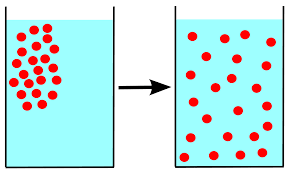
The picture below is an example of _________________.
a)
osmosis
b)
isotonic
c)
diffusion
d)
active transport
20.
What is homeostasis?
a)
How the body releases oxygen
b)
Passive transportation 
c)
How the body regulates itself for survival
d)
Active transport
21.
Ideally, your cells should be in a(n) _______ solution
a)
Hypertonic
b)
Hypotonic
c)
Isotonic
d)
Cola
22.
 In the given scenario what will happen?  A cell placed in salt water for 48 hours.
a)
Water will move in and out of the cell equally, and the cell will neither shrink nor swell.
b)
The cell will gain water and swell.
c)
The cell will lose water and shrink.
23.
When both inside and outside of a cell have the same amount of water it is said that the cell has reached a state of ___________.
a)
osmosis
b)
equilibrium
c)
diffusion
d)
hypertonic
24.
If you looked at red blood cells under a microscope and saw the blood cells exploded, what would you say happened?
a)
The cells were placed in a hypotonic solution.
b)
the solution was isotonic.
c)
The solution was hypertonic.
25.
Active transport allows a cell to move molecules from an area of low concentration to an area of high concentration.
a)
True
b)
False
26.
Even though the concentration of salt is high in some gland cells and low in the blood, these cells can move salt out of blood and into the cells.  This is an example of
a)
passive transport
b)
active transport
c)
diffusion
d)
osmosis
27.
Diffusion is the movement of molecules from
a)
an area of equilibrium to an area of high concentration.
b)
an area of low concentration to an area of high concentration.
c)
an area of high concentration to an area of high concentration.
d)
an area of high concentration to an area of low concentration.
28.
Cells sometimes use energy to transport materials across the cell membrane.  This is called
a)
photosynthesis
b)
osmosis
c)
cellular respiration
d)
active transport
29.
Which of these cell processes does NOT require energy?
a)
osmosis
b)
endocytosis
c)
active transport
d)
exocytosis
30.
When the concentration of molecules on both sides of a membrane is the SAME, the solution is
a)
isotonic
b)
hypertonic
c)
hypotonic
31.
If a cell is placed in a hypertonic solution, what will happen?
a)
Water will move into the cell causing it to swell.
b)
Water will move out of the cell causing it to shrink.
c)
nothing.
d)
Water will move out of the cell causing it to swell.
32.
Particles are too large to enter the membrane.
Need help from channel proteins.
No energy
a)
active transport
b)
passive transport
c)
facilitated diffusion
33.
Engulfs large molecules inside the membrane.
uses energy
a)
exocytosis
b)
endocytosis
c)
protein channel 
34.
Low concentration of water.
Cell will shrink
a)
hypotonic
b)
hypertonic
c)
isotonic
35.
The substance that is dissolving in a solution. 
a)
solute
b)
solution
c)
solvent
36.
What does every food chain start with? (Even if it's not drawn or written there!)
a)
producers
b)
sun
c)
consumer
d)
decomposers
37.
An organism that needs to eat other organisms to obtain energy is known as a:
a)
Autotroph
b)
Producer
c)
Consumer
d)
Mutualist
38.
Consumer that eats plants
a)
heterotroph
b)
herbivore
c)
producer
d)
community
39.
What does a food web represent?
a)
All connections of energy flow throughout all organisms in a habitat.
b)
The specific ways that mutualism is carried out.
c)
A single pathway or energy flow between organisms. 
d)
How carnivores get their food. 
40.
relationship in which two species live closely together
a)
resource
b)
mutualism
c)
succession
d)
symbiosis
41.
The rabbit in this food web would be considered a:
a)
Decomposer
b)
Producer
c)
Secondary Consumer
d)
Primary Consumer
42.
Where an organism lives
a)
habitat
b)
niche 
c)
heterotrogh
d)
biosphere
43.
In this Food Web Pyramid Which type of consumer gets only 10% of the energy stored in plants?
a)
Herbivore
b)
Carnivore
c)
Omnivore
d)
Secondary Consumer
44.
What is the term for each step in the transfer of energy and matter within a biological community?
a)
energy path
b)
food web
c)
trophic level
d)
food pyramid
45.
The image provided is an example of a(n):
a)
Carnivore
b)
Herbivore
c)
Producer
d)
Autotroph
46.
The amount of energy that usually transfers from one trophic level to the next...
a)
10%
b)
20%
c)
80%
d)
50%
47.
An illustration that uses arrows to show the MANY possible directions in which matter and energy can pass through the organisms in an ecosystem.
a)
Food chain
b)
Food web
c)
Energy Pyramid
d)
Succession Map
48.
The nonliving aspects of an ecosystem.
a)
Abiotic factors
b)
Biotic factors
49.
The living portions of the ecosystem.
a)
Biotic factors
b)
Abiotic factors
50.
A graphic illustration that shows each trophic level and the amount of useable energy contained within.
a)
Food chain
b)
Food web
c)
Energy Pyramid
d)
All of these
51.
A collection of organisms that make up a community as well as all of the nonliving aspects of the environment.
a)
Population
b)
Community
c)
Habitat
d)
Ecosystem
52.
As you move upward, from level to level, in an energy pyramid, energy _____.
a)
increases
b)
decreases
c)
stays the same
d)
increases exponentially
53.
 plants that convert energy from the sun
a)
decomposer
b)
primary consumer
c)
secondary consumer
d)
producer
54.
Members of a species in a defined area
a)
Ecosystem
b)
community
c)
biodiversity
d)
population
55.
Which of the following leads to a decrease in biodiversity?
a)
protection of ecosystems
b)
pollution control
c)
selective cutting
d)
introduction of exotic or invasive species
56.
A carbon "sink" is best described as:
a)
a reservoir that readily releases carbon to another reservoir
b)
a carbon reservoir that stores more carbon that it is releasing
c)
something that causes carbon to leak out to the atmosphere
d)
a carbon reservoir that is releasing more carbon than it is taking in
57.
Nitrogen fixation processes nitrogen from which of the following sources?
a)
lightning
b)
fertilizers
c)
dead plants
d)
atmosphere
58.
Which is an example of a parasitic relationship?
a)
a bee pollinates a flower
b)
a tapeworm takes nutrients from a dog
c)
an orchid lives in a tree but does not harm the tree
59.
In which type of relationship do both species benefit?
a)
parasitism
b)
mutualism
c)
commensalism
60.
Barnacles grow on whales.  Whales give the barnacles a place to live but the barnacles do not help or harm the whale.  Which type of relationship is this?
a)
commensalism
b)
mutualism
c)
parasitiesm
61.

The largest number of individuals that an environment can support long term is...

a)

carrying capacity

b)

emigration

c)

immigration

d)

population density

62.

What happens if a population grows past its carrying capacity?

a)

The population keeps growing

b)

The population starts to die off

c)

The entire species will go extinct

d)

The carrying capacity just increases

63.

This may cause a population to increase

a)

increase of food supply

b)

removal of predators

c)

removal of disease

d)

all of these

64.

Something that regulates the size of a population is called...

a)

a limiting measure

b)

a limiting factor

c)

carrying capacity

d)

biodiversity

65.

What is the carrying capacity of the graph?

a)

1000

b)

8000

c)

800

d)

600

66.

What is the carrying capacity of the graph?

a)

around 500

b)

more than 800

c)

less than 300

d)

around 700

67.

A scientist was studying a population of fish in a pond over a period of 10 years. He observed that the population increased each year for 3 years, and then remained nearly constant for the rest of the study. The best explanation for this observation is that the population had

a)

stopped reproducing

b)

reached carrying capacity

c)

mutated into a different species

d)

run out of food and all died

68.

What conclusions can you draw from this graph?

a)

The deer population went down over time.

b)

The deer population went up over time.

c)

The dear population went up quickly, then down, but then stayed the same.

d)

There are less dear because of hunters

69.

Which graph represents exponential growth?

a)

The graph on the left

b)

The graph on the right

70.

What is the approximate carrying capacity of this population?

a)

0

b)

1000

c)

2000

d)

2500