wayground logo

Free Printable Worksheets

Font size

S
M
L
XL
Worksheets

Cardiovascular Review

Total questions: 85

Worksheet time: 45mins

Name
Class
Date
1.
All of the following do not contain a pulse except for what?
a)
capillaries
b)
veins
c)
venules 
d)
arteries
2.
Which of the following squirt blood when cut?
a)
capillaries
b)
veins
c)
venules 
d)
arteries
3.
As a venous pathway moves closer to the heart, the veins
a)
get smaller
b)
get larger
c)
do not change in size
d)
watch netflix
4.
As an arterial pathway moves farther from the heart, the arteries
a)
get smaller
b)
get larger
c)
do not change in size
d)
have a party
5.
Valves in veins
a)
make the use of a skeletal muscle pump unnecessary for venous blood flow
b)
are the leading cause of high blood pressure.
c)
cause venous blood flow to go in only one direction
d)
are formed of the tunica media
6.
Oxygen and carbon dioxide are transported between the blood and interstitial fluid by way of
a)
exocytosis and endocytosis by endothelial cells
b)
diffusion from areas of higher concentration to lower concentration
c)
pinocytosis using fluid-filled vesicles
d)
active transport (using ATP) by protein carriers of endothelial cells
7.
These carry blood to the heart:
a)
arteries
b)
veins
c)
capillaries
d)
arterioles
8.
These carry blood away from the heart
a)
arteries
b)
veins
c)
venules
d)
capillaries
9.
These have muscular walls:
a)
capillaries
b)
veins
c)
venules
d)
arteries
10.
Where material exchange takes place between the cells and blood vessels:
a)
arteries
b)
veins
c)
venules
d)
capillaries
11.
Largest artery in the human body:
a)
Pulmonary artery
b)
femoral artery
c)
aorta
d)
carotid artery
12.
Contract and expand with the heart beat:
a)
arteries
b)
veins
c)
venules
d)
capillaries
13.
Supply the heart.
a)
Phrenic arteries
b)
Thoracic aorta
c)
Aortic arch
d)
Coronary arteries
14.
Which pulse site is found on the neck and used during adult CPR
a)
carotid
b)
apical
c)
femoral
d)
temporal
15.
For 120/80, what does "120" indicate?
a)
Systolic -- when the ventricles contract
b)
Diastolic -- when the ventricles are relaxed
c)
systolic -- when the ventricles are relaxed
d)
Diastolic -- When the ventricles contract
16.
The subclavian artery carries blood from ______ to the _______.
a)
arms to the superior Vena Cava
b)
Aorta to the arms
c)
arms to the aorta
d)
Vena cava to the arms
17.
The subclavian vein carries blood from ______ to the _______.
a)
arms to the superior Vena Cava
b)
Aorta to the arms
c)
arms to the aorta
d)
Vena cava to the arms
18.
The common Iliac Artery carries blood from ______ to the _______.
a)
legs to the inferior Vena Cava
b)
Descending Aorta to the legs
c)
legs to the descending aorta
d)
Inferior Vena cava to the legs
19.
The common Iliac vein carries blood from ______ to the _______.
a)
legs to the inferior Vena Cava
b)
Descending Aorta to the legs
c)
legs to the descending aorta
d)
Inferior Vena cava to the legs
20.
The femoral vein carries blood from ______ to the _______.
a)
legs to the common iliac vein
b)
common iliac artery to the legs
c)
legs to the common iliac artery 
d)
common iliac vein to the legs
21.
The femoral artery carries blood from ______ to the _______.
a)
legs to the common iliac vein
b)
common iliac artery to the legs
c)
legs to the common iliac artery 
d)
common iliac vein to the legs
22.
The jugular carries blood from ______ to the _______.
a)
aorta to the neck
b)
neck to the aorta 
c)
from the vena cava to the neck 
d)
from the neck to the vena cava
23.
What is the largest artery in the body?
a)
femoral artery
b)
brachial artery
c)
carotid artery
d)
aorta
24.
Where does blood go after the right atrium?
a)
left atrium
b)
left ventricle
c)
right ventricle
d)
aorta
25.
Where does the blood go after it goes into the pulmonary arteries?
a)
lungs
b)
heart
c)
head
d)
hands
26.
Un-oxygenated blood enters the right atrium from the top of the heart.
a)
inferior vena cava
b)
superior vena cava
c)
aorta
27.

Deoxygenated blood from the inferior part of the body enters the right atrium from which vessel?

a)

inferior vena cava

b)

superior vena cava

c)

pulmonary veins

28.

Identify Structure #2?

a)

Heart

b)

Right Ventricle

c)

Left Atrium

d)

Left Ventricle

29.

Identify Structure #1?

a)

Septum

b)

Right Pulmonary Vein

c)

Superior Vena Cava

d)

Inferior Vena Cava

30.

Identify Structure #7?

a)

Left Atrium

b)

Left Ventricle

c)

Aortic Valve

31.

Identify Structure #9?

a)

Left Ventricle

b)

Left Atrium

c)

Left Pulmonary Vein

d)

Left Pulmonary Artery

32.
A flap of tissue that prevents blood from flowing backward
a)
Aorta
b)
Atrium
c)
Septum
d)
Valve
33.
Which of the following define diastole and systole
a)
systole is the contraction of the heart and diastole is the relaxation of the heart
b)
diastole is the contraction of the heart and systole is the relaxation of the heart
c)
diastole and systole are both contractions of the heart
d)
diastole and systole are both relaxation phases of the heart
34.
Identify
a)
Aorta
b)
Pulmonary Vein
c)
Superior Vena Cava
d)
Inferior Vena Cava
35.

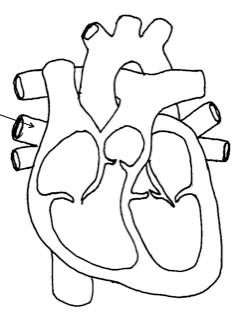
Name the part indicated by the arrow.

a)

Pulmonary veins

b)

Left atrium

c)

Aorta

d)

Pulmonary artery

36.
What is the strongest (thickest) part of the heart?
a)
right atrium
b)
right ventricle
c)
left ventricle
d)
left atrium
37.
What structure of the heart is this?
a)
Tricuspid Valve
b)
Bicuspid Valve
c)
Aortic Semilunar Valve
d)
Pulmonar Semilunar Valve
38.
What structure of the heart is this?
a)
Tricuspid Valve
b)
Bicuspid Valve
c)
Aortic Semilunar Valve
d)
Pulmonar Semilunar Valve
39.

What structure of the heart is this?

a)

Tricuspid Valve

b)

Bicuspid Valve

c)

Aortic Semilunar Valve

d)

Pulmonar Semilunar Valve

40.
About how large is the human heart?
a)
the size of an onion
b)
the size of a fist
c)
4.5 pounds
41.

When the heart rate is less than 60 beats per minute.

a)

Bradycardia

b)

Tachycardia

c)

Leukemia

42.
When the heart rate is more than 100 beats per minute.
a)
Tachycardia  
b)
Bradycardia
c)
Hyperventilation
43.

The Purkinje fibers are indicated by ________.

a)

A

b)

B

c)

C

d)

D

e)

E

44.

The sinoatrial (SA) node is indicated by ________.

a)

A

b)

B

c)

C

d)

D

e)

E

45.

The atrioventricular bundle (bundle of His) is represented by ________.

a)

A

b)

B

c)

C

d)

D

e)

E

46.

The atrioventricular (AV) node is indicated by ________.

a)

A

b)

B

c)

C

d)

D

e)

E

47.

The pointed, inferior portion of the heart, known as the ________, rests on the diaphragm and is oriented toward the left hip.

a)

base

b)

mediastinum

c)

apex

d)

pericardium

48.

Which of the following is often called the pacemaker of the heart?

a)

Purkinje fibers

b)

sinoatrial (SA) node

c)

atrioventricular (AV) bundle (bundle of His)

d)

atrioventricular (AV) node

49.

Which wave on the electrocardiogram (EKG) results from the firing of the sinoatrial (SA) node?

a)

QRS

b)

T

c)

P

d)

S-T interval

50.

Which term means heart contraction?

a)

diastole

b)

tachycardia

c)

systole

d)

fibrillation

51.

What is the volume of blood pumped out of a ventricle with each heart beat?

a)

stroke volume (SV)

b)

heart rate (HR)

c)

cardiac output (CO)

d)

blood pressure (BP)

52.

The T wave on an EKG printout represents

a)

contraction of the ventricles

b)

relaxation of the ventricles

c)

contraction of the atria

d)

relaxation of the atria

53.

Which of the following describes the QRS wave?

a)

atrial repolarization

b)

ventricular depolarization

c)

ventricular repolarization

d)

none of these

54.
An electrocardiogram measures what?
a)
The amount of pressure exerted on blood vessels.
b)
The electrical activity of the heart.
c)
How many times the heart contracts over time.
d)
The body's temperature caused by friction of blood in vessel.
55.
The arrow is pointing to what layer of the blood vessel
a)
tunica externa
b)
tunica interna
c)
tunica media
d)
tunica elastin
56.
Valves in veins
a)
make the use of a skeletal muscle pump unnecessary for venous blood flow
b)
are the leading cause of high blood pressure.
c)
cause venous blood flow to go in only one direction
d)
are formed of the tunica media
57.
Which letter(s) indicates the health of the atria?
a)
QRS
b)
P-Q wave
c)
P wave only 
d)
T wave
58.
Which letter(s) indicates the health of the ventricles?
a)
T-wave  
b)
S-T waves
c)
R wave 
d)
QRS
59.
If there is a flat P wave which structures int he heart are damaged? 
a)
SA/AV node
b)
Bicuspid valve
c)
Bundle of His
d)
Purkinje fibers
60.
The place where the electrical current starts and is considered the heart's pacemaker:
a)
Sino-atrial node 
b)
right atrium
c)
atria-ventricular node 
d)
left ventricle
61.

The p-wave correlates with which event?

a)

atrium depolarization /signals moving from SA node to AV node

b)

ventricle depolarization

c)

ventricle repolarization

d)

both atrial and ventricle contraction

62.
The AV node is located at...
a)
A
b)
B
c)
C
d)
D
63.
What do the letters EKG stand for?
a)
Electrocardiograph
b)
Electromagneticgraph
c)
Electrocardiogram 
d)
Electrolytes
64.
The action of the "P" wave is:
a)
Atrial Depolarization
b)
Atrial Repolarization
c)
Ventricular Depolarization
d)
Ventricular Repolarization
65.
The action of the "QRS" complex is:
a)
Atrial Depolarization
b)
Atrial Repolarization
c)
Ventricular Depolarization
d)
Ventricular Repolarization
66.
What is wrong with this strip?
a)
Tachycardia
b)
Elevated ST segment
c)
No P wave
d)
Wide QRS complex
67.
Your patient is an 84-year-old male with difficulty breathing and peripheral edema. He tells you he has been suffering for many years with "heart failure" and his condition is worsening, especially with trouble breathing at night. Your knowledge of cardiovascular physiology suggests that his condition could have resulted from the failure of either the right or left side of his heart. Which chamber of the heart is the strongest, most muscular part of the heart and is primarily responsible for pumping oxygenated blood to the rest of the body?
a)
left ventricle
b)
right ventricle
c)
left atrium 
d)
right atrium 
68.
Slows electrical conduction impulses in the heart to allow time for the atrium to complete contraction and for the ventricles to fill up: 
a)
AV node
b)
SA node 
c)
Purkinje Fibers
d)
Bundle Branches 
69.
a)
Aortic semilunar valve
b)
Pulmonary semilunar valve
c)
Bicuspid valve
d)
Mitral valve
70.
What is the sequence of events in the transmission of an impulse through the heart muscle?
 a: AV node
 b: AV bundle
 c: SA node
 d: Through the atria
 e: Through the ventricles
 f: Bundle branches
 g: Purkinje fibers 
a)
d, b, a, c, f, g, e

b)
c, d, a, b, f, g, e

c)
b, a, d, c, f, g, e

d)
f, g, d, c, b, a, e

71.
Order the phases an action potential travels in the conduction system
a)
SA node--> AV bundle branches--> AV node--> Purkinje fibers
b)
SA node--> AV node--> AV bundle branches-->  Purkinje fibers
c)
Av bundle branches--> AV node--> SA node--> Purkinje fibers
d)
Purkinje fibers--> SA node--> AV node--> AV bundle branches
72.
The role of the atrioventricular node (AV node) is to
a)
initiate a sinus rhythm
b)
conduct impulses to the sinoatrial node (SA node)
c)
initiate ventricular depolarization
d)
slow down impulses so that the atria can contract to fill the adjacent ventricles with blood
73.
Which of the following lists the valves in the order through which the blood flows from the vena cava through the heart?
a)
tricuspid, pulmonary, bicuspid, aortic
b)
mitral, pulmonary, bicuspid, aortic
c)
bicuspid, aortic, tricuspid, pulmonary
d)
aortic semilunar, pulmonary, tricuspid, bicuspid
74.
Supplies the liver.
a)
Common hepatic artery
b)
Left subclavian artery
c)
Left common carotid artery
d)
Esophageal arteries
75.
Supply the heart.
a)
Phrenic arteries
b)
Thoracic aorta
c)
Aortic arch
d)
Coronary arteries
76.
First branch of the aortic arch.
a)
Thoracic aorta
b)
Ascending aorta
c)
Abdominal aorta
d)
Brachiocephalic
77.
a)
aorta
b)
brachial a.
c)
subclavian a.
d)
vena cava
78.
a)
basilic v.
b)
radial a.
c)
brachial a.
d)
splenic v. 
79.
a)
brachial v.
b)
basilic v. 
c)
cephalic v.
d)
subclavian v.
80.
a)
renal a.
b)
palmar arterial arch
c)
digital a.
d)
hepatic a.
81.
a)
iliac a.
b)
common iliac a.
c)
internal iliac a.
d)
external iliac a.
82.
a)
right internal iliac a.
b)
left common iliac a.
c)
right external iliac a.
d)
left external iliac a.
83.
a)
renal a.
b)
right renal a.
c)
hepatic a.
d)
left common splenic a.
84.
a)
celiac a.
b)
hepatic a.
c)
renal a.
d)
vena cava
85.
a)
aorta 
b)
renal v.
c)
splenic a.
d)
hepatic v.