wayground logo

Free Printable Worksheets

Font size

S
M
L
XL
Worksheets

Biology Midterm Review

Total questions: 90

Worksheet time: 1hrs 6mins
Name
Class
Date
1.
Which of the following statements is not part of the cell theory?
a)
Cells are the basic unit of structure and function in all living things.
b)
All cells are produced from other cells.
c)

Very few cells reproduce

d)
All living things are composed of cells.
2.
Proteins are made of monomers called ___________
a)
Nucleotides
b)
Monosaccharides
c)
Amino Acids
d)
Glycerol and fatty acids
3.
DNA and RNA are examples of 
a)
Carbohydrates
b)
Lipids
c)
Proteins
d)
Nucleic Acids
4.
Nucleotides are monomers of
a)
Carbohydrates
b)
Lipids
c)
Proteins
d)
Nucleic Acids
5.

Monosaccharides like glucose are monomers of

a)
Carbohydrates
b)
Lipids
c)
Proteins
d)
Nucleic Acids
6.
What is the function of nucleic acids?
a)
store genetic information
b)
store energy (long-term)
c)
store energy (short-term)
d)
build skin, hair, nails, muscles
7.
Which of the following organic compounds is the main source of energy for living things?
a)
carbohydrates
b)
lipids
c)
nucleic acids
d)
proteins
8.
Which macromolecule stores energy, insulates us, and makes up the cell membrane?
a)
lipids
b)
proteins
c)
carbohydrates
d)
nucleic acids
9.

Enzymes belong to which class of macromolecules?

a)

lipids

b)

carbohydrates

c)

proteins

d)

nucleic acids

10.
What is the purpose  of an enzyme?
a)
give permission for the reaction
b)
raise activation energy
c)
speed up reactions
d)
control how many reactions occur
11.
Where do substrates bind on an enzyme?
a)
voltage-gated channels
b)
surface receptor
c)
calcium channels
d)
active site
12.
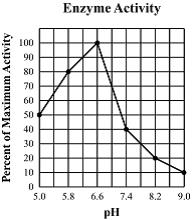
Which of the following conclusions can be drawn from this graph?
a)
The optimum pH of the enzyme is 6.6.
b)
The optimum pH of the enzyme is 5.8
c)
The enzyme’s activity increases as pH increases 5.0 to 9.0
d)
The enzyme’s activity is greater around pH of 8.0 .
13.
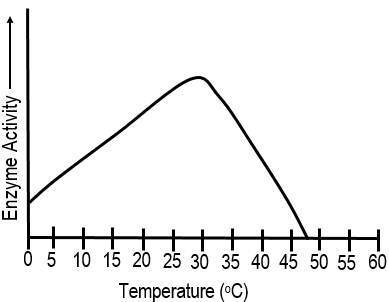
Based on the graph, what temperature does this enzyme work best? 
a)
15 C
b)
40 C
c)
30 C
d)
47 C
14.
What is the activation energy?
a)
The energy of the products
b)
The energy of the reactants
c)
The minimum energy needed by the reactants to form the products.
d)
The energy lost in the reaction
15.
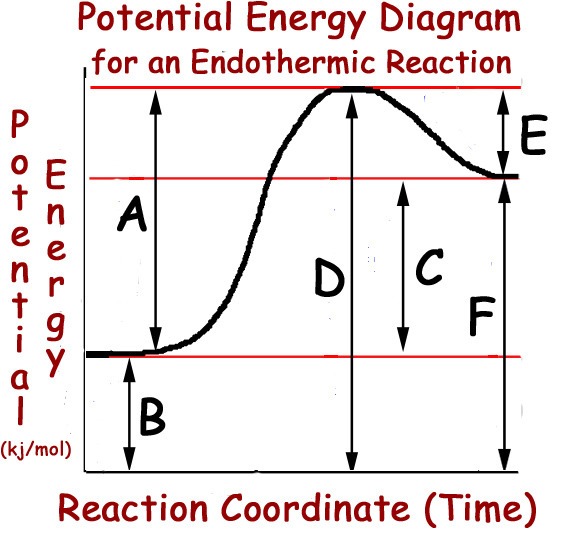
What letter represents the activation energy?
a)
A
b)
B
c)
C
d)
D
16.
Enzymes will make a reaction go _______ and use ______ energy.
a)
faster, less
b)
faster, more
c)
slower, less
d)
slower, more
17.
The graph shows how enzymes affect reactions in cells. Which statement best summarizes the information shown in the graph?
a)
Enzymes increase the energy of the reactants.
b)
Enzymes decrease the energy level of the products.
c)
Enzyme decrease the activation energy of the reaction.
d)
Enzymes reverse the direction of the reaction.
18.

Which organelle contains DNA and controls the cell?

a)

Cell membrane

b)

nucleus

c)

nucleolus

d)

lysosme

19.

Which organelle controls what goes in and out of the cell?

a)

nucleus

b)

nucleolus

c)

cell membrane

d)

nuclear membrane

20.

This organelle digests dead cell parts and contains enzymes

a)

lysosome

b)

golgi body

c)

smooth ER

d)

Rough ER

21.

Proteins are produced at this organelle.

a)

golgi body

b)

ribosome

c)

cytoskeleton

d)

cilia

22.

Ribosomes are produced here

a)

nucleus

b)

nuclear membrane

c)

nucleolus

d)

chromosomes

23.
The clear, jelly-like material in a cell that supports and protects the cell’s organelles.
a)
Cytoplasm
b)
Cell Membrane
c)
Nucleus
d)
Mitochondria
24.
Uses energy from the sun to make food for the plant.
a)
Cell Wall
b)
Cell Membrane
c)
Chloroplasts
d)
Vacuole
25.
Which organelle receives proteins and materials from the ER and packages them and distributes them?
a)
ribosomes
b)
lysosome
c)
nucleolus
d)
golgi body
26.
Which is true of prokaryotic and eukaryotic cells?
a)
Prokaryotic cells are larger than eukaryotic cells.
b)
Eukaryotic cells do not have nuclei, and prokaryotic cells do have nuclei.
c)
Prokaryotic cells lack membrane-bound organelles, and eukaryotic cells contain membrane-bound organelles.
d)
Eukaryotic cells are simpler than prokaryotic cells.
27.

The smallest unit of a living thing are

a)

atoms

b)

cells

c)

DNA

d)

organelles

28.

Bacteria is an example of a(n)

a)

prokaryotic cell.

b)

eukaryotic cell.

29.
Plants and animal cells are examples of ___ cells 
a)
prokaryotic cells 
b)
eukaryotic cells 
30.

Which of the following is not under the Cell Theory?

a)

Cells are the basic unit of life

b)

All organisms are made up of cells

c)

Cells came from other cells

d)

A cell is an indestructible particle

31.

Only plant cells have cell walls.

a)

True

b)

False

32.

These cells make up protists

a)

Prokaryotic

b)

Eukaryotic

c)

Both

33.

These cells make up plants!

a)

Prokaryotic

b)

Eukaryotic

c)

Both

34.

These cells make up Fungi

a)

Prokaryotic

b)

Eukaryotic

c)

Both

35.

If an organism is single-celled, then it must be a prokaryotic cell.

a)

True

b)

False

36.

Animal cells do not have a cell wall.

a)

True

b)

False

37.

During the process of photosynthesis, plants use energy from the Sun to transform carbon dioxide from the air into

a)

oxygen gas and molecules of sugar.

b)

protein and minerals.

c)

minerals and liquid carbon dioxide.

38.

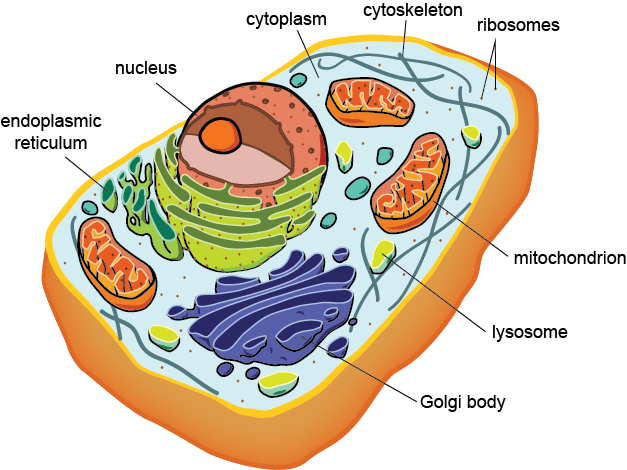
The organelle picture is

a)

Cell Wall

b)

Mitochondrian

c)

Cytoplasm

39.

converts chemical energy into ATP

a)

endoplasmic reticulum

b)

golgi apparatus

c)

vacuole

d)

mitochondria

40.

What structures do all cells have in common?

a)

cytoplasm

b)

Ribosomes

c)

DNA

d)

cell membrane

e)

nucleus

41.
Which of the following is found inside a prokaryote?
a)
cytoplasm
b)
DNA
c)
ribosomes
d)
all of these
42.
___________ allow cells to recognize each other and act like ID tags. 
a)
Carbohydrates 
b)
Proteins
c)
Phospholipids 
d)
Cholesterol
43.
___________ strengthens and stabilizes the cell membrane.
a)
Carbohydrates 
b)
Proteins 
c)
Phospholipids 
d)
Cholesterol
44.
___________ form the two layers of the cell membrane. 
a)
Carbohydrates 
b)
Proteins 
c)
Phospholipids 
d)
Cholesterol
45.
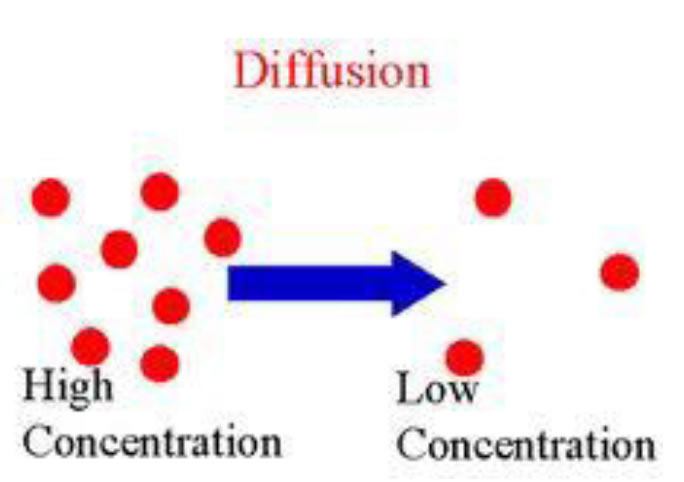
Movement of particles from high to low concentration. 
a)
Passive Transport
b)
Active Transport
46.
Osmosis is a form of ______________. 
a)
Passive Transport
b)
Active Transport
47.
What is it called when molecules move across the cell membrane from an area of high concentration to an area of low concentration through a carrier protein?
a)
Diffusion
b)
Osmosis
c)
Active Transport
d)
Facilitated Diffusion
48.
This picture represents what type of cell transport?
a)
endocytosis
b)
exocytosis
c)
osmosis
d)
passive transport
49.
Osmosis is the movement of _____ across a membrane.
a)
food
b)
energy
c)
oxygen
d)
water
50.
This picture represents which type of cellular transport?
a)
passive transport
b)
endocytosis
c)
exocytosis
d)
osmosis
51.
Which is true about active transport?
a)
It requires energy
b)
it does not require energy
c)
It moves substances down the concentration gradient
d)
it moves material from high to low concentration
52.
In a nerve cell, ATP energy is used to pump sodium (Na) out of the cell and potassium (K) into the cell. This is an example of...
a)
Facilitated Diffusion
b)
Simple Diffusion
c)
Active Transport
d)
Osmosis
53.
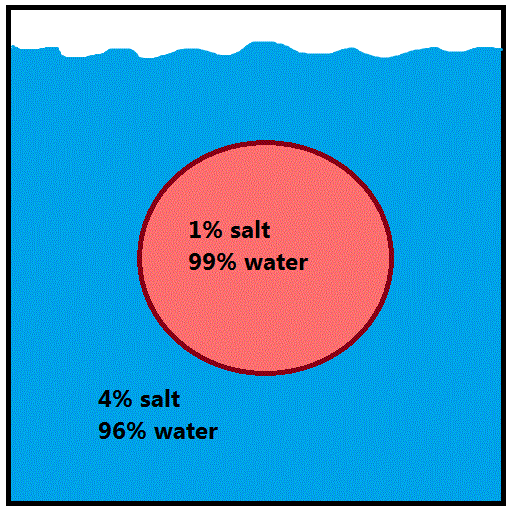
The cell below is in a _________ solution.
a)
Hypotonic
b)
Hypertonic
c)
Isotonic
54.
The cell below is in a _____________ solution.
a)
Hypertonic
b)
Hypotonic
c)
Isotonic
55.
A cell in an isotonic solution will
a)
swell
b)
shrink
c)
stay the same size
d)
impossible to tell
56.
A cell in a hypotonic solution will
a)
swell
b)
shrink 
c)
stay the same size
d)
impossible to tell
57.
Which of the following is the correct equation for PHOTOSYNTHESIS?
a)
CO+ light + H2O --> O+ Sugar
b)
CO+ sugar + H2O --> O+ light
c)
O2 + light + H2O --> CO+ Sugar
d)
CO+ O2 + H2O --> Light+ Sugar
58.
What are the products of photosynthesis?
a)
water and carbon dioxide
b)
oxygen and glucose
c)
oxygen and carbon dioxide
d)
oxygen and water
59.
What is one of the reactants of cellular respiration?
a)
energy
b)
glucose
c)
carbon dioxide
d)
water
60.
What is the correct equation for cellular respiration?
a)
6O2 + C6H12O6 -> 6CO2 + 6H2O + Energy
b)
6O2 + C6H12O6 + Energy -> 6CO2 + 6H2O
c)
6CO2 + 6H2O -> 6O2 + C6H12O6 + Energy
d)
6CO2 + 6H2O + Energy -> 6O2 + C6H12O6
61.
This process releases chemical energy from sugars and other carbon-based molecules to make ATP when oxygen is present.
a)
photosynthesis
b)
light-independent reaction
c)
cellular respiration
d)
light-dependent reaction
62.
What happens when enzymes are heated to a high temperature?
a)
The enzymes die.
b)
The shapes of the enzyme are altered denature
c)
The enzymes' amino acid sequence changes.
d)
The enzymes remain the same
63.
DNA is found in ALL cells.
a)
True
b)
False
64.
Fermentation involves
a)
aerobic respiration
b)
anaerobic respiration 
65.
What is a disadvantage of fermentation as a process? 
a)
It produces too much ATP
b)
It only produces 2 ATP
c)
It occurs in the absence of oxygen
d)
It is only for quick bursts of energy
66.
Fermentation is cellular respiration without which molecule?
a)
CO2
b)
O2
c)
C6H12O6
67.
Where does chemosynthesis occur?
a)
In plants
b)
In animals
c)
At the bottom of the ocean
d)
In the sky
68.

A difference between photosynthesis and chemosynthesis

a)

Photosynthesis doesn't use light and chemosynthesis does

b)

Photosynthesis makes sugar and chemosynthesis doesn't

c)

Photosynthesis uses light and chemosynthesis doesn't

d)

Photosynthesis doesn't make sugar and chemosynthesis does

69.
Which cell process is represented by this equation:
C6H12O6 + 6O2 →          6CO2  +  6H2O +  ATP
a)
diffusion
b)
photosynthesis
c)
cell respiration
d)
mitosis
70.
What is the source of energy for chemosynthesis
a)
Light energy
b)
Chemical energy
c)
Kinetic energy
71.
Where will the water go?
a)
Into the cell
b)
Out of the cell
c)
Equally in & out - it's isotonic
d)
There is no water
72.
A blood cell is placed into the jar, as seen. Where will the water go?
a)
Into the cell
b)
Out of the cell
c)
Equally in & out - it's isotonic
d)
The water is a lie
73.
 If a cell containing 5% salt is placed into a glass of water with 20% salt, the water is _______ compared to the cell.
a)
hypertonic
b)
hypotonic
c)
isotonic
74.
 An animal cell placed in a hypertonic (salty) solution will
a)
Stay the same
b)
Shrink- get smaller
c)
Swell- get bigger
75.
What type of solution allows water to enter the plant cell?
a)
hypotonic solution
b)
hypertonic solution
c)
isotonic solution
d)
active transport
76.
When both inside and outside of a cell have the same amount of water it is said that the cell has reached a state of
a)
Osmosis
b)
Diffusion
c)
Equilibrium
77.

In this experiment for photosynthesis, if you increased the light, what will happen to the amount of bubbles?

a)

more bubbles

b)

same number of bubbles

c)

less bubbles

78.

In this experiment for photosynthesis, what gas is contained in the bubbles?

a)

carbon

b)

carbon dioxide

c)

oxygen

d)

methane

79.

True or False: Chlorophyll and plants appear green because they reflect green light during photosynthesis

a)

True

b)

False

80.

If a students runs an experiment where they grow plants with more or less carbon dioxide in the environment, which would you expect to happen?

a)

Plants grown with less CO2 grow faster and larger

b)

Plants grown with more CO2 grow faster and larger

c)

Plants grown with less CO2 do not grow at all

d)

Plants grown with more CO2 grow slower and smaller

81.

If four plants are grown in four different color lights: red, blue, green, and orange, which light would most likely yield the least plant growth?

a)

red

b)

blue

c)

green

d)

orange

82.

Photosynthesis and Cellular Respiration are very similar reactions and in many ways are opposite reactions. What products of photosynthesis are need as reactants for cellular respiration?

a)

Glucose and Oxygen

b)

Glucose and Carbon Dioxide

c)

Oxygen and Water

d)

ATP and Sunlight

83.

What macromolecule is the primary component of the cell membrane?

a)

Nucleic acid

b)

Protein

c)

Lipid

d)

Carbohydrate

84.

What is the primary difference between chemosynthesis and photosynthesis?

a)

Chemosynthesis uses light and photosynthesis does not

b)

Photosynthesis uses light and chemosynthesis does not

c)

Photosynthesis produces glucose

d)

Chemosynthesis produces glucose

85.

What are the products of fermentation?

a)

Ethanol and carbon dioxide

b)

Water and carbon dioxide

c)

Glucose and oxygen

d)

Carbon dioxide and water

86.

Cyanobacteria produced much of the early earth's oxygen for the atmosphere. What cellular process did they use?

a)

Chemosynthesis

b)

Fermentation

c)

Cellular Respiration

d)

Photosynthesis

87.

Which process does not require the use of oxygen?

a)

Anaerobic Respiration

b)

Aerobic Respiration

c)

Cellular Respiration

88.

If carbon dioxide is taken out of the environment, what would happen to the rate of photosynthesis?

a)

Increase

b)

Decrease

c)

Stay the same

d)

It would depend on the amount of light available

89.

What happens to the rate of photosynthesis when light intensity is increase?

a)

Decreases

b)

Increases

c)

Stays the same

d)

Slows down

90.

What happens to the rate of oxygen production when the rate of photosynthesis increases?

a)

It decreases

b)

It increases

c)

It stays the same

d)

It depends on the amount of light available