wayground logo

Free Printable Worksheets

Font size

S
M
L
XL
Worksheets

Physical Science (Chemistry)_SOL Released Questions and More

Total questions: 83

Worksheet time: 1hrs 9mins

Name
Class
Date
1.
a)

The more acidic the substance, the faster it reacts with steel wool.

b)

The more acidic the substance, the faster the steel wool turns to a gas.

c)

The less acidic the substance, the faster the steel wool becomes covered with air bubbles.

d)

The less acidic the substance, the faster the steel wool changes color.

2.

A major scientific concern over nuclear energy is how to -

a)

deal with the large amounts of fossil fuels required

b)

reduce the high levels of carbon dioxide emitted into the air

c)

prevent the depletion of the ozone layer

d)

store the waste products safely

3.

Why is water known as the "universal solvent"?

a)

It dissolves all known substances.

b)

It dissolves only solid substances.

c)

It dissolves the greatest number of substances.

d)

It dissolves substances faster than all other solvents.

4.

Which of these properties of an unknown liquid can be found using a beaker, a hot plate, and a temperature probe?

a)

Density

b)

Boiling point

c)

Oxygen level

d)

Chemical composition

5.
a)

vaporizes and then freezes

b)

vaporizes and then condenses

c)

condenses and then vaporizes

d)

freezes and then vaporizes

6.
a)

1

b)

2

c)

3

d)

4

7.
a)

column

b)

family

c)

group

d)

period

8.
a)

They combined chemically to form a new compound.

b)

They combined chemically to form carbon and oxygen.

c)

They combined physically to form a new mixture.

d)

They combined physically to form a new element.

9.

Which energy transformation occurs first in a coal-burning power plant?

a)

Chemical energy to thermal energy

b)

Thermal energy to mechanical energy

c)

Thermal energy to electrical energy

d)

Mechanical energy to electrical energy

10.

Which of these best describes the particle motion taking place as CO2 gas is exposed to freezing temperatures?

a)

The particles decrease in speed.

b)

The particles move with more force.

c)

The motion of the particles become random.

d)

The motion of the particles is unchanged.

11.

How is the modern model of an atom different from the Bohr atomic model.

a)

The masses of the atomic particles are different.

b)

The numbers of electrons are different.

c)

The shapes of the nuclei are different.

d)

The arrangement of the electrons are different.

12.

Which of the following are products of combustion?

a)

Heat and light

b)

Newly discovered elements

c)

Liquid and solid water

d)

Additional atoms

13.

Which of these substances is an element?

a)

Steel

b)

Chlorine

c)

Plastic

d)

Sugar

14.

A student makes a drawing of a carbon atom. Which of these should the student show in the nucleus of the atom?

a)

Ions

b)

Protons

c)

Electrons

d)

Molecules

15.
The basic unit of matter is
a)
a mixture
b)
a substance
c)
an atom
d)
a compound
16.
A substance that contains only one type of atom is a(n)
a)
compound
b)
element
c)
heterogeneous mixture
d)
homogeneous mixture
17.
Which of these is a pure substance?
a)
bread
b)
table salt
c)
garden soil
d)
sea water
18.
Which of these is not an example of a molecule?
a)
CH4
b)
C
c)
C6H12O6
d)
H2O
19.
Which of these is a mixture?
a)
Uncooked chocolate chips and cookie dough blended together with a spoon.
b)
Distilled water
c)
A nugget of gold
d)
A molecule of Oxygen
20.
Atoms of an element always have a certain number of
a)
neutrons
b)
protons
c)
electrons
d)
ions
21.
Which of the following would be an example of a chemical equation?
a)
C6H12O6
b)
2 H2+ O2 -> 2 H2O
c)
F= ma
d)
H2O
22.
Which of the following would be an example of a chemical formula:
a)
C6H12O6
b)
F= ma
c)
2 H2 + O2 -> 2 H2O
d)
6.02 x 10 23
23.
The following properties are describing ______:
* pH range of 0-6.9
*turn litmus red
*contains more H+ than OH-
a)
acids
b)
bases 
c)
salts
d)
neutralization
24.
A way to measure the concentration of hydrogen ions in a solution is to use a(n) _____.
a)
indicator
b)
litmus
c)
pH scale
d)
acid
25.
A ___ is formed when an positive ion bonds with a negative ion.
a)
Acid
b)
base
c)
salt
d)
neutral ion
26.
The following  properties describe a(n) ____:
* feel slippery
*have a pH 7.1-14
*turn litmus blue
a)
acid
b)
base
c)
salt
d)
neutral ion
27.
A solution with a pH of 7 is considered  a(n) _____.
a)
Acid
b)
Base
c)
neutral solution
d)
salt
28.
What is an example of a Chemical change?
a)
Ripped paper 
b)
boiled egg
c)
cracked egg
d)
sugar in water
29.
Which is a physical change?
a)
burning match 
b)
vinegar in baking soda 
c)
melting butter
d)
cooking an egg
30.
What kind of properties can only be observed when a substance changes into a different substance?
a)
physical properties
b)
chemical properties
c)
liquid properties
d)
real properties
31.
Which of the following properties is a physical property?
a)
magnetism
b)
reactivity with oxygen
c)
flammability
d)
non-reactive
32.
What characteristic defines all chemical changes?
a)
There is a change of state.
b)
Electricity is produced.
c)
A new material is formed.
d)
Bubbles are produced. 
33.
Which of the following is a Chemical Property?
a)
Dogs
b)
Color
c)
Boiling Point
d)
Reactivity
34.
Which of the following is a Physical Property?
a)
Combustion
b)
Flammability
c)
Color
d)
PH Level
35.
A change in the size, shape, or state of matter.
a)
chemical change
b)
physical change
c)
chemical reaction
d)
electron change
36.
Photosynthesis is an example of a
a)
physical change
b)
chemical change
37.
Melting an ice cube
a)
Chemical Change
b)
Physical Change
38.
a)
Periods
b)
Groups
39.
a)
Periods
b)
Groups
40.
a)
energy levels
b)
valence electrons
c)
protons
d)
neutrons
41.
a)
energy levels
b)
valence electrons
c)
protons
d)
neutrons
42.
a)
Same group
b)
Same period
43.
a)
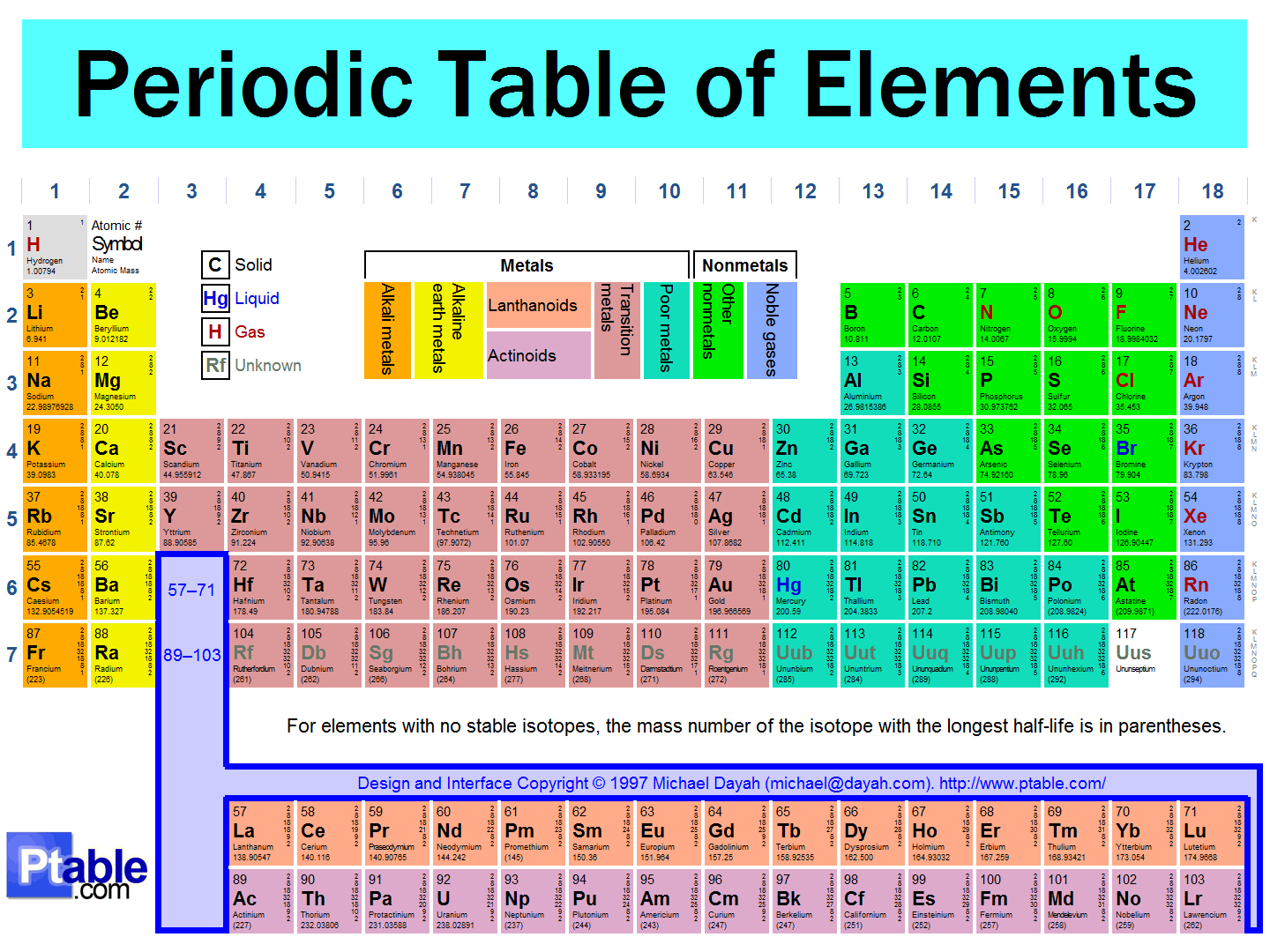
Metals
b)
Nonmetals
c)
Metalloids
44.
a)
Metals
b)
Nonmetals
c)
Metalloids
45.
a)
Metals
b)
Nonmetals
c)
Metalloids
46.
a)
Metals
b)
Nonmetals
c)
Metalloids
47.
a)
Metals
b)
Nonmetals
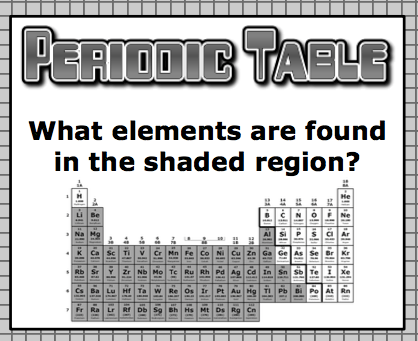
c)
Metalloids
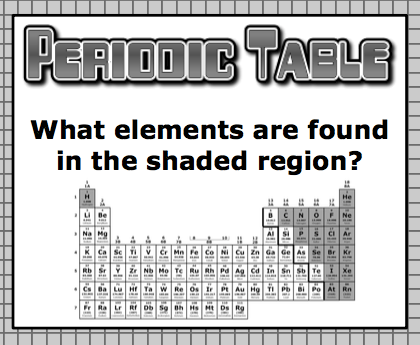
48.
a)
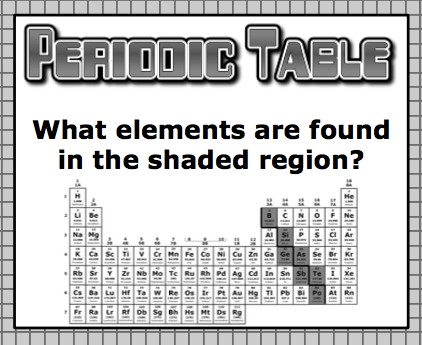
Metals
b)
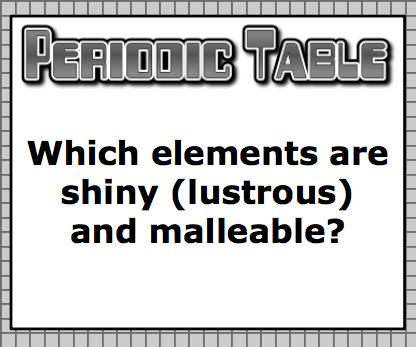
Nonmetals
c)
Metalloids
49.
a)
Metals
b)
Nonmetals
c)
Metalloids
50.
a)
Metals
b)
Nonmetals
c)
Metalloids
51.
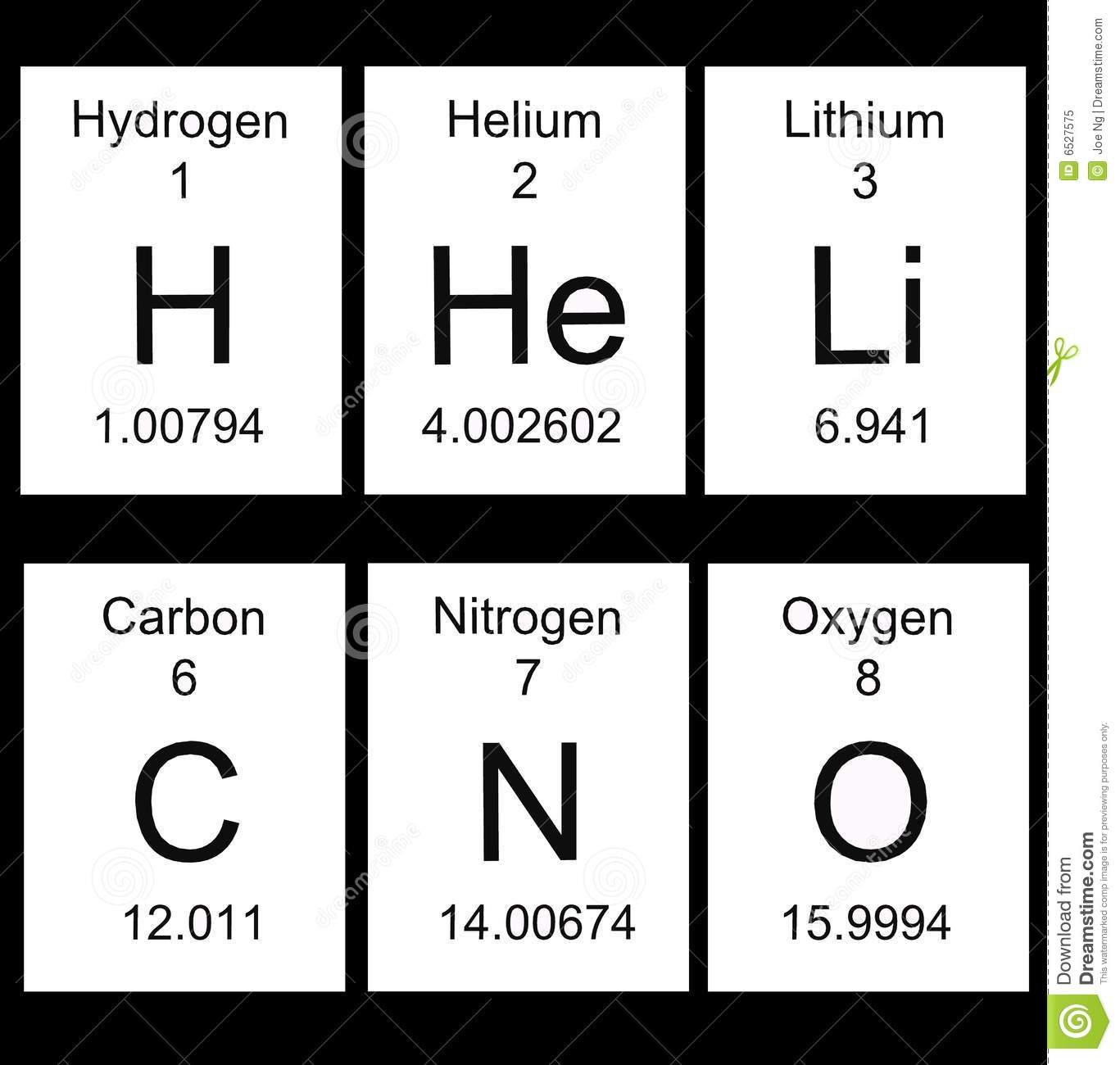
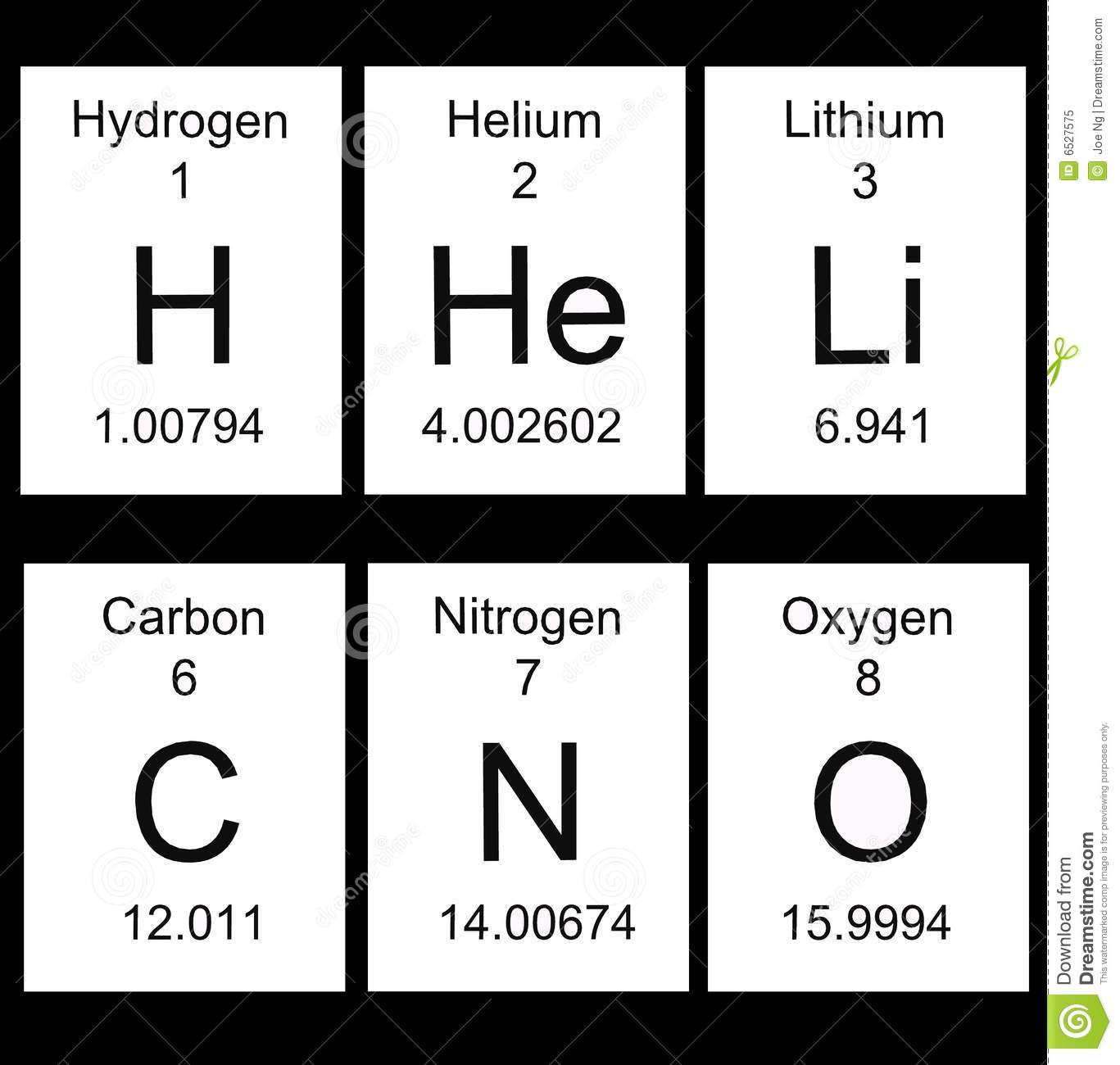
The number at the bottom of each square on the periodic table is the ...
a)
atomic number
b)
atomic mass
c)
chemical symbol
d)
element name
52.
The number at the top of each square on the periodic table is the ...
a)
atomic number
b)
atomic mass
c)
Chemical Symbol
d)
Element Name
53.
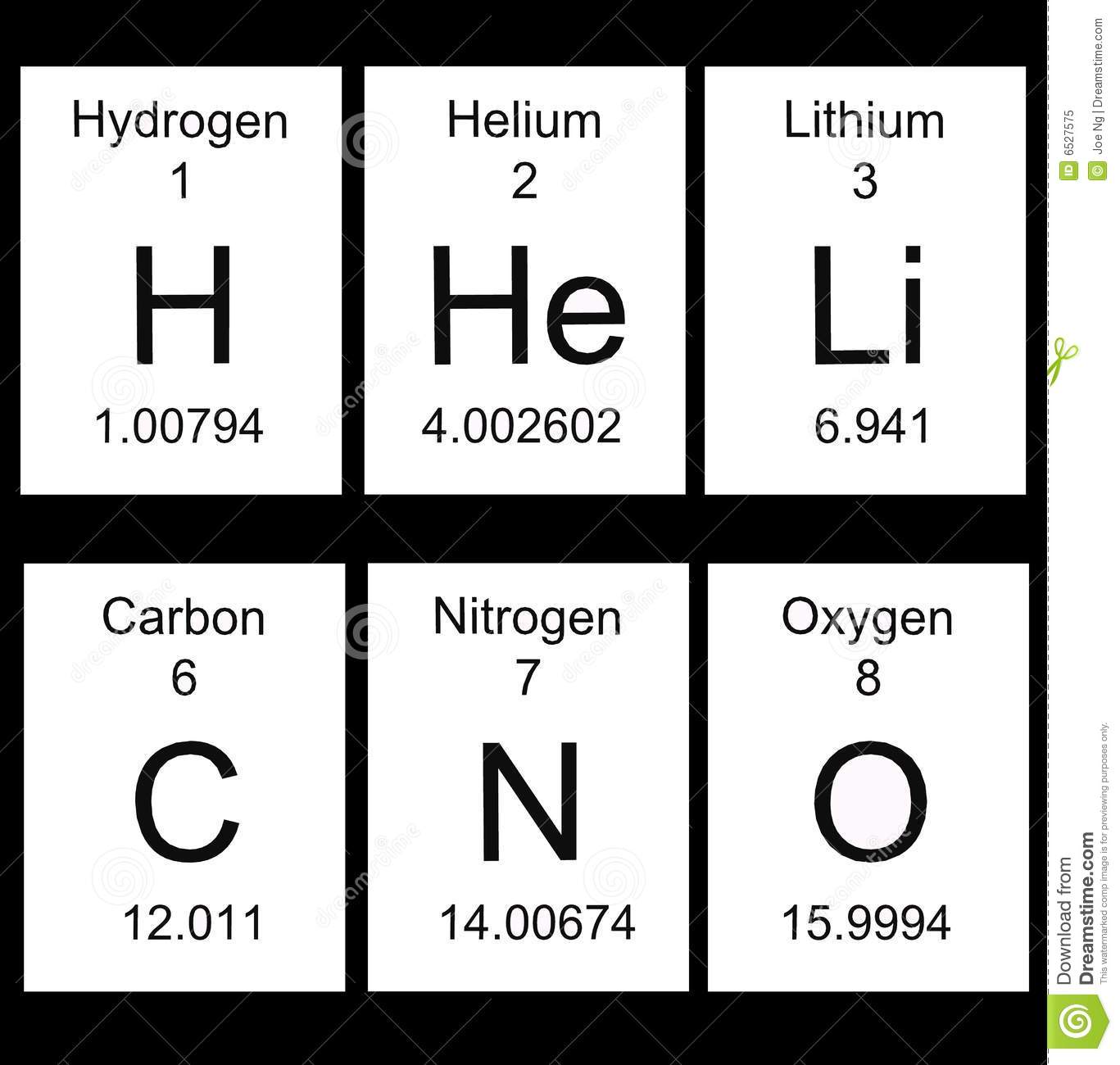
What is the chemical symbol for Lithium?
a)
H
b)
He
c)
Li
d)
N
54.
This class of elements are sometimes called "semiconductors."
a)
Metals
b)
Nonmetals
c)
Metalloids
d)
Groups
55.
How many valence electrons does sodium have?
a)
1
b)
2
c)
3
d)
4
56.
How many valence electrons does Carbon have?
a)
4
b)
12
c)
6
d)
14
57.
How many valence electrons does Neon have?
a)
18
b)
8
c)
10
d)
2
58.
Ionic Bonding involves...
a)
The transfer of protons
b)
The transfer of nuetrons 
c)
The transfer of electrons
d)
None Of the above
59.
Which group of elements have full outer shells?
a)
The alkali metals
b)
The full gases
c)
The halogens
d)
The noble gases
60.
Atoms gain or lose electrons because they ...
a)
are too full.
b)
want to lose weight.
c)
want a full outer shell.
d)
can
61.
Predict the bond that will form between Se and Cl
a)
Ionic
b)
Covalent
62.
How many valence electrons does the atom in the diagram have? 
a)
2
b)
3
c)
5
d)
10
63.
What type of bond is this?
a)
Covalent
b)
Ionic 
c)
Metallic 
d)
Hydrogen
64.
Which particles change the charge in atoms when ions are formed?
a)
Protons
b)
Electrons
c)
Neutrons
d)
Kittens
65.
A covalent compound contains _______, but an ionic compound will have _______________.
a)
2 Alkali metals, 2 Metalloids
b)
Two metals, Two Nonmetals
c)
A metal and a  Nonmetal, 2 Halogen
d)
Two Nonmetals, Metal + Nonmetal
66.
CaBr2
Calcium Bromide is an example of which type of chemical bonding? 
a)
Ionic Bond
b)
Covalent Bond
c)
Both bonds
d)
Neither bond
67.
H2O Water is an example of which type of chemical bonding? 
a)
Ionic Bond
b)
Covalent Bond
c)
Both bonds
d)
Neither bond
68.
What do atoms that form negative ions tend to do?
a)
Tend to lose electrons 
b)
Tend to lose protons
c)
Tend to gain electrons
d)
Tend to gain protons
69.
Metals form positive ions that means they 
a)
Tend to lose electrons 
b)
Tend to lose protons
c)
Tend to gain electrons
d)
Tend to gain protons
70.
Order the atomic models below from the oldest to the mot recent.
a)
2, 1, 3, and 4
b)
1, 2, 4, and 3
c)
3, 2, 4, and 1
d)
3, 1, 2, and 4
71.
Which scientist proposed a model of the atom in which the individual atoms were thought of as tiny solids like balls or marbles?
a)
John Dalton
b)
James Chadwick
c)
Ernest Rutherford
d)
J.J. Thomson
72.
Bohr proposed a model of the atom as a large positive sphere with negatively charged electrons revolving around the center in orbits. What was this model nicknamed?
a)
The Planetary Model
b)
The Billiard Ball Model
c)
The Nuclear Model
d)
The Plum Pudding Model
73.
Which atomic model has a positively charged nucleus and a negatively charged cloud of electrons giving the atom its size?
a)
Modern Model
b)
Plum-pudding Model
c)
Planetary Model
d)
Marble Model
74.
Whose model of an atom is displayed in the picture?
a)
Rutherford
b)
Dalton
c)
Thomson
d)
Bohr
75.
Whose model of an atom is displayed in the figure?
a)
Bohr
b)
Rutherford
c)
Thomson
d)
Modern Model
76.
Why has the model of an atom changed over time?
a)
Scientists discovered new information about atoms over time.
b)
Scientists couldn't agree on what the atom looked like.
c)
Atoms today are different than they were for Democritus in Greece.
d)
Atoms are always changing and may be different in the future.
77.
Which of the following correctly orders the atomic models from the oldest to the most recent?
a)
Dalton, Thomson, Rutherford, Bohr, Modern
b)
Dalton, Thomson, Bohr, Modern, Rutherford
c)
Thomson, Dalton, Rutherford, Modern, Bohr
d)
Modern, Bohr, Rutherford, Thomson, Dalton
78.
What is the nickname for Thomson's model?
a)
Plum pudding model
b)
Electron cloud model
c)
Billiard ball model
d)
Nuclear model
79.
Whose model is in the picture displayed?
a)
Thomson
b)
Dalton
c)
Modern
d)
Rutherford
80.
The splitting of a nucleus into smaller nuclei is
a)
fusion
b)
fission
c)
half-life
d)
gamma radiation
81.
What is a chain reaction?
a)
When electrons travel are emitted causing electricity
b)
When a nuclear fission reaction occurs, the protons emitted can strike other nuclei in the sample, and cause them to split
c)
When a nuclear fission reaction occurs, the neutrons emitted can strike other nuclei in the sample, and cause them to split
d)
When a nuclear fission reaction occurs, the electrons emitted can strike other nuclei in the sample, and cause them to split
82.
How do nuclear power-plants work?
a)
Fusion
b)
Half-life
c)
Fission
d)
Fusion or fission
83.
Do all stars make energy through fusion?
a)
Yes
b)
No
c)
Just our sun
d)
Only large stars