
 Worksheets
ISTEP Review #3 Genetics
Total questions: 64
Worksheet time: 59mins
Name
Class
Date
1.
What is the purpose of using a pedigree?
a)
To determine the average age of a family
b)
To find out family histories and medical records
c)
To find out whether a couple can have a boy or a girl
d)
To trace the inheritance of a certain trait through generations
2.
How many PAIRS of chromosomes do humans have?
a)
23
b)
46
c)
1
d)
2
3.
I have 2 X chromosomes. What am I?
a)
Male
b)
Female
4.
If a gene is found only on the X chromosome and not the Y chromosome, it is said to be what?
a)
sex-linked trait
b)
polygenic trait
c)
codominant trait
d)
incomplete dominance trait
5.

What percentage of the offspring will have this recessive disease?
a)
0%
b)
25%
c)
50%
d)
75%
6.

What percentage of the female offspring will be a carrier for this recessive disease?
a)
0%
b)
50%
c)
100%
d)
25%
7.

Looking at this pedigree, how many female family members are carriers?
a)
1
b)
3
c)
10
d)
7
8.

Looking at this pedigree, how many family members have the disease?
a)
4
b)
7
c)
All
d)
None
9.
What is NOT a possible genotype for someone with type B blood?
a)
BB
b)
AB
c)
BO
10.
Which sequence of DNA bases would pair with this partial strand
ATG TGA CAG
ATG TGA CAG
a)
ATG TGA CAG
b)
TAC ACT GTC
c)
GTA AGT GAC
d)
CAT TCA CTG
11.
What are small stretches of DNA that code for traits
a)
Nucleus
b)
Chromosomes
c)
Gene
d)
Centromeres
12.
The phenotype is the _______________.
a)
physical appearance of an organism
b)
Genetic makeup
c)
Alleles acquired from a specific parent.
13.
How much of your DNA do you inherit from your mom?
a)
10%
b)
25%
c)
50%
d)
it varies
14.
Two brown eyed parents (Bb) have a baby. What is the chance the baby is blue eyed?
a)
0 %
b)
25%
c)
50%
d)
75%
15.
This produces 2 identical cells.
a)
mitosis
b)
meiosis
16.
A human usually has xx amount of chromosomes.
a)
6
b)
22
c)
4
d)
46
17.

Meiosis makes sperm and egg cells. In humans, sperm and egg cells each have _____ chromosomes. Therefore a fertilized human egg cell (sperm and egg cell combined) would create a cell with _____ chromosomes.
a)
23, 46
b)
46, 23
c)
2, 4
d)
50, 100
18.
What causes genetic variation in meiosis?
a)
chromosomes lining up
b)
crossing over of chromosomes
c)
separation of chromosomes
d)
chromosomes pulling apart
19.

When an area of a chromatid is exchanged with the matching area on a chromatid of its homologous chromosome, _________________ occurs
a)
crossing over
b)
mutagenesis
c)
hybridization
d)
fertilization
20.
The chromosomes that pair up during meiosis, are called __________ chromosomes.
a)
homozygous
b)
asexual
c)
homologous
d)
genes
21.

Which of the following genotypes belongs in the red box in the Punnett square?
a)
XBXb
b)
XbXb
c)
XbY
d)
XBY
22.

What genotype is missing from this Punnett Square?
a)
RrYy
b)
RRYY
c)
rryy
d)
RrYY
23.

Based off this punnett square, what fraction of the offspring will have wrinkled, yellow seeds?
a)
9/16
b)
3/16
c)
1/16
d)
16/16
24.
What chromosomal abnormality causes Down's Syndrome?
a)
Trisomy 47
b)
Trisomy 46
c)
Trisomy 21
d)
Trisomy 23
25.

Which is the correct phenotype for this organism?
a)
BB
b)
blue
c)
green
d)
bb
26.

This type of inheritance pattern shows BOTH traits in possible offspring
a)
complete dominance
b)
incomplete dominance
c)
co-dominance
d)
dominant pattern
27.
Which of the following units are repeatedly joined together to form a strand of DNA?
a)
amino acids
b)
nucleotides
c)
fatty acids
d)
polysaccharides
28.

In a molecule of double-stranded DNA, the amount of Adenine present is always equal to the amount of
a)
cytosine
b)
guanine
c)
thymine
d)
uracil
29.
Guanine bonds with ______________.
a)
Adenine
b)
Guanine
c)
Cytosine
d)
Thymine
30.
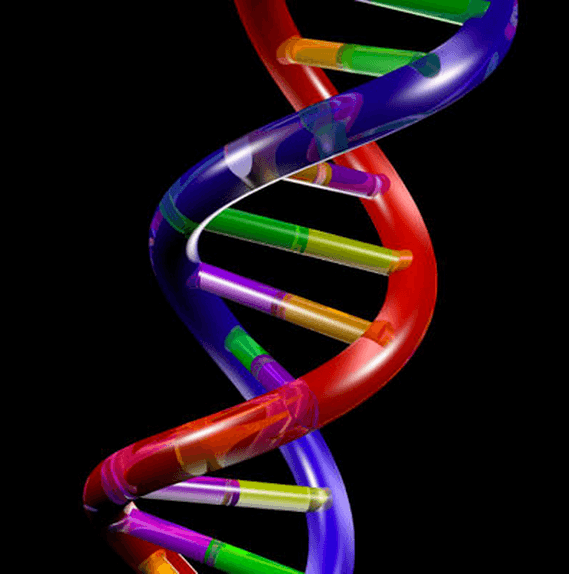
What determines the code, or information, of a DNA molecule?
a)
the shape (structure) of the nitrogen bases
b)
the order (sequence) of the nitrogen bases
c)
the color of the nitrogen bases
d)
the frequency (number) of nitrogen bases
31.
Which organelle is DNA usually found in?
a)
cell membrane
b)
vacuole
c)
chloroplast
d)
nucleus
32.
A process in which DNA has the unique ability to make an exact copy of itself.
a)
Replication
b)
Translation
c)
Transcription
33.
Which two scientists are accredited with correctly deducing the double helix model of DNA?
a)
Watson and Crick
b)
Wilkins and Franklin
c)
Wilkins and Crick
d)
Watson and Franklin
34.

This image shows that DNA Replication is _______.
a)
Conservative
b)
Semiconservative
c)
Dispersive
d)
Spontaneous
35.
What are the following rules called?
1 - The amount of A, T, G, and C varies from species to species.
2 - In each species, the amount of A = T and G = C.
1 - The amount of A, T, G, and C varies from species to species.
2 - In each species, the amount of A = T and G = C.
a)
Rosalind's Rules
b)
Watson's Rules
c)
Crick's Rules
d)
Chargaff's Rules
36.
By using radioactive isotopes, Hershey and Chase were able to conclude that __ is/are the carrier(s) of genetic information.
a)
DNA
b)
Proteins
c)
Carbohydrates
d)
Lipids
37.
Cell mutations are....?
a)
Unnatural and harmful
b)
Unnatural and always affect the organism
c)
Natural and produces genetic diversity
d)
Natural and always affect the organism
38.
What causes mutations?
a)
Mistakes in replication or environmental substances
b)
The amino acids
c)
Passed down by genetics
d)
It's how your born
39.
What is the central dogma of biology?
a)
Proteins are made from RNA that assembles amino acids through DNA ribosomes.
b)
RNA copies all information for an organism onto DNA which assembles ribosomes, and creates amino acids from proteins
c)
DNA is the blueprint for an organism. RNA copies specific sections that need to be built and transfers that information to a ribosome which assembles proteins out of amino acids.
d)
RNA is the blueprint for an organism. It copies its information onto DNA, which takes amino acids (like lego building blocks) and assembles those acids into proteins.
40.

Who is responsible for producing this image?
a)
Francis Crick
b)
James Watson
c)
Rosalind Franklin
d)
Watson and Crick
41.
The instructions governing the traits of an organism are determined by...?
a)
The order of bases
b)
The length of the DNA
c)
Which bases are paired with which
d)
The proportions of A,G,C, and T
42.

The image illustrates which of the following structures?
a)
Amino acid
b)
Nucleotide
c)
Protein
d)
Peptide Bond
43.
What do we call the process of turning DNA into mRNA?
a)
replication
b)
transcription
c)
translation
44.
What type of RNA carries the DNA message out of the nucleus to the ribosomes?
a)
mRNA
b)
tRNA
c)
rRNA
45.
When the RNA gets to the ribosomes, which molecule transfers the amino acids to the mRNA?
a)
mRNA
b)
rRNA
c)
tRNA
d)
YMCA
46.
Amino acids are the building blocks of...
a)
atoms
b)
DNA
c)
proteins
d)
a loving relationship
47.
Which of these is the Central Dogma of Biology in the correct order?
a)
DNA --> mRNA --> polypeptide (protein) chain
b)
DNA --> polypeptide chain (protein) --> mRNA
c)
mRNA --> DNA --> polypeptide (protein) chain
d)
polypeptide chain (protein) --> DNA --> mRNA
48.
DNA molecule segment is : TTACGCAAG
The mutated DNA segment is TTCGCAAG. This is an example of ______ mutation.
The mutated DNA segment is TTCGCAAG. This is an example of ______ mutation.
a)
Substitution
b)
Deletion
c)
Insertion
d)
Inversion
49.
when DNA is transcribed to RNA....
a)
A pairs with U
b)
G pairs with U
c)
C pairs with T
d)
A pairs with C
50.
Which RNA bases would pair with TACGAA in transcription?
a)
AUGCUU
b)
ATGCTT
c)
GCATCC
d)
GCAUCC
51.
Which process is used to make mRNA from the DNA in the nucleus?
a)
transcription
b)
translation
c)
replication
52.
How many amino acids are coded for by this sequence of nucleotides:
ATG GGA ACT CCA
ATG GGA ACT CCA
a)
4
b)
2
c)
6
d)
12
53.
A triplet of mRNA is called a
a)
codon
b)
anticodon
c)
amino acid
d)
peptide bond
54.
What mutation has occurred here?
T-G-A-C-C-A
T-G-A-G-C-A
T-G-A-C-C-A
T-G-A-G-C-A
a)
Substitution
b)
Deletion
c)
Insertion
d)
Frameshift
55.

What is the function of the ribosome?
a)
Carries genetic message from DNA to cytoplasm
b)
Transfers amino acids from cytoplasm to ribosome
c)
Stores genetic information in the nucleus
d)
Reads mRNA and links amino acids to form protein
56.
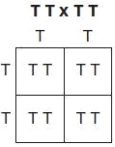
What ratio of the offspring from the cross shown will be homozygous recessive for the trait of tallness?
a)
0 in 4
b)
1 in 4
c)
2 in 4
d)
4 in 4
57.
In a flowering plant species, red flower color (R) is dominant over white flower color (r). What is the genotype of any red-flowering plant resulting from this species?
a)
rr
b)
R
c)
RR
d)
RR or Rr
58.

The type of inheritance pattern demonstrated here is
a)
x-linked recessive
b)
autosomal dominant
c)
x-linked dominant
d)
co-dominant
59.

A chart that tracks which members of a family have a particular trait.
a)
pedigree
b)
genetic diagram
c)
manuscript
d)
flow chart
60.

What disease is a genetic disorder that results in abnormally shaped blood cells?
a)
Sickle Cell
b)
Hemophilia
c)
Cystic Fibrosis
d)
Down Syndrome
61.

What can affect a person's height?
a)
Genetics
b)
Environmental factors
c)
Parents
d)
Genetics and environmental factors
62.
What is the definition of Homozygous?
a)
When one allele is dominant and one is recessive
b)
When an individual has two sets of the same allele.
c)
when it is neither dominant or recessive
63.
The genotype is the ______________.
a)
physical appearance
b)
Genetic makeup
c)
Alleles gained from one parent
64.
The phenotype is the _______________.
a)
physical appearance of an organism
b)
Genetic makeup
c)
Alleles acquired from a specific parent.
100 %

