wayground logo

Free Printable Worksheets

Font size

S
M
L
XL
Worksheets

Water

Total questions: 52

Worksheet time: 2hrs 43mins

Name
Class
Date
1.
What is a water molecule composed of?
a)
1 Hydrogen atom and 2 Oxygen atoms
b)
2 Hydrogen atoms and 1 Oxygen atom
c)
3 Oxygen atoms
d)
2 Helium atoms and 1 Oxygen atom
2.

What are water's unique properties?

a)

It covers 40% of planet Earth

b)

It covers 90% of planet Earth.

c)

It can be all 3 states of matter.

3.

Why does water have charges in different parts of the molecule?

a)

The oxygen end is slightly negative and the hydrogen end is slightly positive

b)

The hydrogen end is slightly negative and the oxygen end is slightly positive

c)

The hydrogen and oxygen ends change in polarity

d)

Because it faces north

4.
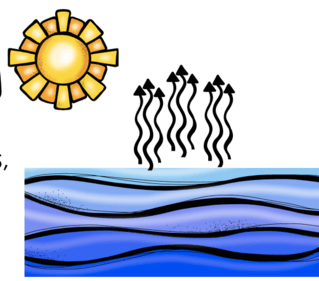
What part of the water cycle does this picture show?
a)
condensation
b)
precipitation
c)
evaporation
5.
Precipitation happens when clouds of water droplets are too ______________.
a)
cold
b)
light
c)
heavy
d)
hot
6.

Which of these is an example of precipitation?

(you may select more than one answer)

a)

snow

b)

air

c)

rain

d)

vapor

e)

sleet

7.
Where is most water found on Earth?
a)
glaciers
b)
lakes
c)
rivers
d)
oceans
8.
River, streams and oceans are all points of _____________ in the water cycle.
a)
collection 
b)
precipitation
c)
condensation
d)
evaporation
9.
What controls whether water is a gas, liquid, or solid ice? 
a)
the shape or size of the cup
b)
where it has been stored
c)
if it is being used for irrigation
d)
what its temperature is 
10.
What is the water cycle?
a)
the 3 forms of water
b)
the movement of water on, above, or below the surface of the Earth
c)
when water melts
d)
when clouds form
11.
What follows evaporation during the water cycle? How does this occur?
a)
Water evaporates into water vapor
b)
Water vapor condenses and forms a  cloud
c)
Water precipitates to the ground
d)
Water runs down into the hydrosphere
12.
What is it called when plants give off water vapor as a waste product?
a)
condensation
b)
evaporation
c)
sublimation
d)
transpiration
13.
The first step in the water cycle 
a)
evaporation
b)
condensation 
c)
precipitation
d)
there is no first step 
14.
The water cycle is also known as ..........
a)
Hypertonic Solution
b)
Hydrological Cycle
c)
Hyperlogical Cycle
d)
None of these
15.
97% of the Earth's water is  located in....
a)
ground wat
b)
the ocean
c)
lakes, rivers, and streams
d)
glaciers
16.

This is what heats up the water to power the water cycle.

a)

sun

b)

moon

c)

stars

d)

Mars

17.
Which is the opposite of condensation?
a)
runoff
b)
evaporation
c)
precipitation
d)
transpiration
18.
When water _________, dew forms.
a)
Melts
b)
Evaporates
c)
Condenses
d)
Precipitates
19.
Is humidity the amount of water in the air?
a)
Yes
b)
No
20.

How much of the Earth is covered with water?

a)

71%

b)

97%

c)

3%

d)

0.5%

21.

How much of the water on Earth is freshwater?

a)

97%

b)

77%

c)

3%

d)

71%

22.
When precipitation hit the ground it creates?
a)
Runoff
b)
Icecaps
c)
Glaciers
d)
Aquifer
23.
On which temperature scale does water freezes at 32 degrees and boil at 212 degrees?
a)
Fahrenheit
b)
Celsius
c)
Kelvin
d)
Calvin
24.
On which temperature scale does water freeze at 0 degrees and boil at 100 degrees?
a)
Fahrenheit
b)
Celsius
c)
Kelvin
d)
Calvin
25.
Water vapor suspended at or near Earth's surface
a)
Dew
b)
Frost
c)
Fog
d)
Snow
26.
Letter D is?
a)
precipitation
b)
transpiration
c)
condensation
d)
run off
27.
Letter E is?
a)
precipitation
b)
accumulation
c)
condensation
d)
run off
28.
A water molecule looks like _____.
a)
smiley face
b)
mickey mouse
c)
a long chain of atoms
d)
grumpy cat
29.
How many hydrogen atoms are in one molecule of water?
a)
1
b)
2
c)
3
d)
4
30.
Which letter represents hydrogen?
a)
A
b)
B
c)
C
d)
D
31.
Which letter represents oxygen?
a)
A
b)
B
c)
C
d)
D
32.
Which letter represents the negative end?
a)
A
b)
B
c)
C
d)
D
33.
Which letter represents the positive end?
a)
A
b)
B
c)
C
d)
D
34.
The property where water molecules are attracted to other types of molecules (surfaces).
a)
adhesion
b)
capillary action
c)
cohesion
d)
universal solvent
35.
The property where water molecules are attracted to other water molecules.
a)
adhesion
b)
capillary action
c)
cohesion
d)
universal solvent
36.
The property where water can dissolve almost all substances on Earth.
a)
adhesion
b)
capillary action
c)
cohesion
d)
universal solvent
37.
The property where water can pull itself up tubes or through spaces in paper or fabrics.
a)
adhesion
b)
capillary action
c)
cohesion
d)
universal solvent
38.
Why can some insects walk on water?
a)
The water sticks to the insect.
b)
The insect is too light to break the surface tension.
c)
The insect has hydrophobic oils on its legs.
d)
Insects can't walk on water.
39.
Why does water move from the roots to the leaves of plants?
a)
Water is pushed by solutes.
b)
Capillary action pulls the water molecules like a chain.
c)
Water is pulled by gravity.
d)
Water’s cohesion causes it to “pull” towards the leaves.
40.
97% of the water on earth is _________, making it undrinkable for humans.
a)
fresh water
b)
ground water
c)
salt water
d)
surface water
41.
Which of the following is a way to save water?
a)
Water the lawn at high noon
b)
washing half loads of dishes
c)
taking shorter showers
d)
running the water while brushing your teeth
42.
Most water pollution is the result of __________________.
a)
natural processes
b)
animal waste
c)
human activities
d)
acid rain
43.
Acid rain is when the pH of rain is less than:
a)
14
b)
7
c)
3
d)
5.1
44.

In a residence, how is most (26%) of the water used?

a)

Toilet

b)

Bath/shower

c)

Faucet

d)

Dishwasher

45.
Which of the following is not a natural cause of water pollution?
a)
Volcanoes
b)
Animal waste
c)
Oil spills
d)
Silt from storms and floods
46.
Most of Earth's water (97%) is...
a)
fresh water
b)
salt water
c)
ice
d)
water vapor
47.
Most water pollution is the result of
a)
droughts
b)
volcanoes
c)
storms
d)
human activity
48.
What is one way a person can help to conserve or save energy?


a)
Drive a big car with no passengers.
b)
Cut off lights when they exit a room.
c)
Brush teeth with hot water.
d)
Ride a bicycle to school.
49.
Water is Polar.
a)
True
b)
False
50.

What word is used to describe the tendency of different particles or surfaces to cling to one another?

a)

cohesion

b)

adhesion

c)

polar

51.
turns blue litmus paper red
a)
acid
b)
base
52.
turns red litmus paper blue
a)
base
b)
acid