
 Worksheets
Ecology Unit Review
Total questions: 85
Worksheet time: 51mins
Name
Class
Date
1.
An organism that produces its own food supply from inorganic compounds is called a(an)
a)
heterotroph
b)
consumer
c)
detritivore
d)
autotroph
2.
What is the original source of almost all energy in most ecosystems?
a)
carbohydrates
b)
sunlight
c)
water
d)
carbon
3.
What is the term for each step in the transfer of energy and matter within a biological community?
a)
energy path
b)
food web
c)
trophic level
d)
food pyramid
4.
What is an heterotroph?
a)
An organism that can produce its own form of energy (via the Sun)
b)
An organism that consumes only plants for energy
c)
Various organisms that consume other organisms for energy
d)
An organism that decomposes other organisms
5.
What is the major difference between a community and an ecosystem?
a)
A community involves only the biotic, not the abiotic
b)
An ecosystem only includes herbivores and carnivores-- no decomposers
c)
An ecosystem involves only the biotic, AND THE abiotic
d)
An ecosystem is just a larger community
6.
What are the correct types of Trophic levels?
a)
Producers
Primary
Secondary
Primary
Secondary
b)
Primary
Secondary
Secondary
c)
Producers
Consumers
Decomposers
Consumers
Decomposers
d)
Producers
Primary
Secondary
Tertiary
Primary
Secondary
Tertiary
7.
What are the major differences between a species and a population?
a)
Populations consist of ALL of the individual organisms within a species in a given area/ecosystem that are fertile
b)
Populations are a collection of many different types of species that are not related to each other
c)
Populations are just a larger amount of individuals
d)
Populations are the number of individuals within a species that are identical
8.

What are the plants in this picture?
a)
Heterotrophs
b)
Autotrophs
c)
Carnivores
d)
Herbivores
9.

Different populations living and interacting with each other in the same area
a)
Biome
b)
Ecosystem
c)
Community
d)
Niche
10.

Organisms that look similar and can produce fertile offspring
a)
Species
b)
Fish
c)
Community
d)
Trees
11.

The non-living part of an ecosystem
a)
Ocean
b)
Lava Flow
c)
Birds
d)
Abiotic
12.

The study of how living things interact with one another and with their environment.
a)
Biology
b)
Lithology
c)
Ecology
d)
Farmacology
13.

An area where an organism finds food, shelter and water in a specific arrangement
a)
niche
b)
biosphere
c)
biome
d)
habitat
14.

All of the living and nonliving things in an area that interact with each other are called a/an ______.
a)
community
b)
habitat
c)
population
d)
ecosystem
15.

What does a food web represent?
a)
All connections of energy flow throughout all organisms in a habitat.
b)
The specific ways that mutualism is carried out.
c)
A single pathway or energy flow between organisms.
d)
How carnivores get their food.
16.

The image provided is an example of a(n):
a)
Carnivore
b)
Herbivore
c)
Producer
d)
Autotroph
17.
The amount of energy that usually transfers from one trophic level to the next...
a)
10%
b)
20%
c)
80%
d)
50%
18.
An illustration that uses arrows to show the many possible directions in which matter and energy can pass through the organisms in an ecosystem.
a)
Food chain
b)
Food web
c)
Energy Pyramid
d)
Succession Map
19.
Which of the following would be the definition of a detritivore?
a)
Animals that eat insects.
b)
Organisms that feed on rocks, recycling the nutrients back into the ground.
c)
Organisms that eat only pants
d)
Things that feed on dead organisms, recycling the nutrients back into the ground.
20.
Water temperature would be an example of ...
a)
A biotic factor
b)
An abiotic factor
21.
The general name for organisms like animals and fungi that get their energy from eating other organisms.
a)
Producers
b)
Consumers
c)
Detritivores
d)
Carnivores
22.
An organism at the second trophic level would be considered a...
a)
Top carnivore
b)
Producer
c)
Herbivore
d)
Carnivore
23.
True or False: It is possible for a carnivore to be a producer.
a)
False
b)
True
24.

In this food web, what is the grasshopper?
a)
producer
b)
tertiary consumer
c)
secondary consumer
d)
primary consumer
25.

In the energy pyramid here, which organisms have the most energy available?
a)
Producers
b)
Carnivores
c)
Herbivores
d)
Top Predator
26.
An animal that is hunted and eaten for food is a
a)
predator
b)
prey
27.
An organism's niche is
a)
the entire role an organism has in the place it lives
b)
the range of temperatures that the organism needs to survive
c)
all the physical and biological factors in the organism's environment
d)
the nutrients that flow from the organism to the environment
28.
What is the original source of almost all energy in most ecosystems?
a)
carbohydrates
b)
sunlight
c)
water
d)
carbon
29.

An individual belonging to a specific species
a)
Biotic
b)
Community
c)
Organism
d)
Reptile
30.
All of the living and nonliving things in an area that interact with each other are called a/an ______.
a)
community
b)
habitat
c)
population
d)
ecosystem
31.

The area between the highest mountain and the deepest ocean where life can be found
a)
Biosphere
b)
Biome
c)
Farm
d)
Ecosystem
32.
If the number of births in a population is the same as the number of deaths in a population, what will happen to the growth of the population?
a)
It will increase.
b)
It will decrease.
c)
It will stay the same.
d)
It will fluctuate.
33.
If the number of births is greater than the number of deaths in a population, what will happen to the growth of the population?
a)
It will increase.
b)
It will decrease.
c)
It will stay the same.
d)
It will fluctuate.
34.
What growth pattern describes a population whose growth rate slows or stops following a period of exponential growth?
a)
logistic growth
b)
population growth
c)
exponential growth
d)
predator-prey cycle
35.
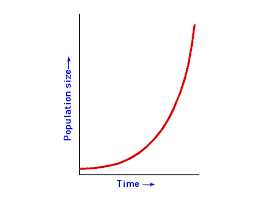
What type of growth is shown in the diagram?
a)
exponential growth
b)
logistic growth
c)
predator-prey cycle
d)
boom-bust curve
36.
Largest number of individuals of a population that the environment can support...
a)
carrying capacity
b)
population crash
c)
lag phase
d)
mutualism
37.

Which type of growth is best illustrated by this rabbit population?
a)
exponential
b)
logistic
c)
S-shaped
d)
predator-prey
38.
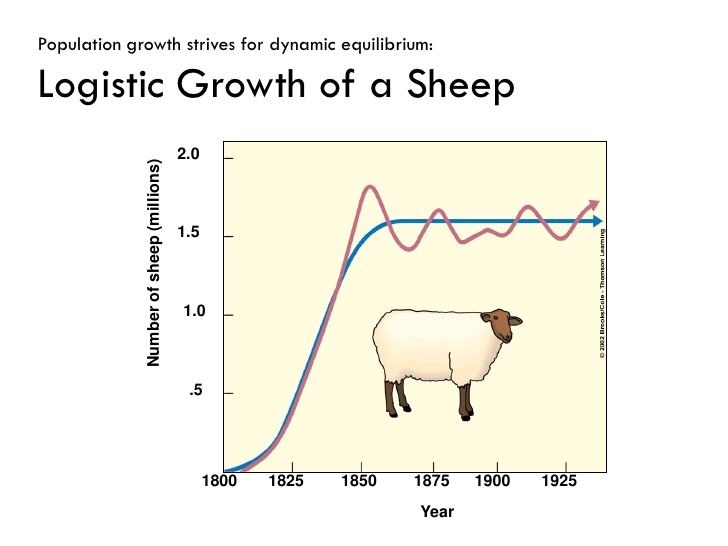
What is the carrying capacity for this sheep population?
a)
1.8 million
b)
1.25 million
c)
1.6 million
d)
1.o million
39.

What point on the graph represents the carrying capacity?
a)
A
b)
B
c)
C
d)
D
40.

When a population grows past the ecosystem's carrying capacity, what happens to the population?
a)
Continues to grow
b)
The population starts to die off to return to carrying capcity
c)
The population will go extinct due to lack of resources
d)
The population grows then finds a new carrying capacity
41.
Food, water, sunlight, shelter, and space are resources that are often __________.
a)
limiting factors
b)
wet
c)
messy
d)
found in rocks
42.
If there is more food than usual in an ecosystem, then the population will mostly likely...
a)
stay the same
b)
decrease
c)
increase
43.
Any thing or organism that regulates the size of a population of another organism is known as __________.
a)
a limiting measure
b)
a limiting factor
c)
factorization
d)
materialization of precipitation
44.

In a forest ecosystem, which of the following is the best example of a limiting factor for a rabbit population?
a)
Squirrel Population
b)
Sunlight
c)
Grass available
45.

Will competition increase/decrease the carrying capacity of an ecosystem for the animal in competition?
a)
Decrease
b)
Increase
46.
Natural disasters can be considered limiting factors.
a)
true
b)
false
47.
Natural disasters and weather patterns like earthquakes, floods, and tornadoes, blizzards, and heatwaves are considered ___________ ____________ limiting factors
a)
Density-dependent
b)
Density-independent
48.
Competition, disease, predation, and parasitism are considered ___________ ____________ limiting factors
a)
Density-dependent
b)
Density-independent
49.
Density-dependent limiting factors have a(n) _______________ affect on populations depending on the density of the population.
a)
similar
b)
different
50.
Density-independent limiting factors have a(n) _______________ affect on populations regardless of population density.
a)
similar
b)
different
51.
Exponential growth is representative of a population in an environment with ________________ resources.
a)
limited
b)
plenty of
52.
Logistic growth is representative of a population in an environment with ________________ resources.
a)
limited
b)
plenty of
53.

Over the course of time, the human population has experienced which type of growth?
a)
linear growth
b)
steady growth
c)
exponential growth
d)
rapid growth
54.
Which factor is outpacing the other for humans?
a)
death rate is faster than birth rate
b)
birth rate is faster than death rate
55.
Which item is a biotic limiting factor for humans?
a)
Ebola
b)
space
c)
fresh water
d)
hurricanes
56.
Which item is an abiotic limiting factor for humans?
a)
fast food
b)
clean air
c)
terrorists
d)
strep throat
57.
How can humans ensure that ecosystems are healthy and remain healthy?
a)
limit habitat destruction
b)
increase biodiversity
c)
remove invader species
d)
all of the above
58.
Global warming has been linked to a decrease in
a)
the size of the polar ice caps
b)
the temperature of Earth
c)
the rate of species extinction
d)
the rate of carbon dioxide production
59.
Which human activity would preserve nonrenewable resources?
a)
deforestation
b)
removing carnivores from a forest
c)
recycling
d)
heating homes with fossil fuels
60.
Deforestation by burning has been described as a "double whammy" to the environment, meaning it has 2 negative impacts. Why is this description accurate?
a)
Forest burning releases CO2 while decreasing oxygen, which disrupts cycles
b)
Deforestation reduces the amount of oxygen in the atmosphere, which depletes the ozone layer
c)
Forest clearing is often followed by land development, which often leads to increased noise pollution
d)
Deforestation increases the number of plant and animal species by destroying habitat
61.
Approximately 75 percent of the Earth's surface is covered in water. So why is water considered such a precious resource?
a)
The greenhouse effect is causing most of the world's freshwater to be trapped in the atmosphere
b)
Only a small fraction of the Earth's water is freshwater available for drinking and irrigation
c)
Each year, more freshwater is being trapped in icecaps located at the North and South Poles
d)
Global warming caused by greenhouse gas emissions will likely cause Earth's oceans to evaporate
62.
Which of the following historical events most likely triggered the largest increase in the human population?
a)
the Black Death plague, which occurred in the mid-1300s
b)
the domestication of wheat crops, which began around 8000 B.C
c)
the fall of the Roman Empire, which occurred around A.D. 800
d)
the Industrial Revolution, which began in the late 1700s
63.
What causes smog?
a)
The burning of particulates
b)
The formation of ozone
c)
Acid Rain
d)
the interaction of sunlight with pollutants produced by fossil fuels
64.
What are renewable resources?
a)
Resources that are used faster than they form
b)
a. Resources that can replenish themselves over time
c)
a. Resources that exist only in urban areas
d)
Resources that exist only in rural areas
65.
What would Earth be like without the greenhouse effect?
a)
Too cold to be habitable
b)
A little cooler than it is now
c)
The same temperature as it is now
d)
A little warmer than it is now
66.
Humans often change ecosystems as a result of population growth, consumption, and technology. Which of the following exemplifies a way in which humans modify ecosystems?
a)
factory and automotive emissions causing acid rain
b)
redirecting and storing freshwater behind dams
c)
cutting down trees to build new buildings and roads
d)
all of these
67.
Which of the following is a renewable resource?
a)
coal
b)
solar energy
c)
natural gas
d)
oil
68.

What is one way that humans can lessen their ecological footprint?
a)
Recycle
b)
Eat more meat
c)
Drive large vehicles
d)
Increase agricultural area
69.
What is deforestation?
a)
throwing someone out of a window
b)
selectively cutting trees for lumber, making sure the forest remains healthy
c)
allowing more animals to graze on the land than it can support
d)
cutting and removal of rainforest
70.
What are some consequences of deforestation?
a)
increased population in cities
b)
building of more infrastructure
c)
soil erosion, loss of biodiversity, loss of ability to remove CO2
d)
more mercury and cyanide released into rivers
71.
What is the number one threat to biodiversity?
a)
invasive species
b)
CO2 Emissions
c)
Global Climate Change
d)
Habitat Fragmentation
72.
The hole in the ozone was caused by:
a)
chlorofluorocarbons
b)
carbon dioxide
c)
global climate change
d)
agriculture
73.
The greenhouse effect is a natural process.
a)
True
b)
False
74.
Which of following is not a greenhouse gas?
a)
methane
b)
chlorofluorocarbon
c)
carbon dioxide
d)
nitrogen
75.
Which of these is an asset of the tropical rainforest ecosystem?
a)
contains 52% of all biodiversity
b)
is a sink for CO2
c)
provides us with much of our oxygen
d)
all of the above
76.
Burning coal releases sulfur oxides and nitrous oxides. This leads to the production of_______ when combined with water in the atmosphere
a)
global climate change
b)
acid rain
c)
a hole in the ozone
d)
invasive species
77.
Which of the following is not an ecosystem good or service provided by the wetlands ecosystem?
a)
contains most of Earth's biodiversity
b)
flood control
c)
recreation
d)
filter out toxins before entering streams/rivers
78.
What happens to native populations when an invasive species is introduced?
a)
they increase
b)
they decrease
c)
the outcompete the invasives
d)
they don't change
79.
Chlorofluorocarbons cause global climate change
a)
true
b)
false
80.

What does biodiversity mean?
a)
Only one species in an area.
b)
The different amount of species in an area
c)
All abiotic life
d)
Nitrogen fixation
81.
What factor describes when populations increase because animals are moving into a population?
a)
Emigration
b)
Limiting Factors
c)
Immigration
d)
Exponential Growth
82.
This occurs when organisms move out of an ecosystem that is in chaos.
a)
Immigration
b)
Emmigration
c)
Birth Rate
d)
Death Rate
83.
The number of individuals per unit area is the definition of which?
a)
Population distribution
b)
Population density
c)
Survivorship type 1
d)
Survivorship type 2
84.

A drought has hit this grassland biome. How will this effect the rabbit population?
a)
The rabbits will increase in number.
b)
The rabbit population will stay the same.
c)
The rabbit population will decrease.
d)
The rabbit population will become extinct immediately.
85.

Which organisms in the food web shown to the right are predators that compete for the same prey in this environment?
a)
Coyotes and rabbits
b)
White-tailed deer and rabbits
c)
Leafy weeds and cotton rats
d)
Bobcats and coyotes
100 %

