wayground logo

Free Printable Worksheets

NEW

Font size

S
M
L
XL
Worksheets

8th Grade MCA Science Review

Total questions: 71

Worksheet time: 53mins

Name
Class
Date
1.
The burning of wood is a physical change
a)
true
b)
false
2.
What charge does an electron have?
a)
positive
b)
negative
c)
neutral
3.

Which form of matter has a definite shape and takes up space (has definite volume)?

a)

liquid

b)

solid

c)

gas

d)

clay

4.
What are the states of matter?
a)
solid, liquid, and juice
b)
solid and liquid
c)
solid and gas
d)
solid, liquid, and gas
5.
Which form of matter fills the space like it has in the balloon?
a)
liquid
b)
string
c)
solid
d)
gas
6.
What is mass?
a)
the force of an object caused by gravity
b)
the amount of space something takes up
c)
the amount of matter in an object
d)
how fast something is moving
7.
The force of friction is caused by:
a)
surfaces rubbing against one another
b)
objects heating or cooling
c)
rough surfaces
d)
smooth surfaces
8.
_________ is described as the energy of motion.
a)
Potential Energy
b)
Chemical Energy
c)
Kinetic Energy
d)
Gravitational Potential Energy
9.
__________ is described as the stored energy in an object due to its position or composition.
a)
Potential Energy
b)
Thermal Energy
c)
Kinetic Energy
d)
Mechanical Energy
10.
On a distance time graph, what would the line look like if the object stopped moving?
a)
Positive slope
b)
Negative slope
c)
Flat line
d)
Uphill line
11.
On a distance time graph, what would the line look like if the object were moving away from its starting point?
a)
Flat line
b)
Horizontal line
c)
Positive Slope
d)
Downhill line
12.

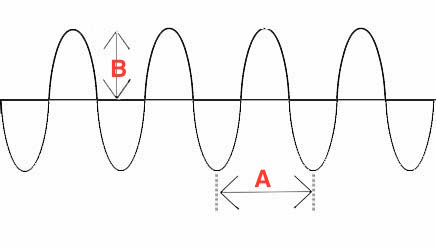
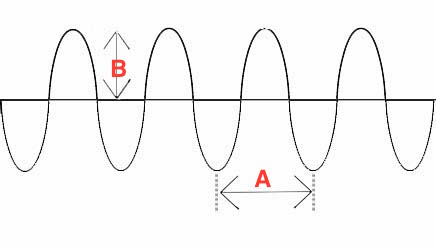
What property of this wave is represented by the letter "A"

a)

amplitude

b)

crest

c)

trough

d)

wavelength

13.
What property of the wave is represented by the letter "B"?
a)
amplitude
b)
crest
c)
trough
d)
wavelength
14.
The highest point on a wave is:
a)
the crest
b)
the trough
c)
the top
d)
the coast 
15.
When a wave strikes and object and bounces off. (example echo)
a)
medium
b)
refraction
c)
reflection
d)
interference
16.
When a wave bends as it passes through at an angle from one medium to another.(example: pencil in a glass of water-)
a)
medium
b)
refraction
c)
reflection
d)
interference
17.
If plants are exposed to sunlight, then they will grow taller.
What part of the scientific method is this an example of?
a)
Procedure
b)
Hypothesis
c)
Question
d)
Results
18.
Anything that can change in an experiment.  There are three types of these in an experiment.
a)
variables
b)
constant
c)
independent
d)
dependent
19.
The variable that is being measured or observed is called the _______________. Hint: this is the variable that is the result or effect 
a)
independent variable
b)
dependent variable
c)
control variable
20.
An experiment is performed on plants to see how different liquids affect plant growth. Each plant in the experiment is given a different liquid: water, apple juice, or milk. What variables should be kept constant/controlled? 
a)
type of plant, flower pot,  soil, and amount of sunlight
b)
water, apple juice, milk
c)
only the amount of sunlight
d)
type of plant only
21.
What is being kept constant?
a)
how fast the water boils
b)
amount of water
c)
temperature of stove
22.
This variable in an experiment is the one being deliberately changed by the scientist. 
a)
dependent variable
b)
independent variable
c)
data
d)
control group
23.
Which of the following statements is true for all living things (organisms)?
a)
All living things have organs
b)
All living things produce their own food through photosynthesis
c)
All living things are made of one or more cells
d)
All living things are made of more than one cell
24.
What is the most basic unit of life?
a)
Tissue
b)
Cell
c)
Organ
d)
Organ System
25.
Which of the following shows biological systems from least to most complex?
a)
Cells, tissue, organ, organ system
b)
Tissue, cells, organ, organ system
c)
Organ system, cells, organism, tissue
d)
Organ system, organ, tissue
26.
What is the function of the nucleus within a cell?
a)
Containing a cell's DNA and acting as the cell's "brain"
b)
Manufacturing proteins
c)
Completing photosynthesis
d)
Storage space
27.
Why are there so many different types of cells in multicellular organisms?
a)
Humans are relatively big
b)
Humans are heterotrophs
c)
Cells in multicellular organisms are specialized to complete different tasks or functions within the organism
d)
Cells in multicellular organisms are similar and complete only the same tasks or functions within the organism
28.
Where do plants receive the energy necessary to carry out photosynthesis?
a)
Heat from the sun
b)
Gamma radiation
c)
Light from the sun
d)
Wind
29.
Besides energy from the sun, what else does a plant require to complete photosynthesis?
a)
Wind energy
b)
Oxygen and carbon dioxide
c)
Oxygen and water
d)
Water and carbon dioxide
30.
What is the main difference between the offspring produced by sexual reproduction and asexual reproduction?
a)
Offspring produced sexually receive genetic material from one parent.
b)
Offspring produced by sexual reproduction receive genetic material from two parents.
c)
Offspring produced by sexual reproduction receive genetic material from two parents.
d)
Asexual and sexual reproduction are the same thing.
31.

Some bacteria live in the stomach of a cow. The bacteria helps the cow break down and digest the plant food that the cow eats. The bacteria gets a meal. This is an example of

a)

Commensalism

b)

parasitism

c)

Mutualism

32.

Why does every animal in an ecosystem rely on producers?

a)

producers start all food chains

b)

producers break down dead waste

c)

producers eat consumers

d)

producers recycle

33.

Which organism is a decomposer?

a)

frog

b)

worm

c)

oak tree

d)

grasshopper

34.

Which organisms will you find the most of in an ecosystem?

a)

Consumer

b)

Producer

c)

Decomposer

35.

Why do consumers need to eat?

a)

to hunt for food

b)

to look for water

c)

to look for shelter

d)

all of these

36.

Plants use photosynthesis to make

a)

water

b)

sunlight

c)

carbon dioxide

d)

sugar

37.
All the living parts of an ecosystem
a)
biotic
b)
abiotic
c)
cell
d)
atom
38.
All members of one kind of organism that live in the same area
a)
population
b)
microorganism
c)
communit
d)
organism
39.
Is sunlight a biotic or abiotic factor?
a)
biotic
b)
abiotic
40.
What level consumer could you consider the deer?  
a)
Primary
b)
Secondary
c)
Tertiary
d)
Quarternary
41.
What might occur when a carnivore is removed from the food web?
a)
A)  Nothing.  Organisms cannot impact things below them on the energy pyramid.
b)
B)  Primary consumers will overpopulate.
c)
C)  Plants will be over browsed by herbivores.
d)
D)  both B and C might occur.
42.
A tick and a dog have this type of relationship.
a)
mutualism
b)
commensalism
c)
neutralism
d)
parasitism
43.
A frog eats a fly. The frog and fly are demonstrating ________.
a)
mutualism
b)
competition
c)
predator/prey
d)
parasitism
44.
A large amount of dust and ash from a recent volcanic eruption settles in the region. Which of the following organisms that live near the volcano will most likely survive? 
a)
Deer
b)
Grasses
c)
Trees
d)
Fish
45.
The passing of traits from parent to offspring 
a)
Heredity 
b)
Genetics 
c)
Hybrid 
d)
Probability 
46.
Who was the father of genetics 
a)
Sagan 
b)
Issac Newton 
c)
Gregor Mendel 
d)
C.jenkins 
47.
the genetic makeup of an organism
a)
heterozygous
b)
punnet square
c)
genotype
48.
having two of the same genes for the trait (sometimes called purebred).
a)
homozygous
b)
hetrozygous
c)
protein
d)
chromosome
49.
What does erosion do?
a)
Break down rock
b)
changes rock chemically
c)
changes sediment in rock
d)
moves broken pieces of rock, or sediment, from one place to another
50.
Erosion helps move ___________ from one place in order to deposit it someplace else.
a)
sediment
b)
transform
c)
erosion
d)
weathering
51.
What is weathering?
a)
the break down of rock
b)
the transport of sediment
c)
a type of climate
d)
the aging of rock
52.
What is an earthquake?
a)
A sudden movement of the Earth's crust caused by a release of stress accumulated along geological faults or by volcanic activity.
b)
a.  energy that builds up inside a volcanic mountain
c)
a.  energy being released when erosion occurs
d)
a.  molten rock pushing up through Earth's surface.
53.

The pattern of weather an area experiences over a long period of time

a)

Climate

b)

Weather

c)

Conditions

d)

Atmosphere

54.

An imaginary line that passes through Earth's center and its North and South Poles

a)

Axis

b)

Equator

c)

Tilt

d)

Orbit

55.

An event that occurs when one object in space passes through the shadow of another object in space

a)

Eclipse

b)

Moon Shadow

c)

Eclipitcal

d)

Moon Change

56.

Rocks formed when sediments are cemented together

a)

Sedimentary Rocks

b)

Igenous Rocks

c)

Metamorphic Rocka

d)

Changing Rocks

57.

Rocks formed when high heat and great pressure change existing rocks into a new form

a)

Metamorphic Rocks

b)

Sedimentary Rocks

c)

Igneous Rocks

d)

Changing Rocks

58.
Why do we have night and day?
a)
Earth's rotation
b)
Earth's revolution around the Sun
c)
The Sun rotating
d)
The moon block the sun
59.
The cycle that powers the ocean currents, weather, and tectonic plates it called
a)
conduction current
b)
radiation
c)
condition current
d)
convection current
60.
The energy from the sun is transmitted through movement of electromagnetic waves by
a)
conduction
b)
convection
c)
contraction
d)
radiation
61.
The main reason that we have currents in the ocean and air is
a)
the sun heats the air and ocean evenly everywhere
b)
the heat inside the earth heats the ocean and the ocean heats the air
c)
the sun cannot heat both the air and water, so one must heat the other
d)
the sun heats air and water more at the equator because it receives more direct sunlight
62.
In convection, WARM air
a)
Rises
b)
Sinks
63.
Heat transfers from an area of ____temperature to an area of ___ temperature.
a)
high to low
b)
low to high
c)
high to high
d)
It can travel high to low and low to high. 
64.
Warm air is __________ dense than cold air and rises creating convection currents.
a)
more
b)
less
65.

The orbit of a planet around the sun is a(an)

a)

ellipse.

b)

straight line.

c)

circle.

d)

parabola.

66.

Which of the following helps explain why the planets remain in motion around the sun?

a)

density

b)

gravity

c)

inertia

d)

Both gravity and inertia

67.
What protects life on Earth from harmful ultra violet rays?
a)
Earth's distance from the Sun
b)
Earth's tilt
c)
Moon's gravity
d)
Ozone layer
68.
When the visible (lit) portion of the moon is increasing, the moon is:
a)
waning
b)
full
c)
waxing
d)
new
69.
About how many days does it take to moon to go through a complete cycle?
a)
7 days
b)
365 days
c)
29 days
d)
20 days
70.
Why do we always see the same side of the moon from Earth?
a)
because the phases change
b)
because it rotates and revolves at the same rate
c)
because half of the moon always receives sunlight
d)
The moon changes positions
71.
The Moon orbits Earth in a ________________ direction
a)
clockwise
b)
counterclockwise
c)
upwards
d)
downwards