wayground logo

Free Printable Worksheets

Font size

S
M
L
XL
Worksheets

History of Life

Total questions: 38

Worksheet time: 1hrs 8mins
Name
Class
Date
1.
The 8 levels of classification, most broad to most specific.
a)
Domain, Genus, Family, Order, Class, Phylum, Kingdom, Species
b)
Domain, Species, Kingdom, Genus, Phylum, Family, Class, Order
c)
Domain, Kingdom, Phylum, Class, Order, Family, Genus, Species
d)
Order, Kingdom, Species, Domain, Phylum, Family, Class, Genus
2.
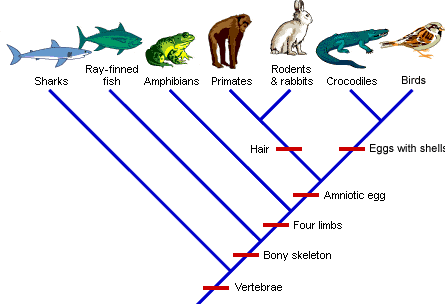
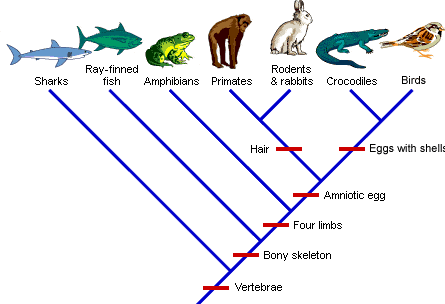
According to this cladogram, sharks are MOST closely related to which organism? 
a)
Amphibians
b)
Ray finned fish
c)
Crocodiles
d)
Birds
3.
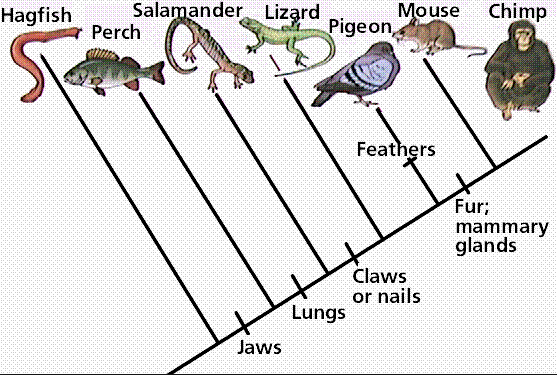
Which two orgainsms have hair? 
a)
Sharks & Ray Finned Fish
b)
Primates & Rodents
c)
Birds & Crocodiles
d)
Rabbits & Birds
4.

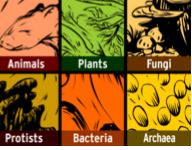
All organisms that do not fit into plant, fungi, and animal kingdoms but have a nucleus are:

a)

archaebacteria

b)

eubacteria

c)

protists

d)

monera

5.
Which kingdoms are prokaryotic?
a)
Archaebacteria and Animalia
b)
Eubacteria and Archaebacteria
c)
Fungi and Protista
d)
Plantae and Eubacteria
6.

One limitation of the Linnaean classification system is that it

a)

organizes organisms into groups.

b)

allows scientists to discuss organisms.

c)

does not use organisms’ common names.

d)

is based on physical characteristics alone.

7.

The embryos of both mammals and reptiles are protected by amniotic fluid. What is this type of trait called?

a)

derived character

b)

molecular evidence

c)

cladogram

d)

outgroup

8.

In classification, a species is defined as

a)

the most general taxon of the classification system.

b)

a group with similar physical characteristics.

c)

the commonly used name for an organism.

d)

a group of organisms that can breed and produce offspring.

9.

What is the function of a dichotomous key

a)

It is a key to predict snow days

b)

It is used to tag animals

c)

It is used to make a cladogram

d)

It is used to identify organisms

10.

In the following cladogram, the hagfish is considered an outgroup because it

a)

shares no derived characters with other groups being studied.

b)

shares specific traits in common with the other species on the cladogram.

c)

is the closest common ancestor to every other species.

d)

has the ability to breed and produce offspring with each other.

11.

The evolutionary history for a group of species which can be shown as a branching tree

a)

Life history

b)

Fossil record

c)

Common ancestry

d)

Phylogeny

12.

Most scientists agree that ____________ should have the "last word" when it comes to figuring out how species are related.

a)

Physical traits

b)

Embryonic development

c)

DNA

d)

Classification

13.
Which question were the scientists trying to answer with this experiment?
a)
Where do cells come from?
b)
How did prokaryotes form cell membranes?
c)
How are biomolecules formed?
d)
What gave rise to the Eukaryotic cell?
14.
The apparatus in the experiment was used to mimic what?
a)
Proteins
b)
Present Earth conditions
c)
Early Earth conditions
d)
Nucleic acids (DNA/RNA)
15.
Miller/Urey and other scientists have shown that:
a)
 Life on early Earth required material from space
b)
Cells survived in the primitive atmosphere
c)
Amino acids could be produced from inorganic molecules 
d)
Simple cells can be produced in a laboratory
16.
Why do some scientists believe that RNA, rather than DNA, was the first genetic material?
a)
RNA probably mutated into DNA
b)
RNA has both information storage and catalytic properties.
c)
RNA can replicate more accurately than DNA.
d)
RNA contains uracil in place of thymine.
17.
Based upon the conditions of the early Earth, which forms of live most likely appeared first?
a)
Prokaryotic and aerobic
b)
Prokaryotic and anaerobic 
c)
Eukaryotic and aerobic
d)
Eukaryotic and anaerobic
18.
____________ & _________________ are organelles that definitely arose from endosymbiosis.
a)
Rough ER & Smooth ER
b)
Mitochondria & Flagellum
c)
Chloroplast & Mitochondria
d)
Chloroplast and Golgi apparatus
19.

Which of the following are evidence for the endosymbiotic theory. Select all that apply.

a)

Chloroplasts and Mitochondria are about the same size as bacteria.

b)

Chloroplasts and Mitochondria have DNA with similar structure and nucleotide sequences to prokaryotes

c)

Chloroplasts and Mitochondria reproduce by binary fission, the same method to which prokaryotes reproduce.

d)

Chloroplast and Mitochondria originated from in-folding of the plasma membrane.

20.
Based upon the conditions of the early Earth, which forms of live most likely appeared first?
a)
Prokaryotic and aerobic
b)
Prokaryotic and anaerobic 
c)
Eukaryotic and aerobic
d)
Eukaryotic and anaerobic
21.

The oxygen gas present in our atmosphere today most likely originated from

a)

the first plant species

b)

decomposition by anaerobic bacteria

c)

aerobic respiration producing oxygen from carbon dioxide

d)

photosynthetic prokaryotes

22.
A system of naming organisms in which each organism is given a genus and species name
a)
binomial nomenclature
b)
genus-species name
c)
speciation
d)
evolutionary classification
23.
A taxonomy based on characteristics such as genetic similarities and reproductive capabilities rather than physical characteristics
a)
baraminology
b)
derived character
c)
binomial nomenclature
d)
evolutionary classification
24.
The shared unique features by which organisms are assigned to a particular clade
a)
speciation
b)
genus-species
c)
gene pool
d)
derived character
25.
A group of related organisms; a branch on a Phylogenetic tree
a)
Phylogenetic tree
b)
derived character
c)
clade
d)
adaption
26.
The process by which new species develop
a)
rapid speciation
b)
speciation
c)
adaption
d)
derived character
27.

Two or more species evolve together

a)

convergent evolution

b)

coevolution

c)

punctuated equilibrium

d)

adaptive radiation

28.

Describes a patter of long, stable periods interrupted by brief periods of more rapid change

a)

convergent evolution

b)

coevolution

c)

punctuated equilibrium

d)

adaptive radiation

29.

The evolution of an ancestral species into an array of species that occupy different niches

a)

convergent evolution

b)

coevolution

c)

speciation

d)

adaptive radiation

30.

Using the diagram, by relative dating, which fossil could you hypothesize to be the oldest?

a)

Gastropod

b)

Trilobite

c)

Crinoid

31.
Two or more species living in close proximity change with one another.
a)
Adaptive radiation
b)
Punctuated equilibrium
c)
Coevolution
d)
Gradualism
32.
The graph displays periods of abrupt changes after long periods of little change which is:
a)
Adaptive radiation
b)
Gradualism
c)
Punctuated equilibrium
d)
Extinction
33.
Dogs are closely related to wolves. To prove this, what type of testing or experiment would a scientist most likely carry out?
a)
compare wolf and dog DNA
b)
examine their social habits and record similarities
c)
feed them similar foods and see if they have similar diets 
d)
determine whether a female dog will care for a wolf pup
34.
According to the diagram, which organism is older?
a)
Ammonite
b)
Coral
c)
Gastropod
d)
Trilobite
35.

What two models used to describe the speed of evolution?

a)

Artificial and natural selection

b)

Gradualism and punctuated equilibrium

c)

Adaptation and natural selection

d)

Mass extinctions and speciation

36.
Cyanobacteria were important in the origin of life on earth because they were able to undergo ________________ and produce ____________________.
a)
photosynthesis, oxygen
b)
photosynthesis, nitrogen
c)
cellular respiration, oxygen
d)
cellular respiration, ATP
37.

High rates of speciation are seen in the fossil record following mass extinction events. This is most likely do to

a)

High mutation rates following catastrophic events

b)

Adaptive radiation in response to open niches

c)

New relationships between surviving species forming coevolutionary pairs.

d)

Increased sexual reproduction as organisms repopulate.

38.

In ___ dating, fossils and surrounding rock are analyzed looking at their amounts of radioactive and nonradioactive (stable) isotopes.

a)

absolute

b)

relative

c)

geologic

d)

evolutionary