Wayground logo

Free Printable Worksheets

Font size

S
M
L
XL
Worksheets

Unit 6: Genetics and Biotechnology Quiz

Total questions: 101

Worksheet time: 2hrs 9mins

Name
Class
Date
1.

A tomato gene, known as the SIKLUH gene, has recently been discovered. The gene leads to the production of larger tomatoes. The gene affects fruit size by increasing cell layers and promoting extra cell divisions. In order to produce large fruit in other commercial plant species, scientists might

a)

clone the genes of other types of plants until they develop larger fruits

b)

breed the tomatoes with other fruits such as apples

c)

insert the gene into other types of plants

d)

stimulate the process of meiosis in the other plants

2.

Which activity enables humans to produce new genetic combinations in other organisms?

a)

selecting and breeding the organisms for specific traits

b)

increasing the number of enzymes available to the organisms

c)

growing organisms that reproduce asexually

d)

decreasing the amount of DNA in the diet of the organisms

3.

Farmers may someday clone their best milk producing cow into a whole herd. What potential disadvantage might be important to consider in having such a large group of clones on one farm?

a)

It may be difficult to tell the animals apart.

b)

Lack of variation may limit survival in the herd

c)

The cows could be fertilized by only one type of bull.

d)

The cows could be mated only with each other.

4.

A farmer wanted to rid his apple trees of a particular leaf-eating insect. He sprayed his trees with an insecticide that killed 98% of the insects. The survival of 2% of this population of insects is most likely due to

a)

genes obtained from another species

b)

certain chemicals that stimulated overproduction

c)

variations that resulted from sexual reproduction

d)

their ability to produce food from the pesticide

5.

Potato farmers in Ireland during the mid 1800s all grew the same type of potato. The potato plants were all produced as clones of one another. When a fungus infected the crop, all of the potatoes were destroyed. This occurred because these potato plants

a)

had little genetic variability

b)

had increased biodiversity

c)

were the product of fertilization

d)

were the result of biotechnology

6.

The corn we eat today is larger and has more kernels than the corn people first grew thousands of years ago. Which process is most likely responsible for the changes that have occurred?

a)

mitosis

b)

succession

c)

direct harvesting

d)

selective breeding

7.

A mutation occurring in a human can be passed from parent to offspring when it occurs in a

a)

lung cell, due to exposure to a toxic gas

b)

gamete formed in the ovary

c)

body cell undergoing mitosis

d)

heart cell with chromosome damage

8.
Genotype refers to the ...
a)
physical expression of the genes
b)
the possible combination of alleles in a gene
c)
whether an allele is dominant or recessive
d)
how an organism will appear
9.

A homozygous dominant dog with brown fur is crossed with a heterozygous dog with brown fur. What are the percentages of the possible genotypes?

a)

100% BB

b)

75% BB and 25%Bb

c)

50 % BB and 50% Bb

d)

50% Bb and 50% bb

10.
Squidward has light blue skin, and his genotype for this trait is Bb. Would Squidward be considered a purebred or hybrid for light blue skin?
a)
Purebred
b)
Hybrid
11.
What is a phenotype
a)
The genetic make up (code)
b)
The physical trait
12.
Which of the following is a phenotype?
a)
BB
b)
Bb
c)
bb
d)
Blue eyes
13.
the passing of genetic traits from parent to offspring.
a)
heredity
b)
trait
c)
gene
d)
allele
14.
Two brown eyed parents (Bb) have a baby. What is the chance the baby is blue eyed?
a)
0 %
b)
25%
c)
50%
d)
75%
15.
An allele whose trait only shows up when no dominant allele is present.
a)
hidden allele
b)
dominant allele
c)
recessive allele
d)
present allele
16.
A dog gives birth to 5 puppies. What percentage of the chromosomes does each puppy share with the mother?
a)
25%
b)
50%
c)
75%
d)
100%
17.
What does heterozygous mean?
a)
An organism that has the same genes for a trait (TT or tt)
b)
An organism that has different genes for a trait (Tt)
c)
When neither gene is fully dominant; offspring is a mixture of both
d)
the different forms of a trait (hair color--> brown, blonde, red
18.
Two brown eyed parents (Bb) have a baby. What is the chance the baby is blue eyed?
a)
0 %
b)
25%
c)
50%
d)
75%
19.
What is one advantage of sexual reproduction?
a)
offspring are identical to parents
b)
offspring are resistant to viruses
c)
offspring are born live, rather thna from eggs
d)
offspring inherit a wider variety of genetic information
20.
The sex of an offspring is determined by ______________________.
a)
the mother
b)
the father
c)
the mother and the father
d)
by the environment
21.
Red/green color blindness is a recessive trait.  A woman who is a carrier for this allele marries a normal-vision male.  What is the probability that they will have a child who is color blind?
a)
1/4
b)
1/2
c)
3/4
d)
1
22.
What determines the kind of genes an organism possesses?
a)
type of amino acids in the cells of the organism
b)
sequence of the subunits A,T,C, and G in the DNA of the organism
c)
size of simple sugar molecules in the organs of the organism
d)
shape of the protein molecules in the organelles of the organism
23.
If a portion of Strand I of DNA has the base sequence GATCAC, what is the sequence of bases on the complementary Strand II?
a)
GATCAC
b)
CUAGUG
c)
CTACAC
d)
CTAGTG
24.
What is the basic unit of DNA?
a)
amino acid
b)
protein
c)
nucleotide
d)
sugar
25.
Which statement correctly describes the sequence of bases found in DNA?
a)
It changes every time it replicates.
b)
It determines the characteristics that will be inherited.
c)
It is exactly the same in all organisms.
d)
It directly controls the synthesis of starch within a cell.
26.
If 15% of a DNA sample is cytosine, C, what percentage is guanine, G?
a)
15%
b)
35%
c)
70%
d)
85%
27.
In human development, the zygote differentiates into heart cells, brain cells, and liver cells.  Which statement is correct regarding the cells and the DNA?
a)
The DNA of the zygote differs from the DNA of all the other cells.
b)
The DNA of the zygote differs from some, but not all, of the other cells.
c)
All cells have identical DNA.
d)
Only the zygote contains DNA.
28.
What is the function of coded instructions contained in the body cells of an organism?
a)
To form a variety of gametes that will pass on hereditary information.
b)
To direct the synthesis of proteins necessary for proper cell functioning.
c)
To synthesize different kinds of amino acids in a specific sequence.
d)
To produce inorganic molecules needed for normal cell growth.
29.
The process of assembling amino acids in the correct order at the ribosomes is known as
a)
energy production
b)
DNA replication
c)
digestion
d)
protein synthesis
30.
The section of DNA that is used to make a strand of mRNA is known as a
a)
carbohydrate
b)
gene
c)
ribosome
d)
chromosome
31.
A characteristic of mutations is that they usually
a)
are caused only by the events of mitosis
b)
do not occur at random
c)
result in different genetic sequences
d)
occur to meet the needs of a species
32.
What type of scientific technique separates the DNA of an organism into segments?
a)
chromatography
b)
gel electrophoresis
c)
centrifuge
d)
culturing
33.
What scientific technique allows the insertion of a gene from one organism into another?
a)
genetic recombination
b)
genetic replication
c)
cloning
d)
genetic engineering
34.
What type of molecule is used to cut the gene from the DNA of an organism?
a)
hormone
b)
ligase
c)
restriction enzyme
d)
glucose
35.
Where is DNA located in a cell?
a)
ribosome
b)
nucleolus
c)
nucleus
d)
vacuole
36.
What sized DNA fragments travel the furthest from the well in gel electrophoresis?
a)
smallest
b)
largest
37.
Which of the following is not a concern of biotechnology?
a)
Ethics concerns with cloning humans.
b)
Health concerns about eating genetically modified foods.
c)
Concerns that we will harvest too much food for the global population.
d)
Environmental concerns of releasing genetically modified organisms into an ecosystem.
38.
Structure (a) is a ____.
a)
chromosome
b)
chromatid
c)
centromere
39.
True or False: Differentiated Cells are cells with a specialization, and have a very specific set of genes activated.
a)
True
b)
False
40.
The cloned animal looks like the
a)
egg donor
b)
nucleus donor
c)
host mother
d)
all of the above
41.
Rice modified to have more Vitamin A
a)
Genetic engineering
b)
Cloning
42.
Pets to be like the original one.
a)
Genetic engineering
b)
Cloning
43.
Why is DNA important?
a)
it is very small and very complicated
b)
it's in everything
c)
it serves as the blueprint for traits of all living things
d)
because we eat it every day for energy
44.
When one base replaces another, this is a common type of mutation called what?
a)
Insertion
b)
Substitution
c)
Inversion
d)
Deletion
45.
What are the building blocks of proteins called?
a)
DNA
b)
RNA
c)
Ribosomes
d)
Amino Acids
46.
A physical or chemical agent that can cause a change in DNA is called what?
a)
Gene Expression
b)
Protein
c)
Mutagen
d)
mRNA
47.
Contains the bases adenine, uracil, cytosine and guanine
a)
DNA
b)
RNA
c)
Both
48.
Contains the bases adenine, thymine, guanine and cytosine
a)
DNA
b)
RNA
c)
Both
49.
What amino acid is represented by the codon UUA?
a)
Phenylalanine
b)
Tyrosine
c)
Leucine
d)
Stop codon
50.
Which statement best describes some protein molecules in a cell?
a)
proteins are long, folded chains that can form various cell parts
b)
proteins are composed of four different starches that direct cell activity
c)
proteins are long, twisted strands of glucose that regulate cells
d)
proteins are genetically diverse substances that are synthesized in the nucleus
51.
A woman changes her hair color to red; however, her children will not inherit this red hair color because the woman does not have
a)
genes for red hair in her skin
b)
genes for red hair in her sex cells
c)
proteins for red hair in the placenta
d)
proteins for red hair in her egg cells
52.
Based on these DNA fingerprints, whose blood was found in the blood stain at the crime scene?
a)
Bob
b)
Sue
c)
John
d)
Lisa
53.
Which DNA strands move the fastest through the gel when the electricity is turned on?
a)
The long strands
b)
The short strands
c)
The medium strands
d)
They all move the same
54.
What is selective breeding?
a)
A process in which mates pick which partner to have offspring with
b)
It is a process humans use to breed or reinforce desired traits into a particular organism.
c)
A process to get rid of beneficial traits
d)
A process to add harmful traits
55.
How would genetic engineering of crops to be resistant to disease be a disadvantage?
a)
They are genetically similar to each other. 
b)
The ecosystem is becoming more stable. 
c)
Crops have a higher survival rate. 
d)
Pests, such as beetles, also become resistant to the disease. 
56.
the genetic makeup of an organism
a)
heterozygous
b)
punnet square
c)
genotype
57.

Characteristics that are inherited.

a)

traits

b)

genetics

c)

heredity

d)

genotype

58.

The ______ trait is hidden by the ______ trait.

a)

recessive/dominant

b)

dominant/recessive

c)

heterozygous/homozygous

d)

homozygous/heterzygous

59.
What is the purpose of PCR?
a)
To produce millions of copies of DNA.
b)
To produce millions of copies of a specific region of DNA
c)
To add nucleotides to a DNA sequence
d)
To watch polymerase work.
60.
What is the purpose of gel electrophoresis?
a)
helps cut DNA
b)
count the genes in DNA
c)
separates DNA based on size
d)
allows for an exact replicated organism
61.
What charge is DNA?
a)
positive
b)
negative
c)
neutral
62.
Restriction Enzymes . . . 
a)
cut DNA at precise locations
b)
help bacteria to pick up DNA
c)
move DNA through a gel
d)
copy DNA
63.

The parents of a new baby believe they brought the wrong child home from the hospital. Gel electrophoresis was performed using DNA samples from the parents and the child. A section of the gel

electrophoresis results is shown below. Which conclusion is valid based on the gel electrophoresis results?

a)

They have the correct child, because her genetic information is identical to that of the father.


b)

They have the wrong child, because her genetic information does not match that of either parent.

c)

They have the correct child, because her genetic information came from both parents.


d)

They have the wrong child, because her genetic information matches only that of the mother.

64.

Plant A and Plant B are the same species. Plant A is given water daily and plant B is only given water once a week. Plant A grows to 10 cm tall after 3 weeks and Plant B only grows to 4 cm tall after 3 weeks. This is the result of:

a)

Better genes in plant A

b)

Better genes in plant B

c)

Environmental factors

d)

Environmental consistancy

65.

Sally Mae was entering the science fair. She wanted to test the effect of sunlight on the color of a plants leaves. Her first plant was placed in a dark room, her second plant was allowed 3 hours of light a day and the third plant was given 6 hours of light a day. The color of the leaves varied in shades of green - lightest (no light plant) to brightest green (6 hour light plant). What is the best reason?

a)

Each plant had different genes that controlled the color of the leaves

b)

There was a genetic mutation affecting leaf color

c)

The expression of the gene that controls chlorophyll production was affected by the environment

d)

It cannot be concluded since she did not run a proper scientific experiment.

66.

The environment will affect how your genes are expressed.

a)

True

b)

False

67.
An application of using DNA technology to help environmental scientists would be ___.
a)
use PCR to analyze DNA at a crime scene
b)
create a tobacco plant that glows in the dark
c)
clone the gene for human growth hormone to treat pituitary dwarfism
d)
make transgenic bacteria that can be used to clean up oil spills more quickly than do the natural bacteria
68.
The entire collection of genes within human cells is referred to as the ______.
a)
human genome
b)
karyotype
c)
pedigree
d)
gene map
69.
_________________ is NOT a common ethical  concern related to human cloning.
a)
That humans will be created who exist solely as a supply of organs for transplants
b)
That clones will be more prone to abnormal development
c)
That parents will pay to have a child that is a clone of a famous athlete
d)
That cloned humans will have no personality
70.
Which biotechnology is used to make exact DNA copies of an organism?
a)
Gel electrophoresis
b)
Genetic Engineering
c)
Inbreeding
d)
Cloning
71.
When cloning an organism, DNA is removed and placed into an empty
a)
virus
b)
sperm cell
c)
bacteria cell
d)
egg cell
72.
What information must be known before a gene can be inserted into a bacteria?
a)
DNA sequence of the gene
b)
mRNA sequence of the gene
c)
tRNA sequence of the gene
d)
protein sequence of the gene
73.
After finding the location of a gene, how can a scientist take it out of a cell?
a)
Using a microscope
b)
Using PCR
c)
Using scissors
d)
Using enzymes
74.
Why do farmers choose to use GM crops rather than regular crops?
a)
They are safer
b)
They are more productive
c)
They are less expensive
d)
They are less controversial
75.

In preparation for an electrophoresis procedure, enzymes are added to DNA in order to

a)

convert the DNA into gel

b)

cut the DNA into fragments

c)

change the color of the DNA

d)

produce longer sections of DNA

76.

This laboratory procedure is known as

a)

CLONING

b)

gel electrophoresis

c)

chromatography

d)

use of a dichotomous key

77.

What is this technique an example of?

a)

chromatography

b)

gel electrophoresis

c)

direct harvesting

d)

genetic engineering

78.

Sample 1: ATTCCGGTAATCCCGTAATGCCGGATAATACTCCGGTAATATC

Sample 2: ATTCCGGTAATCCCGTAATGCCGGATAATACTCCGGTAATATCThe results of DNA analysis are often used to help determine

a)

the number of DNA molecules in an organism

b)

if two species are closely related


c)

the number of mRNA molecules in DNA


d)

if two organisms contain carbohydrate molecules

79.

The arrows in the diagram below indicate the development of four different varieties of vegetable plants from wild mustard.Each of these varieties was most likely produced as a result of

a)

asexual reproduction in the wild for many years

b)

changes in light availability

c)

competition between plants

d)

selective breeding over many generations
80.
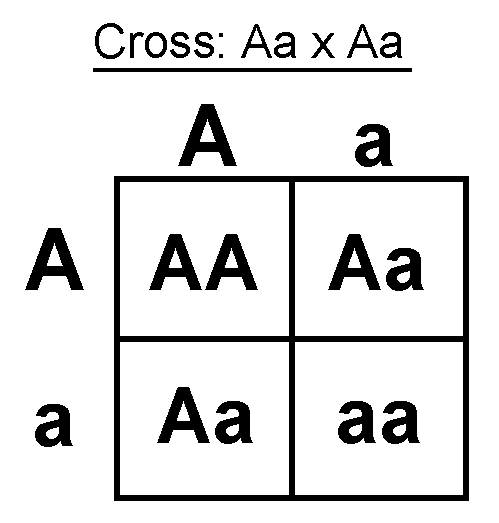
What is the phenotype of the offspring? (A-Brown hair; a-blond hair) 
a)
50 % Brown Hair and 50% Blond Hair 
b)
25 % Brown Hair and 75% Blond Hair 
c)
75 % Brown Hair and 25% Blond Hair 
d)
0% Brown Hair and 100% Blond Hair 
81.
Which of the following genotypes is heterozygous?
a)
Bb
b)
BB
c)
bb
d)
B
82.
Aa, DD, bB, yy are all examples of
a)
genotypes
b)
phenotypes
83.

Why do offspring usually look like their parents?

a)

Their parents choose their features and make sure they look similar to themselves.

b)

The offspring adapt to their surroundings making them look more like their parents

c)

Offspring receive characteristics that have been passed down from their parents

84.
The function of _____ is to transport amino acids in the cytoplasm to the ribosome.
a)
rRNA
b)
tRNA
c)
mRNA
d)
DNA
85.
The process where DNA is transcribed to mRNA happens in what part of the cell?
a)
Nucleus
b)
Mitochondria
c)
Cytoplasm
d)
Endoplasmic Reticulum
86.
How many amino acids are coded for by this sequence of nucleotides:
ATG GGA ACT CCA
a)
4
b)
2
c)
6
d)
12
87.
In proteins, the amino acid order is determined by 
a)
nitrogenous bases in RNA
b)
random placement
c)
nitrogenous bases in DNA
d)
there is no order
88.
This molecule carries genetic information from the nucleus to the ribosomes in the cytoplasm.
a)
rRNA
b)
tRNA
c)
mRNA
d)
DNA
89.
What is the mRNA strand that would result from the DNA template strand CCTA?
a)
GGAT
b)
CCAT
c)
GGAU
d)
CCAU
90.
The process where mRNA is translated into amino acids happens in what part of the cell?
a)
Nucleus
b)
Mitochondria
c)
Cytoplasm
d)
Endoplasmic Reticulum
91.
Which of these nitrogenous bases is NOT in RNA?
a)
Uracil
b)
Thymine
c)
Cytosine
d)
Guanine
92.
Does the order of amino acids in a protein matter?
a)
YES!
b)
NO!
93.
In a molecule of double-stranded DNA, the amount of Adenine present is always equal to the amount of
a)
cytosine
b)
guanine
c)
thymine
d)
uracil
94.
Which sequence of DNA bases would pair with this partial strand
ATG TGA CAG
a)
ATG TGA CAG
b)
TAC ACT GTC
c)
GTA AGT GAC
d)
CAT TCA CTG
95.
Which of the following best describes a DNA molecule?
a)
double helix
b)
contains ribose
c)
made of amino acids
d)
contains Uracil
96.
Would a mutation in the DNA of a skin cell be passed on to an organism's offspring?
a)
Yes, because any change to the DNA is passed on to the offspring
b)
Maybe. Sex cells only use half of the body's genetic code. It might get the copy of a gene that wasn't mutated.
c)
No. Only mutations that occur in the gametes (sex cells) are passed on to the offspring
d)
Without knowing the animal, it would be hard to tell whether or not the mutation would be passed on.
97.
The main function of tRNA is to...
a)
carry a message that, when translated, forms proteins
b)
form a portion of ribosomes
c)
string together complementary RNA and DNA strands
d)
bring amino acids from the cytoplasm to the ribosomes
98.
Protein Synthesis takes place at what organelle?
a)
Nucleus
b)
Mitochondria
c)
Ribosome
d)
Chloroplast
99.

A change in a DNA sequence is called a

a)

codon

b)

anticodon

c)

mutation

d)

triplet

100.
What are proteins composed of?
a)
nitrogen bases
b)
amino acids
101.

What base does RNA have that DNA does not?

a)

uracil

b)

thymine

c)

cytosine

d)

guanine