wayground logo

Free Printable Worksheets

Font size

S
M
L
XL
Worksheets

BIODIVERSITY and EVOLUTION

Total questions: 100

Worksheet time: 2hrs 40mins

Name
Class
Date
1.
What is survival of the fittest?
a)
It is where the fittest die out and therefore reproduce and pass on their genes
b)
It is where the fittest die out and therefore can't reproduce and pass on their genes
c)
It is where the fittest don't die out and therefore can't reproduce and pass on their genes
d)
It is where the fittest don't die out and therefore reproduce and pass on their genes
2.
In the energy pyramid shown, which organism has the least amount of biomass?
a)
Producers
b)
Herbivores
c)
Carnivores
d)
Top Predator
3.
What percentage of energy is passed on to each tropic level in an energy pyramid?
a)
10%
b)
50%
c)
90%
d)
100%
4.
What does evolution mean?
a)
To change something
b)
To change and adapt over time
c)
To lose some original features
d)
To improve ssomething over time
5.
An endangered species is
a)
One whose numbers are so small that it is at risk of extinction
b)
One whose not been spotted after many years.
c)
One whose numbers are abundant.
6.
A species is defined as endangered when it
a)
suffers from damage to its habitat.
b)
suffers from disease or predation.
c)
when there are hazards to the continued life of the species.
d)
all of the above
7.
The Endangered Species Act of 1973 protects registered endangered species by removing them from the "take" list which makes it unlawful to
a)
shoot
b)
capture
c)
trap
d)
all of the above
8.
Which term refers to  the capturing and reintroducing of an endangered species into the wild?
a)
legal protection
b)
captive breeding
c)
habitat conservation
d)
germ-plasm banks
9.
The biggest loss to biodiversity is 
a)
climate change
b)
overharvesting
c)
habitat loss
d)
pollution 
10.
which of the following is NOT a characteristics of a stable, non-evolving population?
a)
the population is small
b)
there is no migration in or out of the population
c)
there is no natural selection in the population
d)
mating in the population is random
11.
Which of the following Best describes evolution?
a)
Rapid change within a species
b)
Gradual change over time
c)
A quick emergence of a new species
d)
Passing of Traits from parent to offspring 
12.
Which of the following best describes an adaptation?
a)
A tight bundle of genetic material in the nucleus of cells
b)
A segment of DNA that codes for a trait
c)
A harmful trait that hurts an organism's chance of survival
d)
trait that allows an organism to be better suit for survival
13.
Who is best known as "The Father of Evolution?"
a)
Carolus Linnaeus 
b)
Charles Darwin 
c)
Robert Hooke
d)
James Watson 
14.
Which is the best example of an adaptation?
a)
Camouflage
b)
Chromosomes
c)
Albinism
d)
Freckles
15.
Which of the following is true about extinction?
a)
No animals currently living on Earth will become extinct
b)
Most species that have lived on Earth are now extinct
c)
fossil record doesnt give clues which lifeforms are extinct
d)
Little is known about all extinct organisms. 
16.
Which of the following is most closely linked to Charles Darwin's concept of natural selection?
a)
Predator-prey relationships influence change among organisms
b)
Survival of the Fittest 
c)
Competition strongly influences change among organisms
d)
Survival of the nicest
17.

What human activities have influenced recent extinction events?

a)

habitat destruction

b)

introducing exotic species

c)

poaching

d)

all of these

18.

Reasons for preserving biodiversity include all of the following EXCEPT

a)

isolating unique genetic material so it can be incorporated into existing crops.

b)

increasing the chances of discovering organisms with medicinal value.

c)

preventing natural evolution or for poaching

d)

finding new plants that can supplement the world’s food supply

19.

Where are many critical Biodiversity Hotspots located?

a)

cities and developed areas of the world

b)

islands, tropical rain forests, and coastal areas

c)

desert and polar environments

d)

all of these

20.

Hunting wolves in Yellowstone National Park resulted in -

a)

an increase in biodiversity.

b)

a decrease in biodiversity.

c)

complete influx of different organisms

d)

beneficial changes in the geography in the land.

21.

Preserving entire ecosystems rather than individual species is a good conservation strategy because

a)

only endangered species will be saved.

b)

developers will have greater access to land.

c)

more than one species can be saved.

d)

it will not be necessary for environmentalists to study the ecosystem.

22.

Which level of biodiversity may still be low even after a species recovers from a low population?

a)

Ecosystem diversity

b)

Population diversity

c)

Genetic diversity

d)

Species diversity

23.

How can zoos, botanic gardens, and wildlife parks help save species?

a)

by preserving threatened species from destruction.

b)

by collecting species from remote wilderness areas.

c)

by participating in captive breeding programs

d)

by destroying their homes

24.
What does biodiversity mean?
a)
Only one species in an area.
b)
The different amount of species in an area
c)
All abiotic life
d)
Nitrogen fixation
25.
A drought has hit this grassland biome. How will this effect the rabbit population?
a)
The rabbits will increase in number.
b)
The rabbit population will stay the same.
c)
The rabbit population will decrease.
d)
The rabbit population will become extinct immediately.
26.
When every organism of a species has died.
a)
Evolution
b)
Natural Selection
c)
Extinction
d)
Artificial Selection
27.
Why are advantageous traits more likely to be passed onto offspring?
a)
Because they are more likely to survive and reproduce.
b)
Because they come from dominant alleles.
c)
Because they come from recessive alleles.
d)
Because the trait is an acquired phenotype.
28.
Which of the following means "genetic change over time"
a)
natural selection
b)
speciation
c)
evolution
d)
fitness
29.
Domesticated dogs are an example of:
a)
Natural Selection
b)
Selective Breeding
30.
If the environment suddenly changed, how could a species go extinct?
a)
The environmental change means fewer predators are around
b)
There are more homes available in the newly changed environment
c)
New resources are available with less competition
d)
There aren't enough members of the species with a trait necessary to survive in the new environment
31.
Penguins are powerful swimmers. Scientists have concluded that penguins evolved adaptations for powerful swimming early in their evolutionary history.  Which of the following pieces of evidence did scientists most likely use to make this conclusion? 
a)
DNA sequences of different penguin species 
b)
maps of the global distribution of penguin species 
c)
fossils showing the shape of ancient penguins’ wings and feathers 
d)
x-rays of the bone structure in modern penguins’ wings 
32.
Programs that breed animals in captivity then release them to the wild are called...
a)
Kidnapping
b)
Breeding Buildings
c)
Captive Breeding Programs
d)
Catch and Release Programs
33.
If a species is only found in one place on Earth we call it a(n)...
a)
Local species
b)
Lonesome species
c)
Allopatric species
d)
Endemic species
34.
The excessive use of a species that has economic value.
a)
Biodiversity
b)
Natural resources
c)
Overexploitation
d)
population growth
35.
The species that plays the biggest role in the habitat is?
a)
Smaller species
b)
Larger species 
c)
Keystone Species
d)
Evolving species 
36.
An event  in which a large percentage of all living species become extinct in a relatively short period of time.
a)
Habitat fragmentation 
b)
Mass extinction
c)
Overexploitation
d)
Background extinction
37.
A declining population of one species can affect an entire what???
a)
Edge effect
b)
Habitat
c)
Ecosystem 
d)
Community 
38.
Which of the following is a term for a group of similar organisms that can reproduce fertile offspring?
a)
individual
b)
population
c)
species
d)
fossil
39.
Which term refers to the process by which individuals that are better suited to the environment survive and reproduce therefore passing down their genes to their offspring? 
a)
Evolution 
b)
Variation 
c)
Adaptation
d)
Natural Selection 
40.
What is THE most major cause of extinction today?
a)
habitat destruction by humans
b)
poaching
c)
disease
d)
hunting
41.

The term biodiversity refers to

a)

the variety of species on Earth

b)

the extinction of the dinosaurs

c)

habitat destruction, invasive exotic species & poaching

d)

the fact that 10% of prescription drugs come from living things

42.

Most of the living species known to science

a)

are large mammals

b)

live in deserts

c)

live in the richer countries of the world

d)

are insects

43.

Some species are so important to the functioning of an ecosystem that they are called

a)

threatened species

b)

keystone species

c)

endangered species

d)

extinct species

44.

Emphasizing the preservation of entire ecosystems will

a)

cause the economic needs of farmers to suffer in order to save a single species

b)

decrease biodiversity, especially in tropical rain forests, coral reefs and islands

c)

throw the food webs of many ecosystems out of balance

d)

save many unknown species from extinction

45.

What human activities have influenced recent extinction events?

a)

habitat destruction

b)

poaching

c)

introducing exotic (alien) species

d)

all of the above

46.
What is Ecological Succession?
a)
Competition between plants in a society
b)
A natural disaster such as a flood or fire
c)
The cycle of a tomato plant
d)
The change an ecosystem experiences over time
47.
A scientist observes two butterflies with similar wing patterns. Which of the following observations would best show that the two butterflies belong to the same species?
a)
The butterflies share a habitat.
b)
The butterflies pollinate the same flowers.
c)
The butterflies mate with each other and produce fertile offspring.
d)
The butterflies make a chrysalis and not a cocoon for metamorphosis.
48.
Which of the following observations best supports the conclusion that dolphins and sharks do not have a recent common ancestor?
a)
Dolphins form social groups, but sharks are solitary.
b)
Dolphins hunt during the day, but sharks are nocturnal.
c)
The number of dolphin species is far less than the number of shark species.
d)
The jawbone structure in dolphins is very different from the jawbone structure in sharks.
49.
Fossils typically provide evidence for evolution because
a)
they are millions of years old.
b)
they exist in all types of rocks.
c)
they supply good samples of RNA.
d)
they show patterns of biological change.
50.
Which of the following relationships is the best example of mutualism?
a)
a tick feeding on a deer
b)
a coyote killing and eating a rabbit
c)
a bee eating nectar and pollinating flowers
d)
a parent tree blocking sunlight from reaching a seedling tree
51.
Which of the following statements describes a role of plants in the water cycle?
a)
Plants release water from their roots into the soil.
b)
Plants transfer water to bacteria during nitrogen fixation.
c)
Plants release water vapor into the atmosphere during transpiration.
d)
Plants convert water vapor into carbon dioxide during photosynthesis.
52.
Approximately 250 million years ago, over 90% of species living in the oceans became extinct. Which of the following conditions most likely contributed to this mass extinction?
a)
changes in global climate
b)
evolution of new parasite species
c)
mutation of species’ DNA sequences
d)
increases in the rates of photosynthesis
53.
What is the primary role of photosynthesis in the carbon cycle?
a)
releasing carbon to the oceans
b)
removing carbon from the atmosphere
c)
transferring carbon from the soil to organisms
d)
transferring carbon from producers to decomposers  
54.
Ticks carry bacteria that cause Lyme disease. Ticks do not get Lyme disease, but they can transfer the bacteria to humans, who can get the disease.Which of the following statements best describes the relationships among the bacteria, the ticks, and the humans?
a)
The relationship between the bacteria and the ticks is competition, and the relationship between the ticks and the humans is predation.
b)
The relationship between the bacteria and the ticks is competition, and the relationship between the ticks and the humans is parasitism.
c)
The relationship between the bacteria and the ticks is commensalism, and the relationship between the ticks and the humans is parasitism.
d)
The relationship between the bacteria and the ticks is commensalism, and the relationship between the ticks and the humans is predation.  
55.

1. Which biome has the highest biodiversity and is the most threatened?

a)

Temperate forests

b)

grasslands

c)

tropical rain forests

d)

deserts

56.

What is global warming

a)

the normal temperature fluctuations of Earth's climate cycle

b)

the melting of the polar ice caps

c)

the trend of increasing temperatures on Earth

d)

the changes in Earth's biosphere that affect the atmosphere

57.

1. What is one of the greatest threats to biodiversity on Earth?

a)

habitat destruction

b)

loss of drinking water

c)

decrease in food supply

d)

pollution

58.
What is a species?
a)
A group of organisms that can mate with each other and produce fertile offspring. 
b)
A group of organisms that genetically are very different from each other. 
c)
A group of organisms that can mate and produce offspring even if those offspring are infertile.
d)
Indivual organisms that live in the same environment. 
59.
What is speciation?
a)
The change from one species into two or more distinct species. 
b)
The movement of a group of organisms into a new area. 
c)
The ability to mate and reproduce.
d)
The death of an entire species. 
60.
What is a mass extinction?
a)
When all the species in a particular area on earth suddenly go extinct
b)
When multiple species from all over the earth suddenly go extinct 
c)
When one species goes extinct due to habitat changes
d)
When all life on earth is wiped out 
61.
how does natural selection lead to evolution?
a)
stronger offspring kill weaker members of the species.
b)
helpful variations accumulate among surviving members of the species.
c)
Overproduction provides food for stronger members of the species.
d)
environmental changes favor weaker members of the species
62.
In an ecosystem, members of the lizards are observed eating members of the insect population.  In this same ecosystem, birds are also observed using insects as a food source.  The relationship between lizards and birds would best be described as –
a)
predator
b)
 competitive
c)
parasitic
d)
mutualistic
63.
succession that occurs in an area with no soil
a)
ecological succession 
b)
primary succession 
c)
secondary succession
d)
pioneer speciles
64.
succession that occurs in an area where soil is already present
a)
ecological succession 
b)
primary succession 
c)
secondary succession
d)
pioneer speciles
65.
What is the order of succession shown in this figure?
a)
A, B, C, D
b)
B, A, D, C
c)
C, D, A, B
d)
D, A, B, C
66.
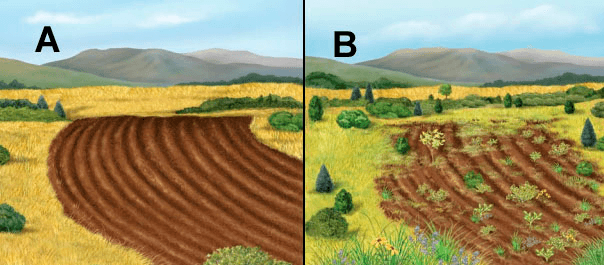
What type of succession is shown going from figure A to figure B?
a)
primary succession
b)
ecological succession
c)
secondary succession
d)
intermediate
67.
What is the goal of the pioneer species in Primary Succession?
a)
To kill the dead materials after a disaster
b)
To rebuild soil
c)
To feed Johnny
d)
To put fresh oxygen into the air
68.
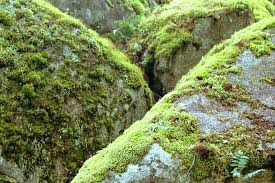
What are examples of pioneer species in a primary succession?
a)
Bushes and Shrubs
b)
Oak trees
c)
Mossess and Lichens 
d)
A rose Bush
69.

What is ecological succession?

a)

When nature wins over humanity

b)

When trees win over bushes and grasses

c)

The changes that occur to an ecosystem over a long period of time

d)

When humans cut down a forest to build cities

70.

Which type of succession takes longer, primary or secondary? Why?

a)

Primary, because the soil is already present

b)

Secondary, because the soil is already present

c)

Primary, because the plants have to wait for the soil to be made

d)

Secondary, because the plants have to wait for the soil to be made

71.

When an ecosystem has enough biodiversity that it becomes stable, it is called a _____________.

a)

Biome

b)

Forest

c)

Climax community

d)

Pioneer species

72.

How do pioneer species start primary succession?

a)

They create the bare rock

b)

The are the first plants to start growing in the soil

c)

They break down rocks to create soil for plants to grow in

d)

Pioneer species don't start primary succession

73.

How do pioneer species start primary succession?

a)

They create the bare rock

b)

The are the first plants to start growing in the soil

c)

They break down rocks to create soil for plants to grow in

d)

Pioneer species don't start primary succession

74.
What is one benefit of Hook and Line fishing?
a)
Very minimal habitat destruction
b)
Very fast technique
c)
Very profitable 
75.
Which definition best matches the term population density?
a)
human beings in general
b)
number of people in a particular area
c)
A measurement of people for a specific area
d)
All the inhabitants of a particular area
76.
Which of the following is NOT part of overall biodiversity?
a)
species diversity
b)
genetic diversity
c)
individual diversity
d)
ecosystem diversity
77.
What does this image represent?
a)
Species Biodiversity
b)
Ecological Biodiversity
c)
Individual Biodiversity
d)
Genetic Biodiversity
78.
What does the following image represent?
a)
Genetic Biodiversity
b)
Ecological Biodiversity
c)
Species Biodiversity
d)
Individual Biodiversity
79.
What does this picture represent?
a)
species diversity
b)
ecosystem diversity 
c)
genetic diversity
d)
biodiversity
80.
Why is biodiversity so important?
a)
Because all species depend on each other to survive, so if one becomes extinct another species that relies on it could go extinct as well
b)
Because it’s better to have only one variation of each species.
c)
Because it better to only have a few species on Earth.
d)
Honestly, I have no idea what biodiversity is!
81.
What factor does NOT affect biodiversity?
a)
Urbanization
b)
Planting Native Plants
c)
Overfishing
d)
Pollution
82.
What are the three types of diversity?
a)
Community, species, and ecosystem
b)
Genetic, food, and ecosystem
c)
Genetic, species, and ecosystem
d)
Language, species, genetic
83.

Which of the following situations contributes to stability in an ecosystem?

a)

increase in biodiversity

b)

decrease in biodiversity

c)

extinction of a population from the ecosystem

d)

removal of many populations of organisms

84.
Which habitat exhibits the greatest biodiversity?
a)
A habitat with 15 different species with about 300 individuals each
b)
A habitat with 10 different species with about 75 individuals each
c)
A habitat with 4 different species with about 150 individuals each
d)
A habitat with only one species with about 2000 individual
85.
Which statement best explains how natural selection occurs?
a)
when adaptations help an organism reproduce and survive.
b)
when organisms are geographically isolated.
c)
when an organism’s offspring grow vestigial structures.
d)
when characteristics from the parent organism are inherited.
86.
Forests are often preserved to protect biodiversity. This helps preserve the unique characteristics of the organisms that live there. Sometimes these forests are divided into separate sections that are spread out instead of one continuous forest. This is known as forest fragmentation. Which types of organisms will be the least likely to be affected by forest fragmentation?
a)
herbivorous birds that are able to migrate great distances
b)
omnivores that hibernate in winter in order to conserve energy
c)
omnivores that burrow underground deep in to the soil.
d)
herbivorous mammals that are dependent upon specific plants for food
87.
How can fire be helpful in an ecosystem?
a)
It helps seeds germinate by opening the seeds under extreme heat.
b)
It spreads seeds to distant locations.
c)
It causes flowers on plants to bloom.
d)
It prevents animals from eating plant populations.
88.
The seasonal movement of an organism from one place to another
a)
camouflage
b)
migration
c)
hibernation
d)
function
89.
Which definition best matches the term population density?
a)
human beings in general
b)
number of people in a particular area
c)
A measurement of people for a specific area
d)
All the inhabitants of a particular area
90.
Which of these would most likely threaten the survival of a species?
a)
A common animal species is hunted.
b)
A plant species is farmed as a crop.
c)
Members of an endangered species reproduce.
d)
A species has fewer and fewer offspring.
91.

Which of these is an example of an adaptation?

a)

The particular shape of a birds beak

b)

Webbed feet on a duck

c)

Camouflage

d)

All of the above

92.
Which human activity would be most likely to have a negative impact on the environment?
a)
Planting trees to control soil erosion
b)
Limiting the use of chemicals that kill weeds.
c)
Stopping the draining of swamps.
d)
Burning coal and oil to generate electric power.
93.
Eutrophication is caused by
a)
runoff of excessive fertilizer and nutrients
b)
cleaning up waterways
c)
using nuclear energy
d)
using solar energy
94.
Which type of air pollution would probably NOT be common in a city having a moist, cloudy climate and few traffic problems?
a)
smog
b)
acid rain
c)
VOCs
d)
none of the above
95.
 Which is NOT an effect or acid precipitation on fish?
a)
suffocation
b)
increased food supply
c)
birth defects
d)
decreased egg population
96.
When there is higher biodiversity
a)
more organisms are likely to die because they can't adapt to environmental changes.
b)
there is less diversity.
c)
there is more diversity and higher sustainability of life.
d)
there is more diversity and lower sustainability of life
97.
Biodiversity is measured by what two factors?
a)
primary and secondary
b)
richness and evenness
c)
amount and type
d)
richness and type
98.

Which statement best summarizes what would happen to an ecosystem if people destroyed most of its decomposers by using chemicals to control bacteria and fungi?

a)

Producers would begin to die out.

b)

Dead organisms would pile up and not decay.

c)

Many nutrients would stop recycling through the ecosystem.

d)

The number of producers would increase dramatically, leading to population growth among consumers.

99.
Biodiversity can affect the ________ of ecosystems and the _________ of populations.
a)
sustainability and stability
b)
stability and sustainability
c)
life and existence
d)
existence and life
100.

Why is genetic diversity important?

a)

A population with less species diversity is more likely to survive an outbreak of disease since less species means less chance of disease spread.

b)

A population with less species diversity is more likely to survive the competition among species.

c)

A population with more genetic diversity is more likely to survive environmental changes, a disease outbreak, or the disappearance of a food source.

d)

A population with less genetic diversity is more likely to survive changes food supply and demand.