wayground logo

Free Printable Worksheets

Font size

S
M
L
XL
Worksheets

AP Review

Total questions: 100

Worksheet time: 4hrs 33mins

Name
Class
Date
1.
As the angle of the incline increases, what happens to the normal force?
a)
The normal force increases
b)
The normal force decreases
c)
The normal force is not affected by the incline
d)
The normal force is only dependent on the force due to gravity
2.
Given the FBD, which of the following must be true?
a)
The frictional force must be accelerating the system to the left.
b)
The box must be accelerating to the right.
c)
The box must be moving to the right.
d)
The FBD is incorrectly drawn. This situation isn't possible
3.
Which of the following is true about the system shown?
a)
The system is not accelerating.
b)
The tension between m2 and m1 is less than the tension between m2 and m3
c)
The acceleration of the system only depends on m3
d)
None of the other answers are true
4.
A uniform rope of weight 10 N is attached to a hook as shown below. A box of weight 50 N is attached to the rope. What is the tension in the rope?
a)
60 N
b)
40 N
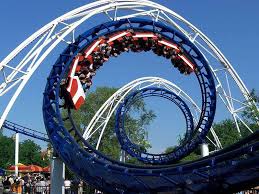
c)
50 N
d)
It varies from 60 N at the top to 50N at the bottom
5.
a)
The accelerations of the blocks will vary according to their mass
b)
The net force acting on each block is the same
c)
The blocks will experience the same acceleration
d)
The force that m exerts on 2m is the same the force that 2m exerts on 3m 
6.
Which of the following is not true about the system?
a)
T3 is equal to the sum of the magnitudes of T2 and T1
b)
T3 is equal in magnitude to Fg
c)
The  x- components of the T1 and T2 and equivalent but in opposite directions
d)
The system is in equilibrium.
7.
Which of these has the greatest centripetal acceleration?
a)
Large Velocity, Large Radius
b)
Small Velocity, Small Radius
c)
Large Velocity, Small Radius
d)
Small Velocity, Large Radius
8.
What force does not cause any torque?
a)
Force perpendicular to the fulcrum, and not on the fulcrum
b)
Force parallel to the fulcrum, and not on the fulcrum
c)
Force perpendicular to the fulcrum, and slightly off center of the fulcrum
d)
Forces at a 45 degree angle to the fulcrum, and not on the fulcrum
9.
The rotational equivalent to d (distance), v (velocity) and a (acceleration) are?
a)
m, m/s, m/s2
b)
θ, ω, α
c)
x, x/t, alphaα
d)
μ, Σ, τ
10.
The center of mass is:
a)
the exact middle
b)
the heaviest part
c)
the point at which you can balance with one finger
d)
the idea that mass is concentrated throughout
11.
How do you get the maximum torque?
a)
longer lever arm and less force at an acute angle
b)
shorter lever arm and less force perpendicularly
c)
shorter lever arm and more force perpendicularly
d)
longer lever arm and more force perpendicularly
12.
A solid  metal bar is at rest on a horizontal frictionless surface. It is free to rotate about a vertical axis at the left end. The figures show forces of different magnitudes that are exerted on the bar at different locations. In which case does the bar's angular speed about the axis increase at the fastest rate?
a)
A
b)
B
c)
C
d)
D
13.
In the diagram above, two masses, one with mass m, the other with mass M = 2m are resting on a uniform plank of length L that pivots at its midpoint. If the mass m is at the far end of the plank, how far away from the pivot should the mass M be to balance the plank in a horizontal position shown?
a)
L/2
b)
L/3
c)
L/4
d)
L/6
14.
Two equal forces do W Joules of work on cylinder (I=1/2mr2) and a hoop (I=mr2) of the same radius and same mass.  What is the ratio of the total kinetic energy of the cylinder to the total kinetic energy of the hoop after this work has been done?
a)
1:1
b)
1:2
c)
2:1
d)
1:4
15.
A cylinder (I=1/2mr2) and a hoop (I=mr2) of the same radius and same mass are traveling at the same angular velocity (ω).  What is the ratio of the angular momentum of the cylinder to the angular momentum of the hoop?
a)
1:1
b)
1:2
c)
2:1
d)
1:4
16.
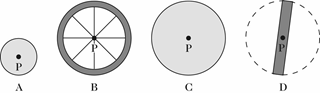
The figure shows scale drawings of four objects, each of the same mass and uniform thickness, with the mass distributed uniformly. Which one has the greatest moment of inertia when rotated about an axis through point P?
a)
A
b)
B
c)
C
d)
D
17.
A person sits on a freely spinning lab stool that has no friction in its axle. When this person extends her arms,
a)
angular momentum is conserved, her moment of inertia increases and her angular speed decreases.
b)
angular momentum is conserved, her moment of inertia decreases and her angular speed increases.
c)
angular momentum increases, her moment of inertia increases and her angular speed increases.
d)
angular momentum decreases, her moment of inertia increases and her angular speed remains the same.
18.

The angle of deflection of an electroscope needle indicates:

a)

If a positive charge is present.

b)

If a negative charge is present.

c)

How much charge is present.

d)

None of the answers.

19.

Which of the following statements is NOT correct about the magnitude of the electric force between two charged objects?

a)

It increases if one of the charges increases.

b)

It increases if the distance between the charges increases.

c)

It increases if both of the charges increase.

d)

It increases if the distance between the charges decreases.

20.
Motion sensors recorded the following data about a runner during a cross-country race. During which segment of the race did the runner have the greatest speed?
a)
W
b)
X
c)
Y
d)
Z
21.
A solid  metal bar is at rest on a horizontal frictionless surface. It is free to rotate about a vertical axis at the left end. The figures show forces of different magnitudes that are exerted on the bar at different locations. In which case does the bar's angular speed about the axis increase at the fastest rate?
a)
A
b)
B
c)
C
d)
D
22.
a)
A
b)
B
c)
C
d)
D
23.
a)
It is at a maximum when the pendulum is at its lowest point
b)
It is at a maximum when the pendulum is at its maximum height h
c)
It is constant throughout the pendulum's motion
d)
It is at a minimum when the pendulum is somewhere between its lowest and highest positions
24.
a)
A
b)
B
c)
C
d)
D
25.
a)
A
b)
B
c)
C
d)
D
26.
a)
A
b)
B
c)
C
d)
D
27.
Tiny drops of oil that have different amounts of electric charge produced by a random process are sprayed into a region between a positively and a negatively charged plate. The charge on each drop is determined by analyzing the effect of the electric force on the drop's motion. Two graphs of the number of drops as a function of the charge on eacd drop, where e is the charge of an electron. Which graph shows the likely results after repeating the experiment many times and why? 
a)
Graph 1, because it shows peaks with approximately the same amplitude
b)
Graph 1, because it shows that within experimental error charge only exists in multiples of e
c)
Graph 2, because it shows a peak value at the charge of an electron
d)
Graph 2, because it shows a narrower range of measurement error
28.
A stone disk is sliding on a frictionless ice to the west with speed v. As the disk slides by, a child uses a rubber mallet to hit the disk at point X, exerting a force directly toward the center of the disk. The child hits point X every half second for about 10 s, changing the trajectory of the disk but not causing it to rotate. Which of the following most closely approximates the path of the disk while the child is hitting it?
a)
A
b)
B
c)
C
d)
D
29.
a)
FB = FA = Fg
b)
(FB = FA) < Fg
c)
FB < (FA = Fg)
d)
FFB < FA
30.
a)
A
b)
B
c)
C
d)
D
31.
a)
A
b)
B
c)
C
d)
D
32.
A system consists of a disk rotating on a frictionless axle and a piece of clay moving toward it. The outside edge of the disk is moving at a linear speed v, and the clay is moving at a speed of v/2. The clay sticks to the outside edge of the disk. How does the angular momentum of the system after the clay sticks compare to the angular momentum of the system before the clay sticks, and what is an explanation for the comparison?
a)
It is the same because there is no external torque acting on the system
b)
It is greater because the rotating mass increases, which increase the rotational intertia
c)
It is less because the speed of the disk decreases when the clay sticks to it
d)
It is less because the angular momentum of the clay opposes that of the disk
33.
Each of the figures above shows a tractor attached to an object. The tractor exerts the same constant force F on each object in each case. Which of the following is a true statement about an object and the relative magnitude of the force exerted by the object on the tractor?
a)
The magnitude of the force exerted by the truck on the tractor is greatest, because the resulting motion is in direction opposite the tractor's pull
b)
The magnitude of the force exerted by the boulder on the tractor is least, because no motion results
c)
The magnitude of the force exerted by the wagon on the tractor is least, because the resulting motion is in the direction of the tractor's pull
d)
The magnitude of the force exerted by each object on the tractor is equal, because tractor exerts an equal force on the object
34.
A student stands at one end of a raft floating in a pool with equally spaced marks along the bottom. The student and the raft have the same mass. The student walks to the opposite end of the raft. Which of the following best shows the final locations of the raft and student relative to the marks at the bottom of the  pool? Assume there is no drag force between raft and the water.
a)
A
b)
B
c)
C
d)
D
35.
a)
A
b)
B
c)
C
d)
D
36.
a)
A
b)
B
c)
C
d)
D
37.
Sphere rolls from rest down an inclined plane. 
a)
B
b)
C
c)
D
d)
E
38.
a)
A
b)
B
c)
C
d)
D
39.
a)
A
b)
B
c)
C
d)
D
40.
A simple pendulum has a period of 2 s. 
a)
A
b)
B
c)
C
d)
D
41.
a)
A
b)
C
c)
D
d)
E
42.
a)
A
b)
B
c)
C
d)
D
43.
a)
A
b)
B
c)
D
d)
E
44.
a)
A
b)
B
c)
C
d)
D
45.
a)
A
b)
B
c)
C
d)
D
46.
a)
A
b)
B
c)
C
d)
D
47.
a)
A
b)
B
c)
C
d)
D
48.
a)
A
b)
B
c)
C
d)
D
49.

A train travels 6 meters in the first second of travel, 6 meters again during the second second of travel, 6 meters again during the third second. What's the train's acceleration ?

a)

0 m/s2

b)

6 m/s2

c)

12 m/s2

d)

18 m/s2

50.
A roller coasters accelerates from an initial velocity of 6.0 m/s to a final velocity of 70 m/s over 4 seconds.  What's the acceleration?
a)
24 m/s2
b)
18 m/s2
c)
16 m/s2
d)
16 m/s
51.
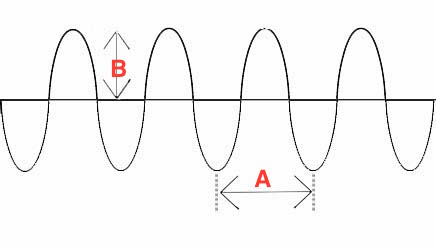
What property of the wave is represented by the letter "B"?
a)
amplitude
b)
crest
c)
trough
d)
wavelength
52.

A string with nodes at both ends is oscillating at the fundamental frequency. if the frequency of the string doubles, the wavelength will

a)

double

b)

get cut in half

c)

remain the same

d)

quadruple

53.
Two pipes of different length are resonating at their fundamental frequencies.  Which is true?
a)
The speed of sound is slower in the longer tube
b)
The speed of sound is slower in the shorter tube
c)
The frequency of the longer tube is higher
d)
The frequency of the shorter tube is higher
54.
Two pendulums are in simple harmonic motion.  Pendulum A is longer than pendulum B.  Pendulum A has a larger mass than B.  The period of pendulum A is
a)
longer than pendulum B
b)
shorter than pendulum B
c)
the same as pendulum B
d)
not enough information
55.
How many wavelengths are there on a string vibrating at its fundamental frequency?
a)
1/4
b)
1/2
c)
1
d)
2
56.
In an open-open tube displaying resonance, the displacement anti-nodes are located at the ends of the tube.
a)
True
b)
False
57.
How many wavelengths are created in a closed-closed tube vibrating at its 3rd harmonic?
a)
1/2
b)
1
c)
3/2
d)
2
58.
How many wavelengths are created in an open-closed tube vibrating at its fundamental frequency?
a)
1/4
b)
1/2
c)
1
d)
5/4
59.

The pictured tube is 1.2 meters long. What is the wavelength of the wave inside?

a)

0.6 m

b)

1.2 m

c)

1.6 m

60.

A pendulum swinging with a maximum amplitude of π/6 has a period of T. If the maximum amplitude is increased to π/3, what is the new period of the pendulum?

a)

T/4

b)

T/2

c)

T

d)

2T

61.

A pendulum's period is initially t. Changes are made to the system so that the new period is 2t. What may have been changed?

a)

The length of the pendulum was increased by a factor of 2.

b)

The pendulum was moved to a planet with 2 times the mass of Earth.

c)

The length of the pendulum was increased by a factor of 4.

d)

The pendulum was moved to a planet with 4 times the mass of earth.

62.
A 5 kg ball hangs from a 10 m string. The ball is swung horizontally outward 90º from its equilibrium position. Assuming the system behaves as a simple pendulum, find the maximum speed of the ball during its swing.
a)
50 m/s
b)
14 m/s
c)
10 m/s
d)
5 m/s
63.

The energy contained in a pendulum depends on its

I. period

II. amplitude

III. mass

a)

I only

b)

II only

c)

II and III only

d)

I, II, and III

64.
Which of the following is true of a damped simple pendulum in which the amplitude of motion decreases exponentially?
a)
Its period decreases through time.
b)
The total energy of the pendulum remains the same.
c)
The maximum kinetic energy decreases through time.
d)
The maximum potential energy increases through time.
65.
A sonar device bounces waves with a frequency of 16 Hz off of an object 2 km away and receives an echo in 0.2 s. What is the wavelength of the waves used?
a)
6.25 m
b)
625 m
c)
1000 m
d)
62500 m
66.

Sound waves travel 10 times as fast through steel as they do through air. What happens to the wavelength of a 200 Hz sound wave as it enters steel from the air?

a)

It decreases by a factor of 10.

b)

The wavelength remains the same.

c)

It increases by a factor of 10.

d)

It increases by a factor of 100.

67.
Which of the following characteristics of a sound wave determines how loud it is?
a)
frequency
b)
wavelength
c)
speed
d)
amplitude
68.

A pipe in a calliope is closed at one end and is 0.5 m long. The calliope uses hot air so that the speed of sound in the tube is 400 m/s. What is the fundamental frequency of the calliope tube?

a)

100 Hz

b)

200 Hz

c)

300 Hz

d)

400 Hz

69.
Which of the following can you use to measure any force?
a)
Force Sensor
b)
Scale
c)
Stop Watch
d)
Force Probe
70.
Which of the following can be used to measure the force due to gravity?
a)
Force Sensor
b)
Scale
c)
Force Probe
d)
Force Sensor & Scale
71.
Which of the following methods completely lead to finding velocity?
a)
Measuring distance and time from a particle diagram/ticker tape
b)
Motion Sensor Creating a Velocity vs Time Graph
c)
Motion Sensor using the slope from a Position vs Time Graph
d)
All of these find Velocity
72.
To find Voltage being used/created by an object....
a)
Connect a Voltmeter in series with the object
b)
Connect a Voltmeter in parallel with the object
c)
Connect an Ammeter in series with the object
d)
Connect an Ammeter in parallel with the object
73.
Two pucks are firmly attached by a stretched spring and are held at rest on a frictionless surface. They are released simultaneously. If puck I has 3X the mass of puck II, which of the quantities is the same for both as the spring pulls the two pucks?
a)
Speed 
b)
Magnitude of acceleration 
c)
Kinetic energy 
d)
Magnitude of momentum
74.
Which of the following is true when an object of mass m moving on a horizontal frictionless surface hits and sticks to an object of mass M > m, which is initially at rest on the surface?
a)
The collision is elastic.
b)
The momentum of the objects that are stuck together is smaller than the initial momentum of object m.
c)
The speed of the objects that are stuck together will be less than the initial speed.
d)
The direction of motion of the objects that are stuck together depends on whether the hit is a head-on collision.
75.
Two objects having the same mass travel toward each other on a flat surface each with a speed of 1.0 meter per second relative to the surface. The objects collide head-on and are reported to rebound after the collision, each with a speed of 2.0 meters per second relative to the surface. Which of the following assessments of this report is most accurate?
a)
Momentum was not conserved therefore the report is false.
b)
If potential energy was released to the objects during the collision the report could be true.
c)
If the objects had different masses the report could be true.
d)
If the surface was inclined the report could be true.
76.
An open cart on a level surface is rolling without frictional loss through a vertical downpour of rain. As the cart rolls, an appreciable amount of rainwater accumulates in the cart. The speed of the cart will
a)
increase because of conservation of mechanical energy
b)
decrease because of conservation of momentum
c)
decrease because of conservation of mechanical energy
d)
remain the same because the raindrops are falling perpendicular to the direction of the cart's motion
77.
A student obtains data on the magnitude of force applied to an object as a function of time and displays the data on the graph shown. The increase in the momentum of the object between t=0 s and t=4 s is most nearly
a)
40 N·s
b)
50 N·s
c)
60 N·s
d)
80 N·s
78.
The two blocks of masses M and 2M shown above initially travel at the same speed v but in opposite directions. They collide and stick together. How much mechanical energy is lost to other forms of energy during the collision?
a)
1/2 M v²
b)
3/4 M v²
c)
4/3 M v²
d)
3/2 M v²
79.
The graph shows the force on an object of mass M as a function of time. For the time interval 0 to 4 s, the total change in the momentum of the object is
a)
40 kg m/s 
b)
20 kg m/s
c)
0 kg m/s 
d)
– 20 kg m/s
80.
A 2 kg object initially moving with a constant velocity is subjected to a force of magnitude F in the direction of motion. A graph of F as a function of time t is shown. What is the increase, if any, in the velocity of the object during the time the force is applied?
a)
0 m/s 
b)
3.0 m/s 
c)
4.0 m/s 
d)
6.0 m/s
81.
A ball of mass m with speed v strikes a wall at an angle θ with the normal, as shown. It then rebounds with the same speed and at the same angle. The impulse delivered by the ball to the wall is
a)
mv sin θ
b)
mv cos θ
c)
2mv sin θ
d)
2mv cos θ
82.
A student at rest on a frictionless frozen pond throws a 1.0 kg hammer in one direction. After the throw, the hammer moves off in one direction while the student moves off in the other. Which correctly describes the situation?
a)
The hammer will have the momentum with the greater magnitude
b)
The student will have the momentum with the greater magnitude
c)
The hammer will have the greater kinetic energy
d)
The student will have the greater kinetic energy
83.
The antinode is also the:
a)
Node number
b)
Crest
c)
Harmonic number
d)
Hertz amount
84.
A rope is attached to the wall at a fixed point. When a wave is reflected what happens?
a)
The crest and trough is inverted
b)
There is no change
c)
The amplitude increases
d)
The reflection is smaller and the amplitude decreases
85.
The speed of a sound wave is affected mainly by the:
a)
Loudness of the sound wave
b)
Pitch of the sound wave
c)
Properties of the medium
d)
Intensity of the sound wave
86.
In a Distance vs Time graph what is the slope? In a Velocity vs Time? Choose the most correct answer.
a)
Position/Time, Velocity/Time
b)
Acceleration, Velocity
c)
Distance Traveled, Change in Velocity
d)
Velocity, Acceleration
87.
When the distance between two charges is halved, the electrical force between them:
a)
doubles
b)
halves
c)
quadruples
d)
reduces to one fourth
88.
What is the total resistance of the circuit?
a)
80 ohms
b)
45 ohms
c)
50 ohms
d)
75 ohms
89.
What is the current through the 45 ohm resistor?
a)
.067 Amps
b)
3 Amps
c)
.05 Amps
d)
.67 Amps
90.
Which
Resistors
are in a series?
a)
C,E
b)
A,B,C,D
c)
A,B,D
d)
A, B
91.
Which collision are both momentum and kinetic energy conserved?
a)
Elastic Collisions
b)
Perfectly Inelastic Collisions
c)
Inelastic Collisions
d)
none of the above
92.
In a frictionless ice rink, a 0.249 kg hockey puck, initially at rest, is hit by a 0.375 kg hockey stick. After the collision, the hockey puck moves to the left with a velocity of 0.125 m/s and the hockey stick continues to move forward with a velocity of 0.651 m/s to the left. What speed was the hockey stick initially moving?
a)
0.734 m/s
b)
1.06 m/s
c)
0.583 m/s
d)
0.916 m/s
93.
A 3 kg box tied to a 2 kg box tied to a 1 kg box are all pulled by a string attached to the front of the 3 kg box. The are being pulled with a force of 18 N. Which of the following is a correct comparisons of the tension in front of each box?
a)
T1 > T2 > T3
b)
T1 = T2 = T3
c)
T1 > T2 = T3
d)
T3 > T2 > T1
94.
A laser beam is aimed 15.95° above the horizontal at a mirror 11,648 m away. It glances off the mirror and continues for an additional 8570. m at 11.44° above the horizon until it hits its target. What is the resultant displacement of the beam to the target?
a)
The target of the laser beam is 20,200 m away an angle of elevation of 14.04°.
b)
The target of the laser beam is 20,000 m away an angle of elevation of 12.08°.
c)
The target of the laser beam is 10,568 m away an angle of elevation of 45.25°.
d)
The target of the laser beam is 20,200 m away an angle of elevation of 14.07°.
95.
You drop a 5 kg ball from a height of 2 m. Just before it reaches the ground, what type of energy does it have?
a)
Potential Energy
b)
Kinetic Energy
c)
Nuclear Energy
d)
Chemical Energy
96.
Which position has the most kinetic energy?
a)
A
b)
G
c)
D
d)
B
97.
A pendulum is released from point C.  Which statement is correct as it  swings from C to A?
a)
The PE increases and KE decreases
b)
The KE increases and PE decreases.
c)
The PE is maximum at A.
d)
The KE is maximum at C and B.
98.
Mr. B's and Mr. P's classes competed in a game of tug of war. Mr. B's class pulled to the right with a force of 4,000 N. Mr. P's class pulled to the left with a force of 5,000 N. As a result the rope moved 5.1 m to the left. How much work was done by the net force?
a)
4100 J
b)
3100 J
c)
5100 J
d)
8100 J
99.
How are work and energy related? 
a)
The work done by an external force acting on an object causes a change in the mechanical energy of the object.
b)
Work is the same thing as energy.  They are equal. 
c)
Energy is m*g*h, and work is 1/2*m*v2
100.
Charlie Holloway is launched out of a cannon with a speed of 40 m/s at 45 degrees with respect with the ground.  Which of the following is true about Charlie's acceleration at the highest point in his trajectory if air resistance is negligible?
a)
the acceleration is unknown
b)
the acceleration is horizontal
c)
the acceleration is straight down
d)
the acceleration is straight up