wayground logo

Free Printable Worksheets

Font size

S
M
L
XL
Worksheets

Bio II Finals Review

Total questions: 92

Worksheet time: 2hrs 30mins

Name
Class
Date
1.
Which of the following tissues lines the interior and exterior of organs?
a)
Epithelial
b)
Connective
c)
Muscle 
d)
Nervous
2.
Which of the following tissues binds everything together?
a)
Epithelial
b)
Connective
c)
Muscle 
d)
Nervous
3.
Which of the following tissues is made up of cells that contract when stimulated?
a)
Epithelial
b)
Connective
c)
Muscle 
d)
Nervous
4.
Which of the following tissues is made up of cells that conduct impulses?
a)
Epithelial
b)
Connective
c)
Muscle 
d)
Nervous
5.
Cartilage is a type of .....
a)
Epithelial Tissue
b)
Connective Tissue
c)
Muscle Tissue
d)
Nervous Tissue
6.
Blood is a type of .....
a)
Epithelial Tissue
b)
Connective Tissue
c)
Muscle Tissue
d)
Nervous Tissue
7.
Examine the pedigree. The allele for the presence of a widow’s peak is dominant. Therefore, we can tell from the chart that in the couple labeled 2:
a)
the male is heterozygous and the female is homozygous.
b)
the male is homozygous and the female is heterozygous.
c)
the male is homozygous and the female is homozygous.
d)
the male is heterozygous and the female is heterozygous.
8.
Why do all the daughters in Generation II carry the colorblind gene?
a)
Because mom passed on the gene.
b)
Because dad passed on the X chromosome.
c)
Because their brother has it.
d)
Because their brother gave it to them.
9.
Give the genotype for person III-3
a)
GG
b)
Gg
c)
gg
10.
What is the mode of inheritance shown here?
a)
 Recessive
b)
Sex Linked
c)
 Dominant
11.
What goes in box 1
a)
AABb
b)
AABB
c)
aabb
d)
AaBb
12.
What genotype is missing from this Punnett Square?
a)
RrYy
b)
RRYY
c)
rryy
d)
RrYY
13.
Based off this punnett square, what fraction of the offspring will have wrinkled, yellow seeds?
a)
9/16
b)
3/16
c)
1/16
d)
16/16
14.
Two brown eyed parents (Bb) have a baby. What is the chance the baby is blue eyed?
a)
0 %
b)
25%
c)
50%
d)
75%
15.
I have 2 X chromosomes. What am I?
a)
Male
b)
Female
16.
I have 1 X chromosome and 1 Y chromosome. What am I?
a)
Male
b)
Female
17.
If a gene is found only on the X chromosome and not the Y chromosome, it is said to be what?
a)
sex-linked trait
b)
polygenic trait
c)
codominant trait
d)
incomplete dominance trait
18.
This type of inheritance pattern is a MIXTURE of both traits, like the old theory of blending
a)
incomplete dominance
b)
co-dominance
c)
complete dominance
d)
recessive pattern
19.
This type of inheritance pattern shows BOTH traits in possible offspring:
a)
complete dominance
b)
incomplete dominance
c)
co-dominance
d)
Indomitable 
20.
In flowers, 2 pink (RW) flowers are crossed. What are the genotypes and phenotypes of their offspring?
a)
100% pink (RW)
b)
50% pink (RW); 25% white (WW); 25% red (RR)
c)
75% pink (RW); 25% white (WW)
d)
100% red (RR)
21.
The stages of mitosis in order
a)
Metaphase, Anaphase, Prophase, Telophase
b)
Prophase, Anaphase, Metaphase, Telophase
c)
Prophase, Metaphase, Anaphase, Telophase
d)
Anaphase, Prophase, Telophase, Metaphase
22.
In which type of cells will mitosis occur?
a)
egg cells
b)
sperm cells
c)
jail cells
d)
Body cells except the sperm and egg cells
23.
How many cells are created at the end of Mitosis?
a)
1 diploid cell
b)
2 diploid cells
c)
3 diploid cells
d)
4 diploid cells
24.
The cells produced via meiosis are called:
a)
sex cells (gametes)
b)
somatic cells
c)
body cells
d)
skin cells
25.
After meiosis is complete, the new cells:
a)
are all identical
b)
are all different
c)
are half identical and half different
d)
are all stretched out
26.
The process on the left is:
The process on the right is:
a)
Left: meiosis
Right: meiosis
b)
Left: meiosis
Right: cloning
c)
Left: mitosis
Right: meiosis
d)
Left: mitosis
Right: mitosis
27.
A human cell has 46 chromosomes before mitotic division.  How many chromosomes will the daughter cells after mitosis.
a)
12
b)
23
c)
46
d)
92
28.
Fruit fly body cells have 8 chromosomes. After mitosis, you would expect a resulting fruit fly daughter cell to have ...
a)
16 chromosomes.
b)
46 chromosomes.
c)
8 chromosomes.
d)
4 chromosomes.
29.
If the Diploid number of Carrots is 18, the haploid number is
a)
18
b)
9
c)
27
d)
36
30.

Sperm cells of the russan dwarf hamster contain 14 chromosomes. how many chromosomes are in a body cell of the hamster

a)

7

b)

42

c)

14

d)

28

31.
Which serves as a temporary storage of sperm cells before they are released   in the urethra?
a)
Testes
b)
Epididymis
c)
Prostate gland
d)
Cowper's gland
32.
Which produces egg cells and female hormones?
a)
cervix
b)
fallopian tube
c)
vagina
d)
ovaries
33.

What do you call the process in which the ovary releases a mature egg cell?

a)

fertilization

b)

ejaculation

c)

ovulation

d)

oogenesis

34.

What do you call the union of egg and sperm cell?

a)

spermatization

b)

ejaculation

c)

fertilization

d)

ovulation

35.
Where does fertilization usually take place?
a)
ovary
b)
fallopian tube
c)
cervix
d)
vagina
36.
a)
Testes
b)
Prostate gland
c)
Bladder
d)
Seminal gland
37.
a)
Produces sperm
b)
Carries the sperm to the urethra
c)
Produces semen (seminal fluid)
d)
Carries the sperm out of the body
38.
The urethra belongs to which reproductive system?
a)
Male
b)
Female
c)
Both
39.
Once a sperm matures, it travels through this tube
a)
Vas deferens
b)
Fallopian tube
c)
Ovaries
d)
Epididymis
40.
a)
ovary
b)
cervix
c)
vagina
d)
uterus
41.
a)
Fallopian tubes
b)
Ovarian ligaments
c)
Oviducts
d)
Vas deferens
42.
Females are born with all the egg cells they will ever have.
a)
True
b)
False
43.
Males are born with all the sperm cells that they will ever have?
a)
True
b)
False
44.

Where a baby grows and develops for approximately 9 months.

a)

uterine tube

b)

fallopian tube

c)

Vagina

d)

Uterus

45.

In what phase of the menstrual cycle does the uterus shed its lining?

a)

menstruation

b)

secretory phase

c)

ovulation

d)

proliferative phase

46.

After conception, where does the embryo/fetus develop?

a)

vagina

b)

fallopian tubes

c)

uterus

d)

ovaries

47.

The menstrual cycle repeats every?

a)

Month

b)

28 days

c)

Week

d)

Year

48.

Ovulation phase typically occurs on what day of the cycle?

a)

1

b)

14

c)

20

d)

7

49.
What does ovulation mean?
a)
A sperm is released
b)
The lining of the uterus breaks down
c)
An egg is released
d)
Menstruation occurs
50.
A fertilized egg undergoes several stages before it is successfully implanted. The diagram below shows these stages as the fertilized egg travels through the female reproductive system. In which of the following structures of the female human reproductive system is the blastocyst implanted during normal human 
a)
ovary
b)
uterus
c)
vagina
d)
amniotic sac
51.
Which of the following is true of a zygote?
a)
It forms into a blastocyst
b)
It is an unfertilized egg
c)
It produces haploid male gametophytes
d)
It is made up of only one cell
52.
Which of the following describes fertilization? 
a)
cell differentiation to form a blastula
b)
formation of germ layers in a deuterostome
c)
a sperm joining an egg to form a zygote
d)
sperm and egg production
53.

Below is a diagram of the male reproductive system. Which structure is represented by the letter D?

a)

scrotum

b)

seminiferous tubule

c)

prostrate gland

d)

epididymus

54.
What is the human embryo called after the eighth week of development?
a)
zygote
b)
an infant
c)
a fetus
d)
a morula
55.
For a human zygote to become an embryo, it must undergo
a)
fertilization
b)
recombination
c)
meiotic dvisions
d)
mitotic divisions
56.
The diagram below represents a stage in the development of a fetus. A major function of structure X is to
a)
produce gametes by meiosis
b)
protect the fetus from physical injury
c)
 exchange materials between the mother and the fetus
d)
store food to provide the fetus with nutrients
57.

The two folds of fatty tissue covered with hair that enclose and protect the vagina are called ______________.

a)

labia majora

b)

labia minora

c)

vulva

d)

perineum

58.

Finger-like projections on the ends of the Fallopian tubes are called ______.

a)

cilia

b)

rugae

c)

villi

d)

fimbriae

59.

The ________ carries both semen and urine in the male.

a)

urethra

b)

ureter

c)

vas deferens

d)

ejaculatory ducts

60.

The middle muscular layer of the uterus is the ___________.

a)

endometrium

b)

minimetrium

c)

perimetrium

d)

myometrium

61.

The ___________ is the narrow end of the uterus that attaches to the vagina.

a)

ovary

b)

cervix

c)

fimbriae

d)

fundus

62.

The name of the procedure to remove the prepuce is a ________.

a)

vulvectomy

b)

vasectomy

c)

hysterectomy

d)

circumcision

63.

The process of the endometrium sloughing away from the uterus each month is ________.

a)

menstruation

b)

ovulation

c)

secretory phase

d)

proliferative phase

64.

The ________ attaches to the mother's uterus and provides oxygen and nutrients to the fetus.

a)

endometrium

b)

placenta

c)

perimetrium

d)

bulbourethral organ

65.
The nesting of a fertilized egg in the wall of the uterus.
a)
Implantation
b)
Fertilization
c)
Conception
d)
Menstruation
66.

If the woman would have been a male, the clitoris would have been a/an:

a)

testicle

b)

epidiymis

c)

penis

d)

scrotum

67.
This layer of the uterus changes every 4 weeks and shed during the woman's menstrual cycle.  
a)
Perimetrium
b)
Myometrium
c)
Endometrium
d)
Cervix
68.
Which layer of the uterus is made up of smooth muscle?
a)
perimetrium
b)
myometrium
c)
endometrium
d)
cervix
69.

What are the tubes that connect the ovaries to the uterus?

a)

fallopian tubes

b)

ureters

c)

urethra

d)

ovarian tubes

70.

Sperm are formed in the

a)

seminiferous tubules

b)

epididymis

c)

rete testes

d)

vas deferens

71.

The process of making new sperm is called:

a)

spermatogenesis

b)

oogenesis

c)

spermatoreguvination

d)

spermatolysis

72.
Number 5 is pointing to the...
a)
Liver
b)
Gallbladder
c)
Pancreas
d)
Stomach
73.
Number 3 is pointing to the...
a)
Small intestine
b)
Rectum
c)
Large intestine
d)
Stomach
74.
Number 2 is pointing to the...
a)
Esophagus
b)
Stomach
c)
Small intestine
d)
Anus
75.
Which organ pushes food down to the stomach?
a)
Mouth
b)
Esophagus
c)
Rectum
d)
Large intestine
76.
Number 7 in the diagram represents the:
a)
Small intestine
b)
Liver
c)
Large intestine
d)
Gall Bladder
77.
2
a)
Mouth 
b)
Salivary Glands
c)
Small Intestine
d)
Rectum
78.
6
a)
Stomach
b)
Small Intestine
c)
Large intestine
d)
Rectum
79.
8
a)
Liver
b)
Gallbladder
c)
Appendix
d)
Pancreas
80.
11
a)
Stomach
b)
Liver
c)
Gallbladder
d)
Pancreas
81.
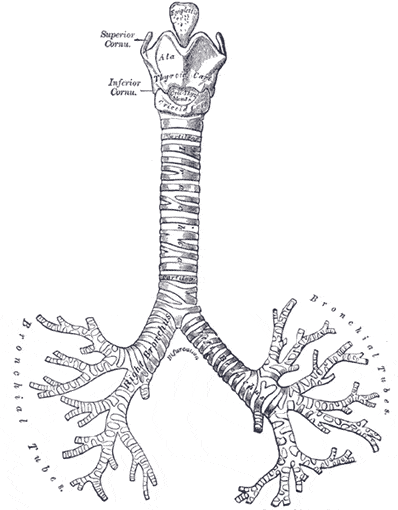
What is tube that is also known as your wind pipe?
a)
esophogus
b)
bronchi
c)
trachea
d)
alveoli
82.
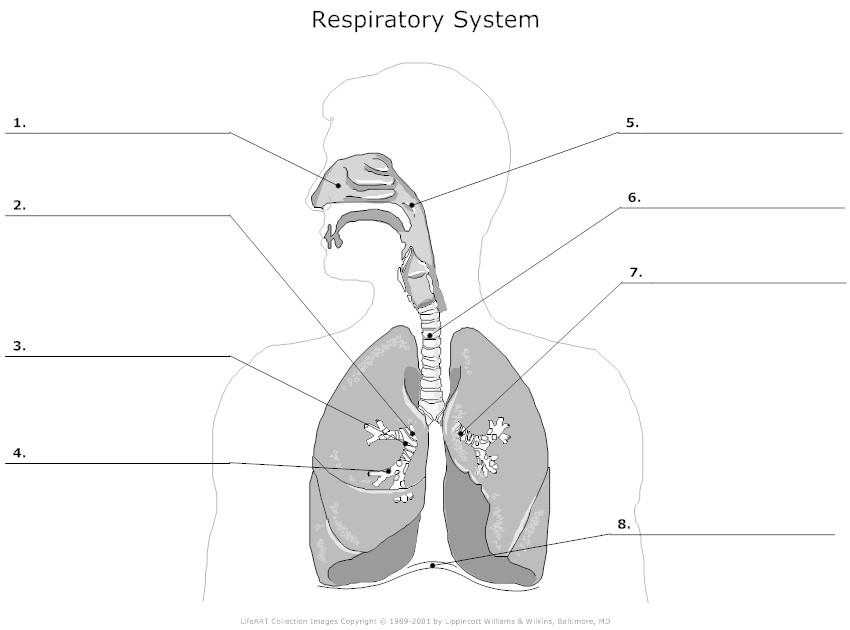
Name the structure labeled 8 
a)
lungs 
b)
trachea 
c)
diaphragm 
d)
alveoli 
83.

Identify this structure.

a)

diaphragm

b)

lungs

c)

alveoli

d)

pleural cavity

84.
The two main branches from the trachea (one to each lung)
a)
bronchi
b)
alveoli
c)
capillaries
d)
bronchioles
85.

The urinary system consists of a pair of _____.

a)

ureters

b)

urethras

c)

urinary bladders

86.

The _____ transports urine from the kidneys to the bladder.

a)

ureter

b)

urethra

c)

kidney

87.

The _____ stores urine.

a)

urinary bladder

b)

kidney

c)

urethra

88.

The _____ conveys urine to the outside of the body.

a)

urethra

b)

urinary bladder

c)

kidney

89.

What is located at #1?

a)

kidneys

b)

urethra

c)

urinary bladder

90.

What is located at #2?

a)

kidney

b)

ureter

c)

urethra

91.

What is located at #3?

a)

urinary bladder

b)

kidney

c)

urethra

92.

What is located at #4?

a)

urethra

b)

ureter

c)

urinary bladder