Wayground logo

Free Printable Worksheets

Font size

S
M
L
XL
Worksheets

APES Final Review

Total questions: 59

Worksheet time: 31mins

Name
Class
Date
1.
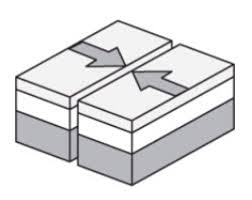
The type of plate boundary where two plates come together is a .....
a)
Convergent Boundary
b)
Divergent Boundary
c)
Transform Boundary
d)
Plate Boundary
2.
What type of plate boundary is this?
a)
Plate
b)
Divergent
c)
Convergent
d)
Transform
3.
Which of the following causes Earth's tectonic plates to move?
a)
Energy from the Sun
b)
Magnetic Pole Reversal
c)
Convection currents in the mantle
d)
Faults in Mountain Ranges
4.
Why are there global winds?
a)
because the cold air sinkes from the poles to the equator
b)
because the earth is rotating from east to west
c)
because the sun heats the air at the equator more than anywhere else on earth
5.
In the Northern Hemisphere, hurricane winds blow
a)
harder than in the Southern Hemisphere
b)
counterclockwise
c)
clockwise
d)
less than in the Southern Hemisphere
6.
What do you call heat getting trapped in the ozone layer?
a)
Coriolis Effect
b)
Temperature Inversion 
c)
Greenhouse Effect 
d)
El Nino 
7.
The Earth would freeze if we did not have which of the following
a)
Greenhouse Effect
b)
Volcanoes 
c)
Carbon Dioxide 
d)
Magnets 
8.
What was the purpose of the formation of the Kyoto protocol?
a)
To limit carbon emissions world wide 
b)
To increase world trade 
c)
To increase world food production
d)
To decrease world population number
9.

What are the most populous countries, in order from largest to smallest?

a)

China, US, India

b)

India, China, Nigeria

c)

China, India, US

d)

China, India, Nigeria

10.

Which of the following are forms of indirect solar energy?

a)

coal

b)

wind

c)

geothermal

d)

nuclear

e)

tidal

11.

Which phase of the demographic transition model is exemplified by low death rates, high birth rates, and rapidly growing population?

a)

Post-industrial

b)

Industrial

c)

Transitional

d)

Pre-industrial

12.

Check all of the following statements that can be made about this image.

a)

pyramid A is most likely in a developing county.

b)

pyramid B has a high age dependency ratio

c)

pyramid A represent a country with a larger population.

d)

pyramid A has a high youth dependency

13.

A low DO may be attributed to

a)

a low BOD

b)

a high BOD

c)

warm water

d)

high riffle

e)

cold water

14.

The Replacement Fertility Rate is lower in MDC's because in MDC's

a)

infant mortality is higher

b)

less babies are being born

c)

more babies are being born

d)

infant mortality is lower

15.

Which of the following water cycle process are connected to surface water on the Earth?

I. ground water flow

II. surface water runoff

III. evaporation

a)

I only

b)

I and II only

c)

II and III only

d)

I, II, and III

16.

Which of the following is a non-point source of water pollution?

a)

Effluent from a sewage treatment plant

b)

BP refiner in Indiana discharging ammonia in a river.

c)

Runoff of pesticides from regional farms into the Illinois River.

d)

Hot water discharges from a nuclear power plant.

17.

Which of the following are not a water treatment procedures used to disinfect and kill harmful bacteria?

a)

Distillation

b)

Chlorine

c)

UV rays

d)

Ozone

e)

Desalination

18.
If a paper mill dumps a lot of paper wast into a nearby river all of the following are likely to happen EXCEPT:
a)
Increase in BOD
b)
Decrease in DO
c)
Algae growth
d)
Decrease in decomposers
19.

What is it called when a persistent pollutant (like mercury or PCBs) builds up in the tissues of an organism as they continue to eat something that contains the pollutant?

a)

Negative Feedback Loop

b)

Biomagnification

c)

Tragedy of the Commons

d)

Bioaccumulation

e)

Positive Feedback Loop

20.
What do we call the land area that supplies water to a river system?
a)
runoff
b)
recharge
c)
watershed
d)
valley
21.

Which size of particulate matter causes the greatest health concerns?

a)

PM2.5

b)

PM10

c)

PM100

d)

PM30

e)

PM15

22.

Carbon monoxide

a)

increases lung cancer rates.

b)

leads to the formation of photochemical smog.

c)

is most problematic in rural areas

d)

does not directly cause deaths.

e)

is produced by incomplete combustion.

23.

Acid deposition forms as a result of

a)

nitrogen oxides and photochemical smog.

b)

carbon monoxide and VOCs.

c)

sulfur dioxide and VOCs.

d)

nitrogen oxides and sulfur dioxide.

e)

carbon monoxide and photochemical smog.

24.

The effects of acid deposition include

a)

increased cancer rates in aquatic organisms.

b)

decreased aquatic biodiversity.

c)

decreased mobilization of metals.

d)

increased pH of lake water.

e)

decreased human health in impacted areas.

25.

Which method is used to reduce nitrogen oxide emissions?

a)

Installation of catalytic converters

b)

Increased temperature of combustion

c)

The addition of oxygen to combustion processes

d)

The use of fluidized bed combustion

e)

The use of calcium carbonate to absorb emissions

26.

Isotopes have the same number of _____, but a different number of __________.

a)

protons; neutrons

b)

protons, electrons

c)

electrons, neutrons

d)

protons; bosons

27.

Which two subatomic particles make up the atomic nucleus?

a)

Negative electrons; neutral neutrons

b)

Negative electrons; positive protons

c)

positive protons; negative neutrons

d)

positive protons; neutral neutrons

28.

Carbon 12 and Carbon 14...

a)

Have the same atomic number

b)

Have the same mass number

c)

Have the same number of neutrons

d)

All of the above

29.

Choose all of the compounds:

a)

H2

b)

CO2

c)

O3

d)

H2O

30.

Click all of the autotrophs

a)

trees

b)

humans

c)

cyanobacteria

d)

moss

31.
The step in the nitrogen cycle where bacteria convert ammonia (NH3) to nitrate (NO3-) is:
a)
nitrification
b)
ammonification
c)
nitrogen fixation
d)
assimilation
32.
The process where some bacteria remove nitrate from the soil by converting it to nitrogen gas is:
a)
nitrification
b)
nitrogen fixation
c)
denitrification
d)
nitrification
33.
In this Food Web Pyramid Which type of consumer gets only 10% of the energy stored in plants?
a)
Herbivore
b)
Carnivore
c)
Omnivore
d)
Top carnivore
34.
A bird nests in a tree.  The tree does not gain any benefit and is not harmed.  What relationship best describes this:
a)
commensalism
b)
parasitism
c)
mutualism
d)
mimicry
35.
What percentage of energy is passed on to each tropic level in an energy pyramid?
a)
10%
b)
50%
c)
90%
d)
100%
36.
What type of growth model is this?
a)
exponential growth model
b)
logistic growth model
c)
Type I curve
d)
Type III curve
37.
relationship in which two species live closely together
a)
resource
b)
mutualism
c)
succession
d)
symbiosis
38.
the species that starts life in primary succession
a)
pioneer species 
b)
succession 
c)
nitrogen fixation
d)
cellular respiration 
39.
largest number of individuals of a population that the environment can support  
a)
carrying capacity
b)
primary succession 
c)
denitrification
d)
mutualism
40.
symbiotic relationship in which one organism benefits and the other organism is harmed 
a)
secondary succession 
b)
predation
c)
pioneer species 
d)
parasitism
41.

Smart gird is the interconnection of

a)

Power & IT

b)

Power, IT & Communication

c)

IT & Communication

d)

Power & Mechatronics

42.
Nonrenewable resources are natural resources, such as fossil fuels, that will eventually be used up and can never be replaced
a)
True
b)
False
43.
Fossil Fuels are fuels
a)
formed from the decaying remains of plants only
b)
formed from the decaying remains of plants and animals that were compressed over a short period of time
c)
formed from the decaying remains of plants and animals that lived millions of years ago
d)
formed from decaying food
44.
An example of a biofuel is
a)
gasoline
b)
oil
c)
animal waste
d)
minerals
45.
Geothermal energy is
a)
heat energy naturally produced in earthquakes
b)
is heat naturally produced in space
c)
is heat naturally produced within Earth
d)
is heat energy naturally produced in the water
46.
Nuclear Power is a __________ energy resource.
a)
Renewable
b)
Nonrenewable
47.
The sun produces energy using _____.
a)
fission
b)
fusion
c)
biomass
d)
geothermal
48.

What is one advantage of using hydroelectricity as an energy source?

a)

heat is captured under the earth

b)

might change the migration of salmon

c)

reservoirs can be used to irrigate crops

d)

causes a lot of pollution

49.

A major advantage of nuclear power is

a)

generate a small amount of energy

b)

no greenhouses gases or pollution are produced

c)

the by product is radiation

d)

it can be disposed of easily

50.
What soil type is typically found on the top of soil?
a)
Humus because it made up of dead, organic matter
b)
Loam because it is lighter than the other layers
c)
Clay because it is not able to fit through the finer particles
d)
Rock because the other layers are more dense
51.
What was one of the major causes of the Dust Bowl?
a)
Cold and windy weather
b)
Increasing prices and demand for crops
c)
Removal of grasses and overfarming
d)
Sandy soil composition that would not stay in place
52.
Which layer in the soil will have the greatest concentration of organic nutrients?
a)
A
b)
B
c)
C
d)
O
53.
Soil sample that is 60% clay, 30% silt, and 10% sand has which texture? 
a)
clay
b)
clay loam
c)
sandy loam
d)
silt 
54.
Name the boundary
a)
convergent boundary
b)
divergent boundary
c)
transform boundary
d)
sergent boundary
55.
Which type of soil is best for growing plants?
a)
clay
b)
sand
c)
dirt
d)
loam
56.
Deficiencies in key proteins or carbohydrates is scientifically referred to as
a)
undernutrition
b)
overnutrition
c)
malnutrition
d)
hypernutrition
57.
The 3 main grain crops (in any order) grown in the US are:
a)
rice, kale, and corn
b)
wheat, barley, and hops
c)
corn, wheat, and rice
d)
hemp, corn, and rice
58.
The order of soil horizons from top to bottom is
a)
O, E, C, B, A
b)
O, C, A, B, E
c)
O, A, E, B, C
d)
A, B, C, E, O
59.
The largest cause of soil erosion and removal of topsoil is/are
a)
flowing water
b)
strong wind
c)
industrial monooculture
d)
clear-cutting forests