wayground logo

Free Printable Worksheets

Font size

S
M
L
XL
Worksheets

BIO II Final Review

Total questions: 100

Worksheet time: 1hrs 12mins

Name
Class
Date
1.
Which biomolecule is often stored in the body's tissues as energy?
a)
proteins
b)
carbohydrates
c)
lipids
d)
nucleic acids
2.
Which of the following molecules make up the basic structure of a cell membrane?
a)
waxes
b)
steroids
c)
fatty acids
d)
phospholipids
3.
A student is planning an experiment to find out how the height from which he drops a ball affects how high the ball bounces. The dependent variable is the _____.
a)
Diameter of the ball
b)
Force acting on the ball
c)
Height that the ball bounces
d)
Height from which the ball is dropped
4.
The 3 categories of carbohydrates are:
a)
Monosaccharide, disaccharide, polysaccharide
b)
glucose, fructose, galatose
c)
starch, cellulose, chitin
d)
There are no categories of carbohydrates
5.
What type of carbohydrate is this?
a)
polysaccharide
b)
disaccharide
c)
monosaccharide
d)
it isn't a carbohydrate
6.
Which of the following is an Autotroph?
a)
Gray Squirrel
b)
Bald Eagle
c)
Puffer Mushroom
d)
Sunflower
7.
Which organelle is referred to as the "control center?"
a)
Mitochondria
b)
Golgi body
c)
Nucleolus
d)
Nucleus
8.
Which organelle is the main site for protein synthesis?
a)
Smooth ER
b)
Cytoskeleton
c)
Ribosome
d)
Lysosome
9.
Which of the following correctly describes the Nucleolus?
a)
Powerhouse of cell
b)
Post Office of cell
c)
Ribosome Factory
d)
Suicide Sac
10.
Which organelle disposes of old organelles?
a)
Ribosome
b)
Lysosome
c)
Rough ER
d)
None of the above
11.
What is the function of the Golgi Bodies?
a)
Modify, sort, package proteins
b)
Synthesis of protein chains
c)
Creation of ATP energy
d)
Secretion of digestive enzymes
12.
Which of the following can NOT be found within a Plant Cell?
a)
Nucleus
b)
Mitochondria
c)
Vacuole
d)
Lysosome
13.
A plant cell wall is made of:
a)
Fructose
b)
Chlorophyll
c)
Microtubules
d)
Cellulose
14.
Which of the following can be found in ANY living cell? (Both prokaryotes and eukaryotes)
a)
Nucleus
b)
Mitochondria
c)
DNA
d)
Cell wall
15.
Which of the following cell types is prokaryotic?
a)
Plant
b)
Protist
c)
Bacteria
d)
Animal
16.
The "bilayer" of the cell membrane is composed of:
a)
Amino acids
b)
Phospholipids
c)
Cellulose
d)
Aquaporins
17.
Which of the following structures can be found in BOTH prokaryotes and eukaryotes?
a)
Nucleolus
b)
Lysosome
c)
Ribosome
d)
None of these
18.

Which sequence of DNA bases would pair with this partial strand:

ATG TGA CAG

a)

ATG TGA CAG

b)

TAC ACT GTC

c)

TAC AGT GAC

d)

CAT TCA CTG

19.
In a molecule of double-stranded DNA, the amount of Adenine present is always equal to the amount of
a)
cytosine
b)
guanine
c)
thymine
d)
uracil
20.

Which of the following units are repeatedly joined together to form a strand of DNA? ( The monomers of DNA)

a)

amino acids

b)

nucleotides

c)

fatty acids

d)

polysaccharides

21.

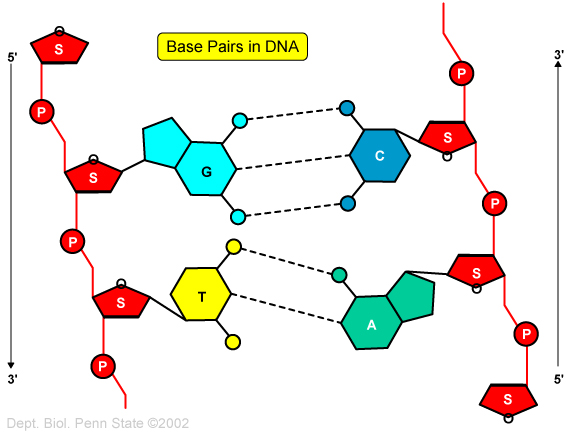
Guanine and Cytosine are attached by how many Hydrogen bonds?

a)

1

b)

2

c)

3

d)

4

22.

Which of the following correctly describes Rosalind Franklin?

a)

Used radioactive molecules to label both DNA and protein

b)

Crystallized DNA to observe the X-ray diffraction pattern

c)

Manipulated S & R-strain bacteria to inject into laboratory mice

d)

Published an article called "The Double Helix" & won a Nobel prize

23.
Which 2 molecules form the sides (backbone) of the DNA ladder?
a)
deoxyribose sugar and adenine
b)
deoxyribose sugar and a hydrogen bond
c)
deoxyribose sugar and the nucleus
d)
deoxyribose sugar and phosphate
24.

Which organelle contains DNA that is only passed down from the mother?

a)

Nucleus

b)

Lysosome

c)

Riboome

d)

Mitochondria

25.

Nitrogenous bases are joined by which type of bond?

a)

peptide bonds

b)

ionic bonds

c)

covalent bonds

d)

hydrogen bonds

26.

The enzyme that unzips the DNA to prepare for replication

a)

helicase

b)

replicase

c)

DNA polymerase

d)

ligase

27.

Which of the following is a Purine base?

a)

Cytoseine

b)

Thymine

c)

Adenine

d)

Uracil

28.
In what phase of the cell cycle does DNA replication take place?
a)
G1
b)
S
c)
G2
d)
M
29.

What are the three main components of a nucleotide?

a)

sugar, amino acid, nitrogen base

b)

sugar, phosphate, nucleic acid

c)

sugar, phosphate, nitrogen base

d)

sugar, phosphate, protein

30.

DNA Replication is considered to be:

a)

Semi-permeable

b)

Semi-conservative

c)

Semi-active

d)

Semi-regressive

31.

The DNA of Prokaryotic cells is contained within an area called a:

a)

Nucleus

b)

Nucleosome

c)

Nucleolus

d)

Nucleoid

32.
The division of the nucleus of a cell is called:
a)
mitosis
b)
cytokinesis
c)
fission
d)
crossing over
33.
Name the phase:
a)
Anaphase
b)
Telophase
c)
Metaphase
d)
Prophase
34.
Which event does NOT happen during cell division?
a)
Condensing of chromosomes
b)
Lining up on Metaphase plate
c)
Formation of the spindle
d)
The replication of DNA
35.
Which stages of the cell cycle are collectively known as Interphase?
a)
G1, G2, G3
b)
G1, M, G2
c)
G2, S, G1
d)
G1, C, M, S, G2
36.
Name the phase:
a)
Metaphase
b)
Metaphase I
c)
Metaphase II
d)
Anaphase I
37.
How many functional eggs (ova) are produced by Oogenesis?
a)
4
b)
3
c)
2
d)
1
38.
A cell has 44 chromosomes in G1 of the cell cycle. How many will it have in G2?
a)
44
b)
22
c)
88
d)
46
39.
What causes genetic variation in meiosis?
a)
chromosomes lining up
b)
crossing over of chromosomes
c)
separation of chromosomes
d)
chromosomes pulling apart
40.
A cell with a complete set of chromosomes can be defined as:
a)
2N
b)
1N
c)
1/2N
d)
4N
41.
The process of crossing over occurs in what phase of meiosis?
a)
anaphase I
b)
prophase I
c)
prophase II
d)
metaphase I
42.
The sperm cell of a lion contains 60 chromosomes. How many chromosomes are the stomach cell of a lion?
a)
60
b)
120
c)
30
d)
15
43.
"Gametes" is a term that refers to:
a)
Homologous chromosomes
b)
Fertilized eggs
c)
Sperm cells only
d)
Sperm and egg cells
44.
What may happen if a cell fails to pass a cell cycle check point?
a)
The cell will begin the Meiosis process
b)
The cell will likely undergo Apoptosis
c)
The cell will likely undergo Phagocytosis
d)
The cell's DNA will immediately replicate
45.
The nucleus of a human body cell contains:
a)
46 pairs of chromosomes
b)
23 total chromosomes
c)
23 pairs of chromosomes
d)
46 total chromosomes
46.
If you look at body cells under a microscope, the majority of those cells will be in which phase?
a)
Prophase
b)
Metaphase
c)
Interphase
d)
Anaphase
47.
Which of the following cell types cannot undergo Mitosis once it is fully formed?
a)
Skin cells
b)
Brain cells
c)
Stomach cells
d)
Blood vessel cells
48.
A fertilized egg is called a(n):
a)
Zygote
b)
Gamete
c)
Ova
d)
Blastula
49.
Cytokinesis is the division of the:
a)
Nucleus
b)
Centromere
c)
Cytoplasm
d)
Protoplasm
50.

Which of the following is ABIOTIC?

a)

Butterfly

b)

Mold

c)

Sand

d)

Sunflower

51.

A cell has 10 chromosomes. After Mitosis, each new daughter cell has how many chromosomes?

a)

20

b)

10

c)

5

d)

30

52.
A set of principles that explains and predicts a phenomena is called a _____. 
a)
scientific law
b)
scientific method
c)
scientific theory
d)
scientific instructor
53.
A scientific ____________ is a statement that describes what always happens under certain conditions in nature.
a)
law
b)
theory
c)
method
d)
variable
54.
Cellulose is a type of ____________
a)
carbohydrate
b)
nucleic acid
c)
lipid
d)
protein
55.
These organic molecules are used by the body to store the genetic code.
a)
Carbohydrates
b)
Lipids
c)
Proteins
d)
Nucleic Acids
56.
Amino acids are the monomers of
a)
Carbohydrates 
b)
Lipids
c)
Proteins 
d)
Nucleic Acids
57.
Enzymes are considered to be 
a)
Lipids
b)
Carbohydrate
c)
Protein
d)
Nucleic Acid
58.
When electrons are shared between two atoms, the bond formed is
a)
ionic
b)
covalent
c)
hydrogen
d)
peptide
59.

When you step out into the cold, your body shivers in order to keep its temperature at 98.6F. What characteristic of life is this?

a)

All living things use energy

b)

All living things contain cells

c)

All living things maintain homeostasis

d)

All living things grow

60.

Which of the following is NOT a characteristic of life?

a)

All living things reproduce

b)

All living things grow

c)

All living things respond to stimuli

d)

All living things move

61.

The DNA information must be coded into which of the following before a protein can be made?

a)

rRNA

b)

Genes

c)

mRNA

d)

Anticodons

62.

In Eukaryotic cells, the Transcription process takes place in the:

a)

Nucleus

b)

Cytoplasm

c)

Golgi Apparatus

d)

Rough E.R.

63.

In DNA, each gene codes to make ONE:

a)

Amino acid

b)

Codon

c)

Lipid

d)

Protein

64.

Translation is a process in eurkaryotic cells that takes place in the:

a)

Cytoplasm

b)

Nucleus

c)

Nucleolus

d)

Golgi Bodies

65.

Which structure serves as the "platform" for the Translation process?

a)

tRNA

b)

Plasma membrane

c)

Ribosome

d)

Nucleus

66.

Given the DNA code: "TAG," which Anti-codon would result?

a)

AUC

b)

UAG

c)

ATC

d)

UUC

67.

Which types of RNA are needed during the Translation process?

a)

mRNA

b)

tRNA

c)

rRNA

d)

All of the above

68.

Amino acids in the polypeptide chain are joined together by:

a)

Hydrogen bonds

b)

Covalent bonds

c)

Peptide bonds

d)

London forces

69.
B=brown eyes
b= blue eyes
What is true about two brothers that have brown eyes?
One has genotype BB the other Bb.
a)
they have same phenotype and genotype
b)
they have different genotypes and phenotypes
c)
they have same phenotype but different genotypes
d)
they have same genotype but different phenotypes
70.
What does heterozygous mean?
a)
An organism that has the same genes for a trait (TT or tt)
b)
An organism that has different genes for a trait (Tt)
c)
When neither gene is fully dominant; offspring is a mixture of both
d)
the different forms of a trait (hair color--> brown, blonde, red
71.
Two brown eyed parents (Bb) have a baby. What is the chance the baby is blue eyed?
a)
0 %
b)
25%
c)
50%
d)
75%
72.
Which of the following cell types is formed by meiosis?
a)
muscle cells
b)
skin cells
c)
sperm cells
d)
blood cells
73.

Gregor Mendel is called the:

a)

Father of DNA

b)

Father of Cells

c)

Father of Genetics

d)

Father of Protein

74.

Cell "drinking" is referred to as:

a)

Phagocytosis

b)

Pinocytosis

c)

Exocytosis

d)

Planocytosis

75.

Which of the following helps DNA coil into tight Chromosomes?

a)

Helicase

b)

Histones

c)

Lactose

d)

Ligase

76.

The mutation of a single nitrogenous base is called a:

a)

Group mutation

b)

Letter mutation

c)

Basic mutation

d)

Point mutation

77.

There are two letters for each trait (Example: Bb). Mendel called these "factors," but they are now called:

a)

Characters

b)

Alleles

c)

Transcriptors

d)

Polyploids

78.

This picture represents a:

a)

Monotype

b)

Polymerase smear

c)

Karyotype

d)

Amniocentesis

79.

What are the monomers of Lipids?

a)

Amino Acids

b)

Glycerol and fatty acids

c)

Nucleotides

d)

Disaccharides

80.

The structure shown in the photo is a:

a)

amino acid

b)

protein

c)

nucleotide

d)

monosaccharide

81.
What type of macromolecule are enzymes?
a)
Protein
b)
Carbohydrate
c)
Lipid
d)
Nucleic Acid
82.

What are the four types of macromolecules?

a)

proteins, nucleic acids, carbohydrates, and lipids

b)

monosaccharides, lipids, polysaccaharides, and proteins

c)

RNA, DNA, proteins, and carbohydrates

d)

proteins, DNA, RNA, and steroids

83.

All of the following are examples of lipids EXCEPT:

a)

oil

b)

wax

c)

estrogen

d)

cellulose

84.

What types of bonds join amino acids together?

a)

Hydrogen bonds

b)

Peptide bonds

c)

Ionic bonds

d)

Oxide bonds

85.

Which rule states that polar substances dissolve polar substances and nonpolar substances dissolve nonpolar substances?

a)

Octet rule

b)

Occum's rule

c)

Like dissolves like rule

d)

Solution solute rule

86.

What is the purpose of a Buffer?

a)

It constantly increases the level of acidity in human cells

b)

It balances the pH of cells by preventing sudden pH spikes

c)

It changes the cell from a polar substance to a nonpolar substance

d)

It causes sharp, sudden changes in pH within human cells

87.

A Red flower and white flower are pollinated and the result was Pink-flowered offspring. This is an example of:

a)

Complete dominance

b)

Incomplete dominance

c)

Codominance

d)

X-linked

88.

This term describes organisms that display two dominant phenotypes equally at the same time:

a)

codominance

b)

incomplete dominance

c)

multiple alleles

d)

linked genes

89.

Human body chromosomes (numbered #1-22) are called:

a)

mutations

b)

genosomes

c)

sex chromosomes

d)

autosomes

90.

What is the DIPLOID number in human cells?

a)

42

b)

23

c)

46

d)

92

91.

A person with type A blood could have which genotype? (Select all that apply):

a)

AO

b)

AB

c)

AA

d)

AAB

92.

Which is true about the Y chromosome compared to the X chromosome?

a)

The Y is longer than the X

b)

The Y carries more genes than the X

c)

The Y is homologous to the X

d)

The Y is much smaller than the X

93.

Colorblindness (b) is a recessive, X-linked trait. A colorblind woman marries a normal man. Which of the following is TRUE of their children?

a)

All will be colorblind

b)

All daughters will be normal and all sons will be carriers

c)

All daughters will be carriers and all sons will be colorblind

d)

All daughters will be colorblind and all sons will be normal

94.

A "Polyploid" organism has:

a)

A missing body chromosome

b)

An extra sex chromosome

c)

An extra set of chromosomes

d)

Half the normal number of chromosomes

95.
What is a Plasmid?
a)
A circular ring of DNA found in eukaryotes
b)
A specialized organelle found in plant cells
c)
A circular ring of DNA found in prokaryotes
d)
Surface projections that help cells attach
96.

The theory that mitochondria and chloroplasts were once ancient bacterial cells is called the:

a)

Cell Theory

b)

Origin Theory

c)

Endosymbiotic Theory

d)

Equilibrium Theory

97.

The outermost layer of a prokaryotic cell that helps it to attach to surfaces is called the:

a)

Cell membrane

b)

Slime layer

c)

Nucleoid layer

d)

Plasmid

98.
Osmosis is the movement of _____ across a membrane.
a)
food
b)
energy
c)
oxygen
d)
water
99.

When both the inside and outside of a cell have the same amount of water, this cell is in what type of solution?

a)

Hypertonic

b)

Hypotonic

c)

Isotonic

d)

Megatonic

100.
Who is responsible for producing this image?
a)
Francis Crick
b)
James Watson
c)
Rosalind Franklin
d)
Watson and Crick