wayground logo

Free Printable Worksheets

Font size

S
M
L
XL
Worksheets

East Asia Unit

Total questions: 73

Worksheet time: 43mins

Name
Class
Date
1.
What major crop was grown in the south along the banks of the Yangtze River?
a)
Corn
b)
Millet
c)
Rice
d)
Barley
2.
The mountain ranges that border western China are the...
a)
Himalayas
b)
Andes
c)
Alps
d)
Kunlun Shan & Tian Shan
3.
The two most important rivers in China are the...
a)
Yangtze & Huang He
b)
Huang He & Xi
c)
Yangtze & Xi
d)
Yalu & Amur
4.
Which statement best explains why the eastern half of China is more densely populated than the west?
a)
  Conflict with Tibet has caused inhabitants to flee western China.
b)
Western China’s dry and mountainous climate and topography are less hospitable to human habitation
c)
 Overgrazing has affected the west more than the east.
d)
Heavy monsoon rains and flooding have slowed the growth of population in western China
5.
Which of the following best explains how physical features have influenced the distribution of population in China?
a)
Most Chinese live in China’s western mountainous areas with cooler temperatures
b)
Most Chinese live in the north where they are safe from attack by neighbors
c)
Most Chinese live either on China’s eastern plain, with its fertile river valleys, or along the coast
d)
Most Chinese live on China’s southern border with Indochina, where they can engage in trading activities
6.
What project in China included forcing more than a million people to move?  
a)
Three Gorges Dam
b)
The Grand Dam 
c)
Two Gorges Dam
d)
None are correct
7.
Northeast China has lots of __________, an inexpensive fossil fuel.
a)
oil
b)
coal
c)
petroleum
d)
copper
8.
What river is known as the "Chinese sorrow" because it has killed hundreds of thousands of people over the years. 
a)
Chang Jiang 
b)
Huang He
c)
Shanghai
d)
Xix
9.

The most common vegetation of the tropical zones of East Asia is the _________.

a)

steppe

b)

rain forest

c)

evergreen forest

d)

tundra

10.

What climate and vegetation would you expect to see in the dry zones of East Asia?

a)

subarctic with mosses and lichens

b)

semiarid steppes & deserts with short grasses

c)

semiarid with evergreen forests

d)

tropical zone with rain forests

11.

Mountains have influenced the distribution of China's population by being a barrier of movement and because the mountainous western regions have less land available for ag.

a)

true

b)

false

12.
Why is the Huang He River also known as the Yellow River?
a)
Because people dump sewage in the river.
b)
Because of the amount of mud in the river.
c)
Yellow sediment from the Taklimakan desert falls into the river. 
d)
Yellow sediment from the Gobi desert falls into the river
13.
Along what river did China's earliest civilizations develop?
a)
Huang He (Yellow)
b)
Indus
c)
Yangtze
d)
Nile
14.
The right of a Chinese Dynasty to rule with the blessings of the Gods is called...?
a)
The Mandate of Heaven
b)
The Dynastic Cycle
c)
The Heavenly Commandments
d)
The Oracle Bones
15.
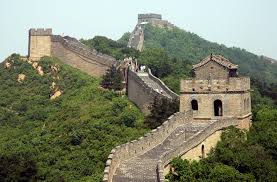
What is the purpose of the structure pictured here?
a)
It is a temple
b)
To protect China's northern border
c)
To protect China's Southern border
d)
To protect China from India 
16.
What is the name for the system of rise and fall of Chinese ruling families?
a)
Dynastic Cycle
b)
Mandate of Heaven
c)
Dynastic Change
d)
Mandate of Dynasties
17.
____ is fine, windblown yellow soil
a)
Loess
b)
Clan
c)
Oracle Bone
d)
Yangzi
18.
Confucius believed respect for parents, or _____, was very important to the relationships.
a)
civil service system
b)
mandate of heaven
c)
filial piety
d)
dynastic cycle
19.
What religion was spread to China on the Silk Road?
a)
Christianity
b)
Buddhism
c)
Islam
d)
Hinduism
20.
Shang weapons were especially strong because skilled artisans made these objects from
a)
iron 
b)
stone
c)
bones
d)
bronze
21.
A symbol in a writing system based on pictures
a)
ideograph
b)
pictograph
c)
bureaucracy
d)
currency
22.
Use the passage to answer question 13.

Which of the following is best supported by the quote from Confucius? (7.21)
a)
If you wish for something hard enough it will just happen.
b)
If you work hard despite the challenges you will be rewarded. 
c)
If you love everyone then good things will happen to you.
d)
Loving is easier to do than hating.
23.
Women in Ancient China:
a)
Were treated well
b)
Were educated
c)
Served as member of the government
d)
Were treated as second class citizens
24.
Why were people so willing to convert to Buddhism in ancient China? (7.20)
a)
It created peace.
b)
It healed sickness.
c)
It made people rich.
d)
It was forced on people by governments.
25.
Early civilizations like Mesopotamia, Egypt, India and China have one thing in common.....
a)
each civilization flourished despite harsh desert conditions
b)
we know little about them due to catastrophic natural disasters
c)
they were founded along rivers and fertile valleys
d)
their coastal locations allowed them to trade with the Roman Empire
26.
What was the main idea of Confucianism?
a)
Respect
b)
Education
c)
Honor
d)
Truth
27.
According to the Mandate of Heaven, a ruler would stay in power as long as he...?
a)
Obeys the priests
b)
controlled an army
c)
governed justly and truly
d)
conquered new territories
28.
Which Confucian group believed everyone should have proper behavior?
a)
Father over Son
b)
Ruler over Ruled
c)
all three
d)
Older Brother over Younger Brother
29.
The 5 Key Relationships were the foundation for
a)
Daoism
b)
Suffering
c)
Nirvana
d)
a harmonious society
30.
The most important person to influence China was
a)
the emperor
b)
oldest son
c)
ancestors
d)
elders
31.
According to Confucius , families need to 
a)
honor their ancestors
b)
conquer desire
c)
honor women
d)
gain enlightenment
32.
Finding a way to live in harmony with nature and find inner peace
a)
Confucianism
b)
Taoism
c)
Legalism
33.
How did Legalism affect people's belief of the after life
a)
It didn't
b)
They loved it
c)
They would be punished.
34.
Belief in Yin and Yang
a)
Confucianism
b)
Taoism
c)
Legalism
35.
"_______" is the key to truth and freedom in Taoism.
a)
Ancestor Worship
b)
Simplicity
c)
Humility
d)
Emphasis on Education
36.
Which of the following beliefs is NOT related to Taoism?
a)
Humans are mostly good
b)
Humans should not destroy the environment around them
c)
Humans are naturally selfish and evil
d)
Opposite forces are more similar to each other than people think
37.
Legalists believe in _____ for good behavior, and _____ for bad.
a)
Punishments, Rewards
b)
Candy, Jail
c)
Rewards, Punishments
d)
Ice Cream, Frozen Yogurt
38.
Legalists believed that people are naturally _________________
a)
Self - interested
b)
Workers
c)
Animals
d)
Good
39.
Legalists believed that rulers should create a stable society with...
a)
Free food
b)
Parties
c)
Harsh Punishments
d)
Drawn-out Meetings
40.
What is Spheres of Influence?
a)
Replacing local leaders with foreigners
b)
Putting local leaders in charge (with guidance from foreigners)
c)
Controlling a country through trade and economy
d)
Removing the government and having anarchy
41.
What was the name of the conflicts between Britain and China over trade rights?
a)
Opium Wars
b)
Anglo-Chinese Wars
c)
Clone Wars
d)
Hundred Days War
42.
What was the name of "unequal treaty" signed by the British and Chinese in 1842?
a)
Treaty of Nanking
b)
Treaty of Hong Kong
c)
The Free Trade Treaty
d)
The New Port Authority Treaty
43.
What rebels attacked foreigners in China and especially hated Chinese who converted to Christianity?
a)
The Boxers
b)
The Wuchang Clan
c)
Sworn Chinese Brotherhood
d)
The New Army
44.
What term describes America's desire to trade with China but NOT to form colonies there?
a)
Boxer Rebellion
b)
Open Door Policy
c)
A Square Deal
d)
Big Stick Diplomacy
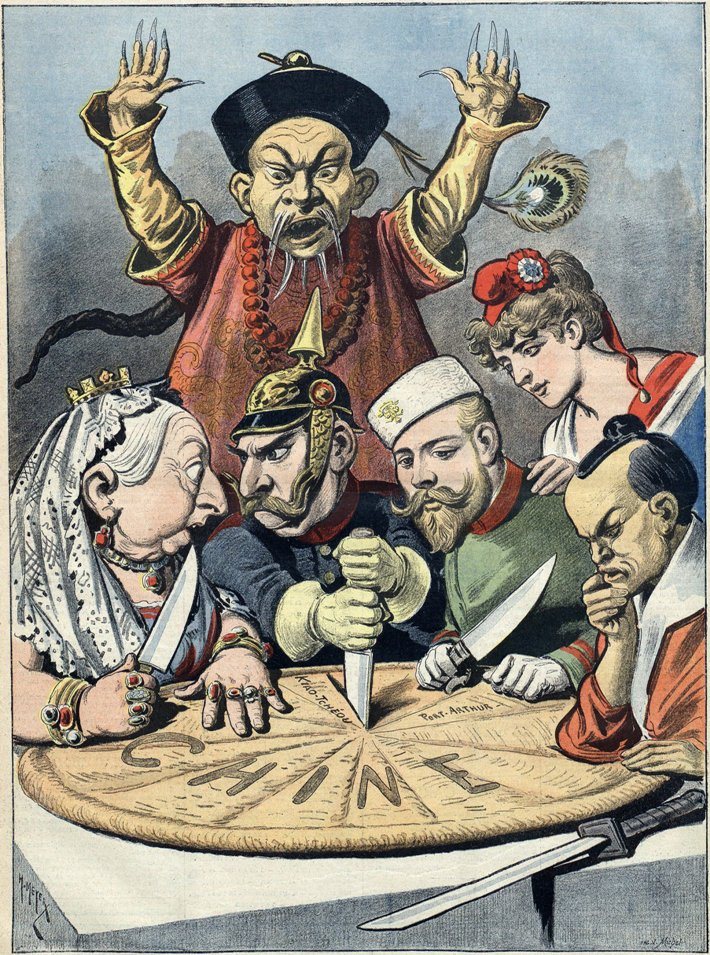
45.
What is the best interpretation of this political cartoon?
a)
China successfully resisted imperialism
b)
Chine modernized and became imperialist
c)
China was divided into spheres of influence by imperialist powers
d)
China isolated itself from trade with other nations
46.
How the loss of the Opium War impact China?
a)
It allowed foreign countries to imperialize China
b)
It caused Chinese peasants to rebel against their govt.
c)
China modernized and became an imperialist power
d)
China returned to isolationism from trade with the West
47.
How did industrialism lead to imperialism?
a)
Industrialized nations wanted new technology
b)
Industrialized nations wanted natural resources and markets
c)
Industrialized nations wanted a cheap source of labor
d)
Industrialized nations wanted to spread their culture
48.
What was the result of the Boxer Rebellion?
a)
an alliance of imperialist nations suppressed the rebels
b)
imperialist nations were forced to withdraw from China
c)
imperialist nations fought each other over control of China
d)
China became a territory of the United States
49.
Define balance of trade
a)
refers to the difference between how much a country imports and how much it exports.
b)
refers to how much a country exports only.
c)
making large amounts of a product available for sale, this lowers the price.
d)
pay for losses in a war.
50.
In ________ the Communists took control of China. 
a)
1945
b)
1937
c)
1949
d)
1941
51.
What was the name of the island to which the Nationalist forces retreated at the end of the war?
a)
Japan
b)
Australia
c)
Tawain
d)
Greenland
52.
What were the huge collective farms formed during the Great Leap Forward called?
a)
Agribusiness
b)
Communes
c)
Dalai Lama
d)
China
53.
What is the name of the campaign that was launched by China's leader, Mao, in 1966 with the aim of restoring radical Communist values?
a)
Great Leap Forward
b)
The Cultural Revolution
c)
Mandate of Heaven
d)
communes
54.
Leader of the communist party in China.
a)
Mao Zedong
b)
Jiang Jieshi
c)
Stalin
d)
Mussolini 
55.
Militia units formed when Mao attempted to revive the revolution in 1966: 
a)
Red Guard
b)
Blue Guard
c)
Purple Guard
d)
Black Guard
56.
The  goal of the  _________ was to increase agriculture and industrial production in China.
a)
Cultural Revolution
b)
Communist Revolution
c)
President
d)
Great Leap Forward
57.
The Nationalist and the Communists fought together against what nation during World War II?
a)
Japan
b)
Thailand
c)
Australia 
d)
Mongolia
58.
Which side in China's civil war-the Communist or Nationalists - had more support from the peasants?
a)
Communist
b)
Nationalists
59.
Which side did the U.S. support with financial aid and weapons during the civil war?
a)
Communist 
b)
Nationalists
60.
The Red Gaurd were ______ who wanted to rid China of any capitalists. 
a)
old men
b)
doctors
c)
lawyers
d)
students
61.
All are true regarding the Cultural Revolution EXCEPT:
a)
It was led by the Red Guards
b)
Its goal was to establish a society pf peasants and workers in which all were equal
c)
Colleges and schools were shutdown to discourage intellectual and artistic activity
d)
It united the people of China
62.
In 1958, Mao Zedong introduced an economic plan for China called the Great Leap Forward. What was a result of this plan? 
a)
It greatly enhanced wages.
b)
 It allowed capitalism to begin.
c)
It encouraged the growing of cash crops.
d)
It caused a severe economic depression. 
63.
What is the theme that ties The Great Leap Forward, the Cultural Revolution, and Tienanmen Square Massacre together? 
a)
They all led to fewer freedoms for people of China.
b)
Mao Zedong led each of them.
c)
Improvements to China’s economy were a result. 
d)
They all led to more opportunities for people of China.
64.
A shaman is ______
a)
one who acts as an intermediary between the human world and the realm of the spirits, usually by consulting the I Ching.
b)
one who acts as an intermediary between the human world and the realm of the spirits, usually by entering a trance state.
c)
one who acts as an intermediary between the human world and the realm of the spirits, usually by throwing bones and studying how they land.
d)
one who acts as an intermediary between the human world and the realm of the spirits, usually by studying tea leaves.
65.
Shinto is ______
a)
the indigenous religion of the islands of Japan.
b)
“the way of the goddesses.”
c)
native to China and Japan.
d)
a hybrid of ancient Buddhism.
66.
China introduced __________ to Japan.
a)
fishing, writing, and ancestor worship
b)
sewing, weaving, and writing
c)
Buddhism, Confucianism, and writing
d)
Buddhism, writing, and weaving
67.
Shinto is strongly oriented toward ______
a)
man.
b)
ethics.
c)
nature.
d)
water.
68.
In general, kami can be described as powers that are in and near the world. They fall into three major categories:
a)
natural disasters, personifications of the forces of nature, and important ancestors.
b)
animal spirits, personifications of the forces of nature, and mountains.
c)
animal spirits, personifications of the forces of nature, and important ancestors.
d)
natural objects, personifications of the forces of nature, and important ancestors.
69.
What is the Japanese term for the gate that marks the entryway of a Shinto shrine?
a)
torii
b)
shimenawa
c)
honden
d)
temizuya
70.

In Japan which group defended the land and kept order in society

a)

shogun

b)

diaymo

c)

samurai

d)

emperoe

71.

What is the code of conduct that all samurai must follow?

a)

bushido

b)

chivarly

c)

kamikaze

d)

seppuku

72.

What is a system of government where there is an exchange of land for military service?

a)

Shinto

b)

monarchy

c)

feudal

d)

bushido

73.

What was a ritual suicide called?

a)

kamikaze

b)

seppuku

c)

daimyo

d)

chivalry