Wayground logo

Free Printable Worksheets

Font size

S
M
L
XL
Worksheets

Physical Science Course Review

Total questions: 87

Worksheet time: 2hrs 37mins

Name
Class
Date
1.
One type of tectonic boundaries is...
a)
Super Sized
b)
Volcano
c)
Convergent
d)
Dominos 
2.
Name this plate boundary.
a)
divergent
b)
convergent
c)
transform
d)
allegiant 
3.
Name this plate boundary.
a)
divergent 
b)
convergent
c)
transform
d)
transformers
4.
Name this plate boundary.
a)
divergent
b)
convergent 
c)
transform
d)
insurgent
5.
What are the deepest places on Earth formed by pushing oceanic crust under continental crust?
a)
mid-ocean ridges
b)
rift valleys
c)
trenches
d)
mountain ranges
6.
A huge cloud of dust and gas that is the location for star formation is known as
a)
Planetisimal
b)
Protoplanet
c)
Nebula
d)
Red Giant
7.
What force draws matter together into a dense central core?
a)
Magnetism
b)
Gravity
c)
Inertia
d)
Fusion
8.
The Solar Nebula Hypothesis explains
a)
Mixed orbit direction of planets
b)
How our sun and planets formed
c)
How the universe formed
d)
How the Milky Way formed
9.
What is the shaking of the Earth’s crust caused by a release of energy?
a)
Earthquake
b)
Epicenter
c)
Fault
d)
Plate
10.
What is a break in the lithosphere along which movement in an earthquake has first occurred?
a)
Earthquake
b)
Epicenter
c)
Fault
d)
Focus
11.
Earthquakes under the water can cause _________________________________.
a)
tornadoes
b)
tsunamis
c)
lightening
d)
hailstorms
12.
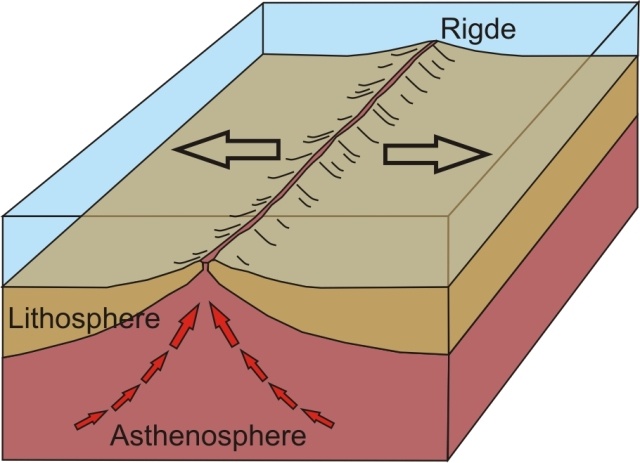
What kind of plate boundary is shown here?
a)
divergent
b)
convergent
c)
transform
d)
subducting
13.
What geologic feature/event you be most likely to find at a transform boundary?
a)
Earthquakes
b)
Volcanoes
c)
Mountains
d)
Rift Valleys
14.
In which type of boundary do the plates move away from each other?
a)
convergent
b)
normal
c)
divergent
d)
transform
15.
Why do ice cubes float in a  glass of water?
a)
the ice cubes are more dense than the water
b)
the water is more dense than the ice cubes
c)
the water is more dense than the glass
d)
the ice is more dense than the glass
16.
A scientist has four different liquids and pours them all into a bottle.  The silver liquid sinks to the bottom, the red liquid settles on top of the silver one, and the pink liquid stays at the surface. Which liquid has the smallest density?
a)
the pink liquid
b)
the silver liquid
c)
the red liquid
d)
the water
17.
The Law of Conservation of Energy states:
a)
Energy can created or destroyed but not transformed 
b)
Energy cannot be created or destroyed, it can only transformed
c)
Energy can't be created, destroyed or transformed
18.
On a roller coaster, where is maximum potential energy?
a)
At the bottom of a big hill
b)
When going around a corner
c)
When going upside down
d)
At the top of a big hill
19.
On a roller coaster, where is maximum kinetic energy?
a)
At the bottom of a big hill
b)
When going around a corner
c)
When going upside down
d)
At the top of a big hill
20.
How long will it take a moving object traveling at a velocity of 6 m/s to move 30 meters?
a)
5 s
b)
180 s
c)
36 s
d)
24 s
21.
Calculate the KE of a moving 4 kilogram object traveling at a velocity of 3 m/s.
a)
18 J
b)
36 J
c)
12 J
d)
6 J
22.
The flow of energy from an object at a higher temperature to an object at a lower temperature.
a)
heat
b)
temperature
c)
radiation
d)
conduction
23.
Energy that travels across distances in the form of electromagnetic waves. 
a)
Convection
b)
Radiation
c)
Conduction
d)
Induction
24.
an image made by light bouncing off a surface, such as a mirror or metal spoon
a)
refraction
b)
reflection
c)
absorbtion
d)
medium
25.
True or false: as you move along the spectrum, left to right, the wavelengths decrease in size (get smaller)
a)
true
b)
false
26.
Select the correct order of waves on the EMS 
a)
Radio, Micro, Infra, Visible, Ultra, X-ray, Gamma
b)
Gamma, X-ray, Ultra, Vis, Infra, Micro, Radio
c)
Vis, Micro, Infra, Ultra, X-ray, Gamma, Radio
d)
Micro, Radio, Vis, Infra, Ultra, X-ray, Gamma
27.
Which section of the spectrum is the ONLY one we can see?
a)
X-rays
b)
Visible Light
c)
Gamma Rays
d)
Ultraviolet Rays
28.
Sound is caused by? 
a)
force
b)
vibrations
c)
instruments
29.
Why is sound able to travel faster through a solid than a gas?
a)
Gas molecules are packed tightly.
b)
Sound does not travel faster through a solid than a gas.
c)
Solid molecules are packed tightly.
d)
Gas molecules move slowly.
30.
What medium does sound travel through slowest?
a)
gas
b)
solid
c)
liquid
d)
trees
31.
Sound waves are NOT___________________________.
a)
EM Waves
b)
Waves
c)
Mechanical Waves
d)
Compression
32.
EM waves ________ a medium.
a)
require
b)
don't require
c)
can have
d)
sometimes have
33.
What is force?
a)
A force is a push or a pull upon an object resulting from the object's interaction with another object.
b)
something used in Star Wars 
c)
It is the amount of space between two points.
d)
It is Superman's power
34.
The force that pulls objects towards Earth.
a)
Gravity
b)
Friction
c)
Inertia
d)
Force
35.
Earthquakes are caused by the release of stored energy along a fault.
a)
True
b)
False
36.
How is energy released from an earthquake?
a)
When tectonic plates collide
b)
When tectonic plates separate
c)
When tectonic plates slip past each other
37.
What causes earthquakes?
a)
A decrease in energy along a fault
b)
A release of energy along a fault
c)
A release of energy along an ocean
d)
An increase in radon gas
38.
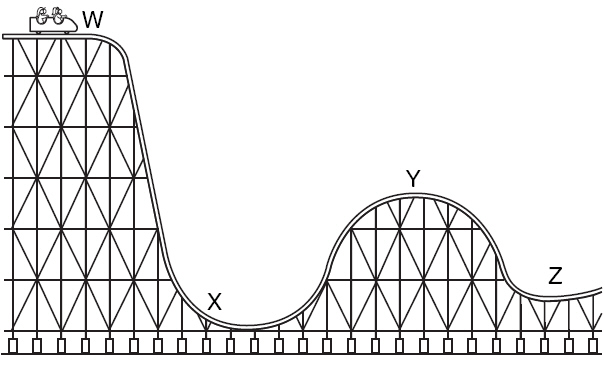
At which point is potential energy greatest?
a)
W
b)
X
c)
Y
d)
Z
39.
At which point is kinetic energy greatest? 
a)
W
b)
X
c)
Y
d)
Z
40.
You serve a volleyball with a mass of 2 kg. The ball leaves your hand with a speed of 30 m/s. What is the KE of the ball?
a)
900 J
b)
1800 J
c)
60 J
d)
30 J
41.
There is a bell at the top of a tower that is 45 m high. The bell weighs 100 kg. What is the potential energy of the bell?
a)
980 J
b)
441 J
c)
4,500 J
d)
44,100 J
42.
A material that does not allow heat to pass through easily is a(n) _______________. 
a)
Friction
b)
Conductor
c)
Insulator
d)
Magnet
43.
Which color absorbs the most heat?
a)
Light Blue
b)
White
c)
Black
44.
all matter is made of what 
a)
energy 
b)
atoms 
c)
electrons 
d)
compounds 
45.
an atom with atomic number 6 would have how many protons 
a)
6
b)
12
c)
3
d)
cannot be determined 
46.

Identify elements in the following compound: NaCl

a)

Sodium, Carbon

b)

Nitrogen, Chlorine

c)

Sodium, Chlorine

47.

Identify elements in the following compound: NH3

a)

Sodium, Helium

b)

Sodium, Hydrogen

c)

Nitrogen, Helium

d)

Nitrogen, Hydrogen

48.

Identify elements in the following molecule: H2

a)

2 atoms of Helium

b)

2 atoms of hydrogen

49.

Identify elements in the following compound: KMnO4

a)

Potassium, Magnesium, Oxygen

b)

Potassium, Manganese, Oxygen

c)

Krypton, Magnesium, Oxygen

50.
CaCo3
a)
Element
b)
Compound
51.

Mass cannot be created or__________ during a chemical reaction?

a)

Reacted

b)

Transferred

c)

Born

d)

Destroyed

52.

Which compounds are the PRODUCTS of this reaction?

a)

CO2 + H2O

b)

C6H12O6 + O2

c)

C6H12O6 + CO2

d)

H2O + O2

53.

Which compounds are the REACTANTS of this reaction?

a)

CO2 + H2O

b)

C6H12O6 + O2

c)

C6H12O6 + CO2

d)

H2O + O2

54.

To balance a chemical equation, there must be the same number of atoms of each kind of element on both sides of the arrow.

a)

True

b)

False

55.

How many molecules of O2 are in this balanced equation?

a)

6

b)

2

c)

3

d)

1

56.
Which problem is balanced?
a)
PbO2 + 2H2
b)
SO2 + H20 --> H2SO4
c)
2Na + 2H2O --> 2NaOH + H2
57.
What is a coefficient?
a)
The small number on the right of the chemical symbol.
b)
The large number to the left of a formula.
58.
Balance this equation:
MgCl2 --> Mg4+ Cl2
a)
It's already balanced.
b)
4MgCl2 --> Mg4+ 4Cl2
c)
4MgCl2 --> Mg4+ 5Cl2
59.
How many valence electrons does the atom in the diagram have? 
a)
2
b)
3
c)
5
d)
10
60.
Study the diagram carefully, In what period would you find this atom? 
a)
2
b)
3
c)
5
d)
10
61.
How many valence electrons does Aluminum have? 
a)
3
b)
13
c)
14
d)
27
62.
Valence electrons determine an element's _____________.
a)
Reactivity
b)
Location
c)
Identity
d)
Color
63.
Which particles change the charge in atoms when ions are formed?
a)
Protons
b)
Electrons
c)
Neutrons
d)
Kittens
64.
Why are ions formed?
a)
Because atoms like to change
b)
Because atoms want 8 valence electrons
c)
Because atoms have the same number of protons and electrons
d)
Because atoms gained neutrons
65.
A covalent compound contains _______, but an ionic compound will have _______________.
a)
2 Alkali metals, 2 Metalloids
b)
Two metals, Two Nonmetals
c)
A metal and a  Nonmetal, 2 Halogen
d)
Two Nonmetals, Metal + Nonmetal
66.
CaBr2
Calcium Bromide is an example of which type of chemical bonding? 
a)
Ionic Bond
b)
Covalent Bond
c)
Both bonds
d)
Neither bond
67.
H2O Water is an example of which type of chemical bonding? 
a)
Ionic Bond
b)
Covalent Bond
c)
Both bonds
d)
Neither bond
68.
What do these isotopes of carbon all have in common?
a)
neutrons & mass number
b)
atomic number and neutrons
c)
atomic number and electrons
d)
protons, atomic number, and mass number
69.
What element is this?  What is the mass number of this atom?
a)
sodium, 23
b)
magnesium, 23
c)
magnesium, 12
d)
sodium, 11
70.
Four isotopes of lead include lead-204, lead-206, lead-207, and lead-208.  The average atomic mass of lead is 207.2.  Which isotope of lead is likely to be the most abundant.
a)
204
b)
206
c)
207
d)
208
71.
How many valence electrons does calcium have?
a)
2
b)
4
c)
6
d)
7
72.
How many valence electrons does hydrogen have?
a)
1
b)
2
c)
3
d)
4
73.
When an atom loses an electron, it becomes a:
a)
positive ion
b)
negative ion
c)
neutral ion
d)
neutral atom
74.
This could be the dot diagram of
a)
Ne
b)
H
c)
C
d)
F
75.
How are covalent bonds explained?
a)
When one atom takes the other atom's electron
b)
When the atom shares an electron with an another atom
c)
When the two nucleus merge
d)
When the neutrons leave the nucleus
76.
What two types of atoms make a covalent bond?
a)
2 Nonmetals
b)
1 Nonmetal and 1 Metal
c)
2 Metals
d)
2 Noble Gases
77.
A covalent bond in which electrons are shared unequally is:
a)
polar
b)
a double bond
c)
ionic
d)
polyatomic
78.
How many valence electrons do most atoms need to be stable?
a)
1
b)
2
c)
6
d)
8
79.
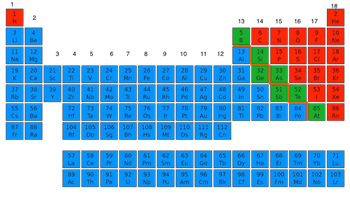
Where are the nonmetals located on the periodic table? 
a)
Blue
b)
Red
c)
Green
80.
What is the correct formula for this molecule?
a)
NH
b)
N3H
c)
NH3
d)
NH4
81.
How many valence electrons are elements trying to reach in their outer shells?
a)
1
b)
2
c)
5
d)
8
82.

When two atoms share electrons, a chemical bond is formed. This type of bond is called:

a)

covalent bond

b)

ionic bond

c)

crystal bond

d)

polyatomic bond

83.
What type of elements will form an ionic bond?
a)
Metals + Metals
b)
Nonmetals + Nonmetals
c)
Metals + Nonmetals
d)
None of the above
84.
How are covalent bonds formed?
a)
Sharing of electrons
b)
Transfer of electrons
85.
How are ionic bonds formed?
a)
Transfer of electrons
b)
Sharing of electrons
86.

An electron that resides in the outermost shell, or principal quantum level, of an atom

a)

periodic trend

b)

electron shell

c)

ionic radius

d)

valence electron

87.
In which group would you find the Noble Gases?
a)
5
b)
6
c)
7
d)
8