wayground logo

Free Printable Worksheets

Font size

S
M
L
XL
Worksheets

Physical Science Final (Term 2)

Total questions: 80

Worksheet time: 59mins

Name
Class
Date
1.
How is the use of sound waves helpful to this whale?
a)
It helps the whale locate food.
b)
It makes the water warmer.
c)
It makes it easier to obtain oxygen.
d)
It signals fish to move out of the whale’s path.
2.
Which form of energy is being used by the toaster?
a)
Chemical
b)
Electrical
c)
Solar
d)
Nuclear
3.
To describe this car’s motion, a student should use its —
a)
direction and speed
b)
mass and volume
c)
speed and color
d)
volume and direction
4.
Which object helps people understand what makes up white light?
a)
Barometer
b)
Prism
c)
Microscope
d)
Thermometer
5.
Which of these shows how frozen water changes as the temperature of the air increases?
a)
Gas → liquid → solid
b)
Solid → gas → liquid
c)
Liquid → gas → solid
d)
Solid → liquid → gas
6.
The flower’s stem appears larger under water because the water —
a)
absorbs light
b)
produces light
c)
repels light
d)
refracts light
7.
Which of these has kinetic energy?
a)
                         A
b)
                         B
c)
                         C
d)
                         D
8.
Which of these substances conducts electricity the best?
a)
Wood
b)
Brick
c)
Copper 
d)
Plastic
9.
One way in which light waves are different from sound waves is that light waves --
a)
can move through empty space
b)
are caused by rapid vibrations
c)
travel more slowly
d)
can be reflected
10.
The flow of electricity in a circuit-
a)
current
b)
flow
c)
circuit
11.
____________ allows electricity to flow.
a)
A conductor
b)
An insulator
c)
A magnet
12.

____________ prevents the flow of electricity.

a)

A conductor

b)

An insulator

c)

A magnet

13.
A pathway for electricity to travel is called___________
a)
current
b)
static electrcity
c)
circuit
d)
circle
14.
What size resistor would produce a 3 Amp current flow with a 12 Volt battery
a)
1 Ohm
b)
3 Ohms
c)
4 Ohms
d)
12 Ohms
15.
What is resistance measured in?
a)
Ω (Ohms)
b)
V (Volts)
c)
A (Amps)
d)
W (Watts)
16.

What are three good electrical conductors?

a)

Copper, Gold, Rubber

b)

Gold, Silver, Wood

c)

Gold, Silver, Copper

d)

Copper, Aluminum, Paper

17.

What does an electrical insulator do?

a)

Lets electricity flow in one direction.

b)

Does not let electricity flow through it.

c)

Lets electricity flow through it when light shines on it.

d)

Lets electricity flow through it.

18.
What will happen when these magnets are brought close together?
a)
They will attract each other.
b)
They will repel each other.
c)
Both magnets will turn to the left
d)
Both magnets will turn to the right
19.
Magnets have a north and a south ___________
a)
shape
b)
color
c)
pole
d)
region
20.
What happens when two north poles of a magnet are placed together?
a)
they repel
b)
they attract
c)
they cancel each other out
d)
the strength of the magnet is doubled
21.
Which of the following is true about a bar magnet?
a)
Its magnetic field is strongest near its center.
b)
It is surrounded by a magnetic field.
c)
The north pole is stronger than the south pole.
d)
The south pole is stronger than the north pole.
22.
A north pole and a south pole will attract.
a)
True
b)
False
23.
What do the lines around this magnet represent?
a)
North Pole
b)
South Pole
c)
Magnetic Declination
d)
Magnetic Field
24.

The two poles must be

a)

north

b)

south

c)

the same

d)

opposite

25.

Light is made up of...

a)

electricity and waves

b)

magnetism and waves

c)

electricity and magnetism

d)

electricity and energy

26.

The color with the longest wavelength is...

a)

Blue

b)

Red

c)

Green

d)

Yellow

27.

If you see a green leaf on a tree, that means...

a)

Green is the color being reflected off the leaf.

b)

Green is the color being absorbed by the leaf.

c)

All the colors are being reflected off the leaf.

d)

All the colors are being absorbed by the leaf.

28.
What would be the best use for a material that reflects almost all light?
a)
A mirror
b)
A window
c)
A lightbulb
d)
A sheet of paper
29.
A straw in a cup will appear bent because of...
a)
Reflection
b)
Refraction
c)
Diffraction
d)
Absorption
30.
Which best explains why a white paper looks white?
a)
It absorbs all colors
b)
It reflects red and green
c)
It reflects red and blue
d)
It reflects all colors
31.
What is the key difference between light and sound waves?
a)
Sound waves are electromagnetic
b)
Light and sound are exactly the same
c)
Light waves are energy and sound waves are not
d)
Light waves can travel through space
32.
The angle that light hits a surface is ____________ the angle it is reflected away.
a)
Greater than
b)
Less than
c)
Equal to
d)
Unrelated to
33.
Smooth surfaces _______ a lot of light.
a)
reflect
b)
bend
c)
absorb
d)
twist
34.
Another name for light bending is ....
a)
Reflaction
b)
Absorbing
c)
Refraction
d)
mirror
35.
Which color absorbs all light?
a)
White
b)
Black
c)
Orange
d)
Green
36.
When light passes through a prism it?
a)
Bounces back
b)
Reflects
c)
Refracts
d)
Absorbs
37.
The form of energy found in food, wood, and batteries is _______ energy.
a)
chemical
b)
mechanical kinetic
c)
electrical
d)
solar
38.
Burning wood in a fireplace transforms ________ energy into ________ energy.
a)
sound, light
b)
chemical, heat and light
c)
light, heat
d)
mechanical kinetic, mechanical potential
39.
An electrical circuit contains a battery, wires, and a light bulb. What is the source of electrical energy?
a)
chemical energy
b)
light energy
c)
heat energy
d)
mechanical potential energy
40.
A dam produces power by transforming __________.
a)
heat energy into electrical energy
b)
mechanical potential energy into electrical energy
c)
chemical energy into electrical energy
41.
Moving a wire through a magnetic field ___________.
a)
creates an electrical current in a wire
b)
reduces the strength of the magnetic field
c)
has no effect on the wire
42.
__________ is the ability to do work or cause change.
a)
Chemical energy
b)
Potential energy
c)
Kinetic energy
d)
Energy
43.
What is energy stored in particles of matter called?
a)
electrical energy
b)
thermal energy
c)
chemical energy
d)
solar energy
44.
Energy from the Sun, which provides heat and light energy for Earth is called __________ energy.
a)
solar
b)
heat
c)
light
d)
chemical
45.
A device that uses a magnetic field to turn electrical energy into mechanical-kinetic energy.
a)
electric motor
b)
generator
46.
Energy that travels in the form of waves.
a)
chemical energy
b)
light energy
c)
potential energy
d)
kinetic energy
47.
According to the law of conservation of energy, energy can
a)
be destroyed, but not created.
b)
be created, but not destroyed.
c)
neither be created nor destroyed.
d)
None of the above.
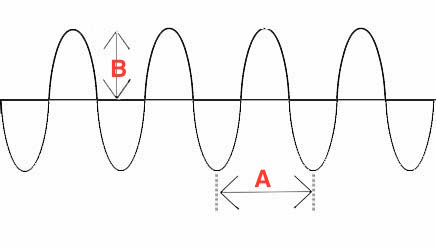
48.

What property of this wave is represented by the letter "A"

a)

amplitude

b)

crest

c)

trough

d)

wavelength

49.
The highest point on a wave is:
a)
the crest
b)
the trough
c)
the top
d)
the coast 
50.
The type of waves that require medium to pass:
a)
Mechanical Waves
b)
Electromagnetic Waves
51.
When the frequency of a wave increases, what happens to the wavelength?
a)
The wavelength is not directly affected by the frequency of a wave.
b)
The wavelength increases.
c)
The wavelength decreases.
d)
More specific information is needed to form a conclusion about the wavelength.
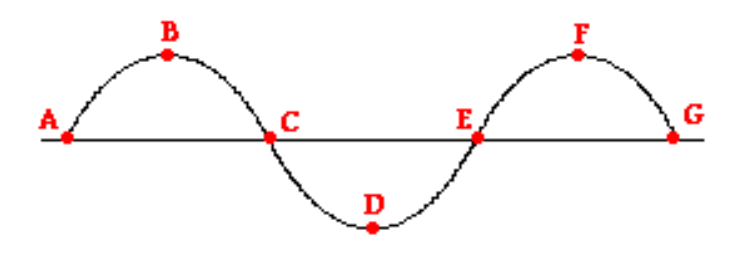
52.
Which letter(s) represent the crest of the wave?
a)
A
b)
B & D
c)
B & F
d)
F
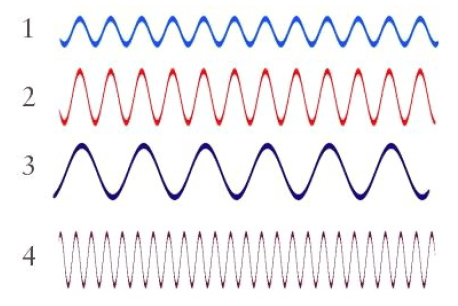
53.
Which wave in the diagram has the greatest frequency?
a)
1
b)
2
c)
3
d)
4
54.
Electromagnetic waves include the following except
a)
radio waves
b)
X-rays
c)
doing the wave at a football game
d)
microwaves
55.
Rubbing a balloon on your hair and making it stand up is an example of what?
a)
Static Electricity
b)
Electric Current
c)
Magnetic Field
56.
Sound is an example of a(n)
a)
Mechanical, Longitudinal Wave
b)
Mechanical, Electromagnetic Wave
c)
Transverse, Electromagnetic Wave
d)
Electromagnetic, Longitudinal Wave
57.
This picture is an example that best describes what interaction?
a)
Reflection of Light
b)
Absorption of Light
c)
Transmission of Light
d)
Absorption of Sound
58.
Electrons have a:
a)
Negative charge
b)
Neutral charge
c)
Positive charge
59.
Protons are ______ charged and neutrons have ______ charged.
a)
Positive, negative
b)
Positive, neutral
c)
Negative, Positive
d)
Neutral, negative
60.

Which of the following heat exchange processes involves the collision of particles?

a)

insulation

b)

conduction

c)

convection

d)

radiation

61.

Why does a floor covered with tile feel colder than a floor covered with carpet?

a)

The tile floor is colder than the carpet.

b)

The tile floor conducts heat better than the carpet.

c)

The carpet conducts heat better than the tile floor

d)

The tile floor is a better insulator than the carpet.

62.

An electric hotplate is used to cook food in an all-metal frying pan.


Which best shows the path of the conduction of thermal energy?

a)

Pan-Coil

b)

Coil-Pan-Meat

c)

Meat-Pan-Handle

d)

Handle-Coil

63.

Thermal energy is:

a)

the energy of motion

b)

energy stored up to use at a later time

c)

the average kinetic energy due to the motion of the atoms in a substance

d)

when an electrical source is connected in a a complete circuit to an electrical device

64.

Thermal equilibrium is:

a)

ability to do work

b)

when two objects that are touching reach two different temperatures

c)

when thermal energy is transferred from the colder object to the warmer object

d)

the point at which two objects that are touching reach the same temperature

65.

Which of the following statements about thermal energy is true?

a)

As you hold a cup of hot water your hands cool the water.

b)

As you hold a glass of cold milk, the cold travels to your hand.

c)

As you hold a cup of cold milk, your hand cools the milk.

d)

As you hold a cup of hot water, the heat moves to your hand

66.

A brick exposed to sunlight becomes warm. How is energy from the Sun transferred to the brick?

a)

conduction

b)

convection

c)

radiation

d)

reflection

67.

Which of the following examples would correctly describe convection currents?

a)

1: Oil is less dense and floats on water.

2: Water is more dense and sinks in oil.

b)

1: Liquid water evaporates.

2: Condensed water precipitates.

c)

1: Animals take in oxygen for respiration.

2: Plants take in carbon dioxide for photosynthesis.

d)

1: Warm air molecules move faster and rise.

2: Cool air molecules move slower and sink.

68.

How does the color of an object affect the amount of energy it receives from sunlight?

a)

Light colored objects reflect more light and become warmer than darker objects.

b)

Light colored objects absorb more light and become warmer than darker objects.

c)

Dark colored objects reflect more light and become warmer than lighter objects.

d)

Dark colored objects absorb more light and become warmer than lighter objects.

69.

Which of the following gives the correct definition and example of a conductor?

a)

an object that transfers thermal/electrical energy very well; plastic bottles

b)

an object that does not transfer thermal/electrical energy very well;metal pans

c)

an object that transfers thermal/electrical energy very well; metal pots

d)

an object that does not transfer thermal/electrical energy very well;carpet

70.

What process forms an image in a mirror?

a)

absorbing light

b)

reflecting light

c)

refracting light

d)

transmitting light

71.

What process in the atmosphere protects people from the ultraviolet rays in sunlight?

a)

Ozone absorbs ultraviolet light.

b)

Nitrogen reflects ultraviolet light.

c)

Water vapor scatters ultraviolet light.

d)

Carbon dioxide blocks ultraviolet light.

72.

Why does a leaf look green in the summer?

a)

The leaf absorbs green light.

b)

The leaf produces green light in its cells.

c)

The leaf uses green light to make food in its cells.

d)

The leaf reflects green light and absorbs other colors of sunlight.

73.

These types of waves do not need a medium to travel through and can travel through the vacuum of space:

a)

longitudinal waves

b)

electromagnetic waves

c)

heat waves

d)

thermal waves

74.

Copper is used in house wiring because it is

a)

magnetic.

b)

an insulator.

c)

an electrical conductor.

d)

hard to bend into new shapes.

75.

This portion of the electromagnetic spectrum is visible to the human eye.

a)

ultraviolet waves

b)

gamma waves

c)

visible waves

d)

infrared waves

76.
A continuous flow of electricity is called_____________
a)
series
b)
circuit
c)
static
d)
current
77.
Potential Energy is:
a)
The energy of motion
b)
always conserved
c)
The energy due to position
78.
The ultimate source of energy is:
a)
The sky
b)
The sun
c)
Plants
d)
Movement
79.
The ultimate source of energy is:
a)
The sky
b)
The sun
c)
Plants
d)
Movement
80.

What is energy?

a)

The ability to do work

b)

A force

c)

Electricity

d)

The ability to transform work