wayground logo

Free Printable Worksheets

Font size

S
M
L
XL
Worksheets

Geology Review

Total questions: 100

Worksheet time: 1hrs 11mins

Name
Class
Date
1.
The hottest layer
a)
crust
b)
inner core
c)
mantle
d)
outer core
2.
The coolest layer
a)
crust
b)
inner core
c)
mantle
d)
outer core
3.
The thinest layer
a)
crust
b)
inner core
c)
mantle
d)
outer core
4.
The thickest layer
a)
crust
b)
inner core
c)
mantle
d)
outer core
5.
The least dense layer
a)
crust
b)
inner core
c)
mantle
d)
outer core
6.
The most dense layer
a)
crust
b)
inner core
c)
mantle
d)
outer core
7.
This layer is completely liquid
a)
crust
b)
inner core
c)
mantle
d)
outer core
8.
This layer is a mix between solid and liquid often referred to as plastic
a)
crust
b)
inner core
c)
mantle
d)
outer core
9.
This layer is completely solid due to the intense pressure it is under
a)
crust
b)
inner core
c)
mantle
d)
outer core
10.
This layer is solid
a)
crust
b)
asthenosphere
c)
mantle
d)
outer core
11.
A can of Coke will sink in a bowl of water.  A can of Diet Coke will float in a bowl of water.  What does this tell you about the density of the Diet Coke?
a)
it is bigger than 1
b)
it is smaller than 1
c)
it is equal to 1
d)
it is equal to -1
12.

Johnny finds a gold colored rock in a river. It has a mass of 9.65 grams and a volume of 0.5 cm3. What is the density of the rock?

a)

10.15 g/cm3

b)

19.3 g/cm3

c)

9.15 g/cm3

d)

4.825 g/cm3

13.
Which property of matter is determined by dividing its mass by its volume?
a)
elasticity
b)
buoyancy
c)
density
d)
viscosity
14.
The following liquids are poured together in a beaker: alcohol (density=0.79), corn syrup (density=1.38), water (density=1.0), and cooking oil (density=0.93).  Which of these liquids will sink to the bottom of the beaker?
a)
alcohol
b)
corn syrup
c)
water
d)
cooking oil
15.
A brick sinks in water while a wooden block of the same size floats.  This is because the brick has a
a)
lower volume than the wooden block
b)
lower density than the wooden block
c)
higher volume than the wooden block
d)
higher density than the wooden block
16.
A scientist has four different liquids and pours them all into a bottle.  The silver liquid sinks to the bottom, the red liquid settles on top of the silver one, and the pink liquid stays at the surface. Which liquid has the smallest density?
a)
the pink liquid
b)
the silver liquid
c)
the red liquid
d)
the water
17.
What is the density of water?
a)
0 g/ml
b)
1 g/ml
c)
10 g/ml
d)
100 g/ml
18.

Which of these would be correct to put at the end of a density answer?

a)

g/cm

b)

cm3

c)

g/ml

d)

g/lb

19.
Which box has a higher density?  
a)
Box A
b)
Box B
c)
cannot be determined
d)
they are the same
20.
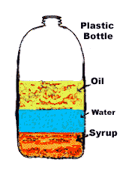
Which liquid is the least dense?
a)
oil
b)
water
c)
syrup 
d)
plastic bottle
21.

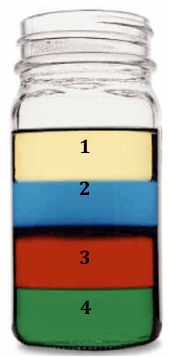
Put the liquids in order from most dense to least dense.

a)

4, 3, 2, 1

b)

1, 2, 3, 4

c)

3, 4, 2, 1,

d)

4, 3, 1, 2

22.
The tool used to measure the mass of a substance or object is a ______________.
a)
balance
b)
graduated cylinder
c)
ruler
d)
thermometer
23.
What is the formula for density?
a)
density = mass x volume
b)
density = mass / volume
c)
density = mass + volume
d)
density = mass - volume
24.

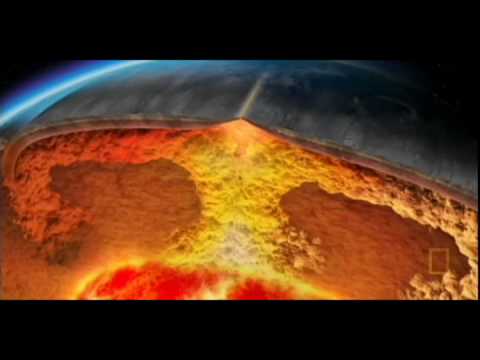
As you travel from the inner core to the crust, how would temperature, pressure and density of the material change?

a)

They would all increase

b)

They would all decrease.

c)

They would stay the same.

d)

Temperature would decrease, but pressure and density would increase.

25.
Which layer of Earth is located above the outer core?
a)
crust
b)
inner core
c)
mantle
d)
lithosphere
26.
What would happen to the convection currents if the heat from the inner core disappeared? 
a)
They would stop. 
b)
They would change directions. 
c)
It would not change. 
d)
They would speed up. 
27.
If you traveled from the center of Earth to the surface, the pressure would...
a)
increase
b)
decrease
c)
stay the same
d)
unsure
28.
Which of the following occurs because of convection currents?
a)
Tectonic plates on the crust move.
b)
The mantle increases in size.
c)
Pressure in the crust increases.
d)
Pressure in the crust decreases.
29.
Scientists think that convection currents that move the plates flow in Earth's
a)
Continental crust
b)
Oceanic crust
c)
Asthenosphere
d)
Lithosphere
30.
The mantle of Earth is made partly of magma. When magma rises and sinks, this is called ______________. 
a)
a conduction current
b)
a hot spot
c)
a volcanic eruption
d)
a convection current
31.
What was the name given to all the continents when they were joined as one super continent? 
a)
Supreme Continent
b)
Eurasia
c)
Plate tectonics
d)
Pangea
32.
Which of the following is NOT evidence to support the theory of plate tectonics?
a)
Fossils
b)
Mountains
c)
Glaciers
d)
Sand Erosion
33.
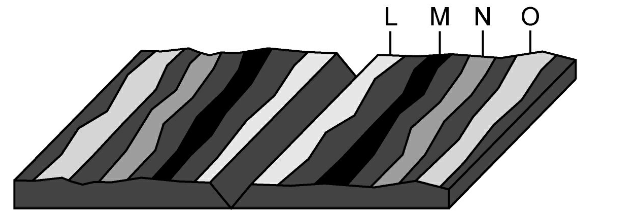
If a mid-ocean ridge is in the center of this picture, where would the oldest rock be found?
a)
L
b)
M
c)
N
d)
O
34.
How is it possible for new crust to be formed without increasing the surface area of the Earth?
a)
Crust is destroyed at the same time it is created
b)
New crust is underwater where it sinks
c)
New crust breaks more easily than old crust
35.
The Great Rift Valley in Africa and the Mid-Ocean Ridge were all created by this type of boundary
a)
Divergent
b)
Convergent
c)
Reform
d)
Transform
36.
What are the two types of crust
a)
continental and oceanic
b)
ocean and upper
c)
lower and upper
d)
pizza and subway
37.
Earthquakes and volcanoes are most likely found in which locations?
a)
At plate boundaries
b)
in oceans
c)
in the middle of continents
d)
in the middle of plates
38.
The Himalayas in Asia are an example of what type of plate boundary?
a)
divergent
b)
continent-to-continent convergent
c)
ocean-to-continent convergent
d)
transform
39.
The area where two tectonic plates meet.
a)
mantle
b)
focus
c)
plate boundary
d)
convection
40.
This landform can occur at a divergent plate boundary.
a)
ocean trench
b)
mid-ocean ridge
c)
tall mountains
d)
transform fault
41.
Supporting Evidence: fossils, continent shape, landforms
a)
Continental Drift
b)
Seafloor Spreading
c)
Plate Tectonics
42.
Supporting Evidence: subduction, earthquakes, volcanoes, Mid-Atlantic Ridge, older theories
a)
Continental Drift
b)
Seafloor Spreading
c)
Plate Tectonics
43.
Supporting Evidence: discovery of Mid-Atlantic Ridge, core rock samples showing older rocks the farther that you get from the mid ocean ridge
a)
Continental Drift
b)
Seafloor Spreading
c)
Plate Tectonics
44.
Ocean trenches always form at subduction zones where dense oceanic crust subducts.
a)
True
b)
False
45.
Volcanoes never form along subduction zones.
a)
True
b)
False
46.
The tectonic plates float on the 
a)
lithosphere
b)
lower mantle
c)
outer core
d)
asthenosphere
47.
Continental crust is more dense than oceanic crust.
a)
True
b)
False
48.
This area contains over 70 percent of volcanoes and 90 percent of earthquakes in the world.
a)
North American plate
b)
ring of fire
c)
fiery rings 
d)
African plate
49.
Mountains form from ...
a)
plates sliding past one another
b)
collision of plates
c)
plates moving away from each other
50.
What did Wegener think happened during continental drift?
a)
continents froze over
b)
continents moved
c)
the mantle warmed
d)
convection stopped
51.
The vibration and shaking of the Earth...
a)
volcanism
b)
plateau
c)
earthquake
d)
richter scale
52.
Younger sea floor crust is located...
a)
farther from the mid-ocean ridges
b)
at the mid ocean ridges
c)
at the subduction zone
d)
near the continents
53.
Which ocean is expanding due to a mid-ocean ridge?
a)
Indian
b)
Dead Sea
c)
Atlantic
d)
Artic
54.
Particles of rock, sand, soil, plant and animal remains
a)
erosion
b)
sediment
c)
weathering
55.
When rocks are broken down into smaller pieces
a)
erosion
b)
weathering
c)
sediment
56.
When water, ice and wind move particles of rock and soil from one place to another
a)
sediment
b)
weathering
c)
erosion
57.
A mass of ice that covers a large area and moves slowly
a)
gravity
b)
glacier
c)
sediment
58.

Erosion occurs when water, ice wind and gravity move __________________ and __________________ from one place to another

a)

water, air

b)

waves, rock

c)

rock, sediment

59.
Erosion caused by _______________ changes beaches and lakes
a)
glaciers
b)
ice
c)
waves
60.
Soil is a mixture of
a)
weathered rock particles
b)
plant and animal remains
c)
all of the above
61.

Water, wind, gravity, ice, plants are all part of this kind of weathering

a)

Chemical

b)

Mechanical

c)

Humid

62.
Earth's surface features are continually changing... this is due to
a)
wearing away of the surface
b)
building up of the surface
c)
Both wearing away and building up
63.
Which event is an example of erosion?
a)
Snow falls during a storm
b)
Rocks slide down a hill slide
c)
A plant grows on a sandy beach
64.
"Mountains are constantly being washed into the sea" ... this statement refers to the effects of
a)
Weathering and erosion
b)
Folding and faulting
c)
Fossil formation
65.
Carbon dioxide in rainwater dissolves limestone
a)
Chemical weathering
b)
Mechanical weathering
66.
The iron in the stones of the Grand Canyon turn the color of red
a)
Mechanical Weathering
b)
Chemical Weathering
67.

What is an unconformity?

a)

A layer of sedimentary rock

b)

A layer of rocks with unusual fossils

c)

An intrustion

d)

A missing time or gap in the rock record because of erosion

68.

Based on the law of superposition, where would the oldest rocks be found.

a)

at the bottom

b)

at the top

c)

second from the bottom

d)

second from the top

69.

What are fossils?

a)

the oldest layers of rock in a region

b)

living creatures with habitats in or around rocks

c)

preserved remains or traces of once living things

d)

objects that people of long ago left behind as artifacts

70.

Which letter matches with the OLDEST layer of rock?

a)

W

b)

X

c)

Y

d)

Z

71.

The time that it takes 50% of an element to decay is called what?

a)

the daughter product

b)

the half-wit

c)

the half-life

d)

the half-time

72.

If the original mass of a radioactive element was 36 grams how much would be left after 1 half life?

a)

36 grams

b)

18 grams

c)

9 grams

d)

4.5 grams

73.

Index fossils are used by geologists to

a)

match rocks of the same age in different regions

b)

determine the relative age of rocks in one place

c)

identify organisms that did not leave fossil evidence behind

d)

determine why some organisms became extinct

74.

What kind of dating is used to compare the age of a rock to those around it?

a)

Radiometric

b)

Relative

75.
What is one cause of an earthquake?
a)
weathering by glaciers
b)
movements along faults
c)
deposition by moving water
d)
tsunamis forming in the ocean
76.
How can some of the impacts of earthquakes be reduced?
a)
by building structures that can sway with the motion
b)
by building structures that do not move with the motion
c)
by using satellites to monitor warning buoys in the ocean
77.

Landslides may be triggered by rain or ground shaking due to earthquakes.

a)

TRUE

b)

FALSE

78.

This hazard is caused when minerals in rocks such as limestone or sandstone are dissolved, creating holes inside the rock that eventually collapse.

a)

sinkhole

b)

liquefaction

c)

land subsidence

d)

ground rupture

79.
Earthquakes happen every day. Most are too small for humans to notice.
a)
True
b)
False
80.

Which type of rock results from melting and cooling of magma or lava?

a)

Igneous

b)

Metamorphic

c)

Sedimentary

d)

Extrusive

81.
Which type of rock forms from extreme heat and pressure?
a)
Igneous
b)
Sedimentary
c)
Organic
d)
Metamorphic
82.
A metamorphic rock changes into an igneous rock by what two processes?
a)
Melting and cooling
b)
Extreme heat and pressure
c)
Compaction and cementation
d)
Weathering and erosion
83.
Wind, water, and ice breaking down rock is called
a)
Erosion
b)
Deposition
c)
Compaction
d)
Weathering
84.
What is the MAIN way rocks are classified?
a)
Their color and shapes
b)
How they form
c)
Mineral bands
d)
Where they form
85.
True/False: Igneous rocks can only turn into metamorphic rocks.
a)
True
b)
False
86.
The process in which dissolved minerals crystallize and glue sediment together.
a)
compaction
b)
deposition
c)
organic rock
d)
cementation
87.

When sediments are pressed together tightly, this is called ____________.

a)

Compaction

b)

Cementation

c)

Weathering

d)

Erosion

88.
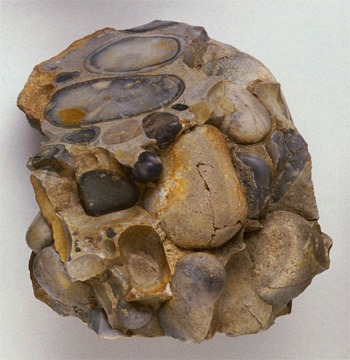
This rock was formed by smaller pieces of rock that settled at the bottom of a lake millions of years ago. What type of rock is this?
a)
Sedimentary
b)
Igneous
c)
Metamorphic
89.
What are the 3 major types of rocks?
a)
Igneous, Metamorphic, Sedimentary
b)
Metamorphic, Igneous, Cementation
c)
Brown, Red, Gray
d)
Streak, Hardness, Breakage
90.
This rock started as lava that cooled and then was heated and put under pressure over time. What type of rock is this?
a)
Sedimentar
b)
Igneous
c)
Metamorphic
91.
This rock is made from tiny pieces of other rocks that settled to the bottom of a valley millions of years ago. What type of rock is this?
a)
Sedimentary
b)
Igneous
c)
Metamorphic
92.
This rock was molten magma that slowly cooled under the ground. What type of rock is this?
a)
Sedimentar
b)
Igneous
c)
Metamorphic
93.
This rock cooled on the outside of a volcano and contained air bubbles when it was forming. What type of rock is this?
a)
Sedimentary
b)
Igneous
c)
Metamorphic
94.
After lots of time, pressure, and heat, you get this kind of rock. What type of rock is this?
a)
Sedimentary
b)
Igneous
c)
Metamorphic
95.
Each rock type can follow only one pathway of the rock cycle.
a)
True
b)
False
96.
Fossils are often found in ____________ because it is formed from the remains of once living things.
a)
metamorphic
b)
magma
c)
igneous
d)
sedimentary
97.

Which of the following changes to Earth's surface take place over a large spatial scale?

a)

mudslides/landslides

b)

canyon formation

c)

mountain building

d)

weathering of an arch

98.

Which of the following changes to Earth's surface take place over a small time scale?

a)

mudslides/landslides

b)

canyon formation

c)

mountain building

d)

volcanic eruption

99.

Which of the following changes to Earth's surface take place over a large time scale?

a)

mudslides/landslides

b)

canyon formation

c)

mountain building

d)

weathering of an arch

100.

Which of the following changes to Earth's surface take place over a small spatial scale?

a)

mudslides/landslides

b)

canyon formation

c)

mountain building

d)

weathering of an arch