
NEW
Font size
S
M
L
XL
 Worksheets
Physical Science review! How much have you learned?
Total questions: 64
Worksheet time: 42mins
Name
Class
Date
1.

This piece of lab equipment is called a _________.
a)
beaker
b)
test tube
c)
graduated cylinder
d)
thermometer
2.

This piece of lab equipment is called a _______________.
a)
beaker
b)
spring scale
c)
graduated cylinder
d)
thermometer
3.
If glass accidentally breaks during your lab, you should
a)
immediately tell the teacher and let the teacher clean it up
b)
tell a student to clean it up for you
c)
leave the pieces on the floor and sneak away
d)
carefully clean it up using a dust pan and a broom
4.
Before beginning a lab, you should always
a)
clear off your table to ensure a clean workspace
b)
ask the teacher about any questions you have
c)
read all directions
d)
all of the above
5.
You are heating a substance in a test tube. Always point the open end of the tube
a)
away from all people
b)
toward another classmate
c)
toward your lab partner
d)
toward yourself
6.
Chipped or cracked glassware is okay to use.
a)
True
b)
False
7.

When should you wash your hands?
a)
After using chemicals or fingerprinting
b)
After sneezing or using tissues
c)
After using the bathroom
d)
All of these!
8.
Something that takes up space and has mass.
a)
volume
b)
matter
c)
mass
d)
density
9.
Iron + oxygen = rust is an example of a ___________.
a)
physical property/change
b)
chemical property/change
c)
mass
d)
volume
10.
What are compounds?
a)
Substances made of one or more types of elements.
b)
Substances made of one or more types of neutrons.
c)
Substances made of one or more types of nuclei.
d)
Substances made of one or more type of electron.
11.
Where can we find a list of all of the elements?
a)
Element List
b)
Element Chart
c)
Periodic Table
d)
Periodic Chart
12.
What is the smallest unit of matter?
a)
Element
b)
Atom
c)
Molecule
d)
Compound
13.

In an exothermic reaction, energy is ...
a)
released
b)
absorbed
c)
protons
d)
electrons
14.
How many atoms are there TOTAL in one molecule of H2SO4
a)
6
b)
5
c)
7
d)
3
15.
How many elements are in H2O?
a)
1
b)
2
c)
3
d)
4
16.
Why must chemical equations be balanced?
a)
So that the equation doesn't explode
b)
The reaction won't happen until it is balanced
c)
Matter cannot be created or destroyed, merely rearranged
d)
None of these
17.
Jayden asked Gabe what she could do to an egg for a chemical change. Gabe answered correctly and said...
a)
You can drop the egg.
b)
You can cook the egg.
c)
You can crack the egg.
d)
You can paint the egg.
18.
What is a synthetic material?
a)
Any material that is man made
b)
Any material that is made from natural resources
c)
Any material that is made of recycled materials
19.
If four hydrogen atoms react with two hydrogen atoms, how many atoms will be in the product?
a)
6
b)
4
c)
8
d)
2
20.
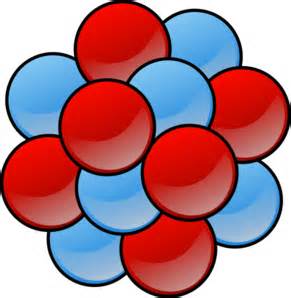
What does the nucleus of an atom contain?
a)
Electrons and neutrons
b)
Protons and neutrons
c)
Neutrinos and positrons
d)
DNA and RN
21.

The atoms along the staircase are called
a)
metals
b)
nonmetals
c)
metalloids
d)
noble gases
22.
Which of the following is not a compound?
a)
HCl
b)
Cl
c)
NaCl
d)
CO2
23.

Which of the following occurs when a liquid becomes a gas?
a)
the particles slow down
b)
the particles beak away from one another
c)
the particles move closer together
24.

At higher temperatures
a)
particles in an object have less energy
b)
particles in an object move faster
c)
a gas contracts
25.
Is melting butter for popcorn a chemical or physical change?
a)
chemical
b)
physical
26.
How many elements are in C6H12O6?
a)
1
b)
2
c)
3
d)
4
27.
Something that takes up space and has mass.
a)
volume
b)
matter
c)
mass
d)
density
28.
A watermelon has more matter than a grape, so it has more
a)
mass
b)
eat
c)
solid
d)
greater
29.
In a ___________change, a substance changes into a different substance.
a)
Physical
b)
Chemical
30.
A recipe for a chemical substance is called a ________ _________.
a)
coefficent
b)
chemical formula
c)
Oxygen
d)
atom
31.
___________________is the force that works against motion and occurs whenever two objects touch.
a)
Gravity
b)
Magnetism
c)
Friction
d)
Electriciy
32.
The force of attraction between any two objects that have mass is called _________________.
a)
gravity
b)
Magnetism
c)
Electricity
d)
friction
33.
When you coil a wire around an iron core and run a current through the wire you create an _______________________________.
a)
Electromagnet
b)
Generator
c)
Motor
d)
Spring Scale
34.
Any push or pull is a _____________________________.
a)
Magnet
b)
Force
c)
Circuit
d)
Newton
35.
The measurement that combines the force of gravity pulling on an object and the mass of an object is _____________________.
a)
Density
b)
Volume
c)
Mass
d)
Weight
36.
Forces are measured in ______________________.
a)
Grams
b)
Pounds
c)
Newtons
d)
Millimeters
37.
Why does the Earth exert gravitational force on objects on its surface?
a)
it has mass
b)
it rotates
c)
it has volume
d)
it's in space
38.
Explain why an astronaut's weight would change if she went on a mission to the moon. How would the astronaut’s weight change?
a)
Her weight would increase because the moon has less mass than Earth
b)
Her weight would decrease because there is no gravity on the moon
c)
Her weight would increase because the moon has less mass than the Earth
d)
Her weight would decrease because the moon has less mass than the Earth
39.
The law of universal gravitation is credited to whom?
a)
Einstein
b)
Galileo
c)
Darwin
d)
Newton
40.
Which of the following never changes no matter where in the universe?
a)
weight
b)
force
c)
mass
d)
pounds
41.

A person not paying attention while skateboarding hits a rock. The skateboard stops...they don't.
a)
The Law of Inertia
b)
The Law of Acceleration
c)
The Law of Conservation of Momentum
42.
Who discovered the Laws of Motion
a)
Aristotle
b)
Sir Issac Newton
c)
Albert Einstein
d)
Ms. Conklin
43.
Which Law is this?
An object at rest will stay at rest and an object in motion will stay in motion until acted upon by an unbalanced force
An object at rest will stay at rest and an object in motion will stay in motion until acted upon by an unbalanced force
a)
First Law
b)
Second Law
c)
Third Law
d)
Fourth Law
44.
Which law is this?
The acceleration of an object as produced by a net force is directly proportional to the magnitude of the net force, in the same direction as the net force, and inversely proportional to the mass of the object.
The acceleration of an object as produced by a net force is directly proportional to the magnitude of the net force, in the same direction as the net force, and inversely proportional to the mass of the object.
a)
First Law
b)
Second Law
c)
Third Law
d)
Fourth Law
45.
Which Law is this?
For every action there is an equal and opposite reaction
For every action there is an equal and opposite reaction
a)
First Law
b)
Second Law
c)
Third Law
d)
Fourth Law
46.
____________ is the ability to cause change.
a)
Energy
b)
Force
c)
Friction
d)
Motion
47.
Energy due to motion is ____________ energy.
a)
Potential
b)
Energy
c)
Kinetic
d)
Friction
48.
The faster an object moves, the ________ kinetic energy it has.
a)
more
b)
less
c)
none of the above
d)
all of the above
49.
__________ is stored energy.
a)
Potential
b)
Kinetic
c)
None of the above
d)
All of the above
50.

What kind of energy is in a person climbing a ladder?
a)
Potential
b)
Kinetic
c)
Both
51.
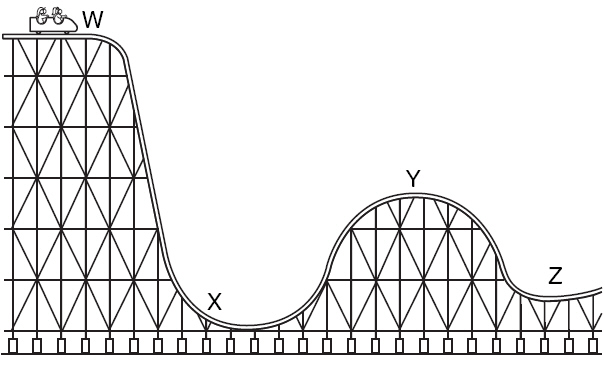
At which point is potential energy greatest?
a)
W
b)
X
c)
Y
d)
Z
52.
Energy can be _____________ or changed from one type to another.
a)
destroyed
b)
transferred
c)
created
d)
ignored
53.
WHEN AN ARCHER BENDS A BOW, WHAT TYPE OF ENERGY INCREASES IN THE BOW?
a)
GRAVITATIONAL
b)
ELASTIC
c)
KINETIC
d)
THERMAL
54.
AS A ROLLER COASTER MOVES DOWN A HILL, POTENTIAL ENERGY IS CONVERTED INTO KINETIC ENERGY, THERMAL ENERGY, AND SOUND ENERGY. WHAT IS TRUE ABOUT THE TOTAL ENERGY OF THIS SYSTEM?
a)
ENERGY IS GAINED (CREATED) AS THE ROLLER COASTER MOVES
b)
ENERGY IS LOST (DESTROYED) AS THE ROLLER COASTER MOVES
c)
THE TOTAL ENERGY REMAINS THE SAME AS THE ROLLER COASTER MOVES
d)
THE TOTAL ENERGY CONSTANTLY CHANGES AS THE ROLLER COASTER MOVES
55.
Friction makes things stop. What happens to the energy of a moving object when friction makes the object stop
a)
It turns to heat and goes to the surrondings
b)
it disapears
c)
it all turns to potential energy
56.

What kind of energy is in a battery?
a)
Potential
b)
Kinetic
57.
Hot coffee is stirred with a spoon; the spoon gets hot due to
a)
conduction
b)
convection
c)
radiation
58.
"Lava lamps" contain colored liquids. These liquids form globs that rise to the top due to
a)
conduction
b)
convection
c)
radiation
59.
Some cook pans have cooper on the bottom to heat evenly.
Copper transfers heat to the pan by
Copper transfers heat to the pan by
a)
conduction
b)
convection
c)
radiation
60.
Warm air over the beach rises while cooler, dense air from the ocean rushes in due to
a)
conduction
b)
convection
c)
radiation
61.
Weather systems in the Earth's atmosphere are due to
a)
conduction
b)
convection
c)
radiation
62.
What is the definition of CONVECTION
a)
When heat transfers through waves.
b)
When heat transfers from objects that are touching.
c)
a hot liquid or air that expands, becomes less dense, and rises or becomes more dense, and sinks.
d)
Heat traveling from the sun
63.
Which electromagnetic waves have the highest frequencies and the shortest wavelengths? (they're the strongest waves)
a)
microwaves
b)
visible light
c)
gamma rays
64.

EM waves________________travel through space.
a)
Never
b)
Cannot
c)
Can
d)
Wish they could
Reset

