Wayground logo

Free Printable Worksheets

Font size

S
M
L
XL
Worksheets

2018 Spring Final Exam

Total questions: 101

Worksheet time: 1hrs 7mins

Name
Class
Date
1.
The Law of Inertia
a)
Newton's
1st
Law of Motion
b)
Newton's
2nd
Law of Motion
c)
Newton's
3rd
Law of Motion
2.

Force = Mass x Acceleration

a)

Newton's

1st

Law of Motion

b)

Newton's

2nd

Law of Motion

c)

Newton's

3rd

Law of Motion

3.
For every action, there is an equal and opposite reaction.
a)
Newton's
1st
Law of Motion
b)
Newton's
2nd
Law of Motion
c)
Newton's
3rd
Law of Motion
4.
The process of breaking down food
a)
homoestasis
b)
circulation
c)
digestion
d)
respiration
5.
maintaining steady internal conditions when external conditions change
a)
homoestasis
b)
circulation
c)
digestion
d)
respiration
6.
removes liquid and gas wastes from the body
a)
digestive system
b)
lymphatic system
c)
excretory system
d)
endocrine system
7.
supplies the body with oxygen and expel harmful carbon dioxide.
a)
respiratory system
b)
lymphatic system
c)
circulatory system
d)
endocrine system
8.
sends signals to the body and controls processes in the body by producing hormones
a)
excretory system
b)
nervous system
c)
endocrine system
d)
muscular system
9.
contains glands such as the adrenal glands or thyroid gland and other organs like the ovaries, testes, and pancreas
a)
excretory system
b)
nervous system
c)
endocrine system
d)
circulatory system
10.
When tissues come together, they form ___________.
a)
cells
b)
atoms
c)
organs
d)
systems
11.
Wearing your seat belt, safety helmets, and following safety rules are examples of protecting what body system?
a)
Endocrine System
b)
Urinary system
c)
Nervous System
12.
In humans, the gases oxygen and carbon dioxide must be exchanged between the environment and cells. During this exchange, oxygen is delivered to the red blood cells so that they can function properly in the blood stream. Which two body systems are working together to achieve this goal?
a)
Digestive system and circulatory system
b)
Endocrine system and respiratory system
c)
Integumentary system and immune system
d)
Respiratory sytem and circulatory system
13.
Which of these is the most complex?
a)
brain
b)
red blood cell
c)
muscle tissue
d)
cow
14.
largest organ in the body
a)
skin
b)
heart
c)
stomach
d)
trachea
15.
Which system produces sperm and egg cells?  In females, it also nourishes the fetus.
a)
reproductive
b)
endocrine
c)
nervous
d)
lymphatic
16.
I have separate male and female systems.
a)
Reproductive System
b)
Muscular System
c)
Nervous System
d)
Digestive System
17.
What does the arrow represent in a food web?
a)
It shows which animals live next to each other.
b)
The flow of water from one organism to another
c)
The flow of energy from one organism to another
d)
It shows how diseases are passed from one organism to another
18.
Where do krill get their energy from?
a)
Phytoplankton
b)
Fish
c)
Phytoplankton & Fish
d)
Blue Whale
19.
Which is true about this food web?
a)
Elephant seals get their energy from penguins
b)
Elephant seals get their energy from killer whales
c)
Elephant seals eat killer whales
d)
Elephant seals and penguins compete for squid
20.
If seaweed and phytoplankton are removed from the ecosystem, what is true about the populations of the remaining organisms?
a)
The populations will decrease
b)
The populations will increase
c)
No change will take place
d)
Some populations will increase and some will decrease
21.
Which organisms are the producers in this food web?
a)
Fox and Buzzard
b)
Dragonfly, Berries, and Plantains
c)
Berries and Plantains
d)
Berries, Butterfly, and Greenfly
22.
Trees in an ecosystem compete for which abiotic factor(s)?
a)
sunlight
b)
water
c)
space
d)
all of the options
23.
Which is an example of a primary producer?
a)
small shrubs
b)
rabbits
c)
coyotes
d)
earthworms
24.
Which is an example of a decomposer?
a)
small shrubs
b)
rabbits
c)
coyotes
d)
earthworms
25.
Which group (level) contains the largest population and energy in the ecosystem?
a)
Primary producers
b)
secondary consumers
c)
tertiary consumers
d)
primary consumer
26.
What is a biotic factor?
a)
A nonliving thing that influences or affects an ecosystem
b)
Anything living or nonliving in an ecosystem
c)
A living thing that influences or affects an ecosystem
d)
A chemical compound in an ecosystem
27.
What is an abiotic factor?
a)
A nonliving thing that influences or affects an ecosystem
b)
Anything living or nonliving in an ecosystem
c)
A living thing that influences or affects an ecosystem
d)
A chemical compound in an ecosystem
28.
What is a predator in an ecosystem?
a)
An organism that creates its own food through photosynthesis
b)
An organism that is hunted for food
c)
An organism that hunts for food
d)
An organism that lives on/in another organism for survival
29.
What is a prey in an ecosystem?
a)
An organism that creates its own food through photosynthesis
b)
An organism that is hunted for food
c)
An organism that hunts for food
d)
An organism that lives on/in another organism for survival
30.
Adding chemical fertilizer to a yard helps keep the grass looking nice. What is a negative impact to the surface water?
a)
Fertilizer can be harmful to organisms in the yard.
b)
The soil undergoes a chemical change.
c)
The chemicals stay in the yard for years.
d)
The runoff from the grass puts harmful chemicals into streams and rivers.
31.
What is biodiversity?
a)
All of the abiotic factors in an ecosystem
b)
All of the different types of one organism in a region or ecosystem
c)
The variety of different types of organisms found in a region or ecosystem
d)
The abiity for organisms to adapt to their environment over time
32.
Which of the following are abiotic factors in a marine environment?
a)
Sunlight which allows producers to perform photosynthesis
b)
Coral populations
c)
Small fish that school together for survival
d)
Seaweed that lives near the surface of the water
33.
Snow, sleet, hail, and rain are all examples of  ________________. 
a)
evaporation
b)
condensation
c)
accumulation
d)
precipitation
34.
What is it called when WATER is FORMED from an LIQUID to a WATER VAPOR Oor an [GAS]?
a)
EVAPORATION
b)
PRECIPITATION
c)
TRANSPIRATION
35.
What is it called when plants give off water vapor as a waste product?
a)
condensation
b)
evaporation
c)
sublimation
d)
transpiration
36.
What is water vapor?
a)
Water on the land (geosphere)
b)
Water in the air (atmosphere)
c)
Water in plants
d)
Water in the water (hydrosphere)
37.
The water cycle has no start or end
a)
true
b)
false
38.
Discharge from a pipe entering a river is point source pollution
a)
True
b)
False
39.
An estuary has this kind of water:
a)
Salt
b)
Fresh
c)
Salt and Fresh
d)
None of the above
40.
Succession that occurs in an area with NO SOIL
a)
ecological succession 
b)
primary succession 
c)
secondary succession
d)
pioneer speciles
41.
Starts with BARE ROCK followed by lichen
a)
primary succession 
b)
secondary succession
c)
both types of succession
42.
The final stable community of plants and animals is called:
a)
pioneer community
b)
farmland
c)
climax community
d)
old field
43.
Reaches a climax community quicker because soil is already present
a)
primary succession 
b)
secondary succession
c)
both types of succession
44.
What are the pioneer species for secondary succession?
a)
lichen
b)
moss
c)
grass
d)
algae
45.
A hurricane hits coastal prairie and destroys the habitat. Years later there is an appearance of small plants with rapidly spreading roots on newly formed coastal sand dunes. The vegetation describes-
a)
a microhabitat
b)
primary succession
c)
secondary succession
d)
biodiversity
46.
How is secondary succession different from primary succession?
a)
Secondary succession occurs after a disturbance in an area that was previously uninhabited.
b)
Secondary succession occurs after a disturbance in an area in which the soil has remained intact.
47.

Which biome contains the most biodiversity?

a)

Temperate Forest

b)

Boreal Forest (Taiga)

c)

Tropical Rain Forest

d)

Grassland / Savannah

48.

This biome is found on nearly every continent and contains fertile soil and mostly short vegetation

a)

Grasslands

b)

Desert

c)

Tundra

d)

Taiga

49.

This Biome receives less than 10 inches of rain a year

a)

Tundra

b)

Taiga

c)

Grassland

d)

Desert

50.

Which biome is found only along the equator?

a)

Taiga

b)

Temperate Forest

c)

Rain Forest

d)

Tundra

51.

What biome is this?

a)

Taiga

b)

Tundra

c)

Grassland

d)

Rain Forest

52.

This biome has very short flowers, less than 10 inches of rain and has permafrost.

a)

Taiga

b)

Temperate Forest

c)

Grassland

d)

Tundra

53.

A species is a group of similar organisms that

a)

can mate with each other and produce fertile offspring (have babies)

b)

can live together on an island

c)

can migrate to an island from the mainland

54.

A trait that helps an organism survive and reproduce is called a(n)

a)

mutation

b)

adaptation

c)

variation

55.

What did Darwin observe about finches (a kind of bird) in the Galapagos Islands?

a)

Their beaks were adaptations related to the foods the finches ate

b)

They had identical phenotypes in all locations (all looked the same)

c)

They had identical genotypes in all locations (were all made the same)

56.

Which term refers to the process by which individuals that are better adapted to their environment are more likely to survive and reproduce?

a)

natural selection

b)

overproduction

c)

competition

57.

Darwin concluded that organisms on the Galapagos Islands

a)

had changed over time

b)

had remained the same (never changed)

c)

had no variations (were all the same)

58.

According to Darwin's theory of natural selection, why do species evolve over time?

a)

Only the fittest (strongest) survive to reproduce

b)

Members of a species work together to survive

c)

Organisms cause changes to their environment

59.

In a population of cod fish, a scientist notices that some fish have larger fins than others. These differences among the traits of organisms in a population are know as

a)

variations

b)

extinction

c)

competition

60.
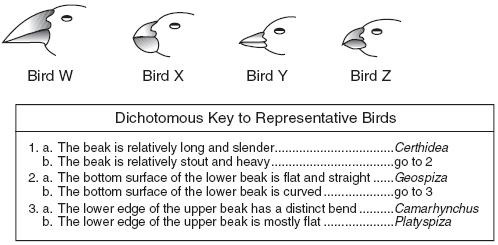
What is the purpose of a dichotomous key?
a)
to find a common ancestor
b)
to show the evolution of organisms
c)
to see what organisms eat
d)
to identify organisms
61.
What is the name of bird W?
a)
Certhidea
b)
Geospiza
c)
Camarhynchus
d)
Platyspiza
62.
The proces where soil and rock are moved from one place to another.
a)
Deposition
b)
Abrasion
c)
Erosion
d)
conservation
63.
Water stored below the Earth's surface is called:
a)
Groundwater
b)
Bogs
c)
Water in the ground
64.
The materials that make up Aquifers A and B are
a)
permeable
b)
impermeable
65.
What gas is released by plants from the process of photosynthesis?
a)
air
b)
carbon dioxide
c)
oxygen
d)
hydrogen
66.
Which of the following is the correct equation for PHOTOSYNTHESIS?
a)
carbon dioxide + water --> oxygen + glucose
b)
carbon dioxide + glucose + water --> oxygen 
c)
oxygen + water --> carbon dioxide + glucose
d)
glucose+ oxygen ---> water + carbon dioxide 
67.
Producers capture energy from
a)
sunlight
b)
food
c)
plants
d)
sugar
68.
What is the source of energy for photosynthesis?
a)
carbohydrates-chemical
b)
sunlight-radiant
c)
heat-thermal
d)
television-electrical
69.
The Baltomore Oriole has the scientific name: Icterus galbula. What taxonomic levels do the scientific name include? 
a)
Genus and species
b)
Phylum and genus
c)
Kingdom and phylum
d)
Class and species
70.
Which of the following is the correct way to write the scientific name of a house cat? (imagine that these options are all in italics)
a)
Felis Domesticus
b)
felis domesticus
c)
Felis domesticus
d)
felis Domesticus
71.
You should not underline a scientific name.
a)
True
b)
False
72.

All bodies of fresh water, salt water, ice, and snow that are found above ground

a)

Groundwater

b)

Surface water

c)

Runoff

d)

Swimming pool

73.

A ___________________ is the area of land where the surface water and groundwater drain into a particular body of water; separated from other watersheds by drainage divides

a)

village creek

b)

gully

c)

stream channel

d)

watershed

74.

water held underground in the soil or in pores and crevices in rock.

a)

groundwater

b)

aquaifer

c)

water table

d)

Mrs. Gleasmann's coffee

75.

A layer of permeable rock that retains and filters water is

a)

Aquifer

b)

Mrs. Dyess' Keurig

c)

watershed

d)

surface water

76.

A single identifiable and localized source of water pollution, such as wastewater discharge into a stream is

a)

Point source water pollution

b)

Nonpoint scource water pollution

c)

Trash cans

d)

drainage divide

77.

Pollutants introduced into surface or groundwater that are without a specific location source, such as water flowing over a lawn that has been fertilized and into a drain is called

a)

Nonpoint source water pollution

b)

Point source water pollution

c)

Permeable rock

d)

Room 206 Zone

78.
Violent shaking of the ground as a result of plate tectonic movement along faults; causing a sudden shift in landscape, gas lines breaking causing fires and building falling 
a)
Earthquake
b)
Tsunami
c)
Volcanic Eruption
79.
A prolonged period of abnormally low rainfall which results in a loss of plant and animal life, including crops 
a)
Drought
b)
Volcano
c)
Blizzard
80.
A mountain with a vent from which lava and ash flow 
a)
Volcano
b)
Drought
c)
Landslide
81.
Fire caused by lightning or by a person in a wooded area
a)
Wildfire
b)
Drought
c)
Mudslide
82.
Long, high sea wave caused by an earthquake in the ocean; causes massive flooding, a change in landscape, and a decrease in population 
a)
Tsunami
b)
Earthquake
c)
Volcanic Eruption
83.
Storm with violent wind, warm water, low pressure and revolution
a)
Hurricane
b)
Tsunami
c)
Flood 
84.
An overflow of a large amount of water beyond its normal confines; removes critical sediments, and causes a temporary decrease in populations
a)
Flood
b)
Tsunami
c)
Hurricane
85.
Destructive vortex of violent winds; devastating to anything in its path, possible loss of populations
a)
Tornado
b)
Tsunami 
c)
Wildfire
86.
_________________happens when gravity moves sediment downhill.
a)
Weathering only
b)
Mass movement
c)
Erosion only
d)
Gravity
87.
Which is NOT a type of mass movement?
a)
landslide
b)
slump
c)
mudflow
d)
windstorm
88.
The slowest type of mass movement is called a _____________________.
a)
slump
b)
creep
c)
landslide
d)
mudflow
89.
This is a picture of a
a)
slump
b)
creep
c)
mudflow
d)
landslide
90.

Which ecoregion would have flooding?

a)

High Plains

b)

Edwards Plateau

c)

Piney Woods

d)

Gulf Coast Prairies and Marshes

91.

An astronaut should not remove his or her helmet while working outside the space station because the helmet provides -

a)

hydrogen

b)

nitrogen

c)

argon

d)

oxygen

92.

The accommodation that is designed to help overcome the unique difficulties associated with using the restroom in space is –

a)

a vacuum system to control the flow of waste

b)

a drain in the floor of the bathroom

c)

a skid-proof floor mat

d)

a bench in the bathroom

93.

Can you explain the "Goldie Locks" idea as concerns to life in outer space?

a)

No I can't

b)

Not sure, so

c)

Might be

d)

Yes

94.
For scientific data to be considered accurate and reliable, most science experiments should be
a)
Conducted as many times as possible
b)
Conducted 3 times
c)
Conducted only 1 time
d)
Repeated no more than 2 times
95.
What is the best title of this figure?
a)
The Scientific Method
b)
The Technology Process
c)
The Scientific Arrangement
d)
The Technology Method
96.
What equipment would a scientist most likely use to measure the volume of a liquid?
a)
Graduated cylinder
b)
Triple beam balance
c)
  Ruler
d)
Electron microscope
97.
The dependent variable in this experiment is - 
a)
Number of Bacteria
b)
Time of Incubation
c)
Culture Number
d)
Type of Bacteria
98.
Elin is conducting a scientific investigation in which she measures a certain type of plant's growth in response to different amounts of fertilizer.  What is the independent variable?
a)
Amount of fertilizer
b)
Plant growth
c)
Type of plant
d)
Temperature of fertilizer
99.
What type of graph would best represent the following data?
a)
Line graph
b)
Bar graph
c)
Circle graph
d)
Pictograph
100.
Factors in an experiment that must be kept the same are called - 
a)
constants
b)
variables
c)
experimental error
d)
hypothesis
101.
What can you infer about the temperature for E.coli bacterial growth?
a)
E. coli does not grow well at low and high temperatures.
b)
E coli will continue to grow at very high temperatures.
c)
E.coli grows best at very low temperatures
d)
E.coli grows best at very high temperatures.