
 Worksheets
Honors Chemistry Week 2
Total questions: 87
Worksheet time: 4hrs 28mins
Name
Class
Date
1.

a)
1
b)
2
c)
3
d)
4
2.

a)
2
b)
3
c)
4
d)
5
3.

a)
10
b)
2
c)
8
d)
18
4.

a)
14
b)
4
c)
3
d)
28
5.

This is a correct dot diagram for oxygen (O)
a)
true
b)
false
6.

This is a correct dot diagram for fluorine (F)
a)
true
b)
false
7.
What atom matches this electron configuration?
1s22s22p63s2
1s22s22p63s2
a)
Neon
b)
Magnesium
c)
Aluminum
d)
Potassium
8.
What electron configuration matches an oxygen atom?
a)
1s22s22p63s2, 3p64s23d104p5
b)
1s22s22p4
c)
1s22s22p6
d)
1s22s22p63s23p64s23d1
9.
What atom matches this electron configuration?
1s22s22p63s23p64s23d10
1s22s22p63s23p64s23d10
a)
Zinc
b)
Copper
c)
Nickel
d)
Germanium
10.
How many electrons can the first energy level hold?
a)
1
b)
2
c)
8
d)
0
11.

a)
2
b)
6
c)
10
d)
16
12.
What element has 4 valance electrons and is located in period 3?
a)
Silicon
b)
Carbon
c)
Germanium
d)
Arsenic
13.
The elements in this group all have 5 valance electrons.
a)
Group 5
b)
Group 15
c)
Group 3
d)
Group 18
14.

1. What is the shape of an s orbital?
a)
sphere
b)
dumbbell
c)
double dumbbell
d)
TOO COMPLEX TO KNOW IT.
15.

Which is associated with more energy?
a)
2p
b)
2s
c)
3p
d)
1s
16.
Waves with a large wavelength have a __________ frequency
a)
high
b)
low
17.
How many orbitals are in the f sublevel
a)
1
b)
3
c)
5
d)
7
18.
Which of the following has the highest energy
a)
red
b)
orange
c)
green
d)
purple
19.
Which is a particle of electromagnetic radiation with no mass that carries a quantum of energy?
a)
electron
b)
neutron
c)
microwave
d)
photon
20.
Who determined that it is not possible to simultaneously determine the electron's position and velocity?
a)
Pauli
b)
Hund
c)
Heisenberg
d)
Einstein
21.
What are patterns made when excited electrons emit light of certain wavelengths?
a)
electromagnetic spectra
b)
atomic emission spectra
c)
spectroscopes
d)
prisms
22.
Number of waves per second. Measured in Hertz (Hz)
a)
Amplitude
b)
Wavelength
c)
Frequency
d)
Quantum
23.

What is the shape of a p orbital?
a)
sphere
b)
it's just too complex to thing about it
c)
dumbbell
d)
pyramidal
24.

How many d orbitals are there in a given sublevel?
a)
1
b)
3
c)
5
d)
7
25.

How many electrons can the d sublevel hold?
a)
8
b)
10
c)
2
d)
4
26.

How many total electrons can the f orbitals in a sublevel hold?
a)
2
b)
14
c)
6
d)
10
27.
Chadwick discovered which subatomic particle
a)
Proton
b)
Neutron
c)
Electron
28.
Who came up with an equation which describes the behavior of electrons in terms of waves?
a)
Bohr
b)
Heisenberg
c)
Rutherford
d)
Schrodinger
29.

Which rule is being broken this orbital diagram?
a)
Aufbau Principle
b)
Pauli Exclusion Principle
c)
Hund's Rule
d)
The diagram is correct.
30.
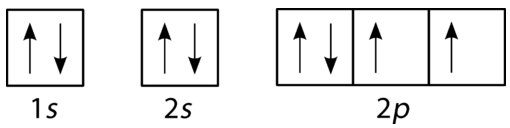
This orbital diagram represents:
a)
C
b)
B
c)
N
d)
O
31.

Which orbital shows a violation of the Pauli Exclusion Principle?
a)
A
b)
B
c)
C
d)
D
32.

Which orbital shows a violation of the Aufbau Principle?
a)
A
b)
B
c)
C
d)
D
33.
Electrons occupy orbitals of lowest energy first is part of what electron configuration rule?
a)
Hund’s Rule
b)
Aufbau Principle
c)
Pauli Exclusion Principle
34.

Which example shows a violation of Hund's Rule?
a)
A
b)
B
c)
C
d)
D
35.

Which rule is being broken with this orbital diagram?
a)
Aufbau Principle
b)
Pauli Exclusion Principle
c)
Hund's Rule
d)
The diagram is correct.
36.
Which group of the periodic table is composed of inert (not reactive) gases?
a)
alkali metals
b)
alkaline earth metals
c)
halogens
d)
noble gases
37.
Elements which are shiny, conduct electricity and heat are called
a)
metal
b)
nonmetal
c)
metalloid
d)
nonexistent
38.

The atoms along the staircase are called
a)
metals
b)
nonmetals
c)
metalloids
d)
noble gases
39.
The atoms along the staircase are called
a)
metals
b)
nonmetals
c)
metalloids
d)
noble gases
40.
Which is a halogen?
a)
Helium
b)
Chlorine
c)
Oxygen
d)
Neptune
41.
Which is an alkali metal?
a)
Magnesium
b)
Iron
c)
Sodium
d)
Europium
42.
Metalloids can be described as...
a)
same as nonmetals
b)
bad conductors
c)
characteristics of metals and nonmetals
d)
same as metals
43.
True or False: Elements in a group have the same number of electrons in their outer shell.
a)
true
b)
false
44.

What section is the least reactive?
a)
yellow
b)
red
c)
dark blue
d)
orange
45.
How many electrons do atoms need to be stable?
a)
1
b)
2
c)
6
d)
8
46.
Which group of elements occur only as compounds in nature because they are extremely reactive?
a)
1
b)
18
c)
11
d)
16
47.
Which of the following would produce an anion?
a)
Ca
b)
Al
c)
K
d)
F
48.
What will nitrogen's charge be as an ion?
a)
+3
b)
-3
c)
0
d)
-1
49.
Cations are _______ that form ____________ ions and __________ electrons.
a)
nonmetals, positive, lose
b)
nonmetals, negative, gain
c)
metals, positive, gain
d)
metals, positive, lose
50.
Anions are _______ that form ____________ ions and __________ electrons.
a)
nonmetals, positive, lose
b)
nonmetals, negative, gain
c)
metals, positive, gain
d)
metals, positive, lose
51.
Which is most likely to form a negative ion?
a)
an element from group 17
b)
a metal
c)
an element from group 1
d)
an element with atoms that have eight valence electrons
52.
When an atom loses a valence electron, it becomes a(n) _____________ ion.
a)
positive
b)
negative
c)
neutral
d)
polyatomic
53.
If an element has 3 valence electrons, what charge will likely form on its ion ?
a)
+3
b)
+5
c)
-3
d)
-5
54.
Ionic Bonding involves...
a)
The transfer of protons
b)
The transfer of nuetrons
c)
The transfer of electrons
d)
None Of the above
55.
Covalent compounds
a)
Share electrons
b)
transfer electrons
c)
contain a sea of electrons
d)
conduct electricity
56.
What two types of atoms make a covalent bond?
a)
2 Nonmetals
b)
1 Nonmetal and 1 Metal
c)
2 Metals
d)
2 Noble Gases
57.

What elements generally make an ionic bond?
a)
metal and nonmetal
b)
2 or more nonmetals
c)
metal
d)
none of the above
58.
Predict the bond that will form between Be and F.
a)
Ionic
b)
Covalent
59.
Predict the bond that will form between Sr and S.
a)
Ionic
b)
Covalent
60.
In order for sulfur to reach an octet, sulfur will...
a)
Gain 2 electrons
b)
Lose 2 electrons
c)
Gain 1 electron
d)
Lose 1 electron
61.
In order for lithium to reach an octet, lithium will...
a)
Gain 2 electrons
b)
Lose 2 electrons
c)
Gain 1 electron
d)
Lose 1 electron
62.
A measure of the size of an atom, and is generally defined as the distance from the nucleus to the outermost electron orbit
a)
chemical reactivity
b)
atomic radius
c)
energy levels
d)
orbit
63.
The minimum energy required to remove an electron from the ground state of an atom
a)
electron configuration
b)
energy levels
c)
ionization energy
d)
ionic bond
64.
As you move down the periodic table atoms get bigger. This is because ____________.
a)
The atoms have more mass.
b)
The atoms have more protons.
c)
The atoms have more energy levels
d)
The atoms have more nuetrons
65.
As you move across the periodic table atoms tend to get smaller because, ______________.
a)
the atoms have more mass.
b)
the atoms have less mass
c)
the atoms have more protons.
d)
the atoms have less electrons.
66.
Name the following ionic compound: BeCl2
a)
beryllium chlorine
b)
beryllium II chloride
c)
beryllium chloride
d)
beryllium dichloride
67.
Name the following compound: FeCl3
a)
iron chloride
b)
iron III chloride
c)
iron chlorate
d)
iron III chlorate
68.
Name the following ionic compound: Cr(NO2)3
a)
chromium nitrite
b)
chromium nitride
c)
chromium III nitride
d)
chromium III nitrite
69.
Name the following ionic compound: LiNO3
a)
lithium nitrate
b)
lithium III nitrate
c)
lithium nitride
d)
lithium oxide
70.
Name the following ionic compound: MgSO4
a)
magnesium sulfoxide
b)
magnesium sulfide
c)
magnesium sulfate
d)
magnesium oxide
71.
Name the following ionic compound: Cs2S
a)
cesium sulfide
b)
cesium sulfate
c)
cesium II sulfate
d)
cesium II sulfide
72.
The chemical formula of lead (IV) nitrate is
a)
PbN₄
b)
PbNO₃₄
c)
Pb(NO₃)₄
d)
Pb₃NO₄
73.
What is the formula for Calcium phosphide?
a)
CaP
b)
Ca2P3
c)
Ca3P2
d)
Ca2P
74.
What is the name of the following ionic compound? Ba3(PO4)2
a)
tribarium diphosphate
b)
barium diphosphate
c)
barium phosphate
d)
barium phosphide
75.
What is the name of the compound with the formula FePO4?
a)
iron phosphate
b)
iron (II) phosphate
c)
iron (IV) phosphate
d)
iron (III) phosphate
76.
Write the formula for the following compound : calcium phosphate
a)
CaPO4
b)
Ca2(PO4)3
c)
Ca3PO4
d)
Ca3(PO4)2
77.
Ionic compounds are written with
a)
cation (+ ion) first then anion (- ion)
b)
anion (- ion) first then cation (+ ion)
c)
either way is fine
78.
What is the name of N2O3
a)
Nitrogen trioxide
b)
Dinitrogen oxide
c)
Dinitrogen trioxide
d)
Nitrogen oxide
79.
What is the chemical formula for Tetrasulfur pentoxide?
a)
SO
b)
S4O
c)
S4O5
d)
S5O4
80.
What is the name of Br6F10 ?
a)
Bromium fluoride
b)
Hexabromine fluoride
c)
Bromium decafluoride
d)
none of the above
81.
What is the chemical formula for Nitrogen triiodide?
a)
NI
b)
N3I
c)
NI3
d)
None of these
82.
What is the chemical formula for Tetraphosphorous Pentachloride ?
a)
4P5Cl
b)
PCl
c)
P4Cl5
d)
none of the above
83.
What is the chemical formula for Fluorine trisulfide ?
a)
S3F
b)
FS3
c)
FS
d)
none of the above
84.
What is the chemical formula for CP ?
a)
Carbon phosphide
b)
Monocarbon phosphide
c)
Carbon monophosphide
d)
none of the above
85.
What is the name of P4S5?
a)
pentasulfur tetraphosphide
b)
pentaphosphorus tetrasulfide
c)
tetraphosphorus pentasulfide
d)
phosphorus pentasulfide
86.
What is the OFFICIAL name for H2O
a)
Hydrogen Oxide
b)
Oxygen Dinitride
c)
Agua
d)
Dihydrogen Monoxide
87.
A binary covalent bond exists between
a)
2 metals
b)
1 metal and 1 nonmetal
c)
2 nonmetals
d)
Any 2 elements
100 %

