wayground logo

Free Printable Worksheets

NEW

Font size

S
M
L
XL
Worksheets

Year 7 review 2017-18

Total questions: 70

Worksheet time: 2hrs 49mins

Name
Class
Date
1.
Which part of a microscope magnifies a sample?
a)
Stage
b)
Lens
c)
Focus Adjustor
d)
Arm
2.
Which part of a cell controls what can enter and leave the cell?
a)
Cell membrane
b)
Cytoplasm
c)
Nucleus
d)
Wall
3.
What is the job of the nucleus?
a)
Controls the cell and contains the DNA
b)
Chemical reactions happen here
c)
It gives the cell structure and support
d)
It is for photocynthesis
4.
What is a tissue?
a)
A group of similar cells that do the same job
b)
A group of different cells that do the same job
c)
A group of similar cells that do different jobs
d)
A group of different cells that do different jobs
5.
What is an organism?
a)
A group of organ systems
b)
A group of organs
c)
A group of tissues
d)
A group of cells
6.
Which organ is not part of the digestive system?
a)
Stomach
b)
Small intestine
c)
Large intestine
d)
Lungs
7.
CaCO3 represents a chemical
a)
Symbol
b)
Formula
c)
Subscript
d)
Reaction
8.
The substances listed on the left side of a chemical equation are the
a)
Products
b)
Coefficients
c)
Precipitates
d)
Reactants
9.
How many Hydrogen (H) atoms are in NH3O5
a)
3
b)
4
c)
5
d)
1
10.

What colour does litmus paper turn when added to an alkali?

a)

Blue

b)

Red

c)

Green

d)

Colourless

11.

What other laboratory substance can you use to test if colourless substance is an acid or an alkali?

a)

Catalyst

b)

Salt

c)

Universal Indicator

d)

Water

12.

Which of the following substance is an alkali?

a)

Vinegar

b)

Distilled water

c)

Baking soda

d)

Lime juice

13.

What happens to the pH of an acid during neutralisation?

a)

It stays the same

b)

It moves toward pH 1

c)

It moves towards pH 7

d)

It moves towards pH 14

14.

A wasp sting is alkali. Which substance would neutralise the sting?

a)

Vinegar

b)

Bleach

c)

Baking soda

d)

Distilled water

15.

Complete this equation:

Acid + Alkali --->

a)

Alkali + Water

b)

Acid + Water

c)

Acid + Alkali

d)

Salt + Water

16.

Which substance is an acid?

a)

Water

b)

Bleach

c)

Orange juice

d)

Washing powder

17.

Which pH levels indicated a strong acid?

a)

1-3

b)

4-6

c)

8-11

d)

12-14

18.

Which pH level indicates a weak alkali?

a)

1-3

b)

4-6

c)

8-11

d)

12-14

19.

Which pH level indicates a strong alkali?

a)

1-3

b)

4-6

c)

8-11

d)

12-14

20.

Acids taste...

a)

Sweet

b)

Salty

c)

Sour

d)

Smooth

21.
Which food contains the most energy per 100g?
a)
Peas
b)
Chips
c)
Cooked beef
d)
Chocolate
22.
Apples contain 200 kJ/100g. Cycling uses 25 kJ/min. How many minutes would you need to cycle to work off 200g of apples?
a)
4
b)
8
c)
10
d)
12
23.
True or false. Energy can be created and destroyed.
a)
True
b)
False
24.
Power is
a)
The energy transferred per hour
b)
The energy transferred
c)
The energy transferred per second
d)
The force over a distance
25.
Which energy source is not renewable?
a)
Wind
b)
Solar
c)
Oil
d)
Biomass
26.
Which energy source will not run out
a)
Petrol
b)
Coal
c)
Oil
d)
Wood
27.
The gas which dissolve to make acid rain is
a)
Carbon dioxide
b)
Sulfur dioxide
c)
Methane
d)
Carbon monoxide
28.
The greenhouse gas made when fuels burn in power stations is
a)
Carbon dioxide
b)
Sulfur dioxide
c)
Methane
d)
Nitrogen oxides
29.

Which of the following is not a part of the male reproductive system?

a)

Penis

b)

Testes

c)

Uterus

30.

Which of the following is not a part of the female reproductive system?

a)

Ovary

b)

Vagina

c)

Sperm duct

31.

What are the male sex cells called?

a)

Sperm cells

b)

Sperm ducts

c)

Scrotum

32.

Where are the male sex cells made?

a)

In the testes

b)

In the sperm duct

c)

In the penis

d)

In the ovaries

33.

What are the female sex cells called?

a)

Cilia

b)

Eggs cells

c)

Cervix

34.

About how long does the menstrual cycle take?

a)

About 5 days

b)

About 14 days

c)

About 28 days

35.

How long is gestation in humans?

a)

28 days

b)

40 weeks

c)

11 years

36.

On what day does ovulation occur?

a)

14

b)

5

c)

1

37.

What structure releases an egg once a month in females?

a)

Testes

b)

Ovaries

c)

Oviduct

38.
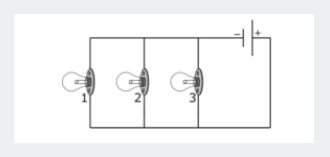
What kind of circuit is this?
a)
series
b)
parallel
39.
If bulb 1 burns out, what will occur?
a)
bulbs 2 and 3 will go out
b)
bulbs 2 and 3 receive more volts
c)
bulbs 2 and 3 will stay lit
d)
nothing will happen
40.
What is a switch's function in a circuit?
a)
to make the current hotter or colder
b)
turn on and off the flow of current
c)
the pathway that current flows
d)
to add more power to the circuit
41.
What type of tissue moves the body? 
a)
Nerve Tissue
b)
Muscle Tissue
c)
Epithelial Tissue
d)
Connective Tissue
42.
The location where two bones meet
a)
Ligament
b)
Joint
c)
Cramp
d)
Dislocation
43.
The picture describes which type of joint?
a)
Pivot Joint
b)
Immovable Joint
c)
Door Knob Joint
d)
Ball-and-Socket Joint
44.
The picture describes which type of joint?
a)
Pivot Joint
b)
Immovable Joint
c)
Hinge Joint
d)
Moving Joint
45.
The Skeletal System does what?
a)
Support your body
b)
Help your body move with muscles
c)
all of the above
d)
protect your organs
46.
What is the name for the connector that attaches muscle to bone?
a)
ligament
b)
tendon
c)
patella
d)
string
47.
What is the name for the connector that attaches bone to bone?
a)
ligament
b)
tendon
c)
patella
d)
string
48.
Condensation is the change of state from _______ to ______ as a result of losing heat energy.
a)
Solid, Liquid
b)
Solid, Gas
c)
Liquid, Gas
d)
Gas, LIquid
49.
Solid particles are...
a)
tightly packed.
b)
loosely bonded and flowing.
c)
free to fly in all directions.
d)
so hot that the electrons are removed from the nucleus.
50.
Gas particles are...
a)
tightly packed.
b)
loosely bonded and flowing.
c)
free to fly in all directions.
d)
so hot that the electrons are removed from the nucleus.
51.
Solid particles have the _________ energy.
a)
most
b)
middle amount of
c)
least
52.
Gas particles have the _______ energy.
a)
most
b)
middle amount of
c)
least
53.
A __________ includes all living and non-living things in an environment. 
a)
population
b)
niche
c)
abitotic
d)
ecosystem
54.
_______ are consumers that eat only meat.
a)
Herbivore
b)
Omnivore
c)
Carnivore
55.
________ are consumers that eat plants and meat.
a)
Herbivore
b)
Omnivore
c)
Carnivore
56.
Which group do fungi, bacteria, and termites belong to?
a)
decomposers
b)
producers
c)
herbivores
d)
omnivores
57.
Which organism make their own food through the process of photosynthesis? 
a)
decomposer
b)
consumer
c)
herbivore
d)
producer 
58.
A girl is pushing a cart by herself with a force of 7 N. What will happen if a boy begins to help her and their combined force is 17 N?
a)
The cart will speed up.
b)
The cart will slow down.
c)
The cart will move at a constant speed in a straight line.
d)
The cart will fly to never never land!
59.
What is the net force?
a)
40 N left
b)
0 N Balalnced
c)
400 N right
d)
40 N right
60.
How will this object move? 
a)
It won't move. 
b)
It will move to the right. 
c)
It will move to the left. 
d)
It will move in both directions. 
61.
How will this object move? 
a)
It won't move. 
b)
It will move to the right. 
c)
It will move to the left. 
d)
It will move up. 
62.
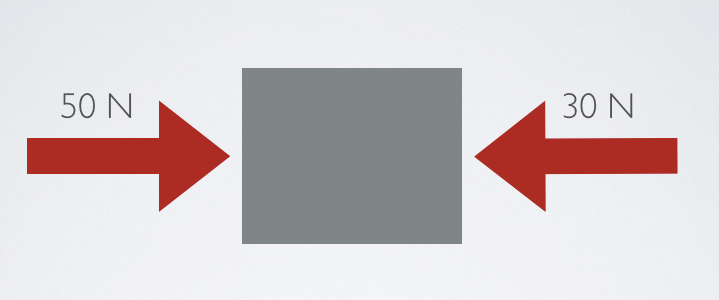
What is the net force?
a)
30 N left
b)
25 N right
c)
5 N left
d)
55 N right
63.
Sound is caused by? 
a)
force
b)
vibrations
c)
instruments
64.
What is vibration?
a)
how loud a sound is
b)
the back and forth movement of matter
c)
how high or low a sound is
d)
the loudness or softness of a sound
65.
What is frequency?
a)
the number of vibrations per second
b)
how high or low a sound is
c)
the loudness or softness of a sound
d)
the back and forth movement of matter
66.
Sound is a form of? 
a)
energy
b)
pitch
c)
volume
67.
Measure of how high or low a sound is
a)
amplitude
b)
compression
c)
speed of sound
d)
pitch
68.
What is gold?
a)
element
b)
compound
c)
mixture
69.
What is sugar?
a)
element
b)
compound
c)
mixture
70.
What is water?
a)
element
b)
compound
c)
mixture