wayground logo

Free Printable Worksheets

Font size

S
M
L
XL
Worksheets

Grade 8 - Visible Light

Total questions: 88

Worksheet time: 54mins

Name
Class
Date
1.
What is the name of the energy that comes from the sun?
a)
Electromagnetic Radiation
b)
Electromagnetic Conduction
c)
Electromagnetic Convection
d)
Magnelectric Radiation
2.
What shape does light travel in?
a)
Waves
b)
Circles
c)
Squares
d)
Diamonds
3.
Light is predictable because it will always travel in a _________ line.
a)
Curvy
b)
Straight
c)
Backwards
d)
Crazy
4.
What does light do when it hits a smooth, flat surface?
a)
Reflect
b)
Refract
c)
Absorb
d)
Diffuse
5.
What does light do when it hits an object that it cannot pass through?
a)
It creates a shadow
b)
It passes through anyway
6.

If light passes through two different types of mediums, it will do what?

a)

Reflect

b)

Refract

c)

Absorb

d)

Diffuse

7.
If someone is wearing a black shirt in the sunshine, what will the black do to the light?
a)
Reflect it
b)
Absorb it
c)
Refract it
d)
Diffuse it
8.
If light strikes a mirror at a 50⁰ angle, what angle will it come off of the mirror?
a)
50⁰
b)
70⁰
c)
45⁰
d)
30⁰
9.
Why does the pencil look broken?
a)
Light is refracting
b)
Light is reflecting
c)
Light is absorbing
d)
Light is diffusing
10.
Which color absorbs all light?
a)
White
b)
Black
c)
Orange
d)
Green
11.
Which color reflects all light?
a)
White
b)
Black
c)
Orange 
d)
Green
12.
When light shines through a prism it creates a ________________
a)
colors
b)
ROY G. BIV
c)
spectrum
d)
electromagnetic wave
13.
Material that allows light to pass through allowing you to see "clearly" to the other side
a)
opaque
b)
translucent
c)
transparent
14.
Light is a form of 
a)
energy
b)
radiation
c)
reflection
15.
What is the short, thick nerve through which signals travel to the brain from the eye?
a)
Lens
b)
Retina
c)
Optic Nerve
d)
Cornea
16.
Visible light is ...
a)
Light bulb
b)
sun
c)
light that we can see with our natural eye
d)
fire
17.
What is reflection in simple terms?
a)
Soaks up light
b)
Passes through
c)
light bounces off
18.
____________________ is the hole through which light enters the eye.
a)
Cornea
b)
Iris
c)
Retina
d)
Pupil
19.
_________________ is the transparent front surface of the eye
a)
Pupil
b)
Cornea
c)
Lens
d)
Iris
20.
What does refract mean?
a)
To shrink
b)
To bend
c)
To widen
d)
To enlarge
21.
What is the speed of light in a vacuum?
a)
300,000,000 km/s
b)
300,000 km/s
c)
3,000 km/s
d)
300 km/s
22.
The part of the electromagnetic spectrum that human sees is
a)
ultraviolet light.
b)
visible light.
c)
infrared light.
d)
x-ray.
23.

What is the function of a Concave Lens?

a)

Make things bigger

b)

Make things smaller

c)

Make things closer

d)

Make things happy

24.

What is the function of a Convex Lens?

a)

Make things bigger

b)

Make things smaller

c)

Make things closer

d)

Make things sader

25.
The number of wavelengths that pass a point each per second is:
a)
frequency
b)
period
c)
longitudinal 
d)
transverse wave 
26.
_____ is a lens that is thicker in the middle and makes an object appear bigger.
a)
prism
b)
convex lens
c)
concave lens
d)
mirror
27.
______ is a lens that is thicker on its edges and makes an object appear smaller?
a)
mirror
b)
convex lens
c)
concave lens
d)
prism
28.
a nearsighted person needs a _____lens to correct their vision
a)
concave
b)
convex
c)
plane
d)
thick
29.
a farsighted person needs a _____lens to correct their vision
a)
concave
b)
convex
c)
plane
d)
thick
30.
As light rays pass from one medium into another medium, the light rays
a)
are refracted
b)
are blocked
c)
form an image that is upside down and smaller
d)
form an image that is upright and larger
31.
When light passes through a(n) ______lens, the light rays are refracted apart. 
a)
convex
b)
concave
32.
When light passes through a(n) ______lens, the light rays are refracted together. 
a)
convex
b)
concave
33.
The ray of light that strikes a reflecting surface is called ________.
a)
incident ray
b)
reflected ray
c)
normal ray
d)
none of the above
34.
As the light bounces off a smooth surface, it will be reflected at the same angle as it hits the surface. This happens in a _______ type of reflection.
a)
diffused
b)
specular
c)
diffusission
d)
spectacular
35.
The imaginary line perpendicular to a reflecting surface is called _____.
a)
crooked line
b)
parallel line
c)
angular line
d)
normal line
36.
The angle produced as a source of light bounces off a reflecting surface is called ______.
a)
angle of crookedness
b)
angle of reflection
c)
angle of incidence
d)
angle of bounce
37.
MCQ 02
Why can you see most objects?
a)
A. they emit light
b)
B. light refracts through them
c)
C. light reflects off them
d)
D. they absorb light
38.
MCQ 08
If a capital letter R is seen in an ordinary mirror, what does it look like?
a)
A
b)
B
c)
C
d)
D
39.
MCQ 011
According to the laws of reflection, if i = angle of incidence and r = angle of reflection,
a)
A. i =  r
b)
B. i >  r
c)
C. r >  i
d)
D. i is not equal to r
40.
MCQ 012
A ray of light is incident on a plane mirror and the angle of reflection is 50 degrees. What is the angle between the incident ray and the reflected ray?
a)
A. 50 degrees
b)
B. 25 degrees
c)
C. 90 degrees
d)
D. 100 degrees
41.

MCQ 013

A ray of light is incident on a plane mirror and the angle of incidence is 250. What is the angle of reflection?

a)

A. 00

b)

B. 500

c)

C. 900

d)

D. 250

42.
MCQ 018
What is the value of the unknown angle (theta) in the following diagram?
a)
A. 30 degrees
b)
B. 45 degrees
c)
C. 90 degrees
d)
D. 60 degrees
43.
MCQ 01
Which of the following is the speed of light?
a)
A. 3 metres per second
b)
B. 30 metres per second
c)
C. 300 metres per second
d)
D. 300 000 000 metres per second
44.
MCQ 020
Which diagram shows the correct image of the key in a plane mirror?
a)
A
b)
B
c)
C
d)
D
45.
Section B1a
Given that the angle of incidence = 30 degrees
a. Draw a ray diagram, labelling clearly the normal, incident ray, angle of incidence, reflected ray and angle of reflection accurately.
Which is the correct diagam? 
a)
A
b)
B
c)
C
d)
D
46.
Section B1c
What laws are you applying when you draw this ray diagram? State the two laws. 
a)
Laws of Reflection
1. The angle of incidence = angle of reflection.
2. The incident ray, the reflected ray and the normal (line perpendicular to the plane of the mirror/ reflective surface) all lie in the same plane.
b)
Laws of Mirror
1. The angle of incidence = angle of reflection.
2. The incident ray, the reflected ray and the normal (line perpendicular to the plane of the mirror/ reflective surface) all lie in different planes
c)
Laws of Light
1. The angle of incidence = angle of reflection.
2. The incident ray, the reflected ray and the normal (line perpendicular to the plane of the mirror/ reflective surface) all lie in the same plane
d)
Laws of Irregular Reflection
1. The angle of incidence = angle of reflection.
2. The incident ray, the reflected ray and the normal (line perpendicular to the plane of the mirror/ reflective surface) all lie in the same plane
47.
Section B2b
State three characteristics of the image F.
Which is correct?
[3]
Virtual or Behind the mirror, Upright, Laterally inverted, Same size as the object
a)
1. Virtual
2. Upright
3. Inverted
b)
1. Not the same size
2. Upright
3. Laterally inverted
c)
1. Virtual
2. Upright
3. Laterally inverted
d)
1. Virtual
2. Upright
3. Not the same distance form the mirror as the object is from the mirror
48.
Section B2c(i)
Which is the correct mirror image of the word SCIENCE? 
a)
A
b)
B
c)
C
d)
D
49.
What does incidence angle equal?
a)
reflection angle
b)
∠C
c)
∠D
d)
all of these
50.
What is line "EO" called if "O" is the point of the ray meets the mirror?
a)
normal
b)
medium
c)
mean
d)
equal
51.
Seeing your face in a mirror is an example of 
a)
Refraction
b)
Fiber Optics
c)
Reflection
d)
Absorption
52.
Why does light reflect of water?
a)
Because that is how phisics work
b)
Because it is science
c)
Because of the rough surface
d)
Because of the smooth surface
53.
When light reflects off of a completely smooth surface it reflects in which way?
a)
Regular Reflection
b)
Diffuse Reflection
c)
Refraction
d)
Color Reflection
54.
straight lines that represent light waves
a)
rays
b)
image
c)
reflection
d)
visible light
55.
a reflection that occurs when parallel rays of light hit a smooth surface
a)
regular reflection
b)
diffuse reflection
c)
real image
d)
virtual image
56.
a reflection that occurs when parallel rays of light hit an uneven surface
a)
regular reflection
b)
diffuse reflection
c)
real image
d)
virtual image
57.
Which picture represents someone seeing the color we think of as RED? 
a)
A
b)
B
c)
C
d)
D
58.
Which picture represents someone seeing the color we think of as YELLOW? 
a)
A
b)
B
c)
C
d)
D
59.
Which picture represents someone seeing the color we think of as WHITE? 
a)
A
b)
B
c)
C
d)
D
60.
Which picture represents someone seeing the color we think of as BLACK? 
a)
A
b)
B
c)
C
d)
D
61.
Indicate the color a pure red apple would appear if illuminated by white light.  
a)
red
b)
white
c)
black
d)
green
62.
Indicate the color a pure red apple would appear if illuminated by red light.  
a)
red
b)
white
c)
black
d)
green
63.
Indicate the color a pure red apple would appear if illuminated by blue light.  
a)
red
b)
white
c)
black
d)
green
64.

When light is transmitted, it is

a)

given off

b)

taken in

c)

bent

d)

bounced

65.

What is the correct order of colors from longest to shortest wavelength?

a)

red, orange, yellow, green, blue, indigo, violet

b)

red, orange, yellow, blue, green, indigo, violet

c)

red, orange, yellow, green, blue, violet, indigo

d)

red, orange, yellow, violet, green, blue, indigo

66.

What does a transparent material do?

a)

lets all or most of the light go through

b)

lets some light go through

c)

prevents all light from going through

67.

What does a translucent material do?

a)

lets all or most of the light go through

b)

lets some light go through

c)

prevents all light from going through

68.

What does an opaque material do?

a)

lets all or most of the light go through

b)

lets some light go through

c)

prevents all light from going through

69.

When something looks yellow,

a)

yellow light is reflected and other colors are absorbed

b)

only yellow light makes up that object

c)

yellow light is absorbed

70.

The material a wave travels through is called

a)

solid

b)

liquid

c)

gas

d)

medium

71.
Which images are opaque?
a)
A & C
b)
A,C,E, & F
c)
D, E, & F
d)
A & E
72.
What does refletion mean?
a)
It is when the light changes the material and the direction of it changes as well. 
b)
It is when the material is rebounding the light.
73.
When a rainbow is formed outside naturally, what causes the light to refract?
a)
A. Small raindrops
b)
B. Sunlight rays
c)
C. Tiny mirrors
d)
D. Glass prisms
74.
Why do we see objects as white?
a)
They absorb all light
b)
They reflect all light
c)
They absorb some light and reflect some light
75.
The Law of Reflection:
The angle of incidence is _________ the angle of reflection
a)
bigger than
b)
the same as
c)
smaller than
76.
When light passes through a prism the light is bent and breaks into the visible spectrum. What color bends the most and has the shortest wavelength?
a)
Red
b)
Yellow
c)
Blue
d)
Violet
77.
Band of color in a rainbow, or from a light passing through a prism.
a)
Spectrum
b)
Space
c)
Prism
d)
Refraction
78.

What might explain why light travels in a straight line?

a)

If there is nothing to interfere with light waves, they should travel in a straight line.

b)

Light waves will always travel in a straight line, even if they come into contact with another object.

c)

Light waves don't travel in a straight line.

d)

Light waves travel in a straight line because sound waves travel in a straight line.

79.

What is it called when light bends as it moves from one substance to another?

a)

absorption

b)

reflection

c)

refraction

d)

incidence

80.

Why doesn’t the surface of a wooden boat reflect light as the surface of water does?

a)

because the boat's surface is rough and absorbs more light

b)

because the surface of the boat is red, not blue

c)

because the boat is not a natural object like the water is

d)

because the boat is on top of the water's surface

81.

What is the angle of incidence?

a)

the angle at which light bends in water

b)

the angle at which light hits a surface

c)

the angle at which light is absorbed by an object

d)

the angle at which light bounces off a surface

82.
The pictures shows what a student observed when he looked through a hand lens at a penny.
What happens to light passing through a hand lens that makes the image of the penny appear larger? The light is-
a)
absorbed
b)
reflected
c)
refracted
d)
stopped
83.
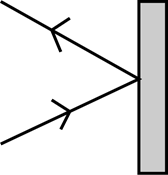
The illustration shows a light ray striking an object.
In the illustration, the light ray striking the object is-
a)
absorbed
b)
stopped
c)
reflected
d)
refracted
84.
Refract or Reflect?
a)
Refract
b)
Reflect
85.
How does light behave as it enters these mediums?
a)
continue its path as straight line.
b)
bends toward the normal
c)
bends away from the normal
d)
reflects
86.
A rainbow forms when white light separates into different colors during?
a)
Absorption
b)
Scattering
c)
Refraction
d)
Transmission
87.
As a light ray exits a dense medium and enters a medium with a smaller refractive index, the ray bends ____ the normal
a)
towards
b)
away from
88.
Which of these best explains why a student can see her reflection in a computer monitor when the monitor is turned off?
a)
Black objects absorb most of the light striking them
b)
The glass allows light to be transmitted through it.
c)
Smooth, shiny objects reflect a great amount of light.
d)
Computers produce light when they are being used.