
 Worksheets
RSS Living Environment Review for Final
Total questions: 86
Worksheet time: 2hrs 34mins
Name
Class
Date
1.
Which of the following IS considered safety equipment in our classroom?
a)
Eyewash Station
b)
Emergency Shower
c)
Fire Extinguisher
d)
All of the Above.
2.
When is it OK to eat or drink in the lab?
a)
Always
b)
Never
3.
You are heating a substance in a test tube. Always point the open end of the tube
a)
away from all people
b)
toward another classmate
c)
toward your lab partner
d)
toward yourself
4.

What is measured with a graduated cylinder?
a)
Passage of time
b)
Distance from one thing to another
c)
Weight of an object
d)
Volume of liquid
5.

What is used to protect your eyes from chemicals, broken glass, and fire?
a)
Fire blanket
b)
Eye wash
c)
Goggles
d)
Flask
6.

Identify this piece of equipment.
a)
microscope
b)
cover slip
c)
magnifying lense or glass
d)
slide
7.

Identify this piece of equipment.
a)
magnifying glass
b)
coverslip
c)
slide
d)
microscope
8.

What type of graph is this?
a)
Bar Graph
b)
Line Plot
c)
Pictograph
d)
Tally Chart
9.

How many more people have purple for a favorite color than red?
a)
3
b)
5
c)
7
d)
9
10.

People buy more drinks on ____ than any other day.
a)
Monday
b)
Tuesday
c)
Thursday
d)
Friday
11.

In this graph, what is the independent variable?
a)
Population
b)
Day
c)
Species 5
12.

In this graph, what is the dependent variable?
a)
Walla Walla Island
b)
Time
c)
Number of Deer
13.
Which is NOT a characteristic that all living organisms share?
a)
Ability to reproduce
b)
Ability to grow
c)
Ability to respond to their environment
d)
Ability to dominate an ecosystem
14.
All living things have an internal structure of ____________, which are the smallest unit of life.
a)
Cells
b)
ATP
c)
Glucose
d)
Sugar
15.
Light, smell, sound, and temperature are all examples of what?
a)
Cells
b)
Stimuli
c)
Fungi
d)
Reactions
16.
You accidentally touch a hot burner and quickly pull your hand away. The burner is
a)
homeostasis
b)
a reaction
c)
ATP
d)
a stimulus
17.
Living things change during their lives through ___.
a)
reproduction
b)
growth and development
c)
making responses
d)
adaptation and organization
18.
All living things ____ to make more living things.
a)
reproduce
b)
develop
c)
grow
d)
adapt
19.
The series of changes an organism undergoes during it's lifetime
a)
development
b)
adaptation
c)
evolution
d)
reproduction
20.
Rocks are not living because
a)
they never move
b)
they aren't needed for humans
c)
they are not made of cells
d)
they don't break down
21.
All organisms have more than one cell.
a)
false
b)
true
22.
Multicellular means
a)
made of many cells
b)
made of one kind of cell
c)
made of only one cell
23.
Something that has never shown the characteristics of life and never will.
a)
dormant
b)
nonliving
c)
living
d)
dead
24.
Something that once showed all the characteristics of life but no longer does and never will again.
a)
dormant
b)
nonliving
c)
dead
d)
living
25.

Non-Living or Living?
a)
Living
b)
Non-Living
26.
Organisms that cannot make their own food and must obtain energy from external sources are called
a)
autotrophs
b)
heterotrophs
c)
thylakoids
d)
plants
27.

Autotroph or heterotroph?
a)
Autotroph
b)
Heterotroph
28.
Organisms that reproduce asexually generally have offspring that are
a)
unicellular.
b)
multicellular.
c)
genetically varied.
d)
genetically identical.
29.
Which reproduction requires a mate?
a)
asexual
b)
sexual
c)
neither
30.
Mushrooms are an example of a
a)
Fungi
b)
Plant
c)
Animal
d)
Archaea
31.
The most specific level of classification is
a)
Domain
b)
Kingdom
c)
Genus
d)
Species
32.
Which is the correct order of The Levels of Taxonomy?
a)
Kingdom, Phylum, Class, Order, Family, Genus, Species
b)
Kingdom, Phylum, Order, Class, Family, Genus, Species
c)
Kingdom, Phylum, Family, Class, Order, Genus, Species
d)
Species, Genus, Family, Class, Order, Phylum, Kingdom
33.

According to this cladogram, birds are LEAST related to:
a)
Amphibians
b)
Sharks
c)
Ray Finned Fish
d)
Crocodiles
34.
Which structures are found in every living cell?
a)
cell membrane and cytoplasm
b)
chloroplasts and mitochondria
c)
a cell wall and nucleus
d)
chloroplasts and cell wall
35.
In what part of the plant cell does the process of photosynthesis take place?
a)
nucleus
b)
mitochondria
c)
chloroplasts
d)
vacuoles
36.

Directs all cell activities through the DNA located there.
a)
Lysosomes
b)
Nucleus
c)
ribosomes
d)
Mitochondria
37.
Where are proteins made?
a)
Golgi body
b)
Mitoichondria
c)
Chromosomes
d)
Ribosomes
38.
This organelle takes food and turns it into ENERGY for plant and animal cells.
a)
Chloroplast
b)
Mitochondria
c)
Lysosome
d)
Ribosome
39.
Proteins are made of monomers called ___________
a)
Nucleotides
b)
Monosaccharides
c)
Amino Acids
d)
Glycerol and fatty acids
40.
The element _______is found in all of the organic compounds.
a)
Iron
b)
Nitrogen
c)
Carbon
d)
Oxygen
41.
Waxes, oils and fats are examples of
a)
Carbohydrates
b)
Lipids
c)
Proteins
d)
Nucleic Acids
42.

What kind of cell is this?
a)
animal cell
b)
bell bell
c)
plant cell
d)
vacuole
43.
what dose the plant cell have what the animal cell doesn't have?
a)
cellmembrane
b)
ctyoplasm
c)
vacuole
d)
chloroplast,cell wall
44.
Which sequence of DNA bases would pair with this partial strand
ATG TGA CAG
ATG TGA CAG
a)
ATG TGA CAG
b)
TAC ACT GTC
c)
GTA AGT GAC
d)
CAT TCA CTG
45.
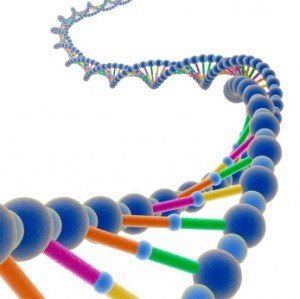
Which of the following best describes a DNA molecule?
a)
double helix
b)
contains ribose
c)
made of amino acids
d)
contains Uracil
46.

In a molecule of double-stranded DNA, the amount of Adenine present is always equal to the amount of
a)
cytosine
b)
guanine
c)
thymine
d)
uracil
47.
Guanine bonds with ______________.
a)
Adenine
b)
Guanine
c)
Cytosine
d)
Thymine
48.
Which organelle is DNA usually found in?
a)
cell membrane
b)
vacuole
c)
chloroplast
d)
nucleus
49.
Before the cell divides, what process needs to happen?
a)
Transcription
b)
Translation
c)
Replication
d)
Protein synthesis
50.
What kind of information does DNA carry?
a)
genetic
b)
nuclear
c)
cell structure
d)
it doesn't carry any info
51.
Any change in the sequence of DNA is...
a)
transgenic shift
b)
Single Genotype
c)
Monohybrid Trait
d)
Mutation
52.
Heredity is the passing of traits from _____________________ to _____________________
a)
predators to prey
b)
water to rain
c)
parents to offspring
d)
fungi to protists
53.
___________________________ is the study of how traits are passed on, or inherited.
a)
dominant traits
b)
ratio
c)
phenotype
d)
genetics
54.
One trait that is ALWAYS present and causes the other traits to disappear is a ________________________
a)
recessive trait
b)
aggressive trait
c)
absent trait
d)
dominant trait
55.

A ________________________ is used to predict the possible genotype from certain parents
a)
Mendel Grid
b)
Genetic Tic Tac Toe
c)
Punnett Square
d)
Pedigree Plot
56.
_____________________ are cells that join to make offspring
a)
speed cells
b)
sex cells
c)
pea cells
d)
pedigree cells
57.
Which of the following is a phenotype?
a)
Aa
b)
red hair
c)
heterozygous
d)
DNA
58.
Emily has brown hair. Which is most likely a true statement about Emily?
a)
Emily’s favorite color is brown.
b)
Emily has a parent with brown hair.
c)
Emily’s older brother has brown hair.
59.

How many parents in sexual reproduction?
a)
1
b)
4
c)
2
d)
3
60.

B = brown fur b = white fur
In the punnett square, what is the probability for white fur?
In the punnett square, what is the probability for white fur?
a)
0%
b)
25%
c)
50%
d)
75%
61.
What are the two genotypes that show the DOMINANT Phenotype
a)
GG, gg
b)
GG, Gg
c)
Gg, gg
62.
What is the only Genotype that shows the RECESSIVE Phenotype?
a)
GG
b)
Gg
c)
gg
63.

What is Bb?
a)
Homozygous
b)
Heterozygous
c)
Recessive
d)
Alleles
64.
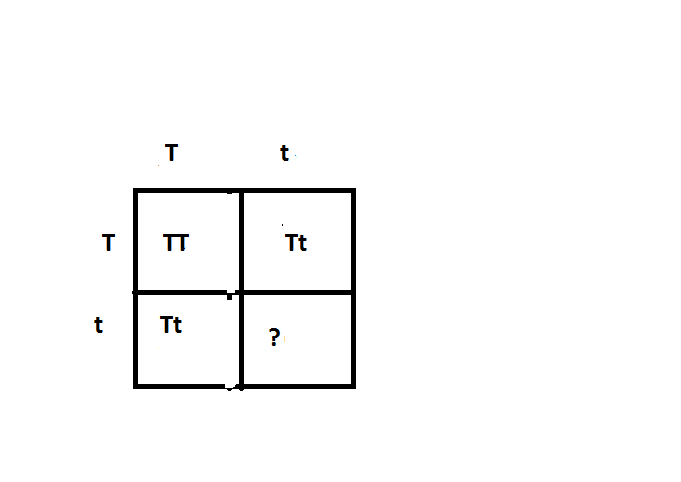
T - tall and t = short
In the punnett square below, what belongs in the missing square
In the punnett square below, what belongs in the missing square
a)
tt
b)
Tt
c)
Bb
d)
TT
65.
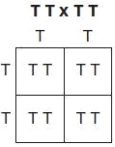
What ratio of the offspring from the cross shown will be homozygous recessive for the trait of tallness?
a)
0 in 4
b)
1 in 4
c)
2 in 4
d)
4 in 4
66.

How many girls did the mother and father from the first generation have?
a)
2
b)
4
c)
5
d)
6
67.

How many people in this whole pedigree have the trait/disease?
a)
2
b)
3
c)
4
d)
6
68.
made of a single cell
a)
multicellular
b)
eukaryotic
c)
prokaryotic
d)
unicellular
69.

a structure made up of different tissues working together
a)
organ
b)
cell
c)
tissue
d)
organelle
70.

a group of cells organized to do a job
a)
cell
b)
tissue
c)
prokaryotic
d)
animal
71.
a group of organs that work together
a)
organ system
b)
tissue
c)
cells
d)
organelle
72.
When many organ systems work together it can form...
a)
organ
b)
cells
c)
organ system
d)
organism
73.
What is the correct order of organization
a)
tissues-cells-organs-organ systems-organism
b)
cell-tissue-organs-organ systems-organism
c)
organism-cells-tissues-organ systems-organism
d)
tissues-cells-organs-organ sytems-organism
74.

Fruit fly body cells have 8 chromosomes. After mitosis, you would expect a resulting fruit fly daughter cell to have ...
a)
16 chromosomes.
b)
46 chromosomes.
c)
8 chromosomes.
d)
4 chromosomes.
75.
The process by which the nuclear material is divided equally between two new cells
a)
mitosis
b)
cancer
c)
spindle
d)
centromere
76.

Name the phase:
a)
Anaphase
b)
Telophase
c)
Metaphase
d)
Prophase
77.

What is the next phase of mitosis?
a)
Prophase
b)
Metaphase
c)
Anaphase
d)
Telophase
78.

In mitosis, the two resulting cells are
a)
different from the starting cell and identical to each other.
b)
different from the starting cell and different from each other.
c)
identical to the starting cell and different from each other.
d)
identical to the starting cell and identical to each other.
79.

Which of the following organisms is a herbivore.
a)
butterfly
b)
snake
c)
fox
d)
ladybird
80.
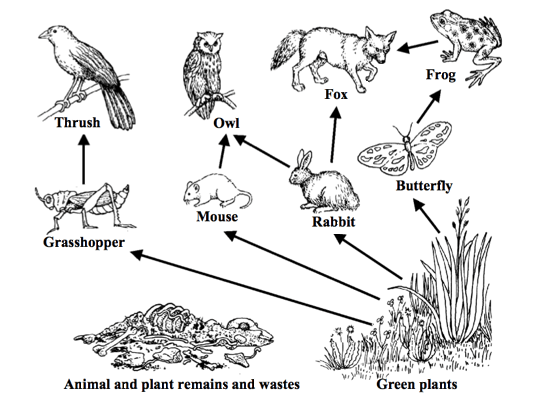
The owl receives energy from which organisms?
a)
grasshopper and mouse
b)
mouse and rabbit
c)
rabbit and butterfly
d)
butterfly and frog
81.
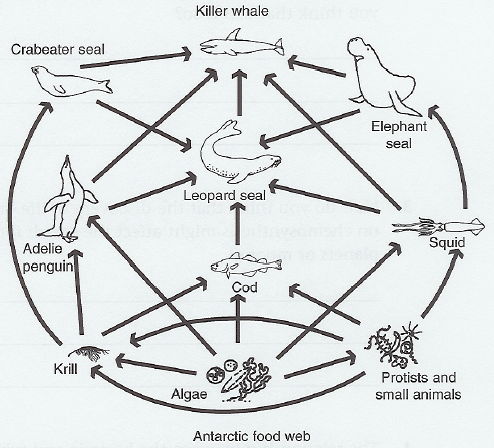
Which organism is the top predator in this food web?
a)
leopard seal
b)
killer whale
c)
elephant seal
d)
crabeater seal
82.
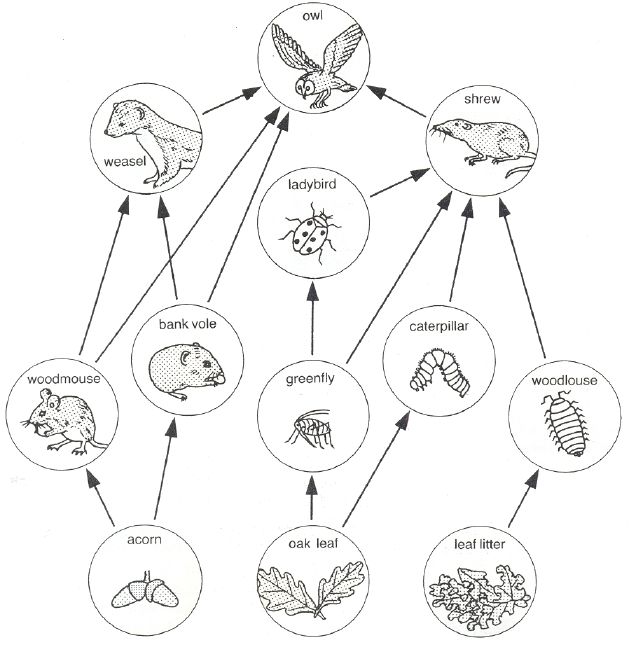
What type of consumer is the shrew?
a)
herbivore
b)
omnivore
c)
carnivore
83.
What is a change in an organism that allows for it to survive in its environment?
a)
homologous
b)
vestigial
c)
variation
d)
adaptation
84.
When all of the organisms of a species have died it is called
a)
evolution
b)
extinction
c)
adaptation
d)
natural selection
85.

What is this an example of?
a)
diversity of species
b)
variation
c)
vestigial structures
d)
DNA studies
86.
When the DNA of an organism is altered it is referred to as…
a)
Mutation
b)
Gene Flow
c)
Genetic Drift
d)
Sexual Selection
100 %

