
 Worksheets
Evolution Review
Total questions: 87
Worksheet time: 2hrs 30mins
What evidence supports the idea that whales and dolphins have a common ancestor?
They eat the same food.
They have similar anatomies.
They swim the same way.
They live in the same area of the ocean.
What most likely causes variation in species?
competition
mutation
changes during their lifetime
predation
What can be determined by similarities in the forearms of humans and dogs?
They are the same species.
Dogs evolved from humans.
Birds evolved from humans.
Humans and dogs share a common ancestor.
Darwin's theory that species develop new traits and change over time is known as:
natural selection
adaptation
speciation
evolution
If natural selection means "survival of the fittest", what does it mean to be "fit"?
you can migrate to new areas
you have a large territory
you can reproduce and pass on your genes
you have more genetic mutations
If a cheetah is born with a mutation that makes it unable to run quickly, what will be the most important for it's survival?
competition for social heirarchy
competition for living space
competition for prey and food
competition for shelter
What type of species has the best chance of survival through significant environmental change?
genetically homogeneous (similar)
genetically diverse
A mutation changes the color of a grasshopper. What color grasshopper will have a genetic disadvantage?
green grasshopper
brown grasshopper
Why did mammals become dominant after the mass extinction of dinosaurs?
They were larger than dinosaurs and ate different food.
They were able to hibernate for hundreds of year.
They lived in different areas of Earth than dinosaurs.
They had traits that helped them adapt to environmental changes.
How could a series of fossils show how a horse evolved over time?
All the fossils would show varying levels of similar structures compared to modern horses.
All the fossils would be found in the same place.
All the fossils would be completely identical.
All the fossils would be found in the same rock layer.
During a freeze, most strawberry plants die. Why would some strawberry plants survive?
The color of the strawberry helps maintain it's temperature.
Some have larger leaves that protect the fruit.
Some have genetic variations that cause them to be resistant to the cold.
Some are able to reproduce more quickly than others.
Why would a fox have a fur coat that turns white in the winter and brown in the summer?
The foxes genes helped the foxes ancestors survive and reproduce.
The fox inherited genes for white fur from its mother and genes for brown fur from its father.
The foxes parents learned how to change their fur color and passed the trait to their offspring.
The fox eats food in the summer that changes the fur color.
Which is true about the Theory of Natural Selection?
Not all organisms that are born survive to reproduce,
Organisms compete with each other to survive.
Variations exist among organisms.
All of answers are true.
Wisdom teeth have no purpose and are often removed to make room for the other teeth. Wisdom teeth are
homologous structures
vestigial structures
analogous structures
Which of the following would be a good adaptation for living in a desert?
having thick stem to store water
being active during the middle of the day
having large leaves to absorb sunlight
having dark feathers to absorb sunlight
Why do woodpeckers have long beaks to dig into trees for insects?
As insects became more common, birds that ate more insects grew longer beaks.
The long beak is an adaptation that helps the bird eat more insects.
A harmful mutation occured.
The long beak helps woodpeckers fight off predators.
Recent fossils can be found in upper rock layers. What two scientific ideas does this support?
The law of superposition and the periodic nature of the elements
Cell theory and the theory of evolution
the theory of evolution and the law of superposition
the periodic nature of the elements and cell theory
Which is the best evidence for evolution?
old rock layers contain fossils unlike existing organisms
old rock layers contain fossils of complex organisms
new rock layers contain fossils of simple organims
new rock layers contain fossils unlike existing organisms
Match the following pictures with the words they represent

Analogous Structure

Homologous Structure

Adaptation

Artificial selection

Natural selection
Which best describes the phrase survival of the fittest?
strongest in a population are most successful
fastest in a population are most successful
those that can survive and reproduce are most successful
those that can live the longest are most successful

Many different groups of organisms have wings, even though they do not share a recent common ancestor. This is because they evolved in environments with similar selective pressures. Wings are an example of a(n) ______________ structure.
vestigial
analogous
homologous

The forelimbs of mammals have similar anatomy because these groups descended from a recent common ancestor. Their bone structure is an example of a(n) ______________ structure.
vestigial
analogous
homologous
Change over time is
evolution
generation
growth
biogenesis
Mutations are important because ____.
they bring genetic variation needed for a population to evolve
mutations are not important
they bring about benefits for the individual not the population
they bring death of the organism in which they develop

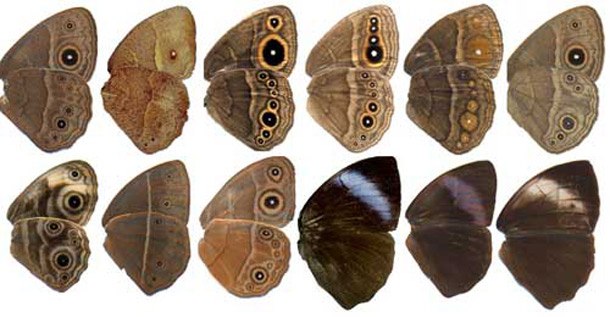
Structures that have no common DNA link, but have similar functions. EX: Butterfly and bird wings. (a)
An inherit characteristic that increases and organism's ability to survive and reproduce is a (n)
vestigial structure
speciation
analogous structure
adaptation
Darwin noticed that many organisms seemed well suited to
being preserved as fossils.
providing humans with food.
surviving in the environments in which they lived.
swimming from South America to the Galápagos Islands.

The difference in the physical traits of individuals within the same population is called a(n)
change
adaption
species
variation
have the ability to interbreed.

Charles Darwin was best known in the 19th century for:
creating the idea of evolution
creating the idea of uniformitarianism
making the idea of evolution acceptable for scientists and the educated general public
all of the above
In the phrase "survival of the fittest," the term "fittest" refers to:
The best-adapted organisms
The biggest organisms
The smartest organisms
The fastest organisms
When is a trait most likely to be passed on to the next generation?
When it serves no purpose
When it becomes an advantage to the organism's survival
When it gives the organism a lot of water
When it prevents the organism from finding a mate
Match the following terms with their definitions
Evolution
a change in a species DNA over time because of natural selection
Adaptation
Any variation that makes an organism better able to survive
Variation
An inherited trait that makes and individual different
Mutation
A permanent change in the DNA
Which statement about evolution is true?
Evolution occurs in individual organisms.
Evolution involves a change in non-inherited traits.
Evolution occurs over multiple generations.




The fossil record help scientists
better understand the kinds of organisms that lived in the past
better understand how the environment has changed over time
better understand how organisms have evolved over time
all of the above
What is common ancestry?
When a species no longer exists
When organisms are descended from a single ancestor

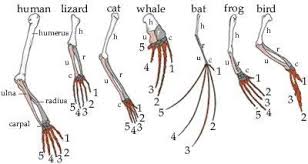
The forelimbs of humans, cats, whales, and bats are similar in structure due to having a common ancestor hundreds of millions of years ago. Is this considered homolgy or analogy?
Homology
Analogy
Which of the following are homologous structures?
whale flipper and bat wing
legs on a beetle and legs on a cat

The cave fish and minnow are related to each other but the cave fish is blind and only has the remnants of an eye. What type of structure is this?
vestigial
analogous
What is an example of a vestigial structure in a human?
liver
appendix
_______________, or selective breeding, is one way that humans impact evolution. One example is how the Belgian Blue cow has been bred to have greater muscle mass.
Artificial selection
Homologous

What can the arm bones of humans and bats show us? That they...
.. shared an ancestor whom had that arm structure
... will eventually evolve into similar creatures
... share a gene pool
Scientists are studying a particular protein found in blood cells. Based on this, which animals are most closely related?
Dog: ARG - LYS - HIS - TYR
Rabbit: ARG - LYS - TYR - TYR
Elk: ARG - PRO - TYR - ARG
Dog & Rabbit
Rabbit & Elk
Dog & Elk

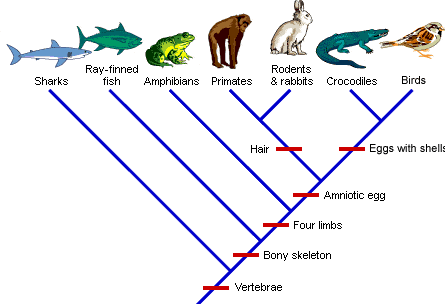
Species from the same ancestor accumulate differences over time
convergent evolution
divergent evolution
parallel evolution
If you take antibiotics, the non-resistant bacteria die while the resistant bacteria survive and pass their antibiotic resistance trait to their offspring. This is an example of...
DNA replication
natural selection
meiosis
a virus
To prevent antibiotic resistance from developing, you should... (Select all that apply.)
only use antibiotics when needed
only take half the amount of antibiotics prescribed by your doctor
only take antibiotics for viruses
complete the full amount of antibiotics prescribed by your doctor
Bacteria develop antibiotic resistance through ______________.
mutations & artificial selection
mutations & natural selection
mitosis &
meiosis
apples and bananas
Humans are using antibiotics correctly.
A pesticide is...
A chemical that kills a bug / insect
A substance that kills bacteria
A nutrient for certain crops
A substance created by biotechnology to induce mutations in insects
An antibiotic is...
A chemical that kills a bug / insect
A substance that kills bacteria
A chemical that destroys any toxins in the stomach
A substance created by biotechnology to induce mutations in bacteria
A pesticide is...
A chemical that kills a bug / insect
A substance that kills bacteria
A nutrient for certain crops
A substance created by biotechnology to induce mutations in insects
An antibiotic is...
A chemical that kills a bug / insect
A substance that kills bacteria
A chemical that destroys any toxins in the stomach
A substance created by biotechnology to induce mutations in bacteria
Why is it important to finish ALL of an antibiotic, even if you feel better?
If all of the infectious bacteria are not killed, the bacteria may continue to multiply. Some of these bacteria may have a mutation that makes them resistant to the antibiotic. This could cause resistant bacteria to spread.
If all of the antibiotic is not used, the surviving bacteria may learn how to fight off the antibiotic, causing the sickness to get even worse.
If all of the antibiotic is not used, the bacteria may begin ingesting your skin cells, causing a new sickness to arise.
If all of the antibiotic is not used, the surviving bacteria may cooperate with other infectious bacteria, resulting in two separate infections at the same time.

The table below shows what happens to an insect population before and after a pesticide is added.
Which of the following best explains why more of the pesticide-resistant insects were present in the second generation?
Because of the pesticides in plants, insects in the second generation developed a tolerance for pesticides
Because of heredity, insects with genes for pesticide resistance passed it on to the following generation
Because of the environment, parent insects taught their offspring to be pesticide resistant in order to survive
Because of heredity, insects learned to avoid pesticides on plants

