wayground logo

Free Printable Worksheets

Font size

S
M
L
XL
Worksheets

Life Science: Expert Mode

Total questions: 88

Worksheet time: 3hrs 54mins

Name
Class
Date
1.

Where in the cell is DNA found?

a)

Nucleus

b)

Cytoplasm

c)

Chloroplast

d)

Cell Membrane

2.
Why are your chromosomes arranged in pairs?
a)
Scientists have no idea
b)
Because you get one from your mom and one from your dad
c)
Because pairs can divide easier
d)
Because DNA is awesome
3.

How many chromosomes are found in each cell of your body (excluding gametes)?

a)

46

b)

23

c)

40

d)

45

4.

What is a gene

a)

A long length of DNA that codes for a chromosome

b)

A short length of DNA that codes for a chromosome

c)

A short length of DNA that codes for a protein.

5.
How are similarities passed from parent to offspring?
a)
through teaching
b)
through learning
c)
through blood
d)
through genes
6.

Order from largest to smallest

a)

Gene, DNA, Chromosome

b)

DNA, Gene, Chromosome

c)

Chromosome, Gene, DNA

d)

Chromosome, DNA, Gene

7.
Which section of this figure shows a gene? Click here to see figure.
a)
W
b)
X
c)
Y
d)
Z
8.
What type(s) of cells undergo mitosis?
a)
sex cells
b)
gametes
c)
body cells
d)
sperm and egg cells
9.
What do the cells look like at the end of mitosis?
a)
different from original cell
b)
similar to the original cell
c)
identical to the original cell
d)
none of these
10.

PMAT helps us remember the correct order of the phases of Mitosis. Which of the following has the phases of Mitosis in the correct Order

a)

Interphase, Mitosis, Cytokinesis

b)

Prophase, Metaphase, Anaphase, Prophase

c)

Anaphase, Telophase, Prophase, Telophase

d)

Prophase, Metaphase, Anaphase, Telophase

11.
What phase is this?
a)
prophase
b)
metaphase
c)
anaphase
d)
telephase
12.
What phase is this?
a)
prophase
b)
metaphase
c)
anaphase
d)
telephase
13.
What phases is this?
a)
Prophase
b)
metaphase
c)
anaphase
d)
telephase
14.
What phase is this?
a)
prophase
b)
metaphase
c)
anaphase
d)
telephaseddddduuu
15.
How many daughter cells are produced in mitosis?
a)
1
b)
2
c)
4
d)
6
16.
What is it called when a sperm and egg meet?
a)
meiosis
b)
fertilization
c)
cell division
d)
mitosis
17.
Which process and type of resulting cells are represented?
a)
mitosis, gametes
b)
mitosis, body cells
c)
meiosis, gametes
d)
meiosis, body cells
18.
The chromosomes that pair up during meiosis, are called __________ chromosomes.  
a)
homozygous 
b)
asexual
c)
homologous
d)
genes
19.
A male shark has 40 chromosomes in each of its sex cells. How many would be present in its body cells?
a)
20
b)
40
c)
80
d)
160
20.
Compared to the number of chromosomes contained in a body cell, how many chromosomes would normally be contained in a gamete?
a)
The same number
b)
One-fourth as many
c)
Twice as many
d)
Half as many
21.
What causes genetic variation in meiosis?
a)
chromosomes lining up
b)
crossing over of chromosomes
c)
separation of chromosomes
d)
chromosomes pulling apart
22.
Crossing over helps promote 
a)
male genotype
b)
genetic variation
c)
DNA replication
d)
mitosis
23.
A human being has a somatic cell that has 46 chromosomes.  What is the haploid number found in a gamete?
a)
23
b)
46
c)
69
d)
92
24.
How many parents does asexual reproduction involve?
a)
one 
b)
two
c)
three
d)
four
25.
The offspring from asexually reproduced organisms are?
a)
Different than their parents
b)
Identical to parents
c)
Like a combination from both parents
d)
A different species
26.
If two organisms reproduce sexually, then their offspring will exhibit a genetic makeup that is -
a)
identical to only one parent
b)
identical to all of its siblings
c)
a unique combination of traits
d)
the recessive traits of each parent
27.
When comparing the offspring of sexually and asexually reproducing organisms, we would expect the genetic material (DNA) of the sexually reproducing organism to -
a)
contain fewer mutations
b)
be lesser in quantity
c)
be simpler overall
d)
show more variation
28.
This is when a new organism grows by cell division on the body of its parent. The bud, or offspring is identical to the parent. The bud, when large enough, can break off of the parent and live on its own.  Examples of this include yeast, hydra and potatoes.
 
a)
Regeneration
b)
Vegetative propagation
c)
Fission
d)
Budding
29.

Requires two parents

a)

sexual

b)

asexual

30.
Which reproduction requires a mate?
a)
asexual
b)
sexual
c)
neither
31.
Passes genetic information
onto future generations
a)
sexual reproduction
b)
asexual reproduction
c)
both
32.

What are some advantages of asexual reproduction are: (select all that apply - there are 3)

a)

it only requires one organism

b)

it takes less energy than sexual reproduction

c)

offspring are already well-adapted for the environment

d)

there is a lot of genetic variety

33.

Some advantages of sexual reproduction include: (select all that apply - there are 3)

a)

genetic variation

b)

improves chances of adapting to the environment

c)

helps species survive catastrophes

d)

it doesn't take as much energy as asexual reproduction

34.

Male and female reproductive cells are collectively known as:

a)

spores

b)

pollen

c)

gametes

d)

offspring

35.

A mutation is defined as:

a)

A change in the cell's structure

b)

Anything that changes in an embryo

c)

Any change in the physical features of a human

d)

A change in the DNA sequence

36.

Genetic mutations can be...

a)

beneficial, harmful, or neutral

b)

beneficial only

c)

harmful only

d)

neutral only

37.
A rabbit that has short deformed legs and cannot jump or run fast would have a____
a)
Harmful mutation
b)
Beneficial mutation
c)
Neutral mutation
d)
normal life
38.
What do hurtful mutations do? 
a)
Decrease chances of survival 
b)
Increases changes of survival 
c)
Decreases likelihood of developing cancer
d)
Increases likelihood of developing cancer
39.

Mutations can benefit humans because they can:

a)

Cause illness

b)

Make an organism more suited to live in its environment.

c)

Make organisms live shorter lives

d)

Cause organisms to grow extra limbs.

40.

Selective breeding is...

a)

a process to create an organism with desired traits from parents with those desired traits

b)

natural method of producing offspring with desired traits

c)

creating a new species

d)

making organisms reproduce during times of stress

41.

One problem with selective breeding is

a)

creating a new species

b)

gene variety is lost

c)

new food sources

42.
Which is another term for selective breeding?
a)
Artificial selection
b)
Natural Selection
c)
Intelligent selection
43.
When DNA is manipulated and moved from one source to another it is known as
a)
genetic engineering
b)
electrophoresis
c)
gene therapy
d)
GMO
44.
Making changes in the DNA of an organism is
a)
selective breeding
b)
artificial selection
c)
genetic engineering
d)
genetic transformation
45.
Aa, DD, bB, yy are all examples of
a)
genotypes
b)
phenotypes
46.
Which of the following is a phenotype?
a)
Aa
b)
red hair
c)
heterozygous
d)
DNA
47.

A version or variation of a gene

a)

trait

b)

gene

c)

allele

d)

DNA

48.

When an organism has two of the same alleles, it is called

a)

homozygous

b)

heterozygous

c)

recessive

d)

dominant

49.

When an organism has two different alleles, it is called

a)

homozygous

b)

heterozygous

c)

recessive

d)

dominant

50.

The genotype Aa is best described as

a)

heterozygous

b)

homozygous

51.

The genotype gg is best described as

a)

heterozygous

b)

homozygous

52.

Which of the following genotypes is homozygous dominant?

a)

A

b)

Aa

c)

AA

d)

aa

53.

Which of the following genotypes is homozygous recessive?

a)

Tt

b)

tt

c)

TT

d)

tT

54.

Select dominant phenotypes. (More then 1 answer)

a)

HH

b)

Hh

c)

hh

d)

None

55.

Brown eyes are dominant to blue eyes. Which of the following is blue eyes?

a)

BB

b)

Bb

c)

bb

d)

None

56.

Round seed is dominant to wrinkled seed. Which of the following is round seed?

a)

RR

b)

Rr

c)

rr

d)

RR and Rr

57.
Drawn observed several different types of finches.  Why are there so many different types?
a)
Finches live in different places, but eat the same food.
b)
Finches live in the same place, but eat different types of food.
c)
Finches live in different habitats and eat different types of food.
d)
Finches are found all over the world.
58.
The differences among a species, like different bird beaks, are called
a)
genes.
b)
variations.
c)
traits.
d)
theories.
59.
Behavioral changes of individuals of a species that allow for better survival. (Acquired traits)
a)
Variation
b)
Adaptation
c)
Behavior
d)
Environment
60.
Where the better adapted organisms survive to pass traits along to offspring.
a)
Evolution
b)
Natural Selection
c)
Extinction
d)
Artifical Selection
61.
Where the better adapted organisms survive to pass traits along to offspring.
a)
Evolution
b)
Natural Selection
c)
Extinction
d)
Artifical Selection
62.
Why are advantageous traits more likely to be passed onto offspring?
a)
Because they are more likely to survive and reproduce.
b)
Because they come from dominant alleles.
c)
Because they come from recessive alleles.
d)
Because the trait is an acquired phenotype.
63.
Do organisms "decide" to evolve and change?
a)
Yes, they know they need to change to survive 
b)
No, they change because of natural selection
64.

A species could go extinct if:

a)

food becomes more plentiful.

b)

members of the species have adaptations to enhance survival.

c)

the environment changes drastically and no one can adapt.

d)

there is less competition for resources.

65.

What is most likely to happen to moth populations in the picture shown?

a)

Light moths--hunted easily, dark moths--population increase

b)

Dark moths--hunted easily, dark moths--population increase

c)

Light moths--hunted easily, light moths--population increase

d)

Lights moths will change their color to match dark moths.
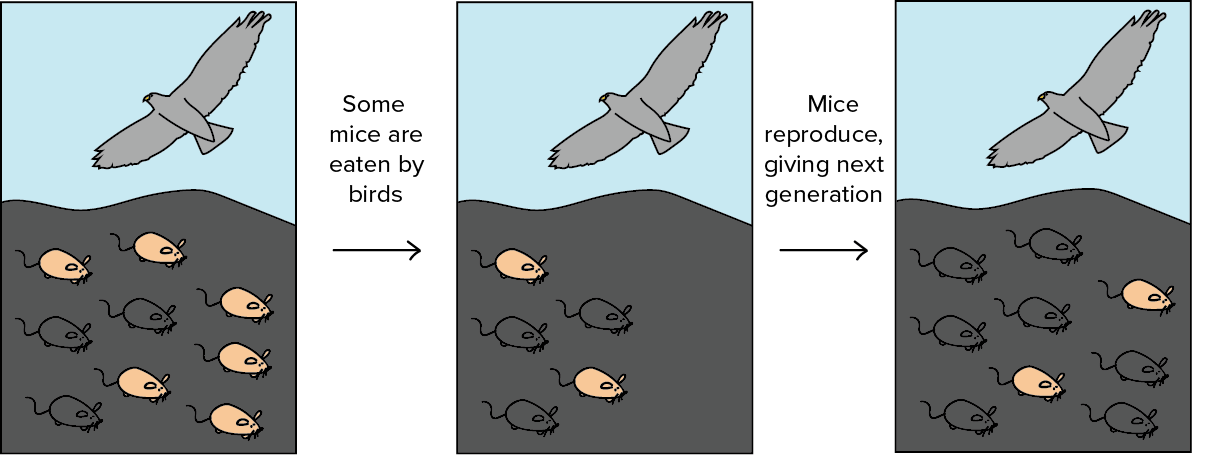
66.
Why is the mouse population changing over time?
a)
The light mice can reproduce more successfully than the dark mice
b)
The hawks eat more dark mice than light mice because the dark mice taste better
c)
The hawks eat more light mice than dark mice because they can see the light mice more easily
d)
The hawks eat more dark mice than light mice because they can see the dark mice more easily
67.
What is a species? 
a)
A group of organisms that can mate with each other and produce fertile offspring. 
b)
A group of organisms that can mate and produce offspring even if those offspring are infertile.
c)
A group of organisms that genetically are very different from each other. 
d)
Indivual organisms that live in the same environment. 
68.

The formation of a new species is called

a)

Natural selection

b)

Struggle for existence

c)

Speciation

d)

Darwinism

69.
When a population becomes divided by an event such as a new river forming, ____________ has occurred.
a)
Differentiation 
b)
Isolation
c)
Adaptation
d)
Separation
70.
Which of the following means "change over time"
a)
natural selection
b)
speciation
c)
evolution
d)
isolation
71.

Which images illustrate ANALOGOUS structures?

a)

1, 2

b)

1, 3

c)

2, 3

d)

1, 2, 3

72.

These limbs provide evidence of common ancestry because they....

a)

have the same basic structure

b)

Perform the same function

c)

Are the same size

d)

Are parts of mammals

73.

Which wings illustrate HOMOLOGOUS structures?

a)

bat & butterfly

b)

bat & bird

c)

butterfly & bird

d)

bat, butterfly, & bird

74.

All these organisms have similar arm bones. What is the reason for this?

a)

The function of these bones is the same in all animals

b)

They live in similar environments

c)

They have a common ancestor

d)

All organisms resemble humans

75.
How does embryology support the Theory of Evolution?
a)
It shows that they have a common ancestor because of their similarities.
b)
         I'm not sure.
c)
Animals change over time. 
76.
In the the third embryonic stage (bottom row), mammal embryos _____
a)
have more characteristics in common with each other than with reptiles or birds.
b)
are still hard to tell from reptiles and birds.
c)
have the same features as fish, reptiles, and birds.
d)
do not have tails.
77.
The more similar the stages of embryonic development, the more likely that organisms share ____________
a)
a common ancestor.
b)
embryos.
c)
eggs.
d)
embryology.
78.
Some organisms that share a common ancestor have features that have different functions, but similar structures.  These are known as
a)
vestigial structures
b)
analogous structures
c)
homologous structures
d)
fossil structures
79.
The diagram illustrates an embryonic stage of two organisms.

Which of the following can be determined by observing the embryos shown in the diagram
a)
The organisms share a common ancestry.
b)
The organisms belong to the same genus.
c)
The organisms are native to the same geographic areas.
d)
The organisms will grow into anatomically similar adults.
80.
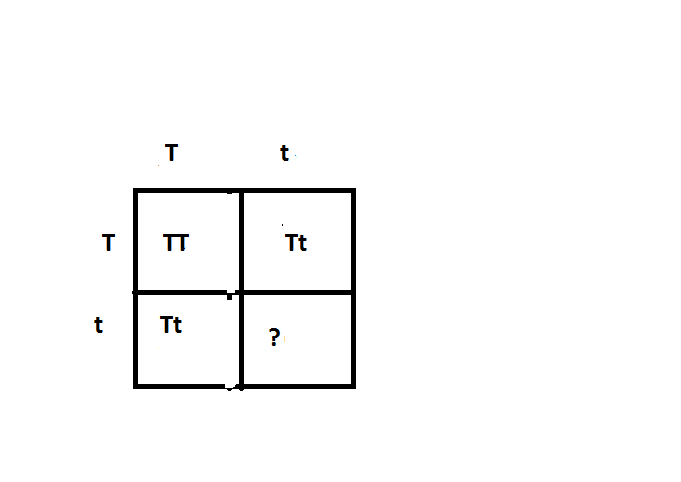
T - tall and t = short
In the punnett square below, what belongs in the missing square
a)
tt
b)
Tt
c)
Bb
d)
TT
81.
B = brown eyes
b = blue eyes
What is true about these two brothers that have brown eyes?
One has genotype BB the other Bb.
a)
they have same phenotype and genotype
b)
they have different genotypes and phenotypes
c)
they have same phenotype but different genotypes
d)
they have same genotype but different phenotypes
82.
AA and Aa always show up as
a)
dominant
b)
recessive
83.
aa always shows up as
a)
dominant
b)
recessive
84.
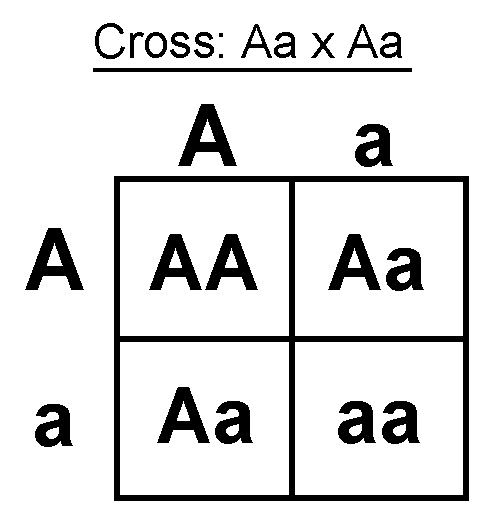
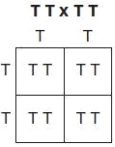
What ratio of the offspring from the cross shown will be homozygous recessive for the  trait of tallness? 
a)
0 in 4
b)
1 in 4
c)
2 in 4
d)
4 in 4
85.
In a punnet square where are the parent alleles written?
a)
Top and inside the boxes
b)
Only on the left and right side of the boxes. 
c)
outside of the boxes (top and left side)
d)
All on the top side of the boxes
86.
What you see, or the physical appearance.
a)
Genotype
b)
Phenotype
c)
Homozygous
d)
Heterozygous
87.
What is the phenotype of the offspring? (A-Brown hair; a-blond hair) 
a)
50 % Brown Hair and 50% Blond Hair 
b)
25 % Brown Hair and 75% Blond Hair 
c)
75 % Brown Hair and 25% Blond Hair 
d)
0% Brown Hair and 100% Blond Hair 
88.
What allele combination should go in the missing box?
a)
AA
b)
Aa
c)
aa
d)
none of these