wayground logo

Free Printable Worksheets

Font size

S
M
L
XL
Worksheets

Review for Particle Theory of Matter Exam

Total questions: 46

Worksheet time: 52mins

Name
Class
Date
1.
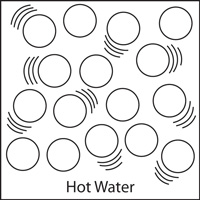
What state of matter is shown in the image?
a)
Solid
b)
Liquid
c)
Gas
d)
Thermal Energy
2.
Which of the following is NOT a part of the Kinetic Theory of Matter?
a)
All matter is made up of tiny particles.
b)
Occasionally, particles stop moving.
c)
Particles are always moving in random paths.
d)
The type of movement of particles depends on the amount of energy.
3.
Which of the following states of matter has the LOWEST level of energy?
a)
Solid
b)
Liquid
c)
Gas
d)
Plasma
4.
What type of phase change occurs when a liquid turns into a gas (at the surface)?
a)
Melting
b)
Freezing
c)
Boiling
d)
Evaporation
5.
Which of the following is TRUE when particles GAIN Thermal Energy?
a)
Particles move more slowly
b)
Particles move further apart
c)
Particles stop moving
d)
Particles move closer together
6.
If the atoms of an object are moving fast, the temperature would be...
a)
High
b)
Low
7.
What is the measure of the average kinetic energy of the particles in an object?
a)
Motion
b)
Temperature
c)
Thermal Energy
d)
Heat
8.
The kinetic theory of matter states that all of the particles that make up matter are constantly
a)
growing
b)
shrinking
c)
crying
d)
moving
9.
Particles that make up a solid have the _____________ attraction toward each other. 
a)
strongest
b)
weakest
10.
Particles (molecules) in a ______________________ have more energy than the other states of matter.
a)
gas
b)
solid
c)
liquid
11.
If you place a balloon in a freezer what happens to the size of the balloon?
a)
Doubles
b)
increases
c)
decreases
d)
stays still
12.
The temperature at which all molecular motion stops is
a)
-460 .C
b)
-273K
c)
0K
d)
0.C
13.
The energy of an object as it is in motion is defined as
a)
Kinetic Theory
b)
Kinetic energy
c)
Potential energy
d)
Electric energy
14.
Pressure is caused by ______.
a)
gravity.
b)
gas molecules colliding with each other.
c)
gas molecules colliding with surfaces of the container.
d)
gas molecules reacting with each other.
15.
Gas molecules can easily be compressed  because ___________. 
a)
gas molecules are soft
b)
gas molecules are far apart
c)
gas molecules follow the shape of the container
16.
The average kinetic energy of water molecules is greatest in ____.
a)
steam at 100 C
b)
liquid water at 90 C
c)
liquid water at 373 K
d)
ice at 0 C
17.
What happens to the average kinetic energy of matter when it is heated?
a)
It increases
b)
It decreases 
c)
It doesn't change
d)
It cannot be determined
18.
If a balloon is cooled what will happen to the volume?
a)
Volume will increase
b)
Volume will decrease
c)
Volume will not change
19.

Which of the following are pressure units?

a)

atm

b)

psi

c)

KPa

d)

mm of Hg (l) or Torr

e)

all the other answers are correct

20.

What happens when you remove pressure acting on a balloon?

a)

the air pressure goes up

b)

the number of particles increases

c)

the number of collisions between air and the object increases

d)

the object's volume goes up

21.

Particles of a solid:

a)

vibrate

b)

mainly slide past each other

c)

mainly collide and spread

22.

What happens to the average kinetic energy of particles in a gas sample, when pressure acting on the system increases and volume decreases:

a)

it goes up

b)

it goes down

c)

it stays the same

23.

At absolute zero on the Kelvin scale, there is:

a)

no kinetic energy

b)

no potential energy, like lattice energy or chemical bond energy

24.
What is 0.00 degrees Kelvin known as
a)
No such thing
b)
Very cold
c)
Freezing point of Water
d)
Absolute Zero
25.
What is the device that measures atmospheric pressure?
a)
Aerometer
b)
Annemeter
c)
Barometer
d)
Humidity Detector
26.
What will happen to the volume of a gas under constant temperature if the pressure increases?
a)
Increase
b)
Decrease
c)
Nothing
d)
Explosion!
27.
Which of the following has the greatest amount of movement at a given temperature?
a)
Gas
b)
Liquid
c)
Solid
d)
They all have the same movement
28.
You have a gas that has a pressure of 2 ATM and a volume of 10L.  What would be the new volume if the pressure was changed to 1 ATM?
a)
5 L
b)
20 L
c)
It would stay at 10L
d)
1 L
29.
Which of the following would increase the pressure on a system?
a)
Increase the Temperature
b)
Pump in more gas
c)
Decrease the volume
d)
All of these
30.
If a balloon is cooled what will happen to the volume?
a)
Volume will increase
b)
Volume will decrease
c)
Volume will not change
31.
a)
Boyle's
b)
Charles
c)
Amonton
d)
Combined
32.
a)
Boyle's
b)
Charles
c)
Amonton's
d)
Combined
33.
If 10L of O2 at 273K and 1 atm is compressed to a 7L container at 250K, what is the new pressure?
a)
1.31 atm
b)
9.16 atm
c)
0.76 atm
d)
6.0 atm
34.
A weather balloon has a volume of 105L at 0.97 atm when the temperature is 318K. What is the volume at 293K and 1.05 atm?
a)
89.4 L
b)
0.32 L
c)
93.8 L
d)
3.13 L
35.
What happens to the volume of a gas as the pressure is increased? 
a)
pressure increases
b)
pressure decreases
c)
volume increases
d)
volume decreases
36.
Which state of matter has a definite shape?
a)
solid
b)
liquid
c)
gas
37.
Particles of a liquid
a)
are tightly packed together and stay in a fixed position.
b)
have no viscosity.
c)
decrease in volume with increasing temperature.
d)
are free to move around one another but still touch.
38.
What term describes a solid changing to a gas?
a)
Deposition
b)
Sublimation
c)
Evaporation
d)
Freezing
39.
The speed of the molecules determines the _____.
a)
volume
b)
density
c)
pressure
d)
temperature
40.
Which has a greater distance between particles?
a)
Solid
b)
Liquid
41.
The slower the particles in a substance move,
a)
the colder it is.
b)
the warmer it is.
c)
the more energy it has.
d)
the less energy it has.
42.
What are the states of matter?
a)
solid, liquid, and juice
b)
solid and liquid
c)
solid and gas
d)
solid, liquid, and gas
43.
State of matter with no definite shape or volume.
a)
solid
b)
liquid
c)
gas
d)
Mississippi
44.

A sample of nitrogen gas has a volume of 32.4 L at 20°C. The gas is heated to 220ºC at constant pressure. What is the final volume of nitrogen?

a)

2.94 L

b)

19.3 L

c)

31.4 L

d)

54.5 L

45.

The gas pressure in an aerosol can is 3.5 atm at 25°C. If the gas is an ideal gas, what pressure would develop in the can if it were heated to 175°C?

a)

3.5 atm

b)

4.8 atm

c)

5.3 atm

d)

7.5 atm

46.

A 1.00 L sample of gas at 760 torr is compressed to 0.800 L at constant temperature. Calculate the final pressure of the gas.

a)

750 torr

b)

800 torr

c)

950 torr

d)

1500 torr