
 Worksheets
Earth Science 1.1
Total questions: 86
Worksheet time: 1hrs 12mins
Name
Class
Date
1.
What is the hydrosphere?
a)
Water
b)
All water on Earth
c)
The Earth's surface
d)
All life on Earth
2.
What is the atmosphere?
a)
The thin blanket of air that surrounds Earth
b)
Air
c)
Pudding
d)
The Earth's surface
3.
What is the Lithosphere?
a)
Structure
b)
Surface
c)
Solid Earth (Earth's Surface)
d)
Tree
4.
What is the biosphere?
a)
Life
b)
All life on Earth
c)
Money
d)
Living Creatures
5.
The Scientific Method always begins with what?
a)
Research
b)
Conclusion
c)
A Question
d)
An experiment
6.
Which is not a part of the scientific method?
a)
Ask a question
b)
Background Research
c)
Construct a Hypothesis
d)
Make a theory or law
7.
How does the biosphere interact with the atmosphere?
a)
Trees releasing carbon dioxide
b)
Fish swimming in the ocean
c)
People hiking up a mountain
d)
Rain weathering a rock
8.
How does the lithosphere interact with the hydrosphere?
a)
Rain weathering and eroding a rock
b)
People enjoy a nice evening hiking
c)
A bird flying through the sky
d)
A massive landslide damages hundreds of homes
9.
How does the atmosphere interact with the hydrosphere?
a)
Rain falling from a cloud and running off eventually into a creek
b)
Birds flying in the sky
c)
Rain falling on the other side of the mountain
d)
Thunder can be heard for miles
10.
A person who studies the oceans and marine life would be an
a)
oceanographer
b)
ecologist
c)
meteorologist
d)
astronomer
11.
What would a meteorologist NOT study?
a)
wind patterns
b)
air pressure
c)
shooting stars
d)
weather
12.
In an experiment which of the following stays the same throughout the experiment?
a)
constants
b)
controls
c)
independent variables
d)
dependent variables
13.
What is Earth science?
a)
the scientific study of chemical mixtures
b)
the scientific study of Earth and the universe around it
c)
the scientific study of animal behavior
d)
the scientific study of life on Earth
14.
In the scientific process, forming a hypothesis is often immediately followed by what step?
a)
publishing the results in a scientific journal
b)
conducting a peer review of the hypothesis
c)
testing the hypothesis by conducting an experiment
d)
drawing conclusions about the hypothesis
15.
Which of the following is true about the impact of science on society?
a)
New technology created by science sometimes causes problems.
b)
The impact of science on society is always positive.
c)
Scientific knowledge does not help us understand the world.
d)
Science never has any impact on society.
16.
If experimental results do not support a hypothesis, what may happen?
a)
The hypothesis will become theory.
b)
The hypothesis may be changed or discarded.
c)
The hypothesis will be published in a scientific journal.
d)
The scientist who developed it may resign his position.
17.
What area of Earth science is likely to involve the study of climate?
a)
geology
b)
biology
c)
astrology
d)
meteorology
18.
What is the process of water vapor changing into liquid water?
a)
Evaporation
b)
Transpiration
c)
Condensation
d)
Infiltration
19.
Why do we want to test one variable at a time?
a)
Because it is hard to setup a data table with more
b)
To know what is causing the changes
c)
It is what has always been done
d)
No one really knows
20.
The name of the information that you get from your experiment (you organize it into charts and graphs).
a)
observations
conclusion
conclusion
b)
data
c)
variables
d)
hypothesis
21.
A list of the steps anyone could follow to conduct an experiment.
a)
obervations
b)
question/problem
c)
materials
d)
procedures
22.
An example of a connection between HYDROsphere and GEOsphere is:
a)
waves eroding rocks on beach
b)
fish swimming in water
c)
water evaporating to make clouds
d)
boats transporting goods
23.

This coral reef is an example of something in the:
a)
Atmosphere
b)
Biosphere
c)
Hydrosphere
d)
Geosphere
24.

The Four Spheres of Earth
a)
are all connected
b)
have nothing to do with one another
c)
exist on Venus and Mars
d)
don't affect human life
25.
An example of a connection between ATMOsphere and GEOsphere is
a)
sand dunes
b)
drinking water
c)
trees
d)
diamonds
26.
All living things on earth are part of the....
a)
Biosphere
b)
Geosphere
c)
Hydrosphere
d)
Cryosphere
27.
What are the 3 main layers of Earth?
a)
geosphere, hydrosphere, and atmosphere
b)
inner core, outer core, and mantle
c)
crust, lithosphere, and biosphere
d)
crust, mantle, and core
28.
Which sphere would contain the oxygen that we breathe?
a)
geosphere
b)
atmosphere
c)
biosphere
d)
hydrosphere
29.
What is Earth's function?
a)
controls the distribution of minerals, rocks and soils and generates natural hazards that shape the land and impact humans
b)
a recycling planet powered by the flow of solar energy to support a network of life.
c)
sustains various life forms and plays an important role in ecosystems and regulating heat on earth.
d)
sustains life forms on the surface of the earth, absorbs and interacts with harmful solar rays.It protects the earth from natural and human-caused space debris.
30.
What is the geosphere's function?
a)
controls the distribution of minerals, rocks and soils and generates natural hazards that shape the land and impact humans
b)
a recycling planet powered by the flow of solar energy to support a network of life.
c)
sustains various life forms and plays an important role in ecosystems and regulating heat on earth.
d)
sustains life forms on the surface of the earth, absorbs and interacts with harmful solar rays.It protects the earth from natural and human-caused space debris.
31.
What is the hydrosphere's function?
a)
a recycling planet powered by the flow of solar energy to support a network of life.
b)
sustains various life forms and plays an important role in ecosystems and regulating heat on earth.
c)
sustains life forms on the surface of the earth, absorbs and interacts with harmful solar rays.It protects the earth from natural and human-caused space debris.
d)
controls the distribution of minerals, rocks and soils and generates natural hazards that shape the land and impact humans
32.
What is the atmosphere's function?
a)
a recycling planet powered by the flow of solar energy to support a network of life.
b)
sustains various life forms and plays an important role in ecosystems and regulating heat on earth.
c)
sustains life forms on the surface of the earth, absorbs and interacts with harmful solar rays.It protects the earth from natural and human-caused space debris.
d)
controls the distribution of minerals, rocks and soils and generates natural hazards that shape the land and impact humans
33.
What is a system?
a)
a set of connected things or parts forming a complex whole
b)
a pattern
c)
a number
d)
and interogative sentence
34.
New crust forms at
a)
divergent plate boundaries
b)
convergent plate boundaries
c)
transform fault boundaries
d)
all of the above
35.
The volcanic Andes Mountains in South America are associated with a _____________ boundary
a)
divergent
b)
oceanic-oceanic convergent
c)
continental-continental convergent
d)
oceanic-continental convergent
36.
The Himalayan Mountains were produced along a _____________ boundary.
a)
divergent
b)
oceanic-oceanic convergent
c)
continental-continental convergent
d)
oceanic-continental convergent
37.
The San Andreas fault is an example of which type of fault?
a)
divergent
b)
continental-continental convergent
c)
transform fault
d)
oceanic-continental convergent
38.
Where would you expect to find a deep-sea trench?
a)
divergent boundary
b)
convergent boundary
c)
transform fault boundary
39.
Where on the ocean floor is there ongoing volcanic activity
a)
ocean ridges
b)
deep sea trenches
c)
continental shelves
d)
abyssal plains
40.
Why does an ocean plate subduct under a continental plate?
a)
the continental crust is more dense
b)
they are diverging
c)
oceanic crust is more dense
d)
oceanic crust is older
41.
Which layer of Earth is the source of lava that erupts from volcanoes?
a)
inner core
b)
outer core
c)
asthenosphere
d)
lithosphere
42.

Identify layer #20.
a)
mantle
b)
pizza crust
c)
inner core
d)
outer core
43.
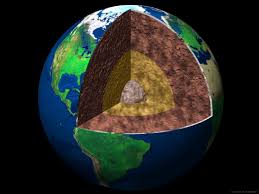
Which layer of Earth is located above the outer core?
a)
crust
b)
inner core
c)
mantle
d)
lithosphere
44.
Which of these two layers is a solid?
a)
innercore
b)
Outercore
45.
What is the top layer of the Earth's surface called?
a)
Mantle
b)
Innercore
c)
Outercore
d)
Crust
46.
Which lists the main layers of Earth in order from outermost to innermost?
a)
lithosphere, asthenosphere, mesosphere
b)
core, mantle, crust
c)
crust, mantle, core
d)
mantle, core, crust
47.
As two continental plates collide, the edges of the plates are crumpled and uplifted. Which of these landforms is most likely a result of this type of collision?
a)
Normal faults
b)
Mountain ranges
c)
U-shaped valleys
d)
shield volcanos
48.
Seafloor spreading occurs along certain boundaries in the ocean. Which are most likely to form at the boundary where the seafloor is spreading?
a)
strike-slip faults
b)
subduction zones
c)
mid-ocean ridges
d)
continental shelves
49.
Seafloor spreading occurs along certain boundaries in the ocean. Which are most likely to form at the boundary where the seafloor is spreading?
a)
strike-slip faults
b)
subduction zones
c)
mid-ocean ridges
d)
continental shelves
50.
Which of these tectonic plate boundaries is most likely to form a volcano?
a)
a continental plate colliding with a continental plate
b)
an oceanic plate sliding past a continental plate
c)
a continental plate sliding past a continental plate
d)
an oceanic plate colliding into a continental plate
51.
What causes the tectonic plates of Earth to continually move?
a)
convection currents in the mantle
b)
volcanic and seismic activity in the crust
c)
strong winds and storms
d)
rotation of the solid core
52.
What was the supercontinent called?
a)
Pangea
b)
Pandora
c)
Pantheon
d)
Pangalactica
53.
What is the idea that the sea floor is being pulled apart and creating new ocean crust at mid ocean ridges called?
a)
Sea floor spreading
b)
Sea isostacy
c)
Continental drift
d)
Continental shift
54.
If ocean crust meets continental crust, what will happen?
a)
Ocean crust will sink under the continental crust
b)
Ocean crust will make mountains with continental crust
c)
Continental crust will sink under the ocean crust
55.
What is a trench classed as?
a)
Divergent Plate Boundary
b)
Convergent Plate Boundary
c)
Hot Spot
d)
Transform Plate Boundary
56.
What do we call the soft, plastic like part of the mantle?
a)
Lithosphere
b)
Mesosphere
c)
Asthenosphere
d)
Hydrosphere
57.
The _________ is the gradually sloping end of a continent that extends under the ocean to 350 m deep.
a)
continental shelf
b)
trench
c)
seamount
d)
abbysal plain
58.
A __________ is the area in an ocean basin where new ocean floor is formed
a)
sea mount
b)
continental shelf
c)
mid ocean ridge
d)
continental slope
59.

This image shows
a)
sea floor is spreading
b)
continental shelf
c)
continental slope
d)
sea mount
60.
Which structure extends from the outer edge of the continental shelf to the ocean floor?
a)
continental
slope
b)
abyssal
plain
c)
oceanic
trench
d)
sea mount
61.
What is the area in an ocean basin where new ocean floor is forming?
a)
New seafloor forms at mid-ocean
ridges as lava erupts through cracks in Earth’s crust.
b)
New ocean floor forms at continental slope
62.

Label A
a)
continental slope
b)
continental shelf
c)
abyssal plain
d)
sea mount
63.

Label B
a)
continental slope
b)
continental shelf
c)
abyssal plain
d)
sea mount
64.

Label C
a)
continental slope
b)
continental shelf
c)
abyssal plain
d)
sea mount
65.

Label D
a)
continental slope
b)
continental shelf
c)
abyssal plain
d)
mid ocean ridge
66.

Label E
a)
continental slope
b)
volcanic island
c)
abyssal plain
d)
sea mount
67.

Label F
a)
continental slope
b)
continental shelf
c)
abyssal plain
d)
sea mount
68.

When we go to beach, we are allowed to go on ____________
a)
continental slope
b)
continental shelf
c)
abyssal plain
d)
sea mount
69.
What percent of the Earth's surface is covered in water?
a)
71
b)
82
c)
50
d)
63
70.
What is the steep slope at the edge of the continental shelf?
a)
seamount
b)
mid-ocean ridge
c)
continental slope
d)
rift zone
71.
What are underwater mountain ranges called?
a)
continental shelf
b)
mid-ocean ridges
c)
abyssal plains
d)
continental slopes
72.
Where is the shallowest part of the ocean floor?
a)
continental slope
b)
continental shelf
c)
abyssal plains
d)
rift zones
73.
What is the flat land located on either side of the mid-ocean ridge?
a)
continental slope
b)
continental shelf
c)
abyssal plain
d)
ocean basin
74.
What is the deepest part of the ocean basin?
a)
abyssal plains
b)
trenches
c)
rift zones
d)
mid-ocean ridge
75.
What is an opening in the surface where lava may flow?
a)
trench
b)
seamount
c)
rift zone
d)
valley
76.
Which of the following is the corresponding oceanic land form for canyons?
a)
Mountain
b)
trench
c)
plains
d)
mid-ocean ridge
77.
a gently sloping, shallow area of the ocean floor that extends outward form the edge of the continent
a)
continental shelf
b)
continental slope
c)
abyssal plain
d)
mid-ocean ridge
78.
This boundary is also called a colliding boundary.
a)
transform
b)
convergent
c)
divergent
79.
This boundary moves away from another boundary.
a)
divergent
b)
convergent
c)
transform
80.
Alfred Wegener believed that all the continents were connected at one time. What did he call this one large land mass?
a)
Pancakes
b)
Pangaea
c)
Pancreas
d)
Patches
81.
the shape of the land that includes the area’s elevation, relief, and landforms
a)
elevation
b)
relief
c)
topography
d)
landform
82.
the height above sea level of a point on Earth’s surface
a)
elevation
b)
relief
c)
topography
d)
landform
83.
a larger unit of mountain ranges and mountain systems in a long, connected chain
a)
Mountain range
b)
Mountain system
c)
Mountain belt
d)
Mountain Valley
84.
Which of the following is not a location in which volcanoes typically occur?
a)
subduction zones
b)
cratons
c)
sea-floor spreading centers
d)
hot spots
85.
Molten rock that pours forth on Earth's surface is called
a)
metamorphic.
b)
magma.
c)
lava.
d)
pyroclastics.
86.
A gently sloping mountain landform built from effusive eruption is known as a
a)
cinder cone.
b)
shield volcano.
c)
crater.
d)
caldera.
100 %

