
 Worksheets
Pre-AP Biology Unit 1 Test Multi Subject Practice
Total questions: 64
Worksheet time: 46mins
Name
Class
Date
1.
Transcription takes place in the
a)
cytoplasm
b)
chloroplast
c)
nucleus
d)
mitochondria
2.
Translation takes place in the
a)
cytoplasm (ribosome)
b)
chloroplast
c)
nucleus
d)
mitochondria
3.
This cannot leave the nucleus
a)
DNA
b)
RNA
c)
Both
4.
Which is the mRNA molecule that would be transcribed from this DNA template:
TGGCAA
TGGCAA
a)
ACCGTT
b)
UGGCAA
c)
UCCGUU
d)
ACCGUU
5.
Carries the genetic code to the ribosome
a)
mRNA
b)
tRNA
c)
rRNA
d)
DNA
6.
What amino acid is represented by the codon UUA?
a)
Phenylalanine
b)
Tyrosine
c)
Leucine
d)
Stop codon
7.
Codes for a single protein
a)
DNA
b)
Gene
c)
Chromosome
d)
Chromatin
8.
What is the job of tRNA in protein synthesis?
a)
It is the blueprint of the genetic code
b)
it reads the mRNA
c)
it brings Amino Acids to the ribosome
d)
it is not involved in protein synthesis
9.

What is the correct amino acid sequence for the mRNA code AUGCCAGUAUGA
a)
Met-Pro-Ala-Val
b)
Met-Pro-Val
c)
Tyr-Gly-His
d)
Tyr-Gly-Arg-His
10.

What amino acid is represented by the codon UUA?
a)
Phenylalanine
b)
Tyrosine
c)
Leucine
d)
Stop codon
11.
Which is the mRNA molecule that would be transcribed from this DNA template:
TGGCAAGTACGT
TGGCAAGTACGT
a)
ACCGTTCATGCA
b)
UGGCAAGUACGU
c)
UCCGUUCUUGCU
d)
ACCGUUCAUGCA
12.
Which sequence of DNA bases would pair with this partiaal strand
ATG TGA CAG
ATG TGA CAG
a)
ATG TGA CAG
b)
TAC ACT GTC
c)
GTA AGT GAC
d)
CAT TCA CTG
13.

What determines the code, or information, of a DNA molecule?
a)
the shape (structure) of the nitrogen bases
b)
the order (sequence) of the nitrogen bases
c)
the color of the nitrogen bases
d)
the frequency (number) of nitrogen bases
14.

DNA codes for...
a)
cholesterol
b)
proteins
c)
fatty acids
d)
a sandwich
15.

Which process is shown?
a)
diffusion
b)
repiration
c)
recombination
d)
translation
16.
Which of the following is the blueprint for the production of RNA within a cell?
a)
DNA
b)
protein
c)
ATO
d)
carbohydrate
17.

What is the relationship between a protein, the cell, and DNA?
a)
DNA is produced by protein which is produced in the cell
b)
Protein is composed of DNA which is produced in the cell
c)
DNA controls the production of protein in the cell
d)
A cell is composed of DNA and protein
18.
Genetic info flows in one direction. Which best represents this flow?
a)
DNA-protein-RNA
b)
Protein-RNA-DNA
c)
RNA-protein-DNA
d)
DNA-RNA-protein
19.

The diagram shows the process of
a)
Transcription
b)
Translation
c)
Replication
d)
Mitosis
20.
Chargaff's rule dictates that...
A= Adenin, T= Thymine, G= Guanine, C= Cytosine
A= Adenin, T= Thymine, G= Guanine, C= Cytosine
a)
A must bond to T and G to C
b)
T must bond to C and A to G
c)
A must bond to A and T to T
21.
Which of the following units are repeatedly joined together to form a strand of DNA?
a)
amino acids
b)
nucleotides
c)
fatty acids
d)
polysaccharides
22.
What are the 4 nitrogen bases?
a)
adenine, thymine, cytoplasm, and guanine
b)
adenine, thymine cytosine, and guanine
c)
adenine, thymine, cytosine, and gylcerol
d)
adenine, thymine, cytosine, and glucose
23.

Name this structure
a)
double helix
b)
nucelotide
c)
twisted ladder
d)
hydrogen bond
24.
DNA codes for...
a)
cholesterol
b)
proteins
c)
fatty acids
d)
a sandwich
25.

Nucleotides are made up of a sugar, phosphate, and..?
a)
nitrogenous base
b)
nucleic acid
c)
cholesterol
d)
fatty acid
26.
What molecules do both DNA and RNA contain?
a)
uracil
b)
nucleotides
c)
thymine
d)
deoxyribose
27.
Which of the following best describes how DNA and RNA are similar?
a)
they both contain A and T
b)
They both have a double helix
c)
They are both composed of 5 different nucleotides
d)
they both have C and G
28.
Nitrogenous bases make up...
a)
The entirety of DNA
b)
The sugars that make up DNA
c)
The rungs of DNA in a double helix
29.
Which process is used to make mRNA from the DNA in the nucleus?
a)
transcription
b)
translation
c)
replication
30.
Where does transcription take place?
a)
nucleus
b)
cytoplasm
c)
ribosome
31.

The process represented in the diagram produces a molecule that is complementary to the template strand of DNA. What type of molecule is produced?
a)
New DNA
b)
Polypeptide
c)
Messenger RNA
d)
Carbohydrate
32.
what does mRNA do?
a)
carry info from genes to ribosomes
b)
carry amino acids to ribosomes
c)
help with RNA splicing
d)
make up ribosomes
33.
Where does transcription take place?
a)
nucleus
b)
ribosome
c)
cytoplasm
d)
smooth ER
34.

DNA codes for...
a)
cholesterol
b)
proteins
c)
fatty acids
d)
a sandwich
35.

The distance between New York City and Miami, Florida would be measured in __?__.
a)
kilometers (km)
b)
meters (m)
c)
centimeters (cm)
d)
millimeters (mm)
36.

To measure the length of a Kleenex box you would use __?__.
a)
kilometers (km)
b)
meters (m)
c)
dekameters (dam)
d)
centimeters (cm)
37.
What SI unit is used to measure volume?
a)
meters
b)
liters
c)
candelas
d)
kilograms
38.
Convert the following SI Units: 3.2 km to meters
a)
32
b)
320
c)
3200
d)
32000
39.
Convert the following SI Units: 5 cm to meters
a)
5
b)
0.5
c)
0.05
d)
0.005
40.
Enzymes are...
a)
nucleic acids
b)
proteins
c)
lipids
d)
carbohydrates
41.
An enzyme speeds up a chemical reaction in the cell but can only be used once. True or False?
a)
true
b)
false
42.
What is the function of an enzyme?
a)
enzymes break themselves into small pieces
b)
enzymes slow down chemical reactions
c)
enzymes speed up chemical reactions
d)
enzymes combine products to form reactants
43.
What happens when enzymes are heated to a high temperature?
a)
The enzymes die.
b)
The shapes of the enzyme are altered denature
c)
The enzymes' amino acid sequence changes.
d)
The enzymes remain the same
44.
Which of these is NOT true?
a)
Enzymes can denature (change shape) when the temperature gets too high.
b)
Enzymes can only be used once in a chemical reaction.
c)
Extreme pH can denature enzymes.
d)
Enzymes speed up chemical reactions.
45.
Enzymes are considered to be
a)
Lipids
b)
Carbohydrate
c)
Protein
d)
Nucleic Acid
46.
Changes in pH and temperature can damage an enzymes active site. What is this called?
a)
reusable
b)
catalyst
c)
specific
d)
fragile
47.
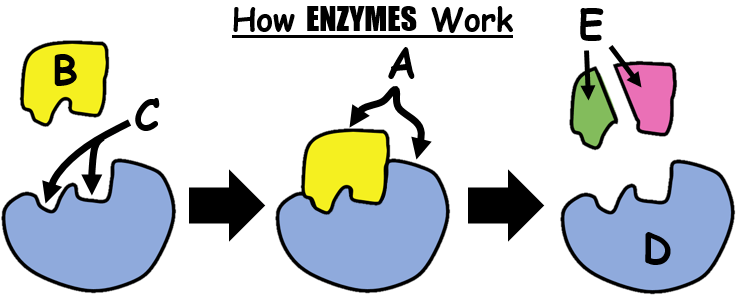
Letter D...
a)
active site
b)
enzyme
c)
substrate
d)
products
48.
Which biomolecule is made of nucleotides and contain you DNA?
a)
Carbohydrate
b)
Lipids
c)
Protein
d)
Nucleic Acid
49.
Which biomolecule is made of amino acids?
a)
Nucleic Acid
b)
Carbohydrate
c)
Protein
d)
Lipid
50.
Which biomolecule contains Deoxyribonucleic acid; a sequence of bases that makes hereditary code; Ribonucleic acid; translate hereditary code into proteins that determine how the cell will function under various conditions; provides storage and retrieval of information; encode genes, gene expression, helps make proteins
a)
Nucleic Acid
b)
Lipid
c)
Carbohydrate
d)
Protein
51.
The monomer of a protein is called...
a)
an amino acid
b)
a monosaccharide
c)
a fatty acid
d)
a nucleotide
52.
What is a factor that is measured for change in an experiment?
a)
control
b)
constant
c)
independent variable
d)
dependent variable
53.
What is the factor that an experimenter changes on purpose?
a)
Dependent Variable
b)
Independent Variable
c)
Constant
d)
Control
54.
What are all the things that are kept the same in an experiment?
a)
controls
b)
data
c)
constants
d)
independent variables
55.
What is the part of the experiment that contains the independent variable?
a)
control group
b)
experimental group
c)
hypothesis
d)
dependent variable
56.

Students used various temperatures of water to see which one dissolved candy faster.
What was the Independent Variable?
What was the Independent Variable?
a)
Amount of Candy
b)
Amount of Water
c)
Temperature of Water
d)
Time for Candy to Dissolve
57.
An experiment is performed on plants to see how different liquids affect plant growth. Each plant in the experiment is given a different liquid; water, apple juice, or milk. Each plant has the same amount of soil, sunlight, and listens to the same music. In this investigation, the independent variable is ...
a)
The type of plant
b)
The amount of sunlight
c)
The type of music
d)
The type of liquid
58.
An experiment is performed on plants to see how different liquids affect plant growth. Each plant in the experiment is given a different liquid; water, apple juice, or milk. Each plant has the same amount of soil, sunlight, and listens to the same music. In this investigation, what is the dependent variable?
a)
Type of plant
b)
Water, apple juice, milk
c)
Plant growth
59.
A student is planning an experiment to find out how the height from which he drops a ball affects how high the ball bounces. The dependent variable is the _____.
a)
Diameter of the ball
b)
Force acting on the ball
c)
Height that the ball bounces
d)
Height from which the ball is dropped
60.
Maria wants to know if birds prefer to eat in one place over another. She makes three feeders out of 2-liter bottles and paints all of them red. She fills each of the feeders with the same amount of mixed birdseed, and plans to keep the feeders out for 10 days before measuring how much seed is eaten from each feeder. She puts each of the feeders in her back yard: one feeder in a large dead tree, another feeder she sits on the dog house, and the last she sits in a small bushy tree.
What is the independent variable?
What is the independent variable?
a)
Red birdfeeders
b)
Placement of birdfeeders
c)
Amount of seed
61.
Jeff is 6 feet 2 inches is a ___________ assesment
a)
Qualitative
b)
Quantitative
62.
The cake has a sweet smell is a _______ assessment.
a)
Qualitative
b)
Quantitative
63.
The type of variable that you change or manipulate in an experiment. It is what you are testing.
a)
Independent
b)
Dependent
c)
Control
64.
The parts of the experiment that must be kept the same.
a)
Constants
b)
independent
c)
Dependent
100 %

