wayground logo

Free Printable Worksheets

NEW

Font size

S
M
L
XL
Worksheets

Cell Cycle Review

Total questions: 59

Worksheet time: 3610secs

Name
Class
Date
1.

Simon looks at an image of a slide and notices that all of the chromosomes are lined up in along the middle of the cell. He is likely looking at a cell that is in

a)

prophase

b)

metaphase

c)

anaphase

d)

telophase

2.

Which statement best describes chromosomes?

a)

They carry out cellular respiration

b)

They consist of the pigment chlorophyll

c)

Their structure is only visible during interphase

d)

They consist of tightly coiled strands of DNA and proteins

3.

What is different between how plant and animal cells use the cell cycle?

a)

Plant cells use the cell cycle for energy, while animal cells use the cell cycle for sugar.

b)

Plant cells are able to complete the cell cycle without using O2, but animals can not.

c)

Plant cells create a cell plate since they are very rigid.

d)

Animal cells create a cell plate since they are very flexible.

4.
What is the cell cycle?
a)
The gradual development of something, especially from a simple to a more complex form.
b)
The study of heredity and the variation of inherited characteristics.
c)
The branch of biology that deals with the relations of organisms to one another and to their physical surroundings.
d)
The series of events that take place in a cell leading to its division and duplication of its DNA to produce two daughter cells.
5.
Which part of the Cell Cycle takes the longest?
a)
Interphase
b)
Mitosis
c)
Prophase
d)
Cytokinesis
6.
True or False.
Mitosis is a continuous process.
a)
True
b)
False
7.
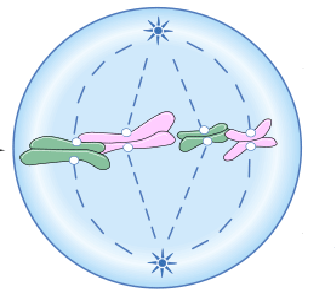
What phase is this cell in?
a)
Cytokinesis
b)
Mitosis
c)
Prophase
d)
Metaphase
8.
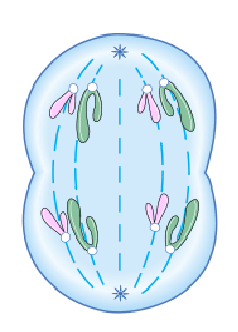
What phase is this cell in?
a)
Mitosis
b)
Interphase
c)
Anaphase
d)
Telophase
9.
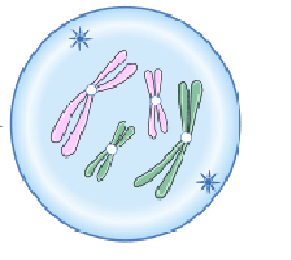
What phase is this cell in?
a)
Mitosis
b)
Cytokinesis
c)
Prophase
d)
Telophase
10.
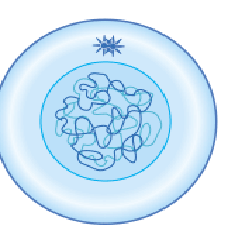
What phase is this cell in?
a)
Mitosis
b)
Interphase
c)
Prophase
d)
Telophase
11.
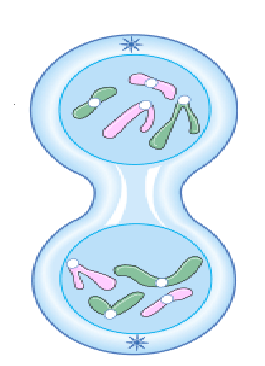
What part of the cell cycle is this cell in?
a)
Mitosis
b)
Interphase
c)
Telophase
d)
Cytokinesis
12.
What is the longest phase in MITOSIS?
a)
Prophase
b)
Metaphase
c)
Interphase
d)
Anaphase
13.
In what phase does chromatin condense to form chromosomes?
a)
Mitosis
b)
Interphase
c)
Prophase
d)
Anaphase
14.
In what phase do the chromosomes get pulled apart into sister chromatid to opposite sides of the cell?
a)
Prophase
b)
Interphase
c)
Metaphase
d)
Anaphase
15.
In what phase do the organelles disperse out into the daughter cells, and the cell prepares for cytokinesis?
a)
Prophase
b)
Interphase
c)
Mitosis
d)
Telophase
16.
What is the longest stage of the cell cycle called?
a)
Cytokinesis
b)
M phase
c)
Interphase
d)
G1 Phase
17.
During which stage of the cell cycle does mitosis and cytokinesis occur?
a)
Interphase
b)
S phase
c)
M phase
d)
G1 phase
18.
During what phase of the cell cycle is DNA replicated?
a)
G1 phase
b)
S phase
c)
G2 phase
d)
M phase
19.
During what phase of the cell cycle does the cell grow?
a)
G1 phase
b)
S phase
c)
M phase
d)
Cytokinesis
20.
During what phase of the cell cycle does the cell prepare for mitosis?
a)
G1 phase
b)
S phase
c)
G2 phase
d)
M phase
21.
Put the following stages of mitosis in order: anaphase, prophase, metaphase, and telophase. 
a)
prophase, metaphase, telophase, anaphase
b)
prophase, anaphase, metaphase, telophase
c)
prophase, metaphase, anaphase, telophase
d)
prophase, telophase, metaphase, anaphase
22.
Put the following stages of the cell cycle in order: G2, S, G1, M. 
a)
G1, S, G2, M
b)
S, G1, G2, M
c)
G1, M, G2, S
d)
M, G1, S, G2
23.
Put the following in order: G2, G1, S, mitosis, cytokinesis. 
a)
G1, G2, S, Mitosis, cytokinesis
b)
G1, S, G2, Mitosis, cytokinesis
c)
G1, G2, S, cytokinesis, mitosis
d)
G1, S, G2, cytokinesis, mitosis
24.
Why would it be important to replicate DNA before a cell divides in mitosis or meiosis?
a)
In order for genetic information to be transferred into daughter cells.
b)
In order for the cell to be able to increase in size.
c)
In order for the DNA to be contained in the nucleus.
d)
In order for the cell to re-order the DNA sequencing in the new cells.
25.
Cell division in animal, plant, fungi, and protists cells is called...
a)
Mitosis
b)
Meiosis
c)
Hydrolysis
d)
Dehydration synthesis
26.
Neuron cells, like the one pictured, rarely replicate. Therefore, we consider them to be in the _____ phase.
a)
G0
b)
G1
c)
S
d)
Delay
27.
At the end of the G1 phase, there's a checkpoint. What is this checkpoint probably checking for?
a)
To see if the cell has grown enough
b)
To see if the DNA was correctly replicated
c)
To make sure the cell does not have cancer
d)
To make sure that the enzymes aren't amalyzed
28.
What cells in your body proceed quickly through the cell cycle?
a)
Skin cells
b)
Hair follicle cells
c)
Both skin and hair cells
d)
Neither of these two proceed quickly through the cell cycle
29.
After mitosis and cytokineses, one cell becomes...
a)
Two identical cells
b)
Two genetically different cells
c)
Four identical cells
d)
Four genetically different cells
30.
Fruit fly body cells have 8 chromosomes. After mitosis, you would expect a resulting fruit fly daughter cell to have -
a)
16 chromosomes.
b)
46 chromosomes.
c)
8 chromosomes.
d)
4 chromosomes.
31.
In mitosis, the two resulting cells are
a)
different from the starting cell and identical to each other.
b)
different from the starting cell and different from each other.
c)
identical to the starting cell and different from each other.
d)
identical to the starting cell and identical to each other.
32.
The dark "spider" looking things on opposite sides of the cell are called "Spindle Fibers".  What is their job?
a)
Eating the chromosomes
b)
Pulling the chromosomes apart
c)
Putting the chromosomes together
33.

Which of the following is/are results of the cell cycle ?

a)

growth

b)

repair of damaged cells

c)

replacement of dying cells.

d)

All of the above

34.

After mitosis the number of chromosomes in the newly created cells will be:

a)

Half the number of the original cell

b)

The same number as the original cell

c)

Twice as much as the original cell

35.

What type of cell will form a cell plate during mitosis?

a)

Haploid cells

b)

Plant Cells

c)

Animal Cells

d)

Diploid Cells

36.

Uncontrolled growth can result in:

a)

G0 phase

b)

S phase

c)

Replication

d)

Cancer

37.
Mitosis
a)
body cells
b)
sex cells
38.
How does cytokinesis differ in plant and animal cells?
a)
Cytokinesis only takes place in animal cells.
b)
Cytokinesis only takes place in plant cells.
c)
Plant cells form a cell plate, animal cells form a cleavage furrow.
d)
Animal cells form a cell plate, plant cells form a cleavage furrow.
39.
Structure (b) is a ____.
a)
chromosome
b)
chromatid
c)
centromere
40.
The absorption of nutrients is determined by...
a)
The cell's volume
b)
The cell's surface area
c)
The cell's ribosomes
d)
The cell's DNA
41.

The amount of nutrients needed is determined by...

a)

The cell's volume

b)

The cell's surface area

c)

The cell's Rough ER

d)

The cell's Smooth ER

42.
As a cell increases in size, the surface area to volume ratio _________________.
a)
increases
b)
decreases
c)
stays the same
43.
Which is true about cellular transport and communication in large cells?
a)
It is more efficient.
b)
It is less efficient.
c)
There is no difference between large and small cells.
44.

The process of mitosis and cytokenesis produce two identical...

a)

daughter cells

b)

proteins

c)

chromosomes

d)

babies

45.

Bacteria reproduce asexually by a process called

a)

replication

b)

meiosis

c)

mitosis

d)

binary fission

46.

The two daughters cells formed from binary fission...

a)

Are identical and contain their own copy of the chromosome, ribosomes, cell wall, etc.

b)

Are genetically unique from each other

47.

All human have _________ chromosomes

a)

23

b)

46

c)

Diploid

d)

Haploid

48.
Body cells have diploid or haploid number of chromosomes?
a)
Haploid
b)
Diploid
49.
A dog has 78 chromosomes in its body cells.  What is the diploid number?
a)
78
b)
39
c)
1
d)
100
50.

What phase am I?

a)

Interphase

b)

Prophase

c)

Metaphase

d)

Anaphase

e)

Telophase

51.

What phase am I?

a)

Interphase

b)

Prophase

c)

Metaphase

d)

Anaphase

e)

Telophase

52.

What phase am I?

a)

Interphase

b)

Prophase

c)

Metaphase

d)

Anaphase

e)

Telophase

53.

What phase am I?

a)

Interphase

b)

Prophase

c)

Metaphase

d)

Anaphase

e)

Telophase

54.

What phase am I?

a)

Interphase

b)

Prophase

c)

Metaphase

d)

Anaphase

e)

Telophase

55.
The individual strands on duplicated chromosomes are called_____________
a)
Centromeres
b)
daughters
c)
Chromatids
d)
Karyotypes
56.
The ___________ holds the replicated sister chromatids together.
a)
centriole
b)
chromosomes
c)
centromere
d)
cycles
57.
The structures labeled B are
a)
centrioles
b)
chromatids
c)
centromeres
d)
chromopheres
58.
Histones are 
a)
proteins wound up in DNA
b)
critical to maintaining the shape of chromosomes
c)
aid in the tight packing of DNA
d)
all of these 
59.
When DNA is in its less coiled, "relaxed," state, between cell divisions, it is called
a)
autosomes
b)
chromatid
c)
chromatin
d)
centromere