Wayground logo

Free Printable Worksheets

Font size

S
M
L
XL
Worksheets

Structure of the Earth and Plate Tectonics

Total questions: 66

Worksheet time: 52mins

Name
Class
Date
1.
This picture shows
a)
Atmosphere
b)
Biosphere
c)
Hydrosphere
d)
Geosphere
2.
A monkey is:
a)
Atmosphere
b)
Biosphere
c)
Geosphere
d)
Hydrosphere
3.
Which layer of the Earth is 5-70km thick
a)
The Mantle
b)
The Crust
c)
The Core
4.
Which layer makes up 2/3 of the Earth's mass
a)
The Crust
b)
The Mantle
c)
The Core
5.
Plates move because of convection currents in the __________.
a)
ocean
b)
mantle
c)
epicenter
d)
continental drift
6.
Volcanic mountains usually form _______.
a)
in the middle of a plate
b)
in corn fields 
c)
where two plates meet 
d)
where a plate folds
7.
What is the theory that the Earth's continents move?
a)
mantle
b)
continental drift
c)
cinder cone
d)
fault
8.
What is the break in the Earth's crust along which  movement occurs?
a)
mantle
b)
continental drift
c)
cinder cone
d)
fault
9.
Plates collide, move apart, or _____ past each other.
a)
move apart
b)
seismograph 
c)
slide
d)
tectonics
10.
Plate ___________ is the theory that the Earth's surface is made of large sections moving over the mantle.
a)
move apart
b)
seismograph 
c)
slide
d)
tectonics
11.
Which layer is layer 1?
a)
Core
b)
Mantle
c)
Crust
d)
Mesophere
12.
Which layer is layer 4?
a)
Core
b)
Mantle
c)
Crust
d)
Mesophere
13.

The outer core is

a)

solid and made of iron

b)

fluid and made of nickel and iron

c)

hollow like the Easter bunny thing

d)

solid like a rock

14.

The inner core is

a)

solid rock

b)

solid iron

c)

liquid rock

d)

water

15.

The reason the inner core is not liquid is because

a)

it is not hot enough

b)

it is under so much pressure

c)

we are not sure why

d)

the tooth fairy wills it

16.
Which layer of the mantle is the least ridged (bendy like play-dough)?
a)
Asthenosphere
b)
Mesosphere
c)
Lithosphere
d)
Inner core
17.
What type of heat transfer in found in Earth"s asthenosphere?
a)
Conduction
b)
Convection
c)
Radiation
d)
I don't know
18.
Which sublayer is made up of the crust and upper mantle?
a)
Inner Core
b)
Outer Core
c)
Lithosphere
d)
Asthenosphere
19.
At which type of boundary are mountains formed?
a)
Convergent
b)
Divergent
c)
Subductive Zone
d)
Transform
20.
At which type of plate boundary does seafloor spreading occur?
a)
Tranform
b)
Convergent
c)
Divergent
d)
Subductive Zone
21.
The San Andrea's Fault in California is which type of boundary?
a)
Convergent
b)
Divergent
c)
Subductive Zone
d)
Transform
22.
Geologists' main evidence about the structure of Earth's interior comes from
a)
temperature measurements in deep mines
b)
observations of other planets
c)
exploration of caves
d)
rock samples and seismic waves
23.
What layer is depicted in yellow?
a)
Asthenosphere
b)
Lithosphere 
c)
Mantel 
d)
Crust
24.
What layer is depicted in yellow?
a)
Crust
b)
Core
c)
Mantel
d)
Lithothsphere
25.
When you have a convergent boundary such as pictured here what happens to the oceanic crust?
a)
Subduction
b)
Subtraction
c)
Convergent
d)
Creates oceanic rifts
26.
Which of the following supports the theory of seafloor spreading?
a)
Correlation of rock layers
b)
Crustal Age
c)
Magnetic Reversal
d)
Continuous Mountain Chains
27.
What technology was used during WWII to detect enemy submarines and produce the first map of the seafloor?
a)
Sonar
b)
Radar
c)
GPS
28.
Undersea mountain range.
a)
Rift
b)
Mid-ocean ridge
c)
seafloor spreading
d)
Continental drift
29.
What is label G
a)
Trench
b)
Mid ocean ridge
c)
abyssal plain
d)
sea mount
30.
True or False : Sea-floor Spreading adds new material to the ocean floor?
a)
True
b)
False
31.
What happens when Subduction occurs?
a)
Parts of the crust fall into the mantle
b)
Parts of the crust fall into the core
c)
Parts of the crust fall into space
d)
None of the Above
32.

What is the name of the supercontinent when all continents were connected?

a)

Godwana

b)

Panama

c)

Pangaea

d)

Kruzasia

33.

True or False: Alfred Wegener showed that the sea floor was spreading and moved the continents

a)

True

b)

False

34.

Which one of the following is not evidence for a one time supercontinent.

a)

Fossils

b)

Mountain Ranges

c)

Convection

d)

Glacier Marks

35.

Which scientist proposed that the ocean floor was expanding around mid ocean ridges?

a)

Harry Hess

b)

Alfred Wegener

c)

Albert Einstein

d)

Albert Heffman

36.

True or False: The oceanic crust is thicker and more dense than the continental crust.

a)

False

b)

True

37.

The mid ocean ridge is which type of boundary?

a)

Convergent Boundary

b)

Divergent Boundary

38.

What is it called when oceanic crust goes down into the mantle under the continental crust?

a)

Divergent boundary

b)

Superposition

c)

Subduction Zone

d)

Sublimation

39.
Why was Wegener's theory not supported at first?
a)
his evidence was lacking
b)
anti-German prejudice
c)
his lack of scientific ackground
d)
he lacked the knowledge of the underlying mechanisms that drive it
40.
What type of event will occur at this boundary?
a)
Earthquake
b)
Volcano Eruption
c)
Tornado
d)
Mountain Building
41.
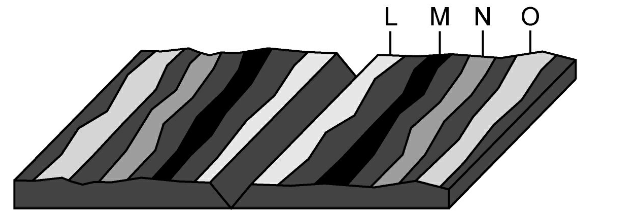
Where would the oldest rock be found?
a)
L
b)
M
c)
N
d)
O
42.
How is it possible for new crust to be formed without increasing the surface area of the Earth?
a)
Crust is destroyed at the same time it is created
b)
New crust is underwater where it sinks
c)
New crust breaks more easily than old crust
43.
Which of these events can ONLY happen on a DIVERGENT BOUNDARY?
a)
Rift Valley
b)
Mountain
c)
A peninsula
d)
An Insanely complex, long answer that you will click out of instinct. 
44.
The Himalayas in Asia are an example of what type of plate boundary?
a)
divergent
b)
continent-to-continent convergent
c)
ocean-to-continent convergent
d)
transform
45.
The Great Rift Valley in Africa and the Mid-Ocean Ridge were all created by this boundary
a)
Divergent
b)
Convergent
c)
Reform
d)
Transform
46.
What process is occurring at Z?
a)
Convection currents       
b)
 Subduction 
c)
Two plates moving apart
d)
New ocean floor forming
47.
Why does the ocean floor sink beneath the continent at Z?
a)
The ocean floor is less dense than the continent.
b)
The ocean floor is more dense than the continent.
c)
The ocean floor is moving faster than the continent.
d)
The ocean floor is moving slower than the continent.
48.
What forms when denser oceanic crust is pushed under less dense oceanic crust?
a)
mountains
b)
volcanic islands
c)
rift valleys
d)
mid-ocean ridges
49.
When an oceanic plate and a continental plate collide, which one will subduct? 
a)
oceanic
b)
continental
c)
neither
d)
both
50.
The youngest rocks on the seafloor are most likely found...
a)
closest to a mid-ocean ridge
b)
farthest from a mid-ocean ridge
c)
near the coastlines
d)
closest to a deep sea trench
51.
The Andes Mountains are a volcanic mountain range located on the western coast of South America. The plate boundary located in this region is most likely an area of-
a)
subduction because the plates are colliding
b)
folded mountains because the plates are colliding
c)
mid-ocean ridges because the plates are pulling apart
d)
ocean-floor spreading because the plates are spreading apart
52.
Rising magma that results from subduction may produce...
a)
fossil layers
b)
volcanic island arcs
c)
deep-sea sediment
d)
seafloor spreading
53.
What is a magnetic field reversal?
a)
when Earth's magnetic field suddenly disappears for short periods of time
b)
when Earth's magnetic field is flipped so that the positions of magnetic north and magnetic south are interchanged
c)
when Earth's magnetic field suddenly runs east/west instead of south/north
d)
none of these
54.
What is the correct order (starting from the surface) of Earth's layers?
a)
crust, outer core, inner core, mantle
b)
mantle, outer core, inner core, crust
c)
crust, mantle, outer core, inner core
d)
outer core, inner core, crust, mantle
55.
Compared to rock in Earth's crust, rocks in the mantle are more
a)
dense
b)
mineral-rich
c)
granular
d)
porous
56.
What is the difference between magma and lava?
a)
Lava is inside the Earth, magma is outside.
b)
Lava is outside the Earth, magma is inside.
57.
The tectonic plates float on the 
a)
lithosphere
b)
lower mantle
c)
outer core
d)
asthenosphere
58.
This layer is completely liquid
a)
crust
b)
inner core
c)
mantle
d)
outer core
59.
This layer is a mix between solid and liquid
a)
crust
b)
inner core
c)
mantle
d)
outer core
60.
This layer is completely solid due to the intense pressure it is under
a)
crust
b)
inner core
c)
mantle
d)
outer core
61.
Supporting Evidence: fossils, continent shape, landforms
a)
Continental Drift
b)
Seafloor Spreading
c)
Plate Tectonics
62.
Supporting Evidence: subduction, earthquakes, volcanoes, Mid-Atlantic Ridge, older theories
a)
Continental Drift
b)
Seafloor Spreading
c)
Plate Tectonics
63.
Supporting Evidence: discovery of Mid-Atlantic Ridge, core rock samples showing older rocks the farther that you get from the mid ocean ridge
a)
Continental Drift
b)
Seafloor Spreading
c)
Plate Tectonics
64.
Ocean trenches always form at subduction zones where dense oceanic crust subducts.
a)
True
b)
False
65.
The circular pattern of heating, rising, cooling, sinking of magma in the mantle causing tectonic plates to move.
a)
Plate Tectonics
b)
Convection Currents
c)
Pangaea
d)
Subduction
66.
Continental crust is more dense than oceanic crust.
a)
True
b)
False