wayground logo

Free Printable Worksheets

Font size

S
M
L
XL
Worksheets

ACP Biology Final Review

Total questions: 180

Worksheet time: 3hrs 36mins

Name
Class
Date
1.
The non-living part of an ecosystem
a)
Ocean
b)
Lava Flow
c)
Birds
d)
Abiotic
2.
The living part of an ecosystem
a)
Biotic
b)
Abiotic
c)
Mother Earth
d)
Flowers
3.
What does every food chain start with? (Even if it's not drawn or written there!)
a)
producers
b)
sun
c)
consumer
d)
decomposers
4.
An organism that needs to eat other organisms to obtain energy is known as a:
a)
Autotroph
b)
Producer
c)
Consumer
d)
Mutualist
5.
Consumer that eats plants
a)
heterotroph
b)
herbivore
c)
producer
d)
community
6.
What does a food web represent?
a)
All connections of energy flow throughout all organisms in a habitat.
b)
The specific ways that mutualism is carried out.
c)
A single pathway or energy flow between organisms. 
d)
How carnivores get their food. 
7.
relationship in which two species live closely together
a)
resource
b)
mutualism
c)
succession
d)
symbiosis
8.
Where an organism lives
a)
habitat
b)
niche 
c)
heterotrogh
d)
biosphere
9.
The image provided is an example of a(n):
a)
Carnivore
b)
Herbivore
c)
Producer
d)
Autotroph
10.
In this Food Web Pyramid Which type of consumer gets only 10% of the energy stored in plants?
a)
Herbivore
b)
Carnivore
c)
Omnivore
d)
Secondary Consumer
11.
When individuals join a population
a)
Aliens
b)
migration
c)
Immigration
d)
Emigration
12.
A population is 
a)
a group of communities that exist in different places
b)
a group of organisms of one species that lives in the same area at the same time
c)
a group of people that populate one place at the same time on different planets
13.
When you leave a population
a)
emigration
b)
mitigation
14.
Carrying Capacity is
a)
the capacity of what one person can carry per day 
b)
how many animals you have in your daily bag limit at the end of the year
c)
wildebeest at a watering hole with zebras
d)
the maximum number of individuals that the environment can support
15.

How can a population grow?

a)

Emigration and death

b)

Immigration and death

c)

Immigration and birth

d)

Emigration and birth

16.
Is a fungal infection in frogs considered biotic or abiotic?
a)
biotic
b)
abiotic
17.
What type of interaction occurs when beech and maple trees are in the same forest? 
a)
cooperation
b)
competition
c)
cohabitance
18.
What type of interaction occurs when bees live in a hive?
a)
cooperation
b)
competition
c)
churros
d)
chimichangas
19.

Producers are plants that take in which gas during the carbon cycle?

a)

oxygen

b)

carbon dioxide

c)

nitrogen

d)

carbon monoxide

20.

symbiosis relationship when 1 organism benefits and the other is harmed

a)

commensalism

b)

parasitism

c)

mutualism

d)

predation

21.

when 1 organism benefits and the other is neither helped nor harmed

a)

parasitism

b)

mutualism

c)

commensalism

d)

predation

22.

when organisms fight over or want the same resource

a)

cooperation

b)

commesalism

c)

combustion

d)

competition

23.

which is the 3rd level consumer

a)

grasshopper

b)

grass

c)

frog

d)

snake

24.

which is the 3rd level consumer

a)

grasshopper

b)

grass

c)

frog

d)

snake

25.

which level contains the most energy?

a)

grass

b)

rabbit

c)

snake

d)

hawk

26.
Anything that can decrease the size of a population including living (biotic) and non living (abiotic) features of an ecosystem such as predators and drought.
a)
limiting factor
b)
habitat
c)
ecosystem
d)
carrying capacity
27.
 plants that convert energy from the sun or chemicals.
a)
decomposer
b)
primary consumer
c)
secondary consumer
d)
producer
28.
An organism that eat's plants and meat.
a)
herbivore
b)
omnivore
c)
carnivore
d)
detrivore
29.
The role or function or job of a species in a community.
a)
habitat
b)
diet
c)
niche
d)
ecosystem
30.
Abiotic
a)
–describes the nonliving parts of the environment
b)
–describes living things in the environment
c)
describes the way in which plants use carbon dioxide
d)
describes all living and nonliving things in the environment
31.
Biotic
a)
–describes living things in the environment
b)
describes the nonliving things in the environment
c)
describe both the living and nonliving things in an environment
d)
describes the part of Earth where ecosystems can be found
32.
Population
a)
–a group of on particular organism that live in the same area
b)
includes all animals living in the same environment
c)
includes both living and nonliving things in an ecosystem
d)
a deer, a frog, and a ducks are an example of a population
33.
Community
a)
–all the populations of species that live in the same area and interact with one another
b)
all living and nonliving things in an ecosystem
c)
is located at the top of the ecological pyramid
d)
a group of animals (for example; otters) that live in the same water source
34.
Biosphere
a)
–the part of Earth where life exists
b)
describes all living things on Earth
c)
the study of living organisms
d)
a deer, a frog, and a ducks are an example of a population
35.
Producers
a)
–organisms that use the sun’s energy to make food.
b)
organisms that must eat other organisms to get food
c)
organisms that cannot make their own food
d)
animals that each both plants and animals
36.
Consumers
a)
–organisms that must eat producers or other animals to get energy.
b)
organisms that can make their own food from the sun's energy
c)
begin all food chains
d)
organisms that get their energy by breaking down dead organisms
37.
Carrying Capacity
a)
– the largest population that an environment can support at any given time
b)
resources that are so scarce that it limits the size of a population
c)
the smallest population that an environment can support at any given time
d)
the amount of nuts a chipmunk can hold in its cheeks at one time
38.
Predator
a)
–an organism that eats all or part of another organism
b)
an organism that is killed and eaten by another organism
c)
the name of a really bad movie
d)
an organism that is large and ferocious
39.
Prey
a)
–an organism that is killed and eaten by another organism
b)
an organism that eats all or part of another organism
c)
an animal that eats meat
d)
an animals that gets its energy by breaking down dead organisms
40.
average weather over time
a)
climate
b)
precipitation
c)
water cycle
d)
nitrogen
41.
model that shows all the possible feeding relationships in a community
a)
food chain
b)
food web
c)
energy pyramid
d)
none of these
42.

What is the series of predictable changes that occur in a community over time called?

a)

succession

b)

limiting factor

c)

carrying capacity

d)

scavenger

43.

Any naturally-occurring event that has an effect on an ecosystem

a)

Natural hazard

b)

Carrying Capacity

c)

Limiting factor

d)

Emigration

44.

Show the position an organism has in a food chain

a)

Trophic Levels

b)

Food Chain

c)

Food Web

d)

Animal Pyramid

45.

Which of these would be considered a decomposer?

a)

lions

b)

snake

c)

mushroom

d)

grass

46.
What are two ways in which the environment can influence population size?
a)
competition and natural disasters
b)
biomes and ecosystems
47.
a)
food webs and consumers
b)
carrying capacity and resource availability  
48.
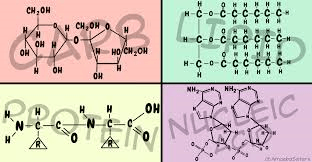
Which biomolecule is this a picture of? (Hint: it is made of amino acids)
a)
Proteins
b)
Nucleic Acids
c)
Lipids
d)
Carbohydrates
49.
Which biomolecule is this a picture of? (Hint: it is used for quick energy!)
a)
Complex Carbohydrate
b)
Nucleic Acid
c)
Lipid
d)
Simple Carbohydrate
50.
Which biomolecule is this a picture of? (Hint: it has a "head and tail" structure)
a)
Protein
b)
Nucleic Acid
c)
Lipid
d)
Carbohydrate
51.
Which biomolecule is also known as enzymes? (Hint: enzymes have MANY forms and functions!)
a)
Carbohydrate
b)
Lipid
c)
Nucleic Acid
d)
Protein
52.
Which biomolecule helps form muscles? 
a)
Nucleic Acid
b)
Carbohydrates
c)
Protein
d)
Lipids
53.
Which biomolecule is responsible for insulation and LONG term energy storage?
a)
Proteins
b)
Nucleic Acids
c)
Lipids
d)
Carbohydrates
54.
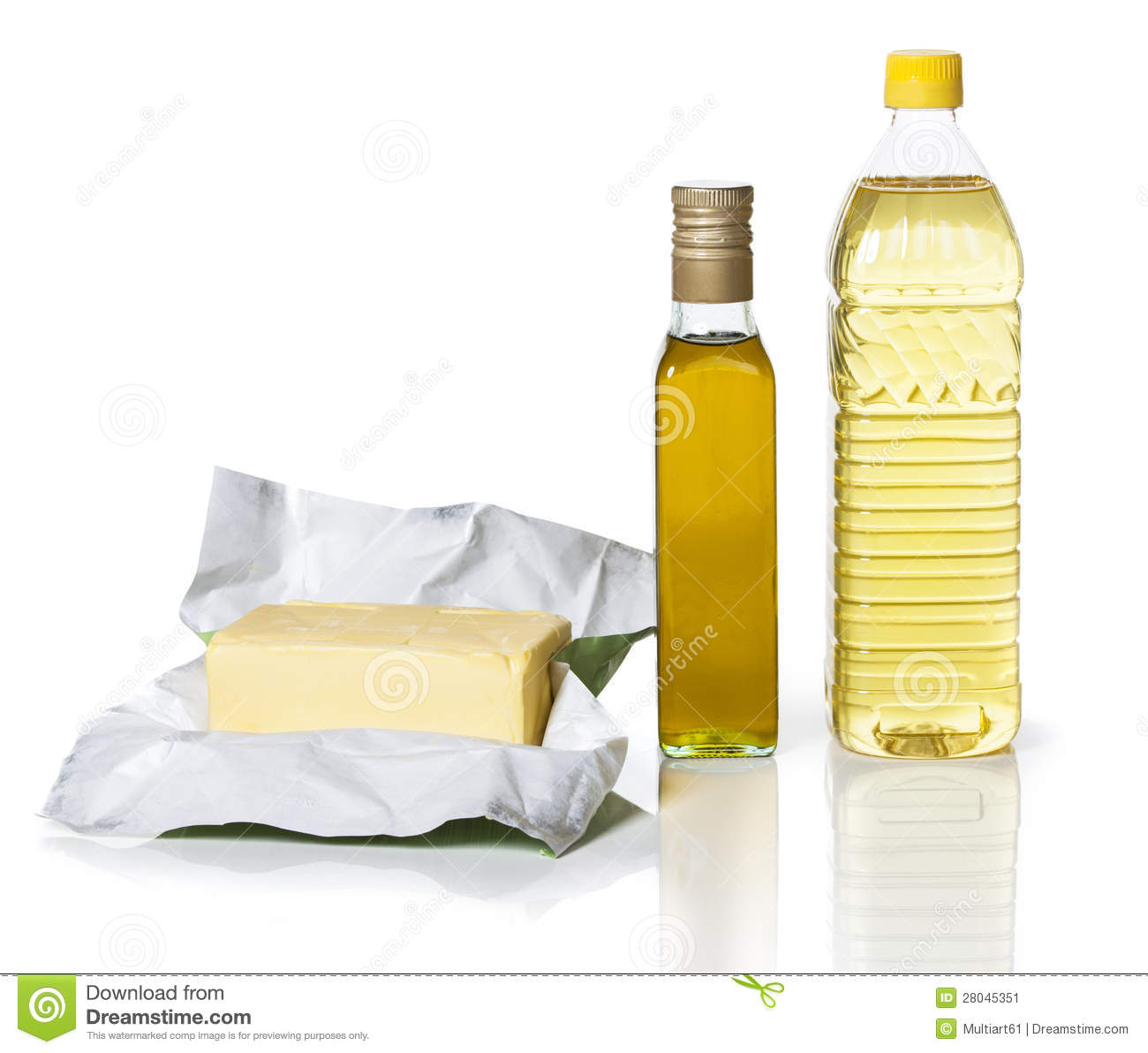
Which biomolecule group includes fats, oils, and waxes?
a)
Proteins
b)
Nucleic Acid
c)
Lipids
d)
Carbohydrate
55.
ALL polymers (large molecules) are made up of...
a)
monosaccharides
b)
monomers
c)
proteins
d)
None of these
56.
Proteins are SO diverse because ....
a)
They all have the same structure
b)
They have a wide range of structures
c)
They just are, it has nothing to do with structure
d)
They are alive and can change their function
57.
What elements are common to all 4 biomolecules?
a)
Carbon, hydrogen, nitrogen
b)
Carbon, Nitrogen, Phosphorus
c)
Carbon, Hydrogen, Oxygen
d)
Carbon, Hydrogen, Phosphorus
58.
Which of the following answers links a biomolecule with one of its proper functions?
a)
Lipids - Store genetic information
b)
Carbohydrates - short term energy storage
c)
Nucleic Acids - Catalyze reactions
d)
Proteins - long term energy storage
59.
Peptide bonds in proteins can be broken down by the enzyme peptidase. Adrian orders a hamburger and French fries for lunch. He adds cheese and mayonnaise to his hamburger and then sits down to eat lunch with his friends. Which structure would most likely result from the action of peptidase in Adrian’s stomach?
a)
Lipids
b)
Glucose
c)
Nucleic Acid
d)
Amino Acid
60.
Molecules consisting only of carbon, hydrogen,   and oxygen atoms make up a large part of a   plant cell wall. These molecules are classified   as (4.1.1)
a)
Enzymes
b)
Proteins
c)
Cellulose
d)
Lipids
61.
Which organic compound is correctly matched   with the subunit that composes it? (4.1.1)
a)
Nucleotide – amino acid
b)
Starch – glucose
c)
Protein – fatty acid
d)
Lipid – sucrose
62.
Which is an organic compound? (4.1.1)
a)
NH3
b)
H2O
c)
NaCl
d)
C12H22O11
63.
Hemoglobin, insulin, albumin, and maltase,   which are composed of chains of amino acids, are examples of: (4.1.1)
a)
Nucleic acids
b)
Carbohydrates 
c)
Lipids
d)
Proteins 
64.
Steroids are a type of ________.
a)
Nucleic Acid
b)
Lipid
c)
Cholesterol
d)
Protein
65.
Which of the following statements is true? 
a)
The function of the biomolecule nucleic acid is carrying genetic code and the main source of energy for the body. 
b)
The function of the biomolecule carbohydrate is energy storage and make up the cell membrane. 
c)
The function of the biomolecule lipid is the main source of energy and structure and support. 
d)
The function of the biomolecule protein is structure or support and enzymes speed up the chemical reactions. 
66.
Alpha helix and beta pleated sheets are part of what level of protein structure?
a)
primary
b)
secondary
c)
tertiary
d)
quaternary
67.
Ionic Bonding involves...
a)
The transfer of protons
b)
The transfer of nuetrons 
c)
The transfer of electrons
d)
None Of the above
68.
What happens when the sodium atom loses an electron?
a)
It become negatively charged 
b)
It become positively charged
c)
none
69.
What usually forms the negative ion?
a)
nonmetals
b)
metal
c)
none
70.
Covalent compounds
a)
Share electrons
b)
transfer electrons
c)
contain a sea of electrons
d)
conduct electricity
71.
What two types of atoms make a covalent bond?
a)
2 Nonmetals
b)
1 Nonmetal and 1 Metal
c)
2 Metals
d)
2 Noble Gases
72.
What happens when an atom loses an electron?
a)
Neutral (no charge)
b)
Positive charge
c)
Negative charge
73.
Which particle has a positive charge?
a)
electron
b)
orbital
c)
proton
d)
neutron
74.
Choose the particle that has no charge.
a)
nucleus
b)
neutron
c)
proton
d)
electron
75.
This particle determines what element you have - the elements identity.
a)
electron
b)
proton
c)
neutron
d)
valence shell
76.
What is the mass of a proton and a neutron?
a)
1amu
b)
2grams
c)
13amu
d)
10cm
77.
An electron has a _____ charge.
a)
negative
b)
positive
c)
neutral
78.
Describe an Electron Cloud?
a)
the mist outside of an atom
b)
home of the protons
c)
where electrons are located
d)
nucleus
79.
What are valence electrons?
a)
electrons on the first orbital always
b)
nucleus
c)
the outermost shell
d)
the number of electrons on the outermost orbital
80.
Which particles make up the nucleus of an atom?
a)
protons and neutrons
b)
electrons and protons
c)
electrons, protons, and neutrons
d)
electrons and neutrons
81.
The particles of the atom you can find by knowing the atomic number.
a)
neutrons
b)
protons and electrons
c)
protons and neutrons
d)
atomic mass
82.
What charge does the nucleus have and why?
a)
positive - the neutrons do not have a charge
b)
positive - the neutrons and protons are positively charged particles
c)
neutral - the neutral charge dominates the positive charge
d)
neutral - electrons cancel out the positive charge of the atom
83.
Matter that cannot be broken down into a simpler substance – building blocks of life.
a)
neutron
b)
atom
c)
electron
d)
quarks
84.
Most of the mass of an atom is contained here.
a)
electron orbitals 
b)
nucleus
c)
shells
d)
atomic #
85.

The monomers of nucleic acids are

a)

Monosaccharides

b)

Nucleotides

c)

Amino Acids

d)

Fatty Acids

86.

What biomolecules would help a bear withstand months of hibernation without eating?

a)

Protein

b)

Carbohydrates

c)

Nucleic Acids

d)

Lipids

87.

What element needs to be present to consider a molecule organic?

a)

Nitrogen

b)

Oxygen

c)

Carbon

d)

Phosphorous

88.

Proteins are used by the body for immunity, enzymes and

a)

Storage of energy

b)

Storage of genetic Information

c)

Quick energy release

d)

Structure

89.

_PO_CH what elements essential for life are missing from the acronym?

a)

Fe and Na

b)

Ca and Na

c)

S and N

d)

S and Na

90.

DNA and RNA are an example of

a)

Amino Acids

b)

Proteins

c)

Lipids

d)

Nuclei Acids

91.

A student burns heats up a piece of orange and some oil. Then he places them in a beaker with water and records the changes in the temperatures. Which food item will hold the temperature for the longest?

a)

The orange, because it is a sugar and sugars give energy

b)

The oil, because the oil is a sugar and it gives energy

c)

The orange, because it has many H-bonds which will cause it to hold the energy the longest

d)

The oil, because it has many H-bonds which will cause it to hold the energy the longest

92.

Which of the following may be caused by a lack of enough proteins in your diets?

a)

Frail nails and hair

b)

Fat deposit in your iris

c)

Low blood-sugar levels

d)

High blood pressure

93.

Which of the following could be cause by a diet rich in saturated fats? (you should select more than 1 answer choice)

a)

Frail nails and hair

b)

High blood pressure

c)

Low blood-sugar levels

d)

Lipid deposit in your eyes

94.
Which biomolecule is a main source of quick energy?
a)
Nucleic Acid
b)
Protein
c)
Lipid
d)
Carbohydrate
95.
Which biomolecule is found in fats, oils, and waxes and is a source of long-term energy
a)
Proteins
b)
Nucleic Acid
c)
Lipids
d)
Carbohydrate
96.
What is the function of the mitochondria?
a)
Pack and ship proteins
b)
Make proteins
c)
Make energy (ATP)
d)
Removes waste
97.
I am the control center of the cell and house the DNA. Who am I?
a)
Cytoplasm
b)
Nucleus
c)
Ribosome
d)
Golgi Apparatus
98.
What organelle is labeled with "D"?
a)
Mitochondria
b)
Golgi Apparatus
c)
Nucleus
d)
Endoplasmic Reticulum
99.

What is the function of the cell membrane?

a)

Produces ATP

b)

Produces proteins and lipids

c)

Keep the organelles in place

d)

Control what enters and leaves the cell

100.
I am the tough exterior that protects plant cells and gives them their shape. Who am I?
a)
Cell wall
b)
Cell membrane
c)
Cytoplasm
d)
Mitochondria
101.
What is the function of the ribosomes?
a)
Transport proteins
b)
Make proteins
c)
Package and ship proteins
d)
Store water, food, and wastes
102.
What organelle is labeled with "A"?
a)
Mitochondria
b)
Golgi Apparatus
c)
Nucleus
d)
Endoplasmic Reticulum
103.
I am way bigger in plant cells than I am in animal cells. What am I?
a)
Golgi Apparatus
b)
Nucleus
c)
Vacuole
d)
Ribosomes
104.
What is the function of chloroplasts?
a)
Helps plants make food from the sun
b)
Protects plant cells
c)
Store food and water
d)
Make energy for the cell
105.
I am the "trash room" and aid the cell with waste removal. Who am I?
a)
Centriole
b)
Golgi Apparatus
c)
Endoplasmic Reticulum
d)
Lysosome
106.
What organelle is labeled with "C"?
a)
Mitochondria
b)
Golgi Apparatus
c)
Nucleus
d)
Endoplasmic Reticulum
107.
Which vital organelle is NOT present in red blood cells?
a)
Vacuole
b)
Nucleus
c)
Lysosome
d)
ER
108.
What is the function of the Endoplasmic Reticulum (ER)?
a)
Package and ship proteins
b)
Transport proteins
c)
Create energy for the cell
d)
Remove waste
109.
I am the structure that holds all the organelles in place within the cell. Who am I?
a)
Cell membrane
b)
Cell wall
c)
Cytoplasm
d)
Centriole
110.
Which of the following organelles will you NOT find in an animal cell?
a)
Cell membrane
b)
Cell wall
c)
Golgi Apparatus
d)
Lysosome
111.
I am very present in muscles in order to provide massive amounts of ATP for movement and exercise. Who am I?
a)
Nucleus
b)
ER
c)
Mitochondria
d)
Ribosomes
112.
What organelle is labeled with "B"?
a)
Mitochondria
b)
Golgi Apparatus
c)
Nucleus
d)
Endoplasmic Reticulum
113.
I am located in the leaves of plants, but NOT the roots. Who am I?
a)
Lysosomes
b)
Chloroplasts
c)
Vacuole
d)
Mitochondria
114.
I am the "mail room" and aid in packaging and shipping proteins and nutrients. Who am I?
a)
Golgi Apparatus
b)
ER
c)
Lysosome
d)
Chloroplast
115.
I am the "security gate" of the cell and controls what enters and leaves. Who am I?
a)
Cell wall
b)
Golgi Apparatus
c)
Cytoplasm
d)
Cell membrane
116.
The theory of Endosymbiosis explains
a)
The origin of eukaryotes
b)
How species develop
c)
How bacteria live
d)
Why cells rely on one another
117.
____________ & _________________ are organelles that definitely arose from endosymbiosis.
a)
Rough ER & Smooth ER
b)
Mitochondria & Flagellum
c)
Chloroplast & Mitochondria
d)
Chloroplast and Golgi apparatus
118.
In this diagram, the endosymbiont is
a)
blue
b)
green
c)
purple
119.
What did the host cell receive from its endosymbiont (cell living inside of it)?
a)
Shelter
b)
Motility
c)
Energy
d)
Reproduction
120.
The main source of energy for all life comes from ____.
a)
the Earth
b)
the moon
c)
the sun
d)
the food we eat/make
121.
Chlorophyll absorbs a higher percentage of _____ and _______ light.
a)
purple and green
b)
red and blue
c)
black and orange
d)
yellow and green
122.
Most plants appear green because chlorophyll
a)
absorbs green light.
b)
absorbs violet light.
c)
reflects green light.
d)
does not absorb violet light.
123.
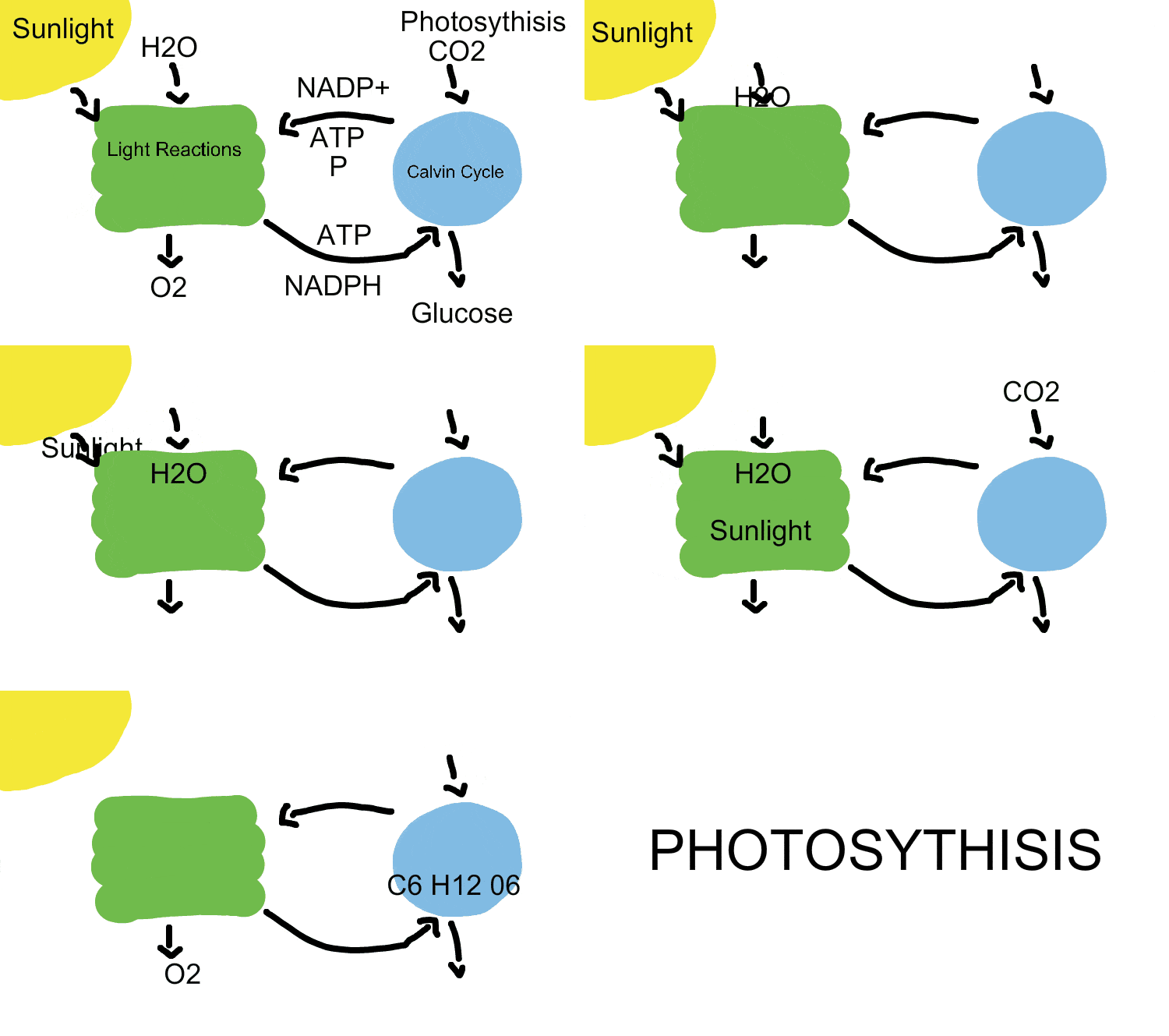
The reactants of photosynthesis are
a)
sugar and water.
b)
sugar and oxygen.
c)
carbon dioxide and water.
d)
carbon dioxide and oxygen.
124.
Which statement about photosynthesis is correct?
a)
Plants get the energy they need for photosynthesis from water.
b)
Plants get the energy they need for photosynthesis from soil.
c)
Plants get the energy they need for photosynthesis from sunlight.
d)
Plants do not require energy to perform photosynthesis.
125.
What are the products of photosynthesis?
a)
Carbon dioxide and water
b)
Carbon dioxide and oxygen
c)
Glucose and oxygen
d)
Glucose and water
126.
What pigment absorbs sunlight for photosynthesis?
a)
chloroplast
b)
thylakoid
c)
grana
d)
chlorophyll
127.
Which of the following is the correct equation for PHOTOSYNTHESIS?
a)
6CO2 + 6H2O --> 6O+ C6H12O6
b)
6CO+ C6H12O6 + 6H2O --> O
c)
6O2 + 6H2O --> 6CO+ C6H12O6
d)
C6H12O6 + 6O2 ---> 6H2O + 6CO2 
128.
Which gas is removed from the atmosphere during photosynthesis?
a)
hydrogen
b)
oxygen
c)
nitrogen
d)
carbon dioxide
129.
What is the function of NADPH and ATP?
a)
They absorb light
b)
They power the light-dependent reactions
c)
They are light-reflecting pigments
d)
They are short term energy carriers
130.
Where do the light-dependent reactions occur? 
a)
thylakoid membrane
b)
stroma
c)
mesophyll
d)
mitochondria
131.
Which of the following is NOT a product of the light-dependent reactions?
a)
ATP
b)
NADPH
c)
Oxygen
d)
Glucose
132.
What is the primary function of the light-dependent reactions of photosynthesis?
a)
To produce glucose
b)
To produce NADPH and ATP
c)
To use ATP
d)
To produce RuBP
133.
Which substance from the light-dependent reactions of photosynthesis is a source of energy for the light-independent reactions?
a)
ADP
b)
H2O
c)
NADPH
d)
pyruvic acid
134.
Most plants appear green because chlorophyll
a)
absorbs green light.
b)
absorbs violet light.
c)
does not absorb green light.
d)
does not absorb violet light.
135.
Plants need carbon dioxide from their environment to produce glucose during which stage of photosynthesis? 
a)
The light-dependent stage
b)
The light-independent stage (The Calvin Cycle)
c)
The electron transport chain
d)
ATP formation
136.
Which of the following best describes photosynthesis?
a)
Photosynthesis converts radiant energy into chemical energy.
b)
Photosynthesis produces carbohydrates.
c)
Plants need sunlight, carbon dioxide, water, nutrients, and chlorophyll to complete photosynthesis.
d)
Plants use chlorophyll, water, and carbon dioxide to make sugar.
137.
In which  organelle does photosynthesis occur?
a)
mitochondria
b)
stomata
c)
xylem
d)
chloroplast
138.
Which product is produced during the light-dependent reactions?
a)
water
b)
oxygen
c)
glucose
d)
carbon dioxide
139.
Which of the following is considered a waste product of photosynthesis?
a)
glucose
b)
oxygen
c)
carbon dioxide
d)
sunlight
140.
Animal cells do not have chloroplasts.
a)
TRUE
b)
FALSE
141.
Chloroplasts are organelles found in leaves.
a)
TRUE
b)
FALSE
142.
What is one of the reactants of cellular respiration?
a)
energy
b)
glucose
c)
carbon dioxide
d)
water
143.
______________ produces the most ATP.
a)
photosnthesis
b)
aerobic respiration
c)
anaerobic respiration
d)
glycolysis
144.
What are the products of aerobic respiration?
a)
Glucose and oxygen
b)
Carbon dioxide and water
c)
Lactic acid
d)
Carbon monoxide
145.
The mitochondria is responsible for ...
a)
photosynthesis
b)
anaerobic respiration
c)
aerobic respiration
d)
fermentation
146.
Aerobic respiration is different from anaerobic respiration in that aerobic respiration needs...
a)
chlorophyll
b)
carbon dioxide
c)
glucose
d)
oxygen
147.

How many ATP are produced in aerobic respiration?

a)

2

b)

28

c)

4

d)

36

148.
What is the correct equation for cellular respiration?
a)
6O2 + C6H12O6 -> 6CO2 + 6H2O + Energy
b)
6O2 + C6H12O6 + Energy -> 6CO2 + 6H2O
c)
6CO2 + 6H2O -> 6O2 + C6H12O6 + Energy
d)
6CO2 + 6H2O + Energy -> 6O2 + C6H12O6
149.

Where does the Krebs Cycle take place?

a)

Cristae

b)

Matrix

c)

cytoplasm

d)

nucleus

150.
Anaerobic respiration.....
a)
doesn't require CO2
b)
requires CO2
c)
doesn't require oxygen
d)
requires oxygen
151.
Cellular Respiration's goal is to
a)
make water
b)
make ATP
c)
make glucose
d)
make  oxygen
152.
What is cellular respiration?
a)
the breakdown of glucose  to release ATP
b)
the breakdown of glucose to release NADH
c)
the breakdown of glucose to release FADH
d)
the breakdown of glucose to release carbon
153.
Glycolysis results in a net gain of how many ATP?
a)
0
b)
2
c)
4
d)
1
154.
 The expression "feel the burn" means that a person exercising is doing 
a)
lactic acid fermentation
b)
alcoholic fermentation
c)
photosynthesis
d)
aerobic respiration
155.
Where does aerobic respiration occur?
a)
glucose molecule
b)
mitochondria
c)
cytoplasm
d)
chloroplast
156.

What is glucose converted to during glycolysis?

a)

Acetyl-Co A

b)

Coenzyme A

c)

Pyruvate

d)

Sucrose

157.

Which of the following shows the three stages of respiration in the correct order?

a)

Calvin Cycle, Glycolysis, Electron Transport Chain

b)

Glycolysis, Krebs Cycle, Electron Transport Chain

c)

Glucose, Krebs Cycle, Electron Transport Chain

d)

Glycolysis, Calvin Cycle, Electron Transport Chain

158.

This process does not make ATP alone, but it allows glycolysis to continue making ATP when oxygen is unavailable for cellular respiration.

a)

Anaerobic respiration (fermentation)

b)

Electron Transport Chain

c)

Glycolysis

d)

Kreb's cycle

159.
What are the products of aerobic respiration?
a)
Glucose and oxygen
b)
Carbon dioxide and water
c)
Lactic acid
d)
Carbon monoxide
160.

Heterotrophs are organisms that-

a)

Produce food

b)

Survive without energy

c)

Consume other organisms to obtain energy

d)

Carry out photosynthesis

161.

Respiration and photosynthesis have the opposite raw materials and products. These

two processes are known as -

a)

Helper processes

b)

Similar processes

c)

Complementary processes

d)

Coupled processes

162.
What is the chemical used by a neuron to transmit an impulse across a synapse to another nerve cell?
a)
Neurotransmitters
b)
Synapse
c)
Threshold
d)
Impulse
163.
Chemicals that emitted into the brain nearly instantly
a)
neurotransmitters
b)
hormones
c)
blood sugar
d)
adrenaline
164.
Chemicals emitted into the blood stream of the body.  Slower for the body to absorb, but more powerful.
a)
neurotransmitters
b)
hormones
c)
endorphins
d)
dopamine
165.
This neurotransmitter is most often associated with pleasure/reward sensations:
a)
Acetylcholine
b)
GABA
c)
Dopamine
d)
Serotonin
166.
Which neurotransmitter is involved in the "Fight of Flight" response?
a)
Acetylcholine
b)
Endorphins
c)
Norepinephrine
d)
Serotonin
167.

What is Homeostasis ?

a)

is the maintenance of a constant internal environment

b)

is the maintenance of a constant external environment

c)

is the maintenance of a constant living environment

168.

Which one here is a hormone?

a)

Glycogen

b)

Glycerol

c)

Glucagon

d)

Glucose

169.

The growth of a plant in response to light is called

a)

Phototropism

b)

Hydrotropism

c)

Gravitropism

d)

Photosynthesis

170.

Which one is NOT the effect of the release of adrenaline on the heart rate, glucose concentration and pupil

a)

heart rate increased

b)

glucose concentration increased

c)

glucose concentration decreased

d)

pupil dilates

171.

what hormone lowers blood glucose levels ?

a)

Insulin

b)

Aldosterone

c)

Protein

172.

Think about how your body responds when you invest a huge amount of sugar . Is your body’s response an example of positive or negative energy?

a)

Positive

b)

Negative

173.

Too low insulin can cause ?

a)

Type 1 diabetes

b)

Type 2 diabetes

c)

Type 3 diabetes

174.

According to the feedback loop what causes the increase of blood sugar ?

a)

Glycogen & glucose

b)

The pancreas

c)

Insulin

175.

Which of the following is NOT a function of blood?

a)

Fights infections

b)

Transports nutrients and waste substances

c)

Lines the respiratory passages

d)

Transports hormones

176.

The proper term for red blood cells is...

a)

leucocytes

b)

thrombocytes

c)

erythrocytes

177.

Where are blood cells made?

a)

Bone marrow

b)

Lymph glands

c)

Spleen

d)

Lungs

178.
How long do erythrocytes live?
a)
forever
b)
100-120 days
c)
2 weeks only
d)
a year
179.

What is the oxygen carrying pigment in blood?

a)

thrombin

b)

plasma

c)

hemoglobin

d)

protein

180.
What part of blood is responsible for fighting infections?
a)
Red Blood Cells
b)
White Blood Cells
c)
Platelets
d)
Plasma