
 Worksheets
Periodic Table & Chemical Bonds Review
Total questions: 72
Worksheet time: 59mins
Name
Class
Date
1.
When an atom loses an electron, it becomes a:
a)
positive ion
b)
negative ion
c)
neutral ion
d)
neutral atom
2.
Ionic compounds are formed when one or more valence electrons are transferred from _____
a)
a nonmetal atom to a metal atom
b)
a nonmetal atom to a nonmetal atom
c)
a metal atom to a nonmetal atom
d)
a metal atom to a metal atom
3.

This is a correct dot diagram for neon (Ne)
a)
true
b)
false
4.

This could be the dot diagram of
a)
Ne
b)
H
c)
C
d)
F
5.

This is a correct dot diagram for oxygen (O)
a)
true
b)
false
6.
How are covalent bonds explained?
a)
When one atom takes the other atom's electron
b)
When the atom shares an electron with an another atom
c)
When the two nucleus merge
d)
When the neutrons leave the nucleus
7.
What two types of atoms make a covalent bond?
a)
2 Nonmetals
b)
1 Nonmetal and 1 Metal
c)
2 Metals
d)
2 Noble Gases
8.
How many valence electrons do most atoms need to be stable?
a)
1
b)
2
c)
6
d)
8
9.
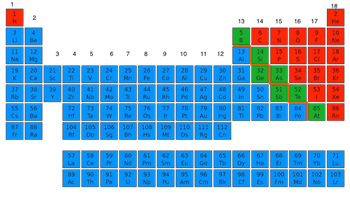
Where are the nonmetals located on the periodic table?
a)
Blue
b)
Red
c)
Green
10.

What is the correct formula for this molecule?
a)
NH
b)
N3H
c)
NH3
d)
NH4
11.
In the correct Lewis Structure for methane (CH4), how many unpaired electrons can be found around Carbon?
a)
0
b)
2
c)
4
d)
8
12.
Which of the compounds below contains a single covalent bond?
a)
Br2
b)
SO
c)
HCl
d)
Both a and c
13.
A molecule with a single covalent bond is....
a)
HCl
b)
SO
c)
CO
d)
SO2
14.
A molecule with a double covalent bond is....
a)
HCl
b)
SO
c)
I2
d)
N2
15.
How many bonds does carbon have to create in order to satisfy the octet rule
a)
1
b)
2
c)
3
d)
4
16.

For the structural formula shown, what is the chemical formula?
a)
NO
b)
N2O2
c)
NO2
d)
N2O
17.
How many electrons are shared in a single covalent bond?
a)
2 pairs
b)
4
c)
2
d)
1
18.
How do covalent bonds form?
a)
Donating & receiving valence e- between atoms.
b)
Opposite slight charges attract each other between compounds.
c)
Scientists are still not sure how they form.
d)
Sharing valence e- between atoms.
19.
In chemical compounds, covalent bonds form when
a)
the electronegativity difference between two atoms is very large.
b)
electrons are completely transferred between two metals.
c)
pairs of electrons are shared between two nonmetal atoms.
d)
two nonmetal atoms are attracted to each other by opposite charges.
20.
Is carbon considered a metal or a non-metal?
a)
metal
b)
nonmetal
c)
other
21.
Is Hydrogen considered a metal or a non-metal?
a)
Metal
b)
Non-metal
22.
What is it called if there are three pairs of electrons being shared?
a)
Triple bond
b)
Bond length
c)
Tribond
d)
Chocolate Mousse
23.
Which of the following is a covalent compound?
a)
LiF - Lithium Fluoride
b)
NH3 - Ammonia
c)
NaBr - Sodium Bromide
d)
CuCl - Copper(I) Chloride
24.
Why do Hydrogen and Helium only need two valence electrons?
a)
The first electron shell can only hold two electrons.
b)
They are both metals.
c)
They both begin with H.
d)
They are both gases.
25.
How are ionic bonds formed?
a)
When atoms share an electron
b)
When opposite charged atoms attract
c)
When one atom takes a proton
d)
When one atom takes a neutron
26.
Why do ionic bonds form?
a)
so the number of protons equals the number of electrons
b)
to fill the outermost energy level
c)
so an atom can become unstable
27.
Atoms form ions in order to become this
a)
isotopes
b)
stable
c)
metals
d)
nonmetals
28.
What is a cation?
a)
positive ion
b)
Neutral atom
c)
Two additional protons
d)
negative ion
29.
What is an anion?
a)
positive ion
b)
negative ion
c)
neutral atom
d)
2 neutrons taken away
30.

Name the following compound:
CO2
CO2
a)
monocarbon dioxide
b)
carbon oxide
c)
carbon dioxide
d)
oxygen carbonide
31.

How many valence electrons does oxygen have?
a)
2
b)
3
c)
6
d)
4
32.

How many valence electrons does nitrogen have?
a)
3
b)
2
c)
5
d)
1
33.

How many bonds does carbon have to create in order to satisfy the octet rule
a)
1
b)
2
c)
3
d)
4
34.

How many valence electrons does hydrogen have?
a)
4
b)
3
c)
2
d)
1
35.
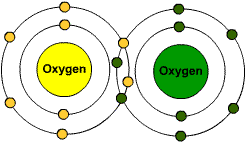
Is this image an example of covalent bonding?
a)
Yes
b)
No
36.

Outer shell electrons are called
a)
outer electrons
b)
valence electrons
c)
negatives
37.

Atoms want
a)
A full outer shell of electrons
b)
One electron short of a full shell
c)
kit kats
38.
With the ________ you must have 8 electrons on the outside ring.
a)
anions
b)
ionic bonds
c)
cations
d)
octet rule
39.
What is the charge on a Hydrogen ion?
a)
+1
b)
1
c)
2
40.
What is the charge on an Aluminium ion?
a)
3
b)
+3
c)
+2
d)
+1
41.
What is the charge on a chloride ion?
a)
-1
b)
1
c)
+2
d)
+1
42.
What is the charge of Neon?
a)
0
b)
+1
c)
-1
d)
1
43.
When an atom loses an electron, it becomes a:
a)
positive ion
b)
negative ion
c)
neutral ion
d)
neutral atom
44.
Magnesium bromide is an ionic compound with the chemical formula MgBr₂. What does the "2" tell you?
a)
There are 2 bromide ions for every magnesium ion
b)
Bromide has a 2- charge
c)
Bromide has a 2+ charge
d)
There are 2 magnesium ions to every bromide ion
45.
Elements in Group 1 lose one electron to form ions with a _________________ charge.
a)
1+
b)
2+
c)
0
d)
1-
46.
A charged particle that has gained at least one electron is called a(n) _____.
a)
Anion
b)
Cation
c)
Anonion
d)
chemistry cat
47.
Nitrogen will ____ electrons when forming an ionic bond.
a)
gain 1
b)
lose 1
c)
gain 3
d)
lose 3
48.
What will be the compound name of the following chemical formula?
NaCl
NaCl
a)
Potassium Chloride
b)
Sodium Chloride
c)
Calcium Chloride
d)
Sodium Chlorine
49.
Ionic bonds form between metals and ____.
a)
metalloids
b)
metals
c)
nonmetals
50.
Chemical bonding occurs when...
a)
Atoms fall in love
b)
Atoms come together to form molecules
c)
Atoms become BFFs
d)
Chemicals explode
51.
Beryllium will ____ valence electrons when forming an ionic bond.
a)
lose 4
b)
gain 4
c)
lose 2
d)
gain 2
52.
What determines how ionic bonds will form?
a)
Number of protons
b)
Mass of the atom
c)
Number of total electrons
d)
Number of valence electrons
53.

What type of bond is this? Lithium with Fluorine?
a)
ionic
b)
covalent
54.
What type of elements will form an ionic bond?
a)
Metals + Metals
b)
Nonmetals + Nonmetals
c)
Metals + Nonmetals
d)
None of the above
55.
The force of attraction that holds together positive and negative ions is a(an):
a)
ionic compound
b)
ionic bond
c)
electrolyte
d)
crystal
56.
Ionic bonds form when ions share electrons.
a)
True
b)
False
57.
To reach a stable state, elements in Groups 15, 16, and 17 will _____
a)
lose electrons to form cations
b)
gain electrons to form cations
c)
lose electrons to form anions
d)
gain electrons to form anions
58.
Definition: a full shell of eight electrons in the outer energy level of an atom
a)
stable octet
b)
unstable octet
c)
octopus
d)
octagon
59.
The maximum number of electrons that can be in the outer energy level of most atoms is
a)
2
b)
4
c)
6
d)
8
60.
This particle has the least mass.
a)
proton
b)
neutron
c)
electron
61.
In a neutral atom, the number of electrons must equal the number of these.
a)
proton
b)
neutron
c)
electron
62.
An ionic bond is the attraction between:
a)
oppositely charged ions
b)
similarly charged ions
c)
neutral ions
d)
neutral atoms
63.
When ions having a positive charge form bonds with ions having a negative charge, the charge on the resulting compound is:
a)
0
b)
1+
c)
1-
d)
37
64.
Alkali metal elements will tend to become an ion with a charge of _____
a)
1+
b)
1-
c)
2+
d)
2-
65.
What are ionic bonds?
a)
valence electrons transferred between atoms
b)
Inner most electrons transferred between atoms
66.
An electron has what kind of charge?
a)
no charge
b)
positive
c)
negative
d)
it depends
67.
An atom that has gained or lost electrons is called ...
a)
a winner
b)
an isotope
c)
an ion
d)
a loser
68.
Atoms that lose electrons become...
a)
negatively charged
b)
postively charged
c)
remain neutral, no charge
d)
losers
69.
Atoms that gain electrons become...
a)
negatively charged
b)
positively charged
c)
remain neutrally charged
d)
21
70.
If an aluminum atom has 13 protons (+) and 10 electrons (-), what is it's charge?
a)
Al3+
b)
Al13+
c)
Al10+
d)
Al10-
71.
If an oxygen atom has 8 protons (+) and 10 electrons (-), what is it's charge?
a)
O10-
b)
O8+
c)
O2-
d)
O10+
72.
In order to have a stable arrangement of 8 valence electrons, metal atoms are likely to _________electrons.
a)
gain
b)
lose
100 %

