
 Worksheets
Biology 9 week Test Review 2019
Total questions: 82
Worksheet time: 1hrs 23mins
Name
Class
Date
1.
In what organelle is the genetic material found inside?
a)
Endoplasmic Reticulum
b)
Golgi Complex
c)
Nucleolus
d)
Nucleus
2.
What organelle is called the "powerhouse" of a cell?
a)
Endoplasmic Reticulum
b)
Nucleus
c)
Mitochondria
d)
Nucleolus
3.

Using this image, what organelle is C?
a)
Cell Wall
b)
Mitochondria
c)
Large Cell Vacuole
d)
Chloroplast
4.
What is the function of the vacuole?
a)
Sac that stores water, nutrients, and waste products
b)
Sac filled with digestive chemicals
c)
Jelly-like substance within the plasma membrane
d)
stack of membranes that packages chemicals
5.
What is the function of nucleus?
a)
Structure that organizes motion of chromosomes.
b)
Structure that contains DNA and directs the cell
c)
Membrane that surrounds and protects the cell
d)
Stack of membranes that packages chemicals
6.
Where does photosynthesis occur?
a)
mitochondria
b)
stomata
c)
xylem
d)
chloroplast
7.

I store water in both plant and animal cells. What am I?
a)
cytoplasm
b)
ribosomes
c)
vacuole
d)
lysosomes
8.

I make proteins for the cell. What am I?
a)
ribosome
b)
mitochondria
c)
chloroplast
d)
lysosome
9.
What can only be found in plant cells?
a)
Cell membrane
b)
Vacuole
c)
Chloroplast
d)
Mitochondrion
10.
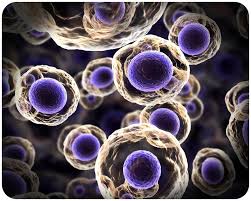
The two kinds of cells are Prokaryotes and Eukaryotes. How are they different?
a)
Prokaryotes have a nucleus.
b)
Eukaryotes have a nucleus.
c)
Prokaryotes are plant cells.
d)
There is no difference.
11.

What cell part is NOT found in all cells?
a)
Cell Wall
b)
Cell Membrane
c)
Cytoplasm
d)
Genetic Material
12.

Complex cell. Can be plant or animal. Contains membrane bound organelles.
a)
Eukaryotic Cell
b)
Prokaryotic Cell
c)
Bacteria
d)
Blood cell
13.

Which part of the cell is often called "the brain of the cell"?
a)
nuclear membrane
b)
endoplasmic reticulum
c)
nucleus
d)
mitochondria
14.

What does this organism use for movement?
a)
Pseudopod
b)
Cilia
c)
Flagella
d)
legs
15.

What does this organism use for movement?
a)
Pseudopod
b)
Cilia
c)
Flagella
d)
legs
16.
In what organelle is the genetic material found inside?
a)
Endoplasmic Reticulum
b)
Golgi Complex
c)
Nucleolus
d)
Nucleus
17.
What organelle helps with cell digestion?
a)
Lysosomes
b)
Ribosomes
c)
Golgi Complex
d)
ER
18.
What is the gel-like substance inside of cells called?
a)
photoplasm
b)
photosynthesis
c)
cytoskeleton
d)
cytoplasm
19.

Using this image, what organelle is D?
a)
Endoplasmic Reticulum
b)
Flagella
c)
Rough ER
d)
Smooth ER
20.

Using this image, what organelle is N?
a)
Centrioles
b)
Cell Membrane
c)
Golgi Apparatus
d)
Ribosome
21.

Using this image, what organelle is A?
a)
Cell Wall
b)
Large Central Vacuole
c)
Mitochondria
d)
Chloroplast
22.

What is the difference between rough and smooth ER?
a)
There is no difference.
b)
Plants have rough ER, animals have smooth ER.
c)
What type of injuries the Doctors treat.
d)
Rough has ribosomes, smooth does not.
23.

Which 2 organelles are in plants and animals?
a)
cell wall and cytoplasm
b)
nucleaus and plastids
c)
cell membrane and cytoplasm
d)
cell membrane and chlorophast
24.
What is the function of the mitochondria?
a)
Structure that manufactures ribosomes
b)
Structures that converts nutrients to energy
c)
Stack of membranes that packages chemicals
d)
Structure that contains DNA and directs the cell
25.

I am the outer most layer of an animal cell. What am I?
a)
cell wall
b)
nucleus
c)
cell membrane
d)
cell skin
26.

Which structure would be identified as the vacuole?
a)
1
b)
2
c)
3
d)
4
27.
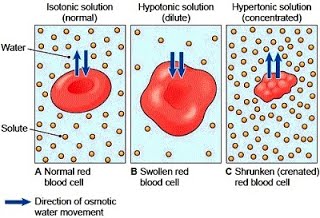
a)
Passive Transport
b)
Active Transport
28.
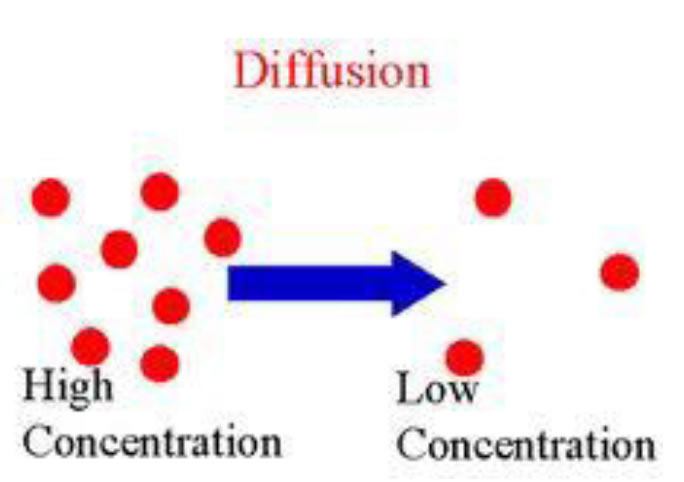
Movement of particles from high to low concentration.
a)
Passive Transport
b)
Active Transport
29.
Osmosis is a form of ______________.
a)
Passive Transport
b)
Active Transport
30.
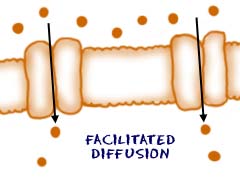
a)
Passive Transport
b)
Active Transport
31.
Solutes move with the concentration gradient, therefore no energy is used.
a)
Passive Transport
b)
Active Transport
32.

a)
Passive Transport
b)
Active Transport
33.
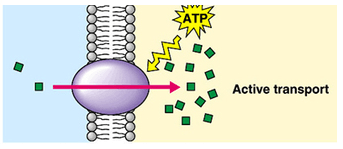
ATP is a form of energy.
a)
Passive Transport
b)
Active Transport
34.
What is it called when molecules move across the cell membrane from an area of high concentration to an area of low concentration through a carrier protein?
a)
Diffusion
b)
Osmosis
c)
Active Transport
d)
Facilitated Diffusion
35.

This is a picture of
a)
Cell wall
b)
Cell membrane
c)
chloroplast
d)
mitochondria
36.
How does a cell maintain homeostasis?
a)
Regulates what enters and leaves the cell
b)
Flexibility
c)
Protective barrier
d)
Structure and support
37.
The cell membrane is selectively permeable, which means...
a)
All materials can enter and leave the cell
b)
Certain things can enter while others cannot
c)
The cell manually sorts through all materials
d)
Only certain cells can interact with the cell.
38.
When molecules are spread evenly across the cell membrane, ______________________ is reached.
a)
difference
b)
transportation
c)
equilibrium
d)
solution
39.
What is homeostasis?
a)
How the body releases oxygen
b)
Passive transportation
c)
How the body regulates itself for survival
d)
Active transport
40.

Where is there a low concentration of dye?
a)
at the bottom of cup
b)
in the color
c)
at the top of cup
d)
no concenteraion gradient
41.

Against the concentration gradient
low to high
uses energy/ATP
low to high
uses energy/ATP
a)
facilitated diffusion
b)
osmosis
c)
active transport
d)
simple diffusion
42.
A molecule that diffuses down a concentration gradient goes from an area of ______ concentration into an area of ______ concentration.
a)
high, low
b)
low, high
c)
passive, active
d)
active, passive
43.

This picture represents what type of cell transport?
a)
endocytosis
b)
exocytosis
c)
osmosis
d)
passive transport
44.
A cell will _____________________ in a hypertonic solution.
a)
swell
b)
shrink
c)
will not change
d)
will explode
45.
A cell will __________________ in a hypotonic solution.
a)
swell and perhaps burst (lyse)
b)
shrink
c)
the size of the cell will not change
d)
the size of the cell will change from large to small and from small to large
46.
Active transport requires ______, moves materials from __________________, and goes _______ the concentration gradient.
a)
No energy, low to high, against
b)
ATP, high to low, with
c)
ATP, low to high, with
d)
ATP, low to high, against
47.
Spraying Axe body spray in a corner of the room and someone on the opposite corner smells it is an example of what?
a)
Osmosis
b)
Facilitated diffusion
c)
Active transport
d)
Diffusion
48.
What do plants give off after photosynthesis?
a)
Oxygen
b)
carbon
c)
nitrogen
d)
hydrogen
49.
Plants need ________from the air for photosynthesis
a)
oxygen
b)
soil
c)
carbon dioxide
d)
sugar
50.
The products of photosynthesis are
a)
water and carbon dioxide
b)
oxygen and water
c)
sugar and cabon dioxide
d)
oxygen and sugar (glucose)
51.
The main source of energy for all life comes from ____.
a)
the Earth
b)
the moon
c)
the sun
d)
the food we eat/make
52.
What are the reactants (what's needed) for photosynthesis?
a)
glucose and oxygen
b)
light, water, and carbon dioxide
53.
What is cellular respiration?
a)
the breakdown of glucose to release ATP
b)
the breakdown of glucose to release carbon
54.
What is the correct equation for cellular respiration?
a)
6O2 + C6H12O6 -> 6CO2 + 6H2O + Energy
b)
6O2 + C6H12O6 + Energy -> 6CO2 + 6H2O
c)
6CO2 + 6H2O -> 6O2 + C6H12O6 + Energy
d)
6CO2 + 6H2O + Energy -> 6O2 + C6H12O6
55.

In which organelle (part of the cell) does photosynthesis take place?
a)
mitochondria
b)
chloroplast
c)
nucleus
d)
cell membrane
56.

The diagram below shows the relationship between photosynthesis and cellular respiration and the organelles in which they occur.Which statement describes how photosynthesis and cellular respiration are interrelated?
a)
Oxygen is produced during cellular respiration and stored during photosynthesis.
b)
Carbon dioxide and water released by cellular respiration are used in photosynthesis.
c)
Photosynthesis releases the energy that is stored during the process of cellular respiration.
d)
Glucose is used during cellular respiration to produce food that is broken down during photosynthesis.
57.

A diagram representing the relationship between photosynthesis and cellular respiration is shown. The numbered boxes in the diagram represent which of the following?
a)
1 - water; 2 - nitrogen
b)
1 - nitrogen; 2 - oxygen
c)
1 - oxygen; 2 - carbon dioxide
d)
1 - carbon dioxide; 2 - water
58.
A weightlifter is using heavy weights in short bursts for a competition. Because his muscle cells are not able to take in enough oxygen to make very much ATP the weightlifter begins to get fatigue in his muscles. Which of the following processes is most likely going on in the muscles of the weightlifter as he competes in his event?
a)
As the cells run out of oxygen they switch to anaerobic respiration, which allows the cell to make small amounts of ATP in the absence of oxygen.
b)
As the cells run out of oxygen, they die off gradually and the weightlifter's muscles have fewer contracting muscle cells.
c)
The cells will never run out of oxygen if the weightlifter is breathing.
d)
As the cells run out of oxygen, they will continue to make the same amount of ATP, since oxygen is not required to make ATP.
59.
Two different species of bacteria are examined. Scientists find that species X always produces CO2 and H2O during cellular respiration. Species Y always produces ethyl alcohol and CO2. Which conclusion can be made from these observations?
a)
Only species Y is aerobic.
b)
Only species Y is anaerobic.
c)
Both species X and Y are aerobic.
d)
Both species X and Y are anaerobic.
60.
Which of the following contains the genetic code for protein synthesis?
a)
carbohydrate
b)
lipid
c)
protein
d)
nucleic acid
61.

What type of macromolecule is being represented in this image?
a)
carbohydrate
b)
lipid
c)
protein
d)
nucleic acid
62.
Which of the following decreases the activation energy necessary to initiate the chemical change within the body?
a)
nucleotides
b)
enzymes
c)
amino acids
d)
fatty acids
63.
What are the building blocks of proteins?
a)
amino acid
b)
fatty acid
c)
nucleotide
d)
lipid
64.
What are the single sugars that are the building blocks of carbohydrates?
a)
monosaccharides
b)
disaccharides
c)
polysaccharides
d)
amino acid
65.
Fats, oils and cholesterol are all types of what?
a)
cell membranes
b)
hormones
hormones
hormones
c)
lipids
d)
fatty acids
66.
RNA and DNA are which type of macromolecules?
a)
carbohydrate
b)
lipid
c)
nucleic acid
d)
protein
67.
The human body maintains a temperature of around 98.6 degrees at all times. Enzymes are involved in almost every chemical reaction in the body. Which of the following describes the connection between these two statements?
a)
Enzymes function best at a specific temperature.
b)
The body needs to be warm to prevent hypothermia.
c)
The body is kept relatively warm to prevent too much enzyme action.
d)
There is no connection between the two statements.
68.
The organic compounds that have many structural purposes and are used in many processes within the
cell are called ____________________.
cell are called ____________________.
a)
Carbohydrates
b)
Lipids
c)
Proteins
d)
Nucleic Acids
69.
What are the four macromolecules?
a)
proteins, nucleic acids, carbohydrates, and lipids
b)
monosaccharides, lipids, polysaccaharides, and proteins
c)
RNA, DNA, proteins, and carbohydrates
d)
proteins, DNA, RNA, and steroids
70.

What is the primary function of carbohydrates in your body?
a)
Speed up chemical reactions.
b)
Give immediate energy.
c)
Help to store energy.
d)
Build cell walls in plants.
71.
Which macromolecule stores energy, insulates us, and makes up the cell membrane?
a)
lipids
b)
proteins
c)
carbohydrates
d)
nucleic acids
72.
Carbohydrates are made of...
a)
C H O
b)
C H O N
c)
C H O N P
d)
C H O N S
73.
Lipids are made of...
a)
C H O
b)
C H O N
c)
C H O N P
d)
C H O N S
74.
Proteins are made of...
a)
C H O
b)
C H O N
c)
C H O N P
d)
C H O N S
75.
This is one job proteins do NOT have in the body
a)
insulation
b)
structure for tissues and organs
c)
speed up chemical reactions
d)
transport things through cell membrane
76.
What is the purpose of an enzyme?
a)
give permission for the reaction
b)
raise activation energy
c)
speed up reactions
d)
control how many reactions occur
77.
Enzymes are capable of increasing the rate of a chemical reaction within a living cell. Enzymes accomplish this through which of the following means?
a)
reducing the number of products
b)
reducing the activation energy
c)
increasing the temperature of the cell
d)
increasing the concentration of reactants
78.
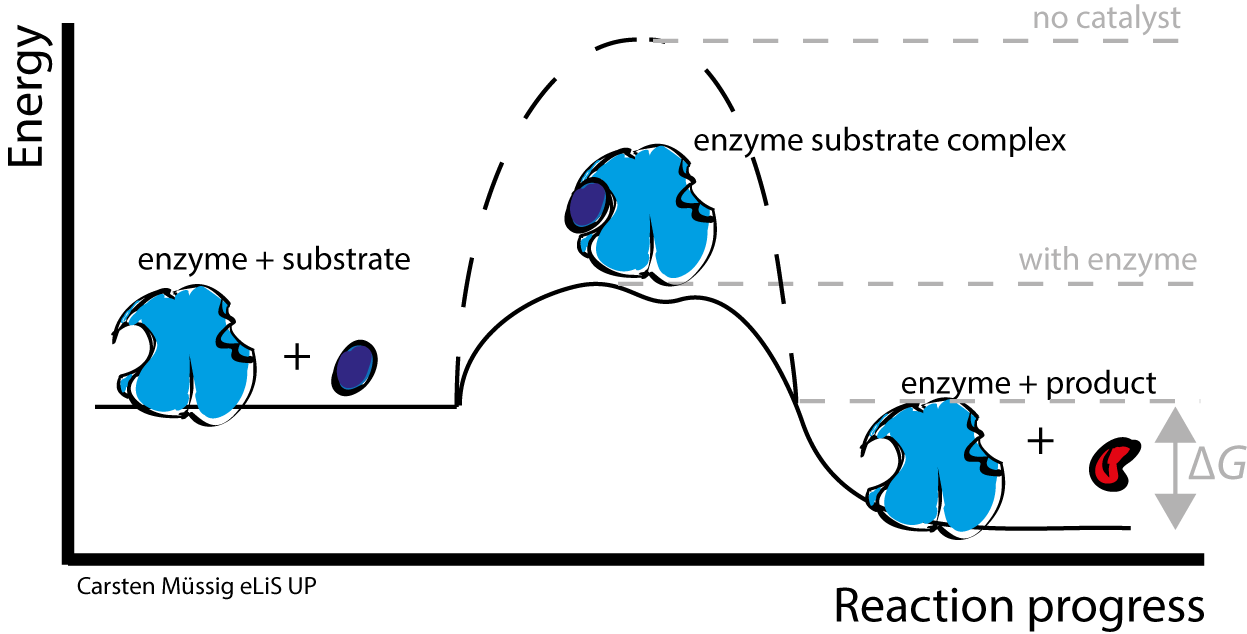
An enzyme speeds up a reaction by
a)
lowering the activation energy.
b)
raising the activation energy.
c)
releasing energy.
d)
absorbing energy.
79.
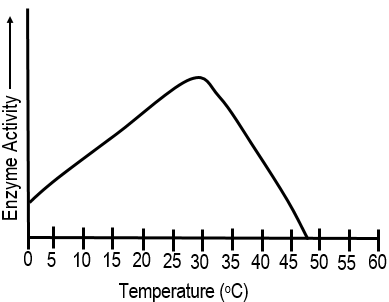
Based on the graph, what is the optimal temperature for this enzyme?
a)
15oC
b)
40oC
c)
30oC
d)
35oC
80.
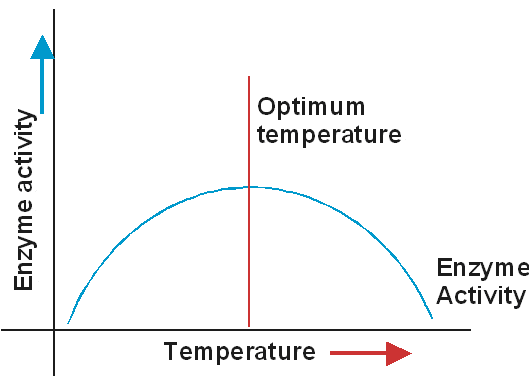
At high temperatures enzyme activity declines because of:
a)
Denaturation
b)
Decreased Kinetic Motion
c)
Increased H-Bonding
d)
Dissociation of Ionic Compounds
81.
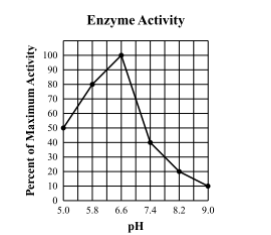
The graph below shows how the activity of an enzyme changes over a range of pH values. Which of the following conclusions can be drawn from this graph?
a)
The optimum pH of the enzyme is 6.6.
b)
The optimum pH of the enzyme is 5.8
c)
The enzyme’s activity continually increases as pH increases from 5.0 to 9.0
d)
The enzyme’s activity is greater around pH of 8.0 than around pH of 5.0.
82.
As food travels through the digestive system, it is exposed to a variety of pH levels. The stomach has a pH of 2 due to the presence of hydrochloride acid (HCl), and the small intestine has a pH ranging from 7 to 9. HCl converts pepsinogen into pepsin, an enzyme that digests proteins in the stomach. Which of the following most likely happens to pepsin as it enters the small intestine?
a)
It becomes inactive.
b)
It begins to replicate.
c)
It's shape changes to engulf large proteins.
d)
It's activity increases to digest more proteins.
100 %

