Wayground logo

Free Printable Worksheets

Font size

S
M
L
XL
Worksheets

Biochem 1

Total questions: 121

Worksheet time: 1hrs 22mins

Name
Class
Date
1.
Proteins are made of monomers called ___________
a)
Nucleotides
b)
Monosaccharides
c)
Amino Acids
d)
Glycerol and fatty acids
2.
The element _______is found in all of the organic compounds.
a)
Iron
b)
Nitrogen
c)
Carbon
d)
Oxygen
3.
_________ are composed out of carbon (C), hydrogen (H), oxygen (O), nitrogen (N), and phosphorus (P)
a)
Carbohydrates
b)
Lipids
c)
Proteins
d)
Nucleic Acids
4.
DNA and RNA are examples of 
a)
Carbohydrates
b)
Lipids
c)
Proteins
d)
Nucleic Acids
5.
DNA and RNA are examples of 
a)
Carbohydrates
b)
Lipids
c)
Proteins
d)
Nucleic Acids
6.
Nucleotides are monomers of
a)
Carbohydrates
b)
Lipids
c)
Proteins
d)
Nucleic Acids
7.
Monosaccharides are monomers of
a)
Carbohydrates
b)
Lipids
c)
Proteins
d)
Nucleic Acids
8.
Waxes, oils and fats are examples of
a)
Carbohydrates
b)
Lipids
c)
Proteins
d)
Nucleic Acids
9.
Glycerol and fatty acids are the monomers of
a)
Carbohydrates
b)
Lipids
c)
Proteins
d)
Nucleic Acids
10.
The organic compounds that have many structural purposes and are used in many processes within the
cell are called ____________________.
a)
Carbohydrates
b)
Lipids
c)
Proteins
d)
Nucleic Acids
11.
Which macromolecule is shown?
 View Figure 1 (if not visible)
a)
lipid
b)
protein
c)
nucleic acid
d)
carbohydrate
12.
What is the function of nucleic acids?
a)
store genetic information
b)
store energy (long-term)
c)
store energy (short-term)
d)
build skin, hair, nails, muscles
13.
Which macromolecule is shown?
 View Figure 2 (if not visible)
a)
lipid
b)
protein
c)
nucleic acid
d)
carbohydrate
14.
Which macromolecule is shown?
 View Figure 3 (if not visible)
a)
lipid
b)
protein
c)
nucleic acid
d)
carbohydrate
15.
Which macromolecule is shown?
 View Figure 4 (if not visible)
a)
lipid
b)
protein
c)
nucleic acid
d)
carbohydrate
16.
What type of macromolecule are enzymes?
a)
Protein
b)
Carbohydrate
c)
Lipid
d)
Nucleic Acid
17.
Which of the following organic compounds is the main source of energy for living things?
a)
carbohydrates
b)
lipids
c)
nucleic acids
d)
proteins
18.
Carbohydrates are made of... 
a)
C H O
b)
C H O N
c)
C H O N P
d)
C H O N S
19.
Lipids are made of... 
a)
C H O
b)
C H O N
c)
C H O N P
d)
C H O N S
20.
Proteins are made of... 
a)
C H O
b)
C H O N
c)
C H O N P
d)
C H O N S
21.
Which macromolecule stores energy, insulates us, and makes up the cell membrane?
a)
lipids
b)
proteins
c)
carbohydrates
d)
nucleic acids
22.
This is one job proteins do NOT have in the body
a)
insulation
b)
structure for tissues and organs
c)
speed up chemical reactions
d)
transport things through cell membrane
23.
Which macromolecule is made of simple and complex sugars?
a)
lipids
b)
proteins
c)
carbohydrates
d)
nucleic acids
24.
What are the four macromolecules?
a)
proteins, nucleic acids, carbohydrates, and lipids
b)
monosaccharides, lipids, polysaccaharides, and proteins
c)
RNA, DNA, proteins, and carbohydrates
d)
proteins, DNA, RNA, and steroids
25.
All of the following are examples of lipids except:
a)
oil
b)
wax
c)
fatty acid
d)
cellulose
26.
What suffix (word ending) is used in the names of most carbohydrates?
a)
-ase
b)
-nic
c)
-ose
d)
-yme
27.

Monomer is to Macrocolecule like ___ is to ____

a)

Building is to Bricks.

b)

Brick is to Building.

c)

Carpenter is to Building.

d)

Building is to Carpenter.

28.
What type of macromolecule is being represented in this image? 
a)
carbohydrate
b)
lipid
c)
protein
d)
nucleic acid
29.
Which macromolecule is this?
a)
carbohydrates
b)
lipids
c)
proteins
d)
nucleic acids
30.

Photosynthesis involves the production of sugar and oxygen. Select the drawing that shows a carbohydrate that is formed in photosynthesis.

a)

A

b)

B

c)

C

d)

D

31.
The following is a diagram of the product of protein synthesis. This protein is a chain of a certain molecule. The molecule labeled Z is most likely classified as
a)
Amino acid
b)
Polypeptide
c)
Glycerol
d)
Sugar
32.
Subunit is to Macrocolecule like ___ is to ____
a)
Building is to Bricks.
b)
Brick is to Building.
c)
Carpenter is to Building.
d)
Building is to Carpenter.
33.
What molecule is used for LONG term energy storage?
a)
carbohydrates
b)
lipids
c)
protiens
d)
nucleic acid
34.
Why is carbon a good atomic backbone for macromolecules?
a)
It has one valence electron.
b)
It has four valence electrons.
c)
It has extra protons.
d)
It has fewer neutrons.
35.
What is the function of carbohydrates?
a)
store genetic information
b)
store energy (long-term)
c)
store energy (short-term)
d)
build skin, hair, nails, muscles
36.
Identify the macromolecule in the picture.
* look at the R.....
a)
carbohydrates
b)
lipids
c)
proteins 
d)
nucleic acids
37.
Identify the macromolecule in the picture
* cholesterol and triglycerides
a)
carbohydrate
b)
protein
c)
lipid
d)
nucleic acid
38.
Proteins are made of monomers called ___________
a)
Nucleotides
b)
Monosaccharides
c)
Amino Acids
d)
Glycerol and fatty acids
39.
The element _______is found in all of the organic compounds.
a)
Iron
b)
Nitrogen
c)
Carbon
d)
Oxygen
40.
The pH scale is a range from:
a)
1-7
b)
0-14
c)
1-5
d)
1-20
41.
A(n) _______ is a substance with a pH greater than 7.
a)
Base
b)
Acid
c)
Buffer
d)
Water
42.
What is the only substance with a neutral pH of 7?
a)
Milk
b)
Orange Juice
c)
Water
d)
Blood
43.
Is this substance acidic, basic, or neutral?
a)
Acidic
b)
Basic
c)
Neutral
44.
Is this substance acidic, basic, or neutral?
a)
Acidic
b)
Basic
c)
Neutral
45.
A solution with a pH of 8.6 would be...
a)
Acid
b)
Base
c)
Neutral
d)
Acid and Base
46.
A solution with a pH of 7.0 would be...
a)
Acid
b)
Base
c)
Neutral
d)
Acid and Base
47.
Complete the sentence.
A substance that is more basic has a _____ pH than a substance that is acidic.
a)
lower
b)
higher
c)
the same
d)
none of the above
48.
The pH scale 8-14 are...
a)
acids
b)
bases
c)
neutral
49.
This substance releases OH- into solution
a)
Acid
b)
Base
c)
Neutral
50.
HBr is an example of a(n)
a)
Acid
b)
Base
c)
Neutral
51.
LiOH is an example of a(n)
a)
Acid
b)
Base
c)
Neutral
52.
A(n) _______ is a substance with a pH greater than 7.
a)
Base
b)
Acid
c)
Buffer
d)
Water
53.
A(n) ______ is a substance with a pH less than 7
a)
Acid
b)
Alkaline
c)
Base
d)
Buffer
54.
Which of the following contains acids?
a)
Milk
b)
Batteries
c)
Ammonia
d)
Chalk
55.
A pH of 14 is a .....
a)
strong acid
b)
weak acid
c)
Strong base
d)
Weak base
56.

If a substance is acidic, what could be added to raise the pH?

a)

Sulfur

b)

Nitrogen

c)

Vinegar

d)

Base

57.

What is the mass number?

a)

the number of protons

b)

the number of protons and neutrons

c)

the number of neutrons

d)

the number of protons and electrons

58.

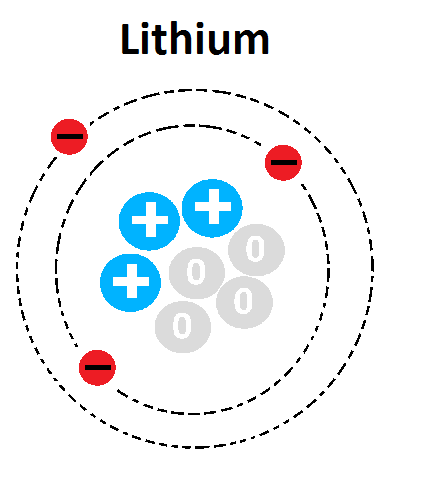
What is the mass number of this nucleus?

a)

1

b)

3

c)

4

d)

7

59.

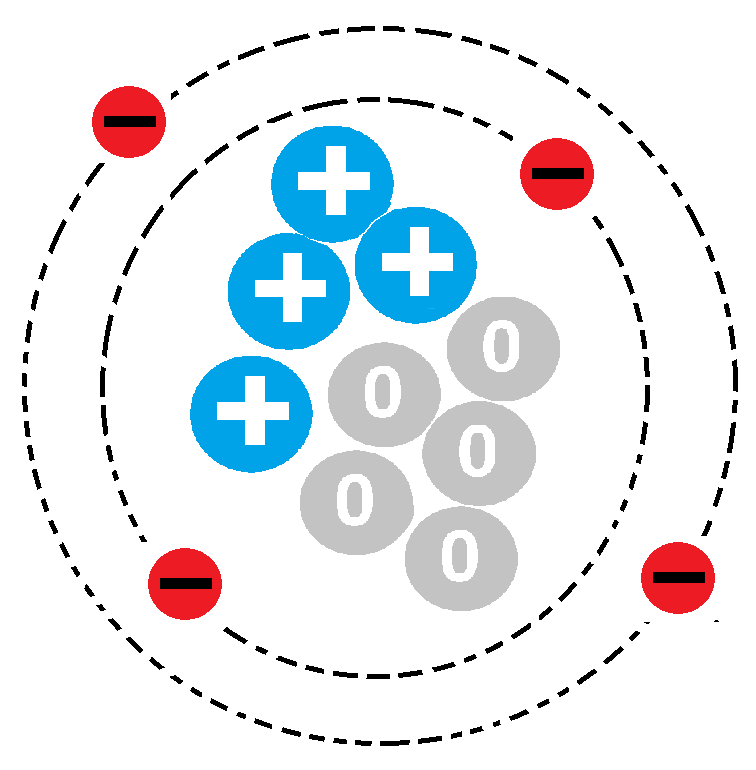
What is the mass number of this atom?

a)

4

b)

5

c)

9

d)

none of the above

60.

What is the mass number of this atom?

a)

2

b)

4

c)

6

d)

none of the above

61.

What is the mass number of this atom?

a)

1

b)

2

c)

3

d)

4

62.

The atomic number of Hydrogen is

a)

1

b)

2

c)

3

d)

4

63.
The atomic number of Lithium is
a)
3
b)
4
c)
5
d)
6
64.
A fluorine atom has 9 protons and 10 neutrons. What is the atomic number of fluorine?
a)
9
b)
10
c)
19
d)
1
65.

Because atoms are neutral, the number of protons is always _______ the number of electrons

a)

greater than

b)

less than

c)

equal to

d)

proportional to

66.
A phosphorus atom has 15 protons and 16 neutrons. What is the mass number?
a)
15
b)
16
c)
31
d)
1
67.
What is the atomic mass of Carbon?
a)
5
b)
6
c)
7
d)
12.01
68.
What element has 20 protons? (Use your periodic table.)
a)
Potassium (K)
b)
Calcium (Ca)
c)
Nitrogen (N)
d)
Neon (Ne)
69.
What is the atomic mass of Carbon?
a)
5
b)
6
c)
7
d)
12.01
70.
The positive particles of an atom are 
a)
electrons 
b)
positrons 
c)
neutrons 
d)
protons 
71.
the central region of an atom where its neutrons and protons are is its 
a)
nucleus 
b)
electron cloud
c)
core 
d)
center 
72.
an atom with atomic number 6 would have how many protons 
a)
6
b)
12
c)
3
d)
cannot be determined 
73.
Particles in an atom that are neutral and have no charge are 
a)
negatrons 
b)
electrons 
c)
neutrons 
d)
protons 
74.
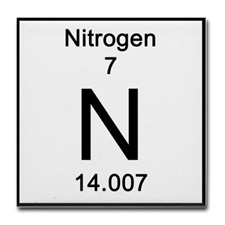
What is the number of protons that the element in this image contain?
a)
14
b)
7
c)
15
d)
18
75.
In the modern periodic table elements are arranged by:
a)
atomic mass
b)
atomic number
c)
valence electrons
d)
number of isotopes
76.
The positive particles of an atom are 
a)
electrons 
b)
positrons 
c)
neutrons 
d)
protons 
77.
Particles in an atom that are neutral and have no charge are 
a)
negatrons 
b)
electrons 
c)
neutrons 
d)
protons 
78.
Which of the following is a negatively charged subatomic particle?
a)
Electron
b)
Proton
c)
Neutron
d)
Quark
79.
The particles that are found in the nucleus of an atom are
a)
neutrons and electrons
b)
electrons only
c)
protons and neutrons
d)
protons and electrons
80.
The atomic number of an elements is the total number of which particles in the nucleus?
a)
neutrons
b)
protons
c)
electrons
d)
protons and electrons
81.
What is the atomic number for an element with three protons?
a)
2
b)
1
c)
3
d)
6
82.
What is the mass number of this atom?
a)
4
b)
5
c)
9
d)
none of the above
83.
What is the atomic number of this atom?
a)
4
b)
5
c)
9
d)
none of the above
84.
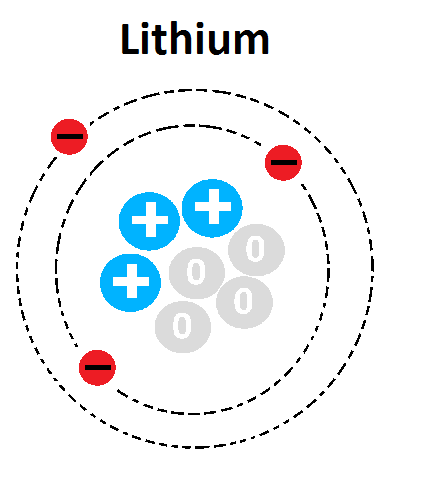
What is the atomic number of this nucleus?
a)
1
b)
3
c)
4
d)
7
85.
What is the atomic number of this atom?
a)
9
b)
10
c)
19
d)
27
86.
What is the mass number of this atom?
a)
4
b)
5
c)
9
d)
none of the above
87.
What is the mass number of this atom?
a)
9
b)
10
c)
19
d)
27
88.

What is the charge of this atom?

a)

+1

b)

+9

c)

-10

d)

-1

89.

What is the charge of this atom?

a)

+1

b)

+2

c)

-2

d)

0

90.
The atomic number of Nitrogen
a)
7
b)
6
c)
8
d)
9
91.
The atomic mass of Silicon is
a)
28
b)
27
c)
26
d)
25
92.

If an atom has a charge of +1 with 10 electrons, how many protons does it have?

a)

0

b)

11

c)

10

d)

5

93.
An element has the mass number 12 and atomic number  6. The number of neutrons in it is:
a)
6
b)
10
c)
4
d)
8
94.

How many electrons are in a neutral atom with an atomic number of 50?

a)

5

b)

8

c)

50

d)

2

95.
What is the atomic number of this atom?
a)
1
b)
3
c)
4
d)
7
96.

What is the mass number of:15N+3

a)

3

b)

11

c)

14

d)

15

97.

What is the mass number of this atom?

a)

1

b)

3

c)

4

d)

7

98.

What is the atomic number of Tin?

a)

65

b)

50

c)

22

d)

81

99.
Bleach is a strong base, what is the pH level of bleach?
a)
13
b)
14
c)
1
d)
2
100.
Pollution causes the pH of rain water fall below 6. What is such type of rain called?
a)
Acid rain
b)
polluted rain
c)
low pH rain
101.
Which of the following is not a compound?
a)
HCl
b)
Cl
c)
NaCl
d)
CO2
102.
A pure substance that cannot be separated into simpler substances by chemical or physical means.  
a)
Element
b)
Compound
c)
Mixture
d)
Chemical
103.
What is the simplest form that cannot be broken down to anything simpler? 
a)
element 
b)
solution
c)
compound
104.
pH measures the presence or what kind of ions?
a)
Sulfur
b)
Oxygen
c)
Nitrogen
d)
Hydrogen
105.
Which formula represents an amino acid?
a)
a.
b)
b. 
c)
c.
d)
d.
106.
Proteins are polymers formed from 
a)
lipids.
b)
carbohydrates.
c)
amino acids.
d)
nucleic acids.
107.
DNA is a polymer formed from 
a)
fatty acids. 
b)
monosaccharides.
c)
amino acids.
d)
nucleotides.
108.
Starch is a polymer formed from 
a)
fatty acids. 
b)
monosaccharides.
c)
amino acids.
d)
nucleotides.
109.
Saturated fat = single bonds between carbon atoms in hydrocarbon chain
Polyunsaturated fat = ?
a)
covalent bonds between carbon atoms in hydrocarbon chain
b)
ionic bonds between carbon atoms in hydrocarbon chain
c)
chemical bonds between carbon atoms in hydrocarbon chain
d)
double bonds between carbon atoms in hydrocarbon chain
110.
Protein = polymer of amino acids
RNA = ?
a)
polymer of acids
b)
polymer of fatty acids
c)
polymer of nucleotides
d)
polymer of ribose sugars
111.
Living organisms use which macromolecule to control the rate of reactions and regulate cell processes?
a)
Fat
b)
Protein
c)
Sugar
d)
Nucleic acid
112.
What is the prefix for 1?
a)
mono
b)
di
c)
tri
d)
tetra
113.

A monosaccharide is a subunit of a:

a)

nucleic acid

b)

lipid

c)

carbohydrate

d)

protein

114.

Which is the monomer (building block) for lipids?

a)

fatty acids & glycerol

b)

nucleotide

c)

amino acids

d)

monosaccharide

115.

Subunit is to Macrocolecule like ___ is to ____

a)

Building is to Bricks.

b)

Brick is to Building.

c)

Carpenter is to Building.

d)

Building is to Carpenter.

116.

A large molecule made up of multiple monomers

a)

Polymer

b)

Polysaccharide

c)

Macromolecules

d)

Protein

117.

Saturated fat are saturated with:

a)

Carbon

b)

Hydrogen

c)

Oxygen

d)

Nitrogen

118.

Why are essential fatty acids called essential fatty acids?

a)

Because they are essential to mental health.

b)

Because they are the opposite of non-essential fatty acids.

c)

Because they are extracted from essential oils.

d)

Because we can't synthesize them ourselves, we need to eat them.

119.

Which of the following is not a job of a protein

a)

Act as hormones and enzymes

b)

Build tissues and muscles

c)

Do much of the work in cells and transport materials

d)

store and transmit genetic information

120.

All organic compounds contain the element _____________

a)

Phosphorus

b)

Nitrogen

c)

Sulfur

d)

Carbon

121.

What is not one of the most common elements found in living organisms?

a)

Carbon

b)

Hydrogen

c)

Silicon

d)

Nitrogen