wayground logo

Free Printable Worksheets

NEW

Font size

S
M
L
XL
Worksheets

AP Macro Unit 1 Review

Total questions: 46

Worksheet time: 25mins

Name
Class
Date
1.
An economist would probably state that in a market economy, prices are generally determined by the interaction between 
a)
buyers and sellers
b)
wholesalers and retailers
c)
producers and labor unions
d)
consumers and government officials
2.
Which of the following is likely to increase the demand for peanut butter?
a)
Fewer children in the population
b)
News that insects have destroyed much of the peanut crop and that there will be less peanut butter on the shelves in three months.
c)
A big increase in the price of jelly.
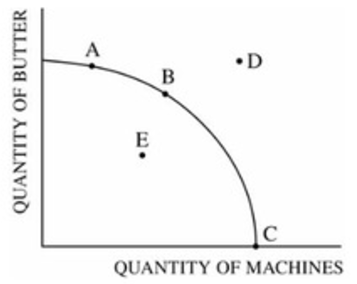
d)
A report from the Surgeon General of the United States that eating peanut butter makes people nutty.
3.
In economics, a shortage of a product occurs when
a)
the product's price falls below its market-clearing level
b)
the product's market-clearing level reduces overall demand
c)
the people who buy the product consume more than they need
d)
the businesses producing the product become less efficient
4.
The US can produce 200 airplanes or 400 trucks. Japan can produce 300 trucks or 100 airplanes. 
Which country has the comparative advantage in producing trucks and what is their opportunity cost? 
a)
Japan, 1/3 airplane per truck
b)
US, 1/2 airplane per truck
c)
US, 2 airplanes per truck
d)
Japan, 3 airplanes per truck
5.
The US can produce 200 airplanes or 400 trucks. Japan can produce 300 trucks or 100 airplanes. 
Which country has the comparative advantage in producing airplanes and what is their opportunity cost? 
a)
Japan, 1/3 trucks per airplane
b)
US, 1/2 trucks per airplane
c)
US, 2 trucks per airplane
d)
Japan, 3 trucks per airplane
6.

Suppliers often reduce prices because they

a)

have a shortage of products

b)

have a surplus of products to sell

c)

want decrease consumer demand

d)

want to increase the product supply

7.
When a point lies inside of the PPF it can be said that
a)
Resources are under employed
b)
Resources are fully utilize
c)
Production is beyond the resource potential
d)
Opportunity cost of production is constant
8.
The opportunity costs seen in a linear PPF would most likely be
a)
 1 for 3
b)
2 for 4
c)
3 for 5
d)
1 for 1
9.
What does the Production Possibilities Frontier represent? 
a)
A.  A catalog of all possible production options, represented as percentages.
b)
B. The tradeoffs between possible production levels for two goods.
c)
C. The amount that a society could produce if it devoted all its resources to producing one good.
d)
D. The possible gains from international trade in two or more goods.
10.
The resource that includes equipment, machinery, buildings, and tools.
a)
Land
b)
Labor
c)
Capital 
d)
Entrepreneur
11.
Which of the following is NOT one of the three basic questions of economics when looking at economic systems? 
a)
What goods should be produced ?
b)
What is the price of the goods? 
c)
How should the goods be produced? 
d)
Who gets to consume the goods? 
12.
The major types of resources used to make a product are called  
a)
natural resources
b)
factors of reduction
c)
factors of production
d)
capital resources
13.

In economics, the pleasure, happiness, or satisfaction received from a product is called:

a)

status fulfillment

b)

marginal cost

c)

rational outcome

d)

utility

14.

Economics may best be defined as the:

a)

interaction between macro and micro considerations.

b)

social science concerned with the efficient use of scarce resources to achieve maximum satisfaction of economic wants.

c)

empirical testing of value judgments through the use of logic.

d)

use of policy to refute facts and hypotheses.

15.

Which of the following will not produce an outward shift of the production possibilities curve?

a)

an upgrading of the quality of a nation's human resources

b)

the reduction of unemployment

c)

an increase in the quantity of a society's labor force

d)

the improvement of a society's technological knowledge

16.

Refer to the above diagram. This economy will experience cyclical unemployment if it produces at point:

a)

A

b)

B

c)

C

d)

D

17.

Refer to the above diagram. At which point will this economy NOT be able to produce, it is currently unattainable?

a)

A

b)

B

c)

C

d)

E

18.

Which of the following might shift a nation's production possibilities curve inward?

a)

improved technology.

b)

devastation by war.

c)

improved health care.

d)

a business downturn in which unemployment temporarily rises.

19.

When the price of a product rises, consumers shift their purchases to other products whose prices are now relatively lower. This statement describes:

a)

an inferior good.

b)

the rationing function of prices.

c)

the substitution effect.

d)

the income effect.

20.

An increase in demand means that:

a)

given supply, the price of the product will decline.

b)

the demand curve has shifted to the right.

c)

price has declined and consumers therefore want to purchase more of the product.

d)

the demand curve has shifted to the left.

21.

Refer to the above diagram, in which S1 and D1 represent the original supply and demand curves and S2 and D2 the new curves. In this market the indicated shift in supply may have been caused by:

a)

an increase in the wages paid to workers producing this good.

b)

the development of more efficient machinery for producing this commodity.

c)

this product becoming less fashionable.

d)

an increase in consumer incomes.

22.

Which of the following is a fundamental characteristic of the market system?

a)

property rights

b)

central planning by government

c)

unselfish behavior

d)

government-set wages and prices

23.

Which of the following is not a characteristic of the market system?

a)

private property

b)

freedom of enterprise

c)

government ownership of the major industries

d)

competition in product and resource markets

24.
The thing you give up to pursue the next best alternative is
a)
capital
b)
product allocation
c)
opportunity cost
d)
relative distribution
25.
Labor Hours to Produce:  
COUNTRY   Wheat  Cloth
France             5         10
England          20        60
Which statement is true?
a)
France has AA in wheat but not cloth
b)
France has neither AA or CA
c)
England has AA in both
d)
England has AA in neither
26.
The "Invisible Hand" is the term Economist Adam Smith used to describe:
a)
comparative advantage
b)
effect of self interest on markets
c)
diminishing marginal utility
d)
how some countries utilize resources better
27.
The Wealth of Nations is ______________'s most famous work.
a)
David Ricardo
b)
Adam Smith
c)
F.A. Hayek
d)
Friedrich Neitsze
28.
According to comparative advantage, a good should be produced at the point where
a)
its explicit costs are least.
b)
its opportunity costs are least
c)
the cost of real resources used is least.
d)
production can occur with the greatest impact on employment
29.
Inferior goods react ___________ to income shifts.
a)
directly
b)
sometimes
c)
constantly
d)
inverse
30.
The Law of Demand says that price and quantity have a(n)
a)
direct relationship
b)
inverse relationship
c)
PPC focus
d)
Diminishing Motility
31.

Related goods impacts Demand because its relationship to what determinant of Demand?

a)

Increasing Marginal Cost

b)

Diminishing Marginal Utility

c)

Scarcity

d)

Substitution Effect

32.
In a mixed economy, what to produce and how much to produce are determined by
a)
a central planning agency
b)
a private planning agency
c)
large corporations and small entrepreneurs
d)
markets and the government
33.
The diagram shows the production possibilities curve for Country Y. Which of the following statements is true?
a)
If Country Y is producing at point C, it is using all its resources efficiently
b)
The opportunity cost of producing more machines is constant
c)
Country Y cannot produce at point E
d)
The most efficient point of production is point D
34.
Two alternative production possibility frontiers for apples and wheat are shown in the figures. As more wheat is produced, how will the opportunity cost of producing wheat, as represented in Figures 1 and 2, be affected? 
a)
Figure 1: Decrease / Figure 2: Increase
b)
Figure 1: Increase / Figure 2: Decrease
c)
Figure 1: No Change / Figure 2: Increase
d)
Figure 1: No Change / Figure 2: Decrease
35.
In the economy of the Bushmen of the Kalahari Desert the people follow the examples of their ancestors.  This is what kind of economy? 
a)
Traditional 
b)
Market 
c)
Command 
d)
Centrally planned 
36.
The Country of North Korea has a dictator that makes all of the economic decisions. What type of economy is this?
a)
Traditional 
b)
Market 
c)
Command 
d)
Centrally Planned 
37.

The economic problem is that

a)

resources are limited and wants are limited.

b)

resources are unlimited and wants are limited.

c)

resources are limited and wants are unlimited.

d)

resources are unlimited and wants are unlimited.

38.
What is the difference between a shortage and scarcity? 
a)
A shortage is temporary but scarcity always exists 
b)
A shortage results from rising prices; scarcity results from falling prices 
c)
A shortage is lack of all goods and services; scarcity concerns a single item 
d)
There is no real difference between a shortage and scarcity
39.

In the time period covered by the production possibilities curve, the company decides to make 4 gallons of red paint. How many gallons of blue paint can the company make with the available time and resources?

a)

2

b)

3

c)

6

d)

8

40.
The term __________ is used to describe what those in one country buy from those in other countries.
a)
A. exports
b)
B. imports
c)
C. trade
d)
D. surplus
41.
Trade allows each country to take advantage of _________________ in the other country. 
a)
A. economies of scale
b)
B. lower opportunity costs
c)
C. specialization
d)
D. worker productivity
42.
The special human resource, distinct from labor, which takes initiative, makes business decisions, innovates, and takes risk, the income from which is called profit.
a)
Productive Efficiency
b)
Entrepreneurship
c)
Utility
d)
Factors of Production
43.
These are goods which are used in the production of consumer goods; they satisfy wants indirectly and increase future productive capacity.
a)
Durable Goods
b)
Non-durable goods
c)
Capital Goods
d)
Consumer Goods
44.
Goods which satisfy wants directly, and are used in the present.
a)
Consumer goods
b)
Capital goods
c)
Durable goods
d)
Non-durable goods
45.
Demonstrated by an outward shift of the Production Possibilities Curve, it indicates an increased capacity for economic production within an economy. 
a)
Inflation
b)
Productive Efficiency
c)
Investment
d)
Economic Growth
46.
The process of producing and purchasing capital goods, often confused with the microeconomic concept of buying stocks and bonds, etc. 
a)
Full employment
b)
Economic Growth
c)
Productive Efficiency
d)
Investment