wayground logo

Free Printable Worksheets

NEW

Font size

S
M
L
XL
Worksheets

Macromolecules and Enzymes

Total questions: 54

Worksheet time: 35mins

Name
Class
Date
1.
Used for short term (quick) energy.
a)
carbohydrates
b)
lipids
c)
proteins
d)
nucleic acids
2.
Provides long term energy and insulation,
a)
lipids
b)
carbohydrates
c)
nucleic acids
d)
proteins
3.

Example include DNA and RNA

a)

lipids

b)

carbohydrates

c)

proteins

d)

nucleic acids

4.

Monomer of this macromolecules contains a phosphate, sugar and nitrogen base

a)

nucleic acid

b)

lipid

c)

carbohydrate

d)

protein

5.
Building blocks of the body, hair , muscles etc.
a)
protein
b)
nucleic acid
c)
lipids
d)
carbohydrates
6.

Is the main component of the cell membrane

a)

lipids

b)

protein

c)

nucleic acid

d)

carbohydrate

7.

The pictured molecule is glucose. Which macromolecule is made of this monomer?

a)

lipid

b)

protein

c)

nucleic acid

d)

carbohydrate

8.

The picture monomer is an amino acid. Which macromolecule is made of these?

a)

carbohydrates

b)

lipids

c)

proteins

d)

nucleic acids

9.

Identify the macromolecule in the picture

a)

carbohydrate

b)

protein

c)

lipid

d)

nucleic acid

10.

Made of monomers of amino acids

a)

Carbohydrates

b)

Lipids

c)

Proteins

d)

Nucleic Acids

11.
Made of monomers of monosaccharides
a)
Carbohydrates
b)
Lipids
c)
Proteins
d)
Nucleic Acids
12.
Made of glycerol and fatty acids
a)
Carbohydrates
b)
Lipids
c)
Proteins
d)
Nucleic Acids
13.

One way a lipid is different from a carbohydrate is:

a)

Carbohydrates are quick energy sources while lipids are stored slow burning energy.

b)

Lipids and carbohydrates are the same.

c)

They can never be found in the same food source.

d)

None of the above.

14.

Which of the following contain carbon, hydrogen and oxygen?

a)

Carbohydrates

b)

Lipids

c)

Proteins

d)

All of the above

15.

An enzyme is a special kind of :

a)

Lipid

b)

Carbohydrate

c)

Protein

d)

Nucleic Acid

16.
All ORGANIC MOLECULES have what 1 element? 
a)
NITROGEN
b)
HYDROGEN
c)
CARBON
d)
CALCIUM
17.
Enzymes are considered to be 
a)
Lipids
b)
Carbohydrate
c)
Protein
d)
Nucleic Acid
18.

What is the purpose of an enzyme?

a)

creates the reaction

b)

increase activation energy

c)

Speed up reactions

d)

control how many reactions occur

19.
Where do substrates bind on an enzyme?
a)
voltage-gated channels
b)
surface receptor
c)
calcium channels
d)
active site
20.
Enzymes are capable of increasing the rate of a chemical reaction within a living cell.  Enzymes accomplish this through which of the following means?
a)
reducing the number of products   
b)
reducing the activation energy
c)
increasing the temperature of the cell
d)
increasing the concentration of reactants 
21.
What 3 letters do enzymes typically end in?
a)
-ose
b)
-ase
c)
-ese
d)
-tic
22.
Which of the following conclusions can be drawn from this graph?
a)
The optimum pH of the enzyme is 6.6.
b)
The optimum pH of the enzyme is 5.8
c)
The enzyme’s activity increases as pH increases 5.0 to 9.0
d)
The enzyme’s activity is greater around pH of 8.0 .
23.

Which macromolecule contains Carbon, Hydrogen, Oxygen, and Nitrogen?

a)

Lipid

b)

Nucleic acid

c)

Carbohydrates

d)

Protein

24.

Which macromolecule contains Carbon, Hydrogen, Oxygen, Nitrogen, and Phosphorus?

a)

Carbohydrates

b)

Protein

c)

Nucleic Acid

d)

Lipids

25.

Which biomolecule maintains a ratio of 1 carbon atom to 2 hydrogen atoms to 1 oxygen atom?

a)

Protein

b)

Carbohydrate

c)

Lipid

d)

Nucleic Acid

26.

Which property of the carbon atom makes it an essential component of organic compounds?

a)

Carbon oxidizes to carbon dioxide.

b)

Carbon is a nonmetal.

c)

Carbon is solid at room temperature.

d)

Carbon can form four covalent bonds.

27.

Which part of an amino acid's structure makes it unique from other amino acids?

a)

The placement of the Hydrogen atom.

b)

The side group, or "R" group.

c)

The carboxyl group.

d)

The amino group.

28.

Which part of a molecule provides energy for life processes?

a)

carbon atoms

b)

chemical bonds

c)

inorganic nitrogen

d)

oxygen atoms

29.
What happens when enzymes are heated to a high temperature?
a)
The enzymes die.
b)
The shapes of the enzyme are altered or denatured
c)
The enzymes' amino acid sequence changes.
d)
The enzymes remain the same
30.
What happens to an enzyme when it is denatured?
a)
Activation energy is lowered.
b)
It becomes stronger.
c)
It loses its shape.
d)
Activation energy is raised.
31.
Which factors can change the shape of an enzyme and thus denatures a enzyme?
a)
Excessive heat and changes in pH
b)
Nothing can
c)
Exposure to light and sound
d)
Exposure to bacteria and Amoebas
32.
Every enzyme has a optimal temperature and pH. True or False?
a)
True 
b)
False
33.
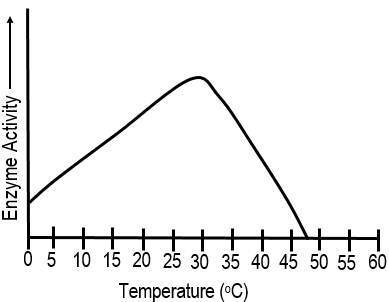
Based on the graph, what temperature does this enzyme work best? 
a)
15 C
b)
40 C
c)
30 C
d)
47 C
34.

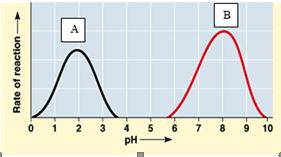
What is the optimal pH of enzyme A?

a)

8

b)

2

c)

5.7-10

d)

10

35.

What is the optimal pH of enzyme B?

a)

8

b)

2

c)

5.7-10

d)

10

36.
The graph shows the relative rates of action of four enzymes, A, B, C, and D. Which enzyme shows the greatest change in its rate of action with the least change in pH?
a)
enzyme A 
b)
enzyme B 
c)
enzyme C
d)
enzyme D
37.

An element with 3 protons in each atom has an atomic number of:

a)

1

b)

2

c)

3

d)

4

38.

An atomic number of 8 means the atom has ________ protons.

a)

7

b)

8

c)

16

d)

88

39.

All matter is made of what

a)

energy

b)

atoms

c)

electrons

d)

compounds

40.
The positive particles of an atom are 
a)
electrons 
b)
positrons 
c)
neutrons 
d)
protons 
41.
Particles in an atom that are neutral and have no charge are 
a)
negatrons 
b)
electrons 
c)
neutrons 
d)
protons 
42.
Most of the mass in an atom is concentrated in the...
a)
electrons
b)
nucleus
c)
protons
d)
empty space
43.
What is a valence electron?
a)
The sum of neutrons and protons.
b)
The # of electrons in the last shell.
c)
A type of bond.
d)
A popular compound.
44.
Same repel, opposites
a)
avoid
b)
attract
c)
push
d)
pull
45.
How are ionic bonds formed?
a)
Transfer of electrons
b)
Sharing of electrons
46.
Why do elements bond?
a)
To be friends
b)
To create a new element
c)
To become stable
47.

Valence electrons are found

a)

in the innermost energy level of an atom

b)

in the middle energy levels of an atom

c)

in the outermost energy levels of an atom

48.

Why do all bonds form?

a)

so the number of protons equals the number of electrons

b)

so an atom can become unstable

c)

to fill the outermost energy level

49.

What macromolecule is made up of C,H,O,N?

a)

Carbohydrates

b)

Lipids

c)

Proteins

d)

Nucleic acids

50.

What is the function of Carbohydrates?

a)

Long-term energy

b)

Muscle development

c)

Short-term energy

d)

enzyme activity

51.

This macromolecules is responsible for providing our genetic material. Choose the macromolecule that best fits.

a)

Carbohydrates

b)

Lipids

c)

Proteins

d)

Nucleic acids

52.

Which macromolecule is structured in this way?

a)

Carbohydrates

b)

Lipids

c)

Proteins

d)

Nucleic acids

53.

Which of the macromolecules are structured in this way?

a)

Carbohydrates

b)

Lipids

c)

Proteins

d)

Nucleic acids

54.
Monosaccharides are monomers of
a)
Carbohydrates
b)
Lipids
c)
Proteins
d)
Nucleic Acids