wayground logo

Free Printable Worksheets

NEW

Font size

S
M
L
XL
Worksheets

Unit 4 - Cell Regulation

Total questions: 50

Worksheet time: 52mins

Name
Class
Date
1.
When a cell is not actively dividing, it is in what phase?
a)
interphase
b)
anaphase
c)
prophase
d)
telophase
2.
What portion of the cell cycle involves the actual dividing?
a)
interphase
b)
mitosis
c)
Gap 1
d)
Gap 2
3.
When you start with 1 cell, at the end of mitosis, how many identical cells will you have?
a)
1
b)
2
c)
3
d)
4
4.
Which phase is shown in the diagram
a)
prophase
b)
metaphase
c)
anaphase
d)
telophase
5.
Mitosis is considered this type of reproduction
a)
sexual
b)
asexual
6.
If a cell starts with 46 chromosomes and goes through mitosis. How many chromosomes will the daughter cells have? 
a)
46
b)
23
c)
92
7.
Name the phase:
a)
Prophase
b)
Metaphase
c)
Anaphase
d)
Telophase
8.
Cells of organism must replicate for ?
a)
growth
b)
repair of damaged cells
c)
replacement of dying cells.
d)
All of the above
9.
Before cells can divide, what must be copied?
a)
mitochondria
b)
cytoplasm
c)
DNA
d)
Cell Wall
10.
Eukaryotic cells store their genetic information(DNA) in __________.
a)
Chromosomes
b)
Centromeres
c)
karyotypes
d)
Proteins
11.
In the G1 stage of the cell cycle, the cell
a)
Grows
b)
Matures
c)
Carries on normal activities
d)
All of the above
12.
In the S stage of interphase_______________
a)
the cell grows
b)
the nucleus divides
c)
the cell membrane divides
d)
the DNA is replicated
13.
When an animal cell goes through cytokinesis,__________
a)
a cell plate forms dividing the 2 new nuclei.
b)
the cell membrane pinches off the 2 new cells.
c)
4 new cells are formed.
d)
None of the above
14.

When a plant cell goes through cell cytokinesis, _____________.

a)

the 2 new nuclei are separated by the cell membrane pinching off.

b)

4 new cells are formed

c)

a cell plate forms, dividing the 2 new nuclei

d)

None of the above

15.
Fruit fly body cells have 8 chromosomes. After mitosis, you would expect a resulting fruit fly daughter cell to have ...
a)
16 chromosomes.
b)
46 chromosomes.
c)
8 chromosomes.
d)
4 chromosomes.
16.
The stages of mitosis in order
a)
Metaphase, Anaphase, Prophase, Telophase
b)
Prophase, Anaphase, Metaphase, Telophase
c)
Prophase, Metaphase, Anaphase, Telophase
d)
Anaphase, Prophase, Telophase, Metaphase
17.
The nuclear membrane breaks down occurs during which stage?
a)
Interphase
b)
Metaphase
c)
Prophase
d)
Telophase
18.
Cytoplasmic division is also known as
a)
cytokinesis
b)
mitosis
c)
interphase
d)
cytotoxic
19.

Compared to most prokaryotic cells, eukaryotic cells typically have

a)

more DNA molecules and larger genomes.

b)

the same number of DNA molecules but larger genomes.

c)

the same number of DNA molecules and similarly sized genomes.

d)

fewer DNA molecules but larger genomes.

20.

A particular cell has half as much DNA as some other cells in a mitotically active tissue. The cell in question is most likely in

a)

G1

b)

G2

c)

S

d)

prophase

e)

metaphase

21.

Which of the following does not occur during mitosis?

a)

replication of the DNA

b)

condensation of the chromosomes

c)

separation of sister chromatids

d)

separation of the spindle poles

22.
In which stage of the cell cycle is the cell preparing for division? 
a)
G1
b)
S
c)
G2
d)
M
23.
What is the result of mitosis?
a)
2 gametes
b)
2 identical somatic cells
c)
4 gametes
d)
2 different somatic cells
24.
Identify the phase of mitosis
a)
prophase
b)
metaphase
c)
anaphase
d)
telophase
25.
Cancer cells can reproduce rapidly because they
a)
are smaller than normal cells
b)
skip interphase
c)
undergo mitosis more slowly
d)
spend less time in interphase
26.
________________is a critical point where stop and go signals can regulate the cycle
a)
Metastasis
b)
Checkpoint
c)
Malignant
d)
Benign
27.
What is the role of the spindle during mitosis?
a)
it changes the chromatin to chromosome
b)
duplicate the DNA
c)
breaks down the membrane
d)
separates the chromatids.
28.
When glucose levels in the blood rise, your brain sends a signal to your pancreas. The pancreas releases insulin, which opens channels in cell membranes to allow glucose to enter the cell, lowering blood sugar levels. 
a)
Positive Feedback Response
b)
Negative Feedback Loop 
29.
When you get cut, your skin cells release hormones that signal platelets to come and stop the bleeding. Platelets then release more hormones that signal even more platelets to help stop bleeding. The hormone signals continue until the cut is closed.
a)
Positive Feedback Response
b)
Negative Feedback Loop 
30.
Rapid growth during puberty causes your body to release more and more growth hormones. As you grow, more and more growth hormones are released until puberty is reached, and then the hormones stop.
a)
Positive Feedback Response
b)
Negative Feedback Loop 
31.
If the calcium in your blood decreases below homeostasis levels, a gland in the brain will sense the decrease and send a chemical message to your bones. Your bones will release calcium into the blood, bringing blood calcium levels back up.
a)
Positive Feedback Response
b)
Negative Feedback Loop 
32.
As you get dehydrated, your blood becomes thicker and harder to pump. Your kidneys will respond by stopping urine production, sending the water from urine into your bloodstream to thin your blood back to normal level.
a)
Positive Feedback Response
b)
Negative Feedback Loop 
33.

What happens if the person's insulin levels get too high?

a)

The glucose level decreases alot.

b)

Glucagon remain turned off.

c)

The blood glucose levels increases

d)

More insulin is added to the person's body

34.
A signal molecule that binds to a plasma-membrane protein is a
a)
ligand
b)
second messenger
c)
protein kinase
d)
receptor protein
35.
What is an organic compound that is made by glands in the body (pituitary, thyroid, etc) that is used in long distance communication between cells?
a)
Hormones
b)
Neurotransmitters
c)
Synapse
d)
Carbohydrates
36.
The 3 steps of signal transduction in order are
a)
reception, transduction, response
b)
response, transduction, reception
c)
reception, response, transduction
d)
transduction, reception, response
37.
This is an example of
a)
paracrine signaling
b)
synaptic signaling
c)
long-distance signaling
d)
all of the above
38.

Which type of membrane protein would help intake a message from outside of the cell to inside of the cell?

a)

Receptor Protein

b)

Enzymatic Protein

c)

Channel Protein

d)

Junction Protein

e)

ATP Synthase

39.

Which letter represents the cell surface receptor protein?

a)

A

b)

B

c)

C

d)

D

e)

E

40.

Which letter represents the secondary proteins?

a)

A

b)

B

c)

C

d)

D

e)

E

41.

Which letter represents the ligand?

a)

A

b)

B

c)

C

d)

D

e)

E

42.

Gymnema tea binds to taste receptors and blocks sugars from binding to receptors. The tea could be known as a(n) ____.

a)

activator

b)

inhibitor

c)

buffer

d)

cell

43.

An example of DIRECT cell communication is:

a)

White blood cells bumping into each other sharing antigen info

b)

Neurons communicating across a synapse

c)

Hormones traveling through the blood stream to target tissues

44.

Cells can communicate with one another via:

a)

chemical messengers

b)

hormones

c)

gap junctions

d)

all of these

45.

Which of the following is a long distance long-term form of cell-to-cell communication?

a)

Circulating hormones

b)

Local hormones

c)

Gap junctions

d)

Apoptosis

46.

Which of the following is a short distance short-term form of cell-to-cell communication that can occur within the same cell or nearby cells?

a)

Circulating hormones

b)

Local hormones

c)

Gap junctions

d)

Apoptosis

47.

Which of the following is a short distance short-term instantaneous form of cell-to-cell communication:

a)

Circulating hormones

b)

Local hormones

c)

Gap junctions

d)

Apoptosis

48.

A cell converting a chemical signal into a cellular response is known as __.

a)

energetics

b)

transduction

c)

ligand response

d)

transformation

49.

How bacteria communicated to all "glow" simultaneously--the fluorescent gene expression was regulated by population density.

a)

quorum quotient

b)

quorum sensing

c)

quorum glowing

d)

quorum majority

50.
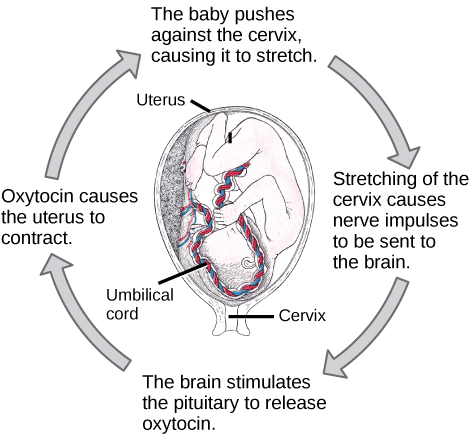
What type of feedback loop is shown?
a)
negative
b)
neutral 
c)
positive