wayground logo

Free Printable Worksheets

NEW

Font size

S
M
L
XL
Worksheets

CSHS Yr 11 Physics Unit 2 revision

Total questions: 57

Worksheet time: 38mins

Name
Class
Date
1.
An _______ force must act on an object for it to CHANGE it's motion
a)
balanced
b)
unbalanced
c)
gravitational
d)
electrical
2.
If a 10 kilogram object accelerates suddenly at 15 m/s^2, how much force was applied to the object?
a)
150 Newtons
b)
15 Newtons
c)
150 kilograms
d)
100 kilograms
3.
The overall force on an object when all the individual forces acting on it are added together
a)
Momentum
b)
Net force
c)
Velocity
d)
Unbalanced force
4.
Which is Newtons first law
a)
Force is equal to an objects mass times its velocity 
b)
an object in motion stays in motion or an object at rest stays at rest unless acted on by an outside force.
c)
Law of the land
d)
For every action there is an equal and opposite reaction
5.
Which is Newtons third law
a)
Force is equal to an objects mass times its velocity 
b)
an object in motion stays in motion or an object at rest stays at rest unless acted on by an outside force.
c)
Law of inertia
d)
For every action there is an equal and opposite reaction
6.
Which is Newtons second law
a)
Force is equal to an objects mass times its velocity 
b)
an object in motion stays in motion or an object at rest stays at rest unless acted on by an outside force.
c)
law of inertia
d)
For every action there is an equal and opposite reaction
7.
You push on a tree with 20 N of force. If the tree doesn't move, the tree is pushing back on you with _____of force.
a)
20N 
b)
40N 
c)
10N 
d)
70N
8.

What force is always opposite the direction of motion?

a)

Weight

b)

Tension

c)

Friction

d)

Spring

9.

Ropes and chains

a)

Thrust Force

b)

Tension Force

c)

Spring Force

d)

Normal Force

10.

The force a surface exerts on an object

a)

Natural Force

b)

Normal Force

c)

Applied force

d)

Inertia

11.
In a tug of war the left team pulls with a force of 200N. The right team pulls with a force of 150N.What is the resultant force?
a)
50N to the left.
b)
350N to the left.
c)
350N to the right.
d)
50N to the right.
12.
What is the net force?
a)
400 N Up
b)
400 N Down
c)
- 400 N Down
d)
800 N Down
13.
What is the net force?
a)
40 N left
b)
0 N Balalnced
c)
400 N right
d)
40 N right
14.
What is it called when the force of gravity is acting on an object?
a)
Weight
b)
Sliding Friction
c)
Momentum
d)
Projectile Motion
15.
If a force of 50 Newton's was applied to an object with a mass of 500 grams, what will the object's acceleration be?
a)
10 m/s^2
b)
.1 m/s^2
c)
100 m/s^2
d)
1 m/s^2
16.
A rabbit pushes down on a turtle. What is the reaction force?
a)
The turtle pushes down on the ground.
b)
The ground pushes up on the turtle.
c)
The air pushes down on the rabbit.
d)
The turtle pushes up on the rabbit.
17.

Forces are measured in

a)

kilograms

b)

pounds

c)

vectors

d)

newtons

18.
 Jermaine runs exactly 2 laps around a 400 meter track. What is the displacement?
a)
800
b)
400
c)
0
d)
200
19.
David walks 3 km north, and then turns east and walks 4 km. What is the distance?
a)
7 km
b)
3 km
c)
4 km
d)
1 km
20.
What kind of quantity has both a magnitude and a direction?
a)
scalar
b)
vector
c)
frame of reference
d)
time
21.
Which of the following is a unit for acceleration?
a)
km/s
b)
m/s2
c)
mi/hr
d)
ft
22.
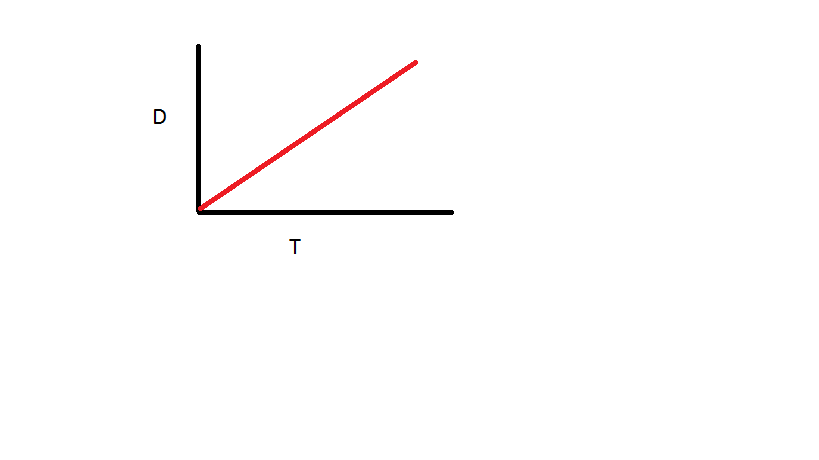
The graph represents
a)
Acceleration
b)
No motion
c)
Deceleration
d)
Constant Velocity
23.
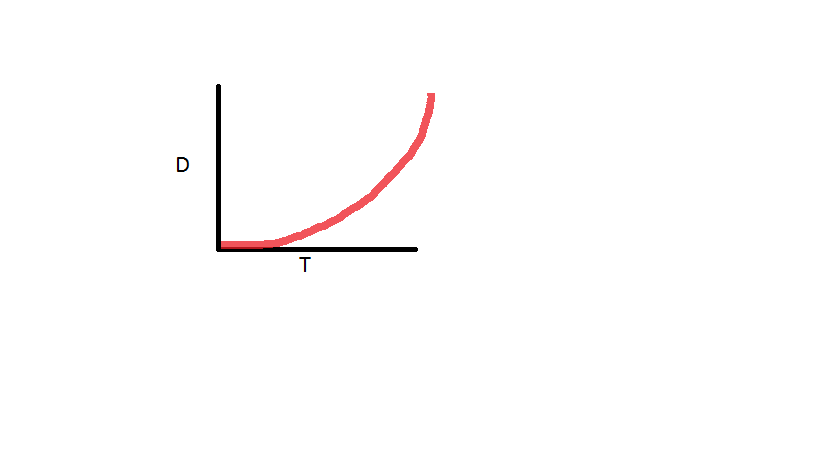
The graph below represents
a)
Speed
b)
Velocity
c)
Acceleration
d)
Deceleration
24.
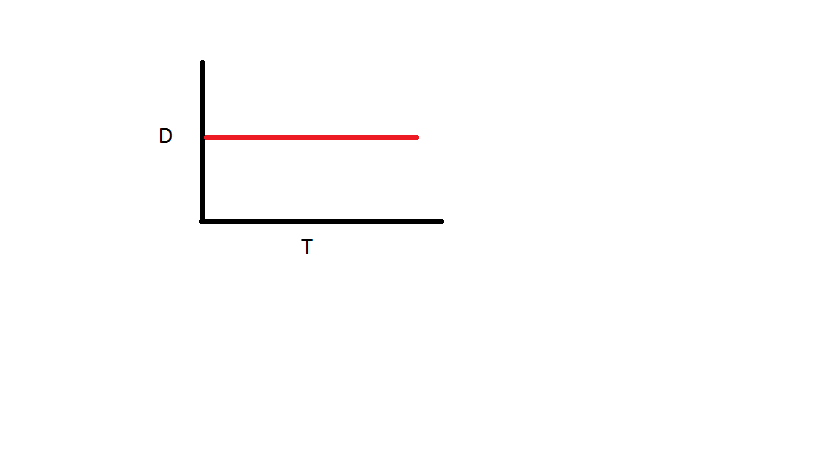
The graph represents
a)
No motion
b)
Constant velocity
c)
Acceleration
d)
Deceleration
25.
The graph respresents
a)
No motion
b)
Constant Velocity
c)
Acceleration
d)
Deceleration
26.
The graph represents
a)
no motion
b)
constant velocity
c)
acceleration
d)
negative acceleration
27.
1.  How far will a train moving at 5.7 km/min go in 45 minutes?
a)
256.5 km
b)
0.12 km
c)
7.89 km
28.
A roller coasters accelerates from an initial velocity of 6.0 m/s to a final velocity of 70 m/s over 4 seconds.  What's the acceleration?
a)
24 m/s2
b)
18 m/s2
c)
16 m/s2
d)
16 m/s
29.
What are the two variables that determine momentum?
a)
speed and height
b)
mass and velocity
c)
car and truck
d)
momentum and distance
30.
If an object decreases its speed each second it moves before stopping, it is...
a)
conserving momentum
b)
insane
c)
accelerating
d)
conserving energy
31.
This driver just experienced which one of newton's laws?
a)
First law
b)
Second law
c)
Third law
d)
Fourth law
32.
This motorcyclist just experienced which one of newton's laws? (the one that fits best)
a)
Inertia: object in motion stays in motion unless acted on by a force
b)
F = ma
c)
Action - Reaction: for every action there is an opposite and equal reaction.
d)
4th law
33.
What is the acceleration on this 250 kg block? (look at the picture)
a)
80 m/s
b)
8 m/s
c)
.08 m/s
d)
800 m/s
34.
Runner A (blue) has the same displacement as Runner B (black).
a)
False
b)
True
35.
What was the total momentum of the two cars before they were hit by the orange truck?
a)
2 kg*m/s
b)
0 m/s2
c)
0 kg*m/s
d)
0 mph
36.
The momentum of an object depends upon the object's ___________&_____________.  
a)
size and shape
b)
mass and speed
c)
mass and veloctiy
d)
mass and energy
37.
The equation to calculate momentum is
a)
p=mv
b)
p=1/2mv2
c)
p=mgh
d)
p=mg
38.
A runner has a momentum of 720 kg m/s and is traveling at a velocity of 5 m/s. What is his mass?
a)
14.4 kg
b)
1400 kg
c)
144 kg
d)
360 kg
39.
A 0.250 kg cart moving at 0.500 m/s has how much momentum?
a)
0.5 kg*m/s
b)
.125 kg*m/s
c)
12.5 kg*m/s
d)
10 kg*m/s
40.
A 2.5 kg ball moving at 5 m/s collides with a 2.5 kg stationary ball in a perfectly elastic collision.  What is the velocity of the second ball after the collision? 
a)
5 m/s
b)
2.5 m/s
c)
10 m/s
d)
7.5 m/s
41.
The impulse is ______ the change in momentum
a)
Greater than
b)
Equal to
c)
less than
d)
always double
42.
When the speed of an object is doubled, its momentum
a)
remains unchanged in accord with the conservation of momentum.
b)
doubles
c)
quadruples
d)
decreases
43.
Momentum is a ____________________ quantity
a)
science
b)
scalar
c)
vector
d)
energy
44.
A boy kicks a football with a force of 20 N, the time the force acts for is 0.3 s.
Calculate the impulse on the ball.
a)
1 N*s
b)
6 N*s
c)
33.3 N*s 
d)
None of these
45.
In any collision (crash) the ______ is ALWAYS constant
a)
Total Momentum
b)
total speed
c)
total Velocity
d)
Energy
46.
How can a tennis ball and a bowling ball have the same momentum?
a)
have the same speed
b)
have different speeds
c)
one is moving backwards
d)
they can't
47.
The purpose of crumble zones on a car is to
a)
decrease time of impact.
b)
increase force of impact.
c)
increase the time of impact.
d)
decrease the impulse during impact.
48.
When two objects collide, the Pbefore is ____________ the Pafter.
a)
more than 
b)
less than 
c)
equal to
d)
unrelated to
49.
Heather noticed a collision outside the coffee shop where two cars collided and stuck together.  What type of collision did she observe?
a)
Elastic
b)
Explosive
c)
 Inelastic
50.

When you ride a playground swing, your potential energy is greatest at the _________ point.

a)

highest

b)

lowest

c)

mid

d)

far

51.

The kinetic energy of an object increases as its ____ increases.

a)

gravitational energy

b)

heat energy

c)

potential energy

d)

velocity

52.

According to the law of conservation of energy, the total amount of energy in the universe ____.

a)

remains constant

b)

increases

c)

changes constantly

d)

decreases

53.

The unit for work is the _____, named after James Prescott _____. [same word for each blank space]

a)

Joule

b)

Watt

c)

Newton

d)

none of these

54.

In order for work to be done on an object, the object must ______.

a)

have a force applied in any direction

b)

move in a direction opposite of the applied force

c)

move in the direction of the applied force

d)

none of these

55.

What location on the coaster has the greatest potential energy

a)

W

b)

X

c)

Y

d)

Z

56.

Which location has the least potential energy but the most kinetic energy.

a)

W

b)

X

c)

Y

d)

Z

57.

A ball has 100 J of potential energy when it is on a shelf. What happens to the potential energy and the kinetic energy as the ball falls, and find the amount of kinetic energy the ball has at the instant it hits the floor?

a)

Greater than 100 Joules because it is speeding up

b)

100 Joules if you neglect the energy lost due to friction

c)

Less than 100 Joules because the energy is lost

d)

none of these