Wayground logo

Free Printable Worksheets

Font size

S
M
L
XL
Worksheets

Ch. 15- Years Of Crisis

Total questions: 45

Worksheet time: 57mins

Name
Class
Date
1.
President Franklin Roosevelt won the election of 1932. The country was in the Great Depression, and Roosevelt introduced the New Deal. Which was the MOST important goal of President Franklin Roosevelt's New Deal programs?
a)
to strengthen the economy 
b)
to avoid going to war 
c)
to improve public education 
d)
to end racial discrimination 
2.

What was the "New Deal" of the 1930s?

a)

a government program that gave free land to homesteaders

b)

a government program that helped women get the vote

c)

a government program that spread civil rights throughout the country

d)

a government program designed to help people during the depression
3.
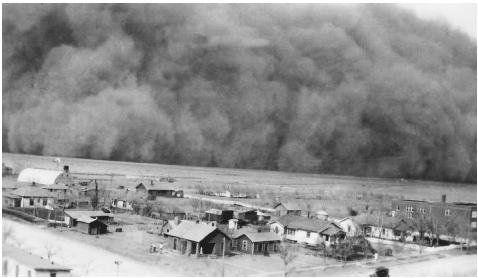
The Dust Bowl devastated what part of the U.S. during the Great Depression?
a)
West Coast
b)
New England
c)
Deep South
d)
Great Plains
4.
Which of the following was NOT a cause of the Great Depression?
a)
Hawley-Smoot Tariff
b)
Easy Credit
c)
Mistakes of the Federal Reserve
d)
high farm prices
5.
Paying a small % of a stock's price & borrowing the rest is known as what?
a)
buying on margin
b)
speculation
c)
fiat money
d)
price supports
6.
Buying stock without knowing the risks, assuming it will just go up is known as ________.
a)
speculation
b)
buying on margin
c)
market capitalization
d)
hammering the market
7.
This natural disaster served to worsen the effects of the Great Depression on Farmers in the Midwest 
a)
Tornados
b)
Dust Bowl
c)
Black Tuesday 
d)
Hurricanes
8.
The collection of markets and exchange where the issuing and trading of equities, bonds and other sorts of securities takes place.
a)
Margin
b)
New Deal
c)
Deficit Spending 
d)
Stock Market 
9.
A time in America following the roaring 20's where America experience rising unemployment that did not end until the onset of World War II. 
a)
New Deal
b)
Roaring 20's
c)
Great Depression
d)
Cold War 
10.
What effect did the Dust Bowl storms have on the Great Depression?
a)
Many farmers were forced to leave the Great Plains.
b)
Unemployment decreased gradually.
c)
Many homes long the Mississippi River were flooded.
d)
Hoover was re-elected as president.
11.
The Bonus Army incident in 1932 best illustrates the idea that
a)
F.D.R.'
s relief programs were unsuccessful.
b)
many felt that Herbert Hoover was not handling the Depression well.
c)
protests by veterans during the Depression were effective.
d)
the U.S. Army had increased in size and power during the Depression.
12.
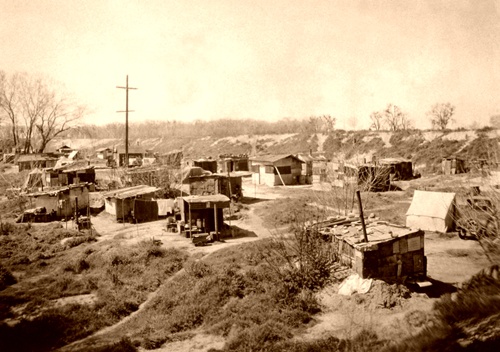
What were the villages full of shacks located in cities filled with unemployed Americans called?
a)
Hoovervilles
b)
Okies
c)
Bonus Army Bases
d)
Rooseveltowns
13.
Which of the following was a major cause of the Great Depression?
a)
overproduction and underconsumption
b)
a decrease in the supply of consumer goods
c)
an increase in demand for imported products
d)
an increase in the price of wheat on the world market
14.
Who was the President of the United States when the Stock Market crashed?
a)
Franklin D. Roosevelt
b)
Herbert Hoover
c)
Woodrow Wilson
d)
Theodore Roosevelt
15.
Which of these statements is true of the 1932 presidential election?
a)
Franklin Roosevelt won in a landslide.
b)
Hoover lost by a narrow margin.
c)
Huey Long ran a strong third-party campaign.
d)
Roosevelt won a third term.
16.
FDR addressed the American public in weekly broadcasts known as:
a)
FDR Hour
b)
Hangin' With Franklin
c)
Fireside Chats
d)
Around the Fire
17.
As part of the New Deal, the Securities and Exchange Commission (SEC) and the Federal Deposit Insurance Corporation (FDIC) were created to
a)
allow for a quick recovery of stock prices
b)
provide direct loans to businesses
c)
protect individual investors from stock fraud and bank failure
d)
allow banks and companies to invest in the stock market
18.
The Civilian Conservation Corps (CCC) and the Works Progress Administration (WPA) were both New Deal programs developed to address the problem of
a)
excessive stock market speculation
b)
high unemployment
c)
increased use of credit
d)
limited income of senior citizens
19.
The TVA is significant because it hired people to 
a)
deliver food to the poverty-stricken Dust Bowl residents
b)
build dams and generators that provided electricity
c)
work on farms to help stabilize agriculture
d)
publish important facts about businesses
20.
Passage of the Social Security Act (1935) helped American workers by 
a)
creating jobs for the unemployed
b)
guaranteeing a minimum wage
c)
legalizing the right to join labor unions
d)
providing financial assistance after retirement
21.
A major result of the New Deal was that it
a)
eliminated poverty in the US
b)
extended the merit system in the civil service
c)
destroyed the private enterprise system
d)
greatly increased the size and power of the Federal Government
22.
The Great Depression began in
a)
1925
b)
1929
c)
1932
d)
1940
23.
In the 1930's, people would line up at ____________ to get food.  These were normally run by charities.
a)
churches
b)
businesses
c)
soup kitchens
d)
work
24.
Which of the following BEST describes the Great Depression?
a)
The depression was severe, but only in the United States. 
b)
Governments acted quickly and the depression only lasted two years
c)
The depression caused revolutions all across the world. 
d)
Many countries around the world experienced the economic depression
25.
What protects one's money in the bank?
a)
CCC
b)
NRA
c)
FDIC
d)
FBLA
26.
 What were the most popular types of music in the 1920’s.
a)
Rap
b)
Classical
c)
Jazz and Blues
d)
Country
27.
During the 1920s people lives changed because they began listening to the what? 
a)
mass media 
b)
movies 
c)
radio 
d)
music 
28.
_______________ were young women who rebelled against traditional ways of thinking and acting.
a)
Expatriates
b)
Jazzers
c)
Flappers
d)
Scats
29.
Henry Ford’s main contribution to the US industry was the idea of the assembly line and __________.
a)
automobile
b)
mass production
c)
sports car
d)
transportation
30.
A single party controls the government and every aspect of people's lives.
a)
Totalitarianism
b)
Fascism
c)
Appeasement
d)
Auschwitz
31.
Which issue best characterizes the years leading to the Second World War?
a)
Expansion of the race for space flight
b)
Rise of dictators and totalitarian states
c)
Introduction of new information technology
d)
Concern for climate change and conservation
32.
Who promised to restore Germany to its former power?
a)
Joseph Stalin
b)
Benito Mussolini
c)
Adolf Hitler
d)
Napoleon Bonaparte
33.
What country was punished most severely by the Treaty of Versailles?
a)
Italy
b)
Japan
c)
Russia
d)
Germany
34.

Who promised to rescue Italy by reviving its economy and rebuilding its armed forces?

a)

Alcide De Gasperi

b)

Benito Mussolini

c)

Silvio Berlusconi

d)

Camillo Benso

35.

What is the shortened version of the National Socialist German Workers' Party?

a)

Kampfer

b)

NSGWP

c)

Nazi

d)

lebensraum

36.

What is the shortened version of the National Socialist German Workers' Party?

a)

Kampfer

b)

NSGWP

c)

Nazi

d)

lebensraum

37.

Adolf Hitler's autobiography

a)

isolationism

b)

Axis Powers

c)

fascism

d)

Mein Kampf

38.
What was one reason the Nazi programs and policies of the early 1930s appealed to many people in Germany?
a)
The people were frustrated with their current political and economic situation.
b)
Germany had been denied membership to the UN.
c)
Communism had been forced on them. 
d)
Germans fear that the British and French would take control. 
39.

What is the best definition of Fascism?

a)

An extreme form of nationalistic militarism

b)

An ideology that guaranteed basic rights for all citizens

c)

An ideology that got rid of social classes

40.

What was it illegal to do in fascist Italy.

a)

say anything bad about the government.

b)

other political parties exist

c)

police allowed to arrest people and put them in jail for any reason.

d)

all of the above.

41.

Which British Prime Minister believed in appeasement?

a)

Lord Halifax

b)

Neville Chamberlain

c)

Winston Churchill

42.

The area of Czechoslovakia inhabited by ethnic Germans coincided with the country's western border, that formed a mountainous U shape. What was the name given to this region?

a)

Bohemia

b)

Silesia

c)

The Sudetenland

d)

Moravia

43.
The Munich Agreement said
a)
Germany gets the Sudetenland
b)
Germany cannot occupy the Sudetenland
c)
Czechoslovakia gets to decide whether Germany gets the Sudetenland or not
44.
The practice of giving in to aggression in order to avoid war.
a)
Genocide
b)
Mein Kampf
c)
Appeasement
d)
Blitzkrieg
45.

Series of laws passed by Congress to prevent the U.S. from entering wars based on economic considerations, like in WW I.

a)

Neutrality Acts

b)

Allied Powers Act

c)

Lend-Lease Act

d)

Arsenal of Democracy