wayground logo

Free Printable Worksheets

NEW

Font size

S
M
L
XL
Worksheets

MT review

Total questions: 58

Worksheet time: 1hrs 16mins

Name
Class
Date
1.
What happens to particles when they are heated?
a)
They speed up and spread out
b)
They slow down and compress
c)
They stop moving
d)
They move closer together and speed up
2.
What word describes when water is attracted to other substances?
a)
cohesion
b)
adhesion
c)
capillary action
d)
surface tension
3.
Why can water have no net charge but have slight charges in different parts of the molecule?
a)
The oxygen end is slightly negative and the hydrogen end is slightly positive
b)
The hydrogen end is slightly negative and the oxygen end is slightly positive
c)
The hydrogen and oxygen ends change in polarity
d)
Because it is hydrophobic
4.
Attractions between water molecules are called
a)
Covalent bonds
b)
Ionic bonds
c)
Polar bonds
d)
Hydrogen bonds
5.
The attraction that causes water and other liquids to form drops on thin films is called ________________. This is also water’s ability to be attracted to other water molecules.
a)
adhesion
b)
capillary action
c)
cohesion
d)
surface tension
6.
tendency of molecules of the same kind to stick to one another
a)
cohesion
b)
adhesion
c)
solution
d)
polar molecule
7.
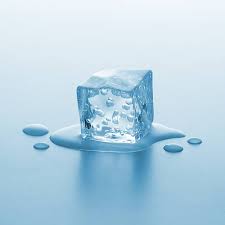
Why does ice float?
a)
As water freezes, it expands and its density decreases.
b)
As water freezes, it takes up more hydrogen from the atmosphere, causing it to have a greater buoyancy.
c)
As water freezes, air becomes trapped between the hydrogen bonds of water molecules.
d)
As water freezes, it takes up more oxygen from the atmosphere, causing it to have a greater buoyancy.
8.
The reason the water balloon did NOT pop while held over a flame is water's _________.
a)
Less dense than air.
b)
Hydrogen bonds between water molecules.
c)
polarity.
d)
high specific heat capacity.
9.
Water beads up on the surface of a penny because of this property.
a)
Adhesion
b)
High Surface Tension
c)
Universal Solvent
d)
Changes in Density
10.
Does H2O have hydrogen bonding?
a)
yes
b)
no
11.

What holds the oxygen and hydrogen atoms together in a water molecule?

a)

nonpolar covalent bond

b)

polar covalent bond

c)

hydrogen bond

d)

ionic bond

12.
Why does water move from the roots to the leaves of plants?
a)
Water is pushed by solutes
b)
Capillary action pulls the water molecules like a chain
c)
Water is pulled by gravity
d)
Water’s surface tension causes it to “pull” towards the leaves
13.
The particles in a liquid are:
a)
moving faster than a solid
b)
mover slower than a solid
c)
moving faster than a gas
d)
moving faster than a plasma
14.

If the temperature increases, then the particle speed _____________?

a)

Increases

b)

Decreases

c)

Stays the same

15.
Which of the following terms identifies the change from a liquid to gas?
a)
Vaporization
b)
Condensation
c)
Deposition
d)
Sublimation
16.
What state of matter is segment 5?
a)
Solid
b)
Liquid
c)
Gas
d)
Plasma
17.
Which of these conditions is always true for an exothermic process?
a)
They leave the surroundings feeling cold
b)
They release energy into the surroundings.
c)
They absorb energy from the surroundings
d)
The reactants gain energy as they form the products
18.
What change occurs from F to E?
a)
sublimation
b)
deposition
c)
melting
d)
condensation
19.
In a solid to liquid mixture, an increase in temperature means...
a)
increase in solubility
b)
decrease in solubility
20.
Which of the following statements is true about how using smaller salt crystals would affect the rate of making a salt solution in water?
a)
Smaller crystals increase the surface area and slow down dissolving.
b)
Smaller crystals decrease the surface area and speed up dissolving.
c)
Smaller crystals increase the surface area and speed up dissolving.
d)
Smaller crystals decrease the surface area and slow down dissolving.
21.

1 What is the correct and balanced equation when potassium reacts with water?

a)

K + H2O KOH + H2

b)

K + H2O K+ + OH- + H2

c)

2 K + 2 H2O 2 KOH- + H2

d)

2 K + 2 H2O 2 K+ + 2 OH- + H2

22.

What is the product of this equation?

K2Osolid + H2Oliquid

a)

KOH

b)

2 KOH

c)

KH

d)

KOH + H2

23.

1 Which of the following illustrates the structure of diamonds?

a)
b)
c)
d)
24.

Which solution is more concentrated?

Solution 1:

500 mL of water

100 g of salt


Solution 2:

500 mL of water

90 g of salt

a)

Solution 1

b)

Solution 2

c)

They have the same concentration

d)

I have no idea

25.

In order to dilute a solution, you need to

a)

add more of the solid

b)

add more water

c)

find the mass

d)

find the volume

26.

Calculate the mass percent of solution, if there is 100 g of sugar and 400 g of water

a)

30

b)

25

c)

20

d)

15

27.
How many liters would you need to make a 1 M solution if you have 6 mol of Sodium Hydroxide? 
a)
2
b)
3
c)
4
d)
28.

Molality (m) = moles of solute / _________________________.

a)

kilogram of solvent

b)

kiloliter of solvent

c)

kilometer of solvent

d)

ounces of solvent

29.

What is the molality of a solution made by dissolving 2 moles of NaOH in 400 grams of water?

a)

5 mol/kg. solvent

b)

4 mol/kg solvent

c)

3 mol/kg. solvent

d)

2.5 moles /kg solvent

30.

The energy required to start a chemical reaction is ___.

a)

endothermic

b)

exothermic

c)

activation

d)

released

31.

Energy is _____ when new bonds form.

a)

absorbed

b)

released

c)

lost

d)

gained

32.

An _______ reaction is when more energy is released than is absorbed. This energy can be in the form of light, heat, electricity, etc.

a)

endothermic

b)

endergonic

c)

exothermic

d)

exergonic

33.
What is Specific Heat?
a)
The  amount of thermal energy required to increase the temperature of 1kg of a material by 1°C.
b)
The  amount of radiant energy required to increase the temperature of 1kgof a material by 1°C
c)
The  amount of energy required to increase the temperature of 1kgof a material by 1°C.
d)
The  amount of friction  required to increase the temperature of 1kgof a material by 1°C.
34.
A high specific heat means...
a)
It heats up quickly with energy added
b)
It requires more energy to change temperature
35.
What  is the formula to calculate heat energy required to raise the temperature of any substance?
a)
Q=mc∆t
b)
Q=mc
c)
Q= ½mv
d)
m=QC
36.

The specific heat of platinum is 0.133 J/g°C. How much heat(Q) is released when a 10 g piece of platinum cools from 100°C to 50°C?

a)

66.5 J

b)

665 J

c)

0.0266 J

d)

0.665 J

37.
Copper, Stainless Steel, Carbon Steel, and Zinc were all heated using the same thermal energy.  What material would be the coolest after being heated?
a)
Copper
b)
Carbon Steel
c)
Zinc
d)
Stainless Steel
38.

Which material heats up quickest?

a)

Aluminium

b)

Concrete

c)

Diamond

d)

Glass

e)

Water

39.

Some 1kg of water and 1kg of diamond are heated to the same temperature. Which is true?

a)

They both require the same amount of energy

b)

The diamond needs around 8 times more energy

c)

The water needs about 8 times more energy

d)

The diamond heats up slower than the water

e)

The water ends up colder

40.

What is happening between D and E?

a)

Melting

b)

Boiling

c)

Condensing

d)

Freezing

e)

Sublimation

41.

What is happening between B and C?

a)

Melting

b)

Boiling

c)

Condensing

d)

Freezing

e)

Sublimation

42.
A catalyst works by
a)
changing the order of the reaction
b)
increasing the temperature
c)
lowering the activation energy
d)
making the activated complex
43.
 For which of these processes is the value of ΔH expected to be positive?
1.  The temperature increases when calcium chloride dissolves in water.
2.  Steam condenses to liquid water
3.  Water boils
4.  Dry ice sublimates
a)
4 only
b)
1 only
c)
3 and 4 only
d)
2 and 3 only
44.
N2 +  3H2 −->  2NH3 
How many moles of ammonium are produced when 3 moles of nitrogen react with hydrogen?
a)
6 moles Ammonium
b)
1.5 moles ammonium
c)
9 moles ammonium
d)
9 moles hydrogen
45.

A temperature increase causes the particles ......

a)

to slow down

b)

move faster

c)

collide higher

d)

in the right order

46.
The following graph shows two different reaction pathways for the same overall reaction at the same temperature. Which pathway is slower and why?
a)
Red, because the activation energy is larger
b)
Blue, because the activation energy is lower
c)
both reaction progress at the same rate
47.

Why does a higher temperature increase the rate of a reaction?

a)

it increases both the frequency and energy of particle collisions

b)

it only increases the frequency of particle collisions

c)

it only increases the energy of particle collisions

d)

it reduces the activation energy of the reaction

48.

When we investigate the rate of reaction we are looking at the...

a)

amount of product formed

b)

speed of reaction

c)

concentration of reacting particles

d)

combining reactants with products

49.

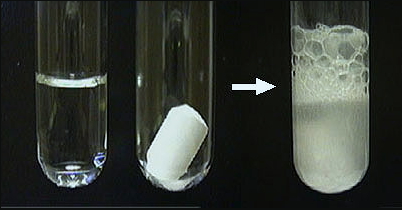
How could we make this reaction happen more quickly?

a)

Decrease the concentration of the acid

b)

crush the chalk to increase the surface area

c)

Put the test tube in an ice bath

50.

The major theory of reaction rate is called

a)

Collision theory

b)

Crash theory

c)

Newton's laws

d)

Thermodynamics

51.
A reaction has the rate law: Rate = k [A][B].
What is the order of reaction with respect to A?
a)
1st
b)
2nd
c)
3rd
d)
4th
52.
A reaction has the rate law: Rate = k [A][B].
What is the overall order of reaction?
a)
1st
b)
2nd
c)
3rd
d)
4th
53.
A possible rate law for a third overall order of a reaction is __________________
a)
Rate = k [A]2[B]2
b)
Rate = k [A][B]3
c)
Rate = k [A]3 [B]
d)
Rate = k [A]2[B]
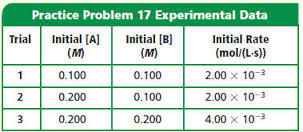
54.
What two trials would you use to find the rate exponent for B?
a)
trials 1 and 2
b)
trials 1 and 3
c)
trails 2 and 3
55.
The rate law of any chemical reaction 
a)
must be determined experimentally
b)
can be deduced based on the stoichiometry of the reaction
c)
changes based on the condition of the experiment
d)
I don't know
56.

It is generally believed that catalysts increase reaction rates by:

a)

removing the activation energy barrier

b)

providing an alternate activation energy barrier that is lower than the original barrier

c)

lowering the activation energy barrier

d)

giving the reacting particles more energy, thus there will be more successful collisions

57.

The minimum amount of energy needed for colliding particles to react is called

a)

Chemical Energy

b)

Kinetic Energy

c)

Activation Energy

d)

Potential Energy

58.
When a substance melts, the kinetic energy _____________.
a)
decreases
b)
stays the same
c)
increases
d)
decreases then increases