Wayground logo

Free Printable Worksheets

Font size

S
M
L
XL
Worksheets

How Elements are Grouped SC.8.P.8.6

Total questions: 50

Worksheet time: 52mins

Name
Class
Date
1.

Mendeleev’s periodic table did not always list elements in order of increasing

atomic mass because he grouped together elements with similar

a)

properties.

b)

atomic numbers.

c)

densities.

d)

colors

2.

Mendeleev predicted that the gaps in his periodic table represented

a)

isotopes.

b)

radioactive elements.

c)

permanent gaps.

d)

undiscovered elements.

3.

Elements in the Periodic Table are arranged according to their

a)

atomic number

b)

atomic mass

c)

relative activity

d)

relative size

4.

The elements in the Periodic Table are arranged in order of increasing

a)

atomic number

b)

atomic radius

c)

mass number

d)

neutron number

5.
   Most of the elements (85%) in the periodic table are.
a)
a. metals..
b)
b. metalloids
c)
c. gases.
d)
d. nonmetals.
6.
 Mendeleev arranged the elements by
a)
a. density.
b)
b. melting point.
c)
c. appearance.
d)
d. increasing atomic mass.
7.
  Another way the periodic table is organized is by…
a)
a. metals and non-metals 
b)
b. metals, non-metals, and metalloids
c)
c. non-metals and metalloids
d)
d. none of the above
8.
  How is the Periodic Table of Elements arranged today?
a)
a. by the type of element
b)
b. by the state of the element (solid, liquid, or gas)
c)
c. the mass of the element
d)
d. all of the above
9.
What does the atomic number tell us?
a)
A.  number of neutrons
b)
B. mass of atom
c)
C. number of protons
d)
D. name of element
10.
How would you describe most metals?
a)
A. They are easily shattered
b)
B. They are bad conductors
c)
C. They are dull
d)
D. They are good conductors of heat and electricity
11.

Which elements often share properties?

a)

Those in a period

b)

Those with the same color

c)

Those in the same family or group

12.

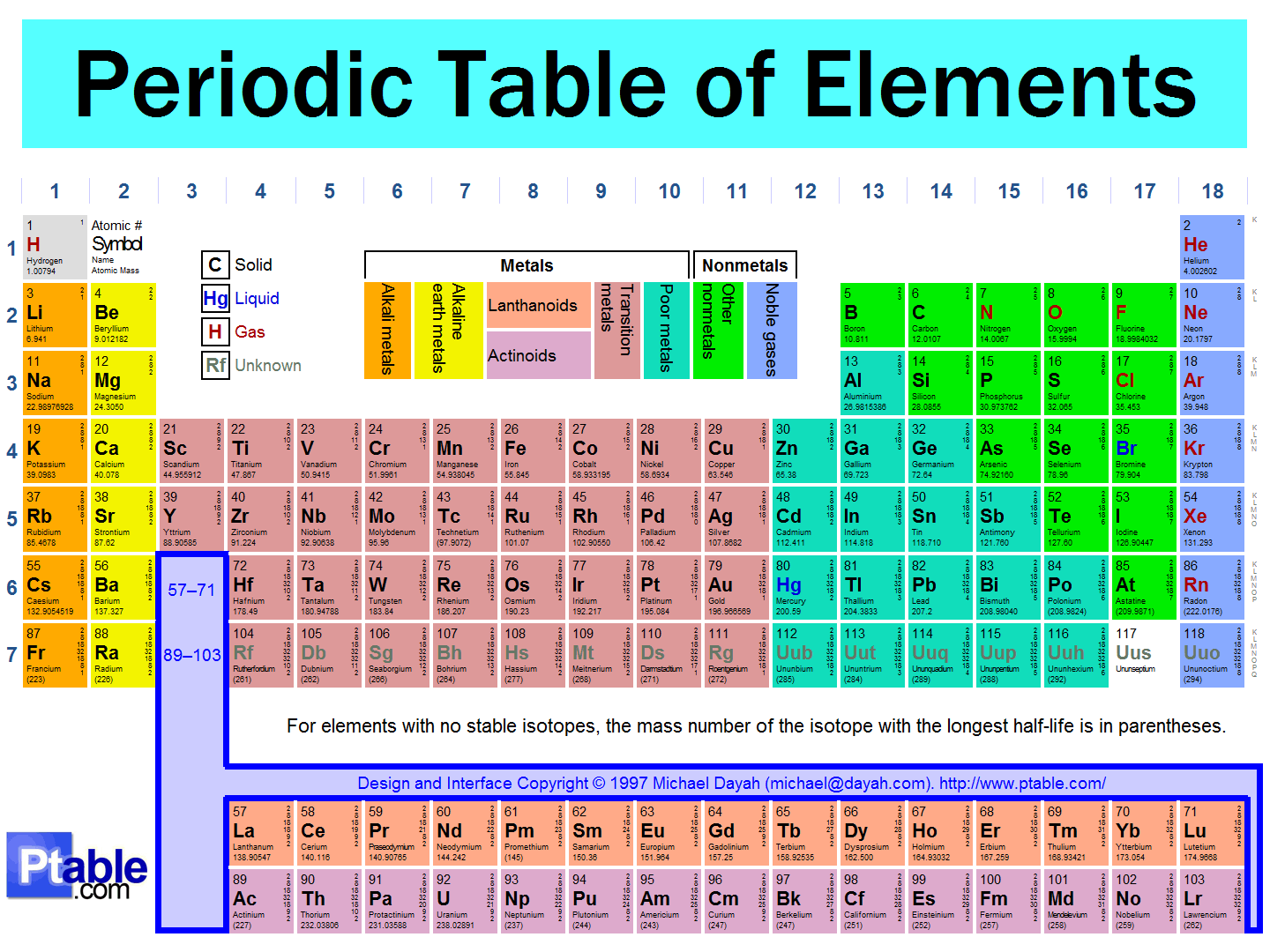
Refer to a periodic table. In which period is calcium?

a)

Period 2

b)

Period 4

c)

Period 6

d)

Period 8

13.

Refer to a periodic table. In which group is calcium?

a)

Group 1

b)

Group 2

c)

Group 17

d)

Group 18

14.

Why are periodic tables useful?

a)

You can predict an element's properties based on location.

b)

We have a record of all elements in the entire universe.

c)

It is a fancy tool for scientists.

d)

Mr. Henry makes us learn it so it must be useful.

15.
Each column in the periodic table is called a 
a)
period
b)
group
c)
cluster
d)
unit
16.
Which group of the periodic table is composed of inert (not reactive)  gases?
a)
alkali metals
b)
alkaline earth metals
c)
halogens
d)
noble gases
17.
Elements which are shiny, conduct electricity and heat are called
a)
metal
b)
nonmetal
c)
metalloid
d)
nonexistent
18.
The atoms along the staircase are called 
a)
metals
b)
nonmetals
c)
metalloids
d)
noble gases
19.
A horizontal row of elements in the periodic table.
a)
column
b)
group
c)
period
20.
A vertical column in the periodic table.  Elements share similar properties.
a)
row
b)
group
c)
period
21.
Elements in a ..................have similar chemical properties.  
a)
period
b)
group
c)
row
22.
What are the two structures found in the atom's nucleus?
a)
Electrons and Neutrons
b)
Protons and Electrons
c)
Protons and Neutrons
d)
Neutrons and Electrons
23.

In an element box, the number at top is the

a)

atomic number

b)

atomic name

c)

atomic mass

d)

atomic symbol

24.

___________________ are positively charged particles located in the nucleus of an atom.

a)

Electrons

b)

Neutrons

c)

Protons

d)

Isotopes

25.

Elements on the Periodic Table are ordered according to their

a)

element name

b)

element symbol

c)

number of atoms

d)

atomic number

26.

Rows in the Periodic Table are called

a)

Periods

b)

Groups/Families

c)

Cousins

d)

Metals

27.

Column in the Periodic Table are called

a)

Periods

b)

Groups/Families

c)

Cousins

d)

Metals

28.

The elements that touch the zigzag line on the Periodic Table are called

a)

metals

b)

nonmetals

c)

metalloids

d)

gasses

29.

What do atoms of the same periodic group have in common?

a)

They have the same atomic number.

b)

They have the same chemical symbols.

c)

The have similar chemical properties.

d)

They have the same atomic mass.

30.

What is the chemical symbol for sodium?

a)

S

b)

So

c)

Na

d)

K

31.

How many protons are in a nitrogen atom?

a)

5

b)

7

c)

14

d)

28

32.
In the modern periodic table elements are arranged by:
a)
atomic mass
b)
atomic number
c)
valence electrons
d)
number of isotopes
33.
The yellow atoms are called 
a)
metals
b)
nonmetals
c)
metalloids
d)
noble gases
34.

Which color on the image of the periodic table corresponds with the halogens.

a)

red

b)

black

c)

blue

d)

orange

35.
The atomic number of this pictured element is
a)
28
b)
58.6934
c)
Ni
d)
Nickel
36.
what does the 6 represent?
a)
Atomic mass
b)
atomic number
c)
chemical symbol
d)
element name
37.
What is the atomic mass of Neon?
a)
10
b)
30
c)
10.18
d)
20.18
38.

The vertical (up and down) columns in the Periodic Table are called

a)

groups

b)

towers

c)

periods

d)

atomic numbers

39.
Something that takes up space and has mass.
a)
volume
b)
matter
c)
mass
d)
density
40.
A pure substance that cannot be broken down into any other substance by chemical or physical means. There are about 100 of us shown in the Periodic Table
a)
compound
b)
mixture
c)
molecule
d)
element
41.
How many Protons are in one atom of Lithium?
a)
3
b)
6
c)
7
d)
6.941
42.

Neutrons have a ____________ charge.

a)

Neutral, or no charge

b)

Positive

c)

Negative

d)

Neutron? I don't know what that is!

43.

Select which things are made up of atoms:

a)

Orange juice

b)

A desk

c)

You and me

d)

Grass

44.

Which statement correctly describes the location and charge of the neutrons in an atom?

a)

The neutrons are inside the nucleus and have a positive charge.

b)

The neutrons are outside the nucleus and have a neutral charge.

c)

The neutrons are outside the nucleus and have a negative charge.

d)

The neutrons are inside the nucleus and have a neutral charge.

45.
Which two particles make up the nucleus of an atom?
a)
Protons and Electrons
b)
Protons and Neutrons
c)
Molecules and Compounds
d)
Neutrons and Electrons
46.
What number indicates an electron?
a)
1
b)
2
c)
3
d)
4
47.
What number indicates the nucleus?
a)
1
b)
2
c)
3
d)
4
48.
Oxygen’s atomic number is 8. This means that an oxygen atom must have
a)
8 electrons
b)
8 protons
c)
8 neutrons
d)
a mass number of 8
49.

How many Neutrons does Lithium have?

a)

3

b)

6

c)

7

d)

6.941

e)

4

50.

How many Neutrons does Nickel have?

a)

28

b)

58.6934

c)

59

d)

31