
 Worksheets
Chemistry and Matter
Total questions: 54
Worksheet time: 29mins
Name
Class
Date
1.
Which of these determines the identity of an atom?
a)
Number of electrons
b)
Number of protons
c)
Number of energy levels
d)
Number of neutrons
2.
The nucleus of an atom contains
a)
only neutrons
b)
protons and electrons
c)
protons and neutrons
d)
only electrons
3.
How are the elements in the modern periodic table arranged?
a)
In alphabetical order
b)
by atomic mass
c)
by date of discovery
d)
by number of protons
4.
Which elements are LEAST LIKELY to combine with other elements?
a)
halogens
b)
noble gases
c)
alkaline metals
d)
transition metals
5.
Carbon and oxygen combine chemically to form carbon dioxide. Carbon dioxide is
a)
an ion
b)
a nucleus
c)
a compound
d)
an atom
6.
Crystals can be made up of which of the following kinds of properties?
a)
atoms only
b)
atoms or ions
c)
atoms, ions, or molecules
d)
molecules only
7.
Which of these is NOT made up of two or more substances that are combined physically?
a)
homogeneous mixture
b)
compound
c)
heterogeneous mixture
d)
solution
8.
Filtration can be used to separate a mixture of ...
a)
a solid and a liquid
b)
a liquid and a gas
c)
two liquids
d)
two solids
9.
What happens during a physical change?
a)
new substances form
b)
the identity of a substance is changed
c)
A chemical reaction occurs
d)
a property of the substance changes but its identity stays the same
10.
which of the following is a chemical change?
a)
water boiling
b)
paper being cut
c)
ice melting
d)
iron rusting
11.
Orange juice without pulp is what?
a)
Heterogeneous mixture
b)
homogeneous mixture
c)
compound
d)
element
12.
Orange juice with pulp is a what?
a)
homogeneous
b)
heterogeneous
c)
compound
d)
element
13.
Why is there a staircase on the periodic table?
a)
separate gases from solids
b)
separate metals from nonmetals
c)
separate transition metals from halogens
d)
separate metals from solids
14.
A new element is discovered that is highly reactive where would it go?
a)
left side
b)
right side
c)
middle
d)
there are no new elements
15.
Why are the noble gases stable?
a)
They have 1 electron in outer shell
b)
They have no electrons in out shell
c)
There outer shell is full
d)
The protons equal the electrons
16.
Which family is most reactive?
a)
Halogen
b)
Alkali metals
c)
Alkaline metals
d)
transition metals
17.
If two or more atoms bond together they are always called a
a)
molecule
b)
compound
c)
homogeneous mixture
d)
heterogeneous mixture
18.
Compounds must always have equal number of atoms of each element present
a)
true
b)
false
19.
Fizzing, color change, or gas generation are signs of what?
a)
physical change
b)
chemical change
20.
Cooking an egg is a what?
a)
physical change
b)
chemical change
21.
Which is example of a chemical and physical change?
a)
Tearing paper and breaking an egg
b)
Tearing paper and burning it
c)
iron rusting and cooking an egg
d)
boiling water and breaking an egg
22.
When ice melts it is an example of
a)
nuclear change
b)
chemical change
c)
physical change
d)
atmospheric change
23.
How many atoms of oxygen are in C02
a)
1
b)
2
c)
3
d)
0
24.
The law of conservation of mass states what?
a)
Matter is neither destroyed nor changed
b)
Matter is neither destroyed or created
c)
Matter is neither created nor changed
d)
Elements are the smallest unit of matter
25.
Which of the following is true according to the law of the conservation of matter?
a)
The mass of the reactants is less than the products
b)
The mass of the reactants equals the products minus gas
c)
The mass of the reactants equals the mass of the products in a closed system
d)
Gases are generated during chemical reactions
26.
Students conduct an experiment in an open system. Which of the following are most likely the reason that the scale does not balance?
a)
More reactants are needed
b)
A catalyst is needed
c)
Gas escaped during the reaction
d)
No reaction occurred
27.
A neutral element has 11 protons and 12 neutrons. How many electrons are present?
a)
not enough information
b)
10
c)
11
d)
12
28.
If the atomic mass of an element is 100 and there are 49 protons, how many neutrons are there?
a)
49
b)
50
c)
51
d)
100
29.
A bohr model shows what?
a)
number of electrons
b)
number of protons and neutrons
c)
number of protons, neutrons, and electrons
d)
number of protons, neutrons, electrons, and valence electrons
30.
During a combustion reaction, oxygen is consumed and CO2 is always released.
a)
True
b)
False
31.
2H2 + O2 -> 2H20
Which of the following are not true?
Which of the following are not true?
a)
This is a balanced equation
b)
There are 2 atoms of oxygen in the product
c)
This is not a balanced equation
d)
There are 2 molecules of hydrogen in the reactants
32.
Groups and families are the
a)
same
b)
different ones
c)
rows across
d)
noble gases only
33.

The yellow atoms are called
a)
metals
b)
nonmetals
c)
metalloids
d)
noble gases
34.

The blue atoms are called
a)
metals
b)
nonmetals
c)
metalloids
d)
noble gases
35.
Covalent bonds are formed with
a)
metal and nonmetal
b)
metal and metal
c)
nonmetal and nonmetal
d)
only noble gases
36.
Ionic bonds are formed with
a)
metal and nonmetal
b)
metal and metal
c)
nonmetal and nonmetal
d)
only noble gases
37.

what does the 6 represent?
a)
Atomic mass
b)
atomic number
c)
chemical symbol
d)
element name
38.
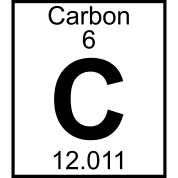
What does the C represent?
a)
atomic mass
b)
atomic number
c)
element name
d)
chemical symbol
39.
Carbon Dioxide's chemical formula is known as....
a)
CO
b)
CO2
c)
Co2
40.
Each row in the periodic table is called a
a)
group
b)
period
c)
cluster
d)
unit
41.
The atomic number tells you what?
a)
number of electrons
b)
number of protons
c)
number of neutrons
d)
both electrons and protons in an atom.
42.

The atomic number of this pictured element is
a)
28
b)
58.6934
c)
Ni
d)
Nickel
43.

Beryllium is in group number______.
a)
Group 2
b)
Group 3
c)
Group 4
d)
Group 7
44.

The period for Bromine is ___________.
a)
3
b)
2
c)
4
45.

What does the 1.00794 stand for?
a)
Hydrogen
b)
atomic number
c)
atomic mass
d)
atomic explosion
46.
What is the total number of subatomic particles in the nucleus of an atom of 36Cl
a)
17
b)
34
c)
36
d)
53
47.
What is the unit used to measure weighted average atomic mass?
a)
amu
b)
gram
c)
angstrom
d)
nanogrm
48.
How many protons, electrons, and neutrons does an atom with atomic number 50 and mass number 125 contain?
a)
50 p+, 50 e-, 75 n
b)
75 e-, 50 p+, 50 n
c)
120 n, 50 p+, 75 e-
d)
70 n, 75 p+, 50 e-
49.
Isotopes of the same element have different
a)
number of neutrons
b)
number of protons
c)
number of electrons
d)
atomic number
50.
An element has an atomic number of 76. The number of protons and electrons in a neutral atom of the element are
a)
152 p+, 76 e-
b)
76 p+, 0 e-
c)
38 p+, 38 e-
d)
76 p+, 76 e-
51.
The particles that are found in the nucleus of an atom are
a)
neutrons and electrons
b)
electrons only
c)
protons and neutrons
d)
protons and electrons
52.
Which of the following is true about subatomic particles?
a)
Electrons are negatively charged and the heaviest
b)
Protons are positively charged and the lightest
c)
Neutrons have no charge and the lightest
d)
Mass of the neutron nearly equals the mass of the proton
53.
The smallest particle of an element that retains the properties of that element is a(n)
a)
atom
b)
electron
c)
proton
d)
neutron
54.
A reaction that generates a new product like H2 + O2 -> H20
is a what?
is a what?
a)
synthesis reaction
b)
decomposition reaction
c)
single replacement
d)
double replacement
100 %

