

wayground logo

Free Printable Worksheets

NEW

Font size

S
M
L
XL
Worksheets

BIO U4: It's All in the Genes

Total questions: 60

Worksheet time: 1hrs 10mins

Name
Class
Date
1.
The diagram below shows homologous chromosomes during prophase I of meiosis
Which of the following correctly describes the process being illustrated?
a)
mutation in which the DNA content of the gene is altered
b)
segregation of sister chromatid
c)
condensation and segregation of alleles
d)
crossing-over in which alleles are exchanged
2.
The diagram below shows a cellular process that occurs in organisms.
What is the name of this process?
a)
meiosis
b)
mitosis
c)
endocytosis
d)
phagocytosis
3.

Which diagram correctly represents a step in the normal process of human reproduction?

a)
b)
c)
d)
4.
Sexual reproduction requires _____ parents and asexual reproduction requires ___ parents
a)
1,1
b)
2,2
c)
2,1
d)
1,2 
5.
What is an advantage of sexual reproduction?
a)
Allows genetic variation
b)
Only needs one parent
c)
Happens very quickly
d)
Offspring are exact copies of parent
6.
A dog has 78 chromosomes in its body cells.  What is the diploid number?
a)
78
b)
39
c)
1
d)
100
7.
A Goat has 60 chromosomes in its body cells.  What is the haploid number?
a)
60
b)
30
c)
100
d)
120
8.
Examine the pedigree. The allele for the presence of a widow’s peak is dominant. Therefore, we can tell from the chart that in the couple labeled 2:
a)
the male is heterozygous and the female is homozygous.
b)
the male is homozygous and the female is heterozygous.
c)
the male is homozygous and the female is homozygous.
d)
the male is heterozygous and the female is heterozygous.
9.
How are individuals III-2 and II-4 related?
a)
Cousins
b)
Dad and Daughter
c)
Uncle and Niece
d)
Grandpa and Granddaughter
10.
If this pedigree shows a recessive disorder, what MUST the genotype of individual II-3 be?
a)
HH
b)
Hh
c)
hh
d)
None of the above
11.
Freckles (F) are dominant over nonfreckles.   What is the phenotype of individual #3
a)
Ff
b)
ff
c)
freckles 
d)
nonfreckles 
12.
Which of the following combinations of sex chromosomes represent a female?
a)
XY
b)
XXY
c)
XX
13.
Tammy is the only one of her siblings to develop breast cancer. She undergoes genetic testing and there is no evidence of the BRAC gene. She is the only one of her siblings who is a long-term smoker. What causes this condition?
a)
Genetics only
b)
Environment only
c)
Neither
d)
Both
14.
Down Syndrome is caused by nondisjunction, when the chromosomes fail to separate during Meiosis. This results in an extra 21st chromosome. What causes this disease?
a)
Genetics only
b)
Environmental only
c)
Both
d)
Neither 
15.
People with PKU are born with a recessive gene for the disease. For these individuals eating protein will result in brain damage. However, if they control their diet and avoid protein they will not ever have any symptoms. The brain damage these people can get is caused by _____________.
a)
Genetics only
b)
Environment only
c)
An interaction of both genetics and environment
d)
Neither
16.
All female bees have the same genes. The bee larva fed a “royal jelly” will become queen bees where the bee larva fed normal nectar will become worker bees. This is describing a trait caused by _________.
a)
Genetics only
b)
Environment only 
c)
Interaction of both
d)
Neither
17.
Twins are used in studies because 
a)
they have different genetics 
b)
they have the same genetics 
c)
they have different environments 
d)
they have identical environments 
18.
Incomplete dominance means that the traits are
a)
expressed equally
b)
dominant
c)
recessive
d)
blended
19.
Term for homozygous organisms that display two dominant phenotypes at the same time
a)
codominance
b)
incomplete dominance
c)
multiple alleles
d)
linked genes
20.
Mitosis produces cells with haploid or diploid number of chromosomes?
a)
Haploid
b)
Diploid
21.
How many cells are produced in Mitosis?
a)
1
b)
2
c)
3
d)
4
22.
How many cells are produced in meiosis?
a)
1
b)
2
c)
3
d)
4
23.
What type of cells are produced in meiosis?
a)
Body Cells
b)
Gametes
c)
Hair cells
d)
Liver cells
24.

Are the cells produced in meiosis identical or unique?

a)

Identical

b)

Unique

c)

I don't know I need to study more
25.
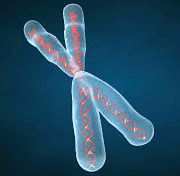
What is a chromosome?
a)
It is condensed DNA
b)
It is the proteins that DNA wraps around
c)
It is a secret
d)
It's a painting technique
26.
A human has 46 chromosomes in their body cells.  What is the haploid number?
a)
46
b)
92
c)
23
d)
12
27.
Body cells have diploid or haploid number of chromosomes?
a)
Haploid
b)
Diploid
28.
Meiosis produces cells with a haploid or diploid number of chromosomes?
a)
Haploid
b)
Diploid
29.
Which of the following does NOT describe this picture?
a)
humans' 46 chromosomes
b)
one gene
c)
the human genome
d)
humans' 23 pairs of chromosomes
30.
What is shown in this karyotype?
a)
A female with Down syndrome
b)
A male with Down syndrome
c)
A normal female
d)
A normal male
31.
Which genetic abnormality is shown in this karyotype?
a)
Partial Addition
b)
Partial Deletion
c)
Trisomy
d)
Monosomy
32.
What percentage of the female offspring will be a carrier for this recessive disease?
a)
0%
b)
50%
c)
100%
d)
25%
33.
The haploid number of human chromosomes is
a)
11
b)
12
c)
23
d)
46
34.
The diploid number of human chromosomes is
a)
23
b)
46
c)
92
35.

Objective 9

Find the gametes for this parent: TtRR

a)

TR, TR, tR, tR

b)

TR, Tr, tR, tr

c)

Tt, RR, TR, tR

d)

Tr, TR, tR, TR

36.
Which of the following is homozygous recessive?
a)
TT
b)
Tt
c)
tt
37.
Which of the following is heterozygous?
a)
TT
b)
Tt
c)
tt
38.
An organisms visible appearance or visible traits
a)
genotype
b)
phenotype
c)
homozygous
d)
heterozygous
39.
Different forms of a gene
a)
genetics
b)
genes
c)
alleles
d)
trait
40.
An organisms genetic makeup or allele combinations
a)
genotype
b)
phenotype
c)
homozygous
d)
heterozygous
41.
An allele whose trait always shows up when the allele is present
a)
homozygous
b)
heterozygous
c)
dominant allele
d)
recessive allele
42.
What is the probability of heterozygous offspring?
a)
25%
b)
50%
c)
0%
d)
100%
43.
What is the probability of homozygous dominant offspring?
a)
0%
b)
100%
c)
50%
d)
25%
44.
What allele combination should go in the missing box?
a)
AA
b)
Aa
c)
aa
d)
none of these
45.
Stuart Snail is heterozygous for tall eyeballs.  Sally Snail has tall eyeballs but does carry the recessive allele.  If their baby snail has tall eyeballs then what is/are the possible genotype(s) he could have?
a)
TT
b)
TT , Tt
c)
TT, Tt, tt
d)
tt
46.
W=white hair
w= non-white hair
If you cross a horse with WW and a horse with ww what fraction of the offspring would be expected to have white hair?
a)
none
b)
3/4
c)
1/2
d)
all
47.
This is an example of ___________.
a)
 Incomplete Dominance
b)
 Codominance
48.
This is an example of ___________?
a)
Incomplete dominance
b)
Co-Dominance
49.
Red/green color blindness is a recessive sex-linked trait.  A woman who is a carrier (XRXr) for this allele marries a normal-vision male (XRY).  What is the probability that they will have a child who is color blind?
a)
25%
b)
50%
c)
75%
d)
100%
50.
What is the genotype for the black chickens?
a)
BB
b)
Bb
c)
bB
d)
bb
51.

What are the possible genotypes for this cross?

a)

TT = 25% Tt= 50% tt=25%

b)

all tall

c)

TT= 75% tt = 25%

d)

Tt = 100%

52.

Red/green color blindness is a recessive sex-linked trait. A woman who is a carrier (XRXr) for this allele marries a normal-vision male (XRY). What is the probability that they will have a child who is color blind?

a)

25%

b)

50%

c)

75%

d)

100%

53.

What are the chances of an offspring being homozygous recessive when both parents are true-breeding recessive too?

a)

100%

b)

50%

c)

75%

d)

0%

54.

A man with type AB blood marries a woman with type B blood. Her mother has type O blood. What is the probability for this couple to have a child with type A blood?

a)

75 %

b)

50 %

c)

25 %

d)

0 %

55.

A man with type AB blood marries a woman with type B blood. Her mother has type O blood. What is the probability for this couple to have a child with type B blood?

a)

75 %

b)

50 %

c)

25 %

d)

0 %

56.
In the second generation-how many people are carriers of the trait?
a)
2
b)
3
c)
5
d)
6
57.
How many individuals are there in the 3rd generation?
a)
2
b)
3
c)
4
d)
6
58.

A normal human zygote should have _____ chromosomes inside.

a)

46

b)

23

c)

92

d)

64

59.
What is the gender of the individual whose karyotype is seen in the image?
a)
Male
b)
Female
60.

Karyotype Analysis

a)

47 chromosomes, female

b)

47 chromosomes, male

c)

45 chromosomes, female

d)

45 chromosomes, male
