
 Worksheets
Mr. B's Fun Factory Unit 4 Pre-Assessment
Total questions: 72
Worksheet time: 54mins
Name
Class
Date
1.
What is the water cycle?
a)
the 3 forms of water
b)
the movement of water on, above, or below the surface of the Earth
c)
when water melts
d)
when clouds form
2.

What part of the water cycle does this picture show?
a)
condensation
b)
precipitation
c)
evaporation
3.
Which of these is an example of precipitation?
a)
snow
b)
air
c)
clouds
d)
vapor
4.
Which best explains why runoff is important?
a)
It returns water to other locations on Earth
b)
It increases the chance of flooding
c)
It makes evaporation occur faster
d)
It increases condensation
5.

What is it called when plants give off water vapor as a waste product?
a)
condensation
b)
evaporation
c)
sublimation
d)
transpiration
6.
What is the energy source for the water cycle?
a)
the sun
b)
the earth
c)
water
d)
the moon
7.
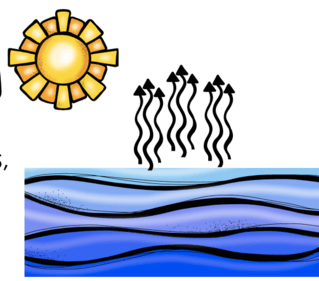
What part of the water cycle does this picture show?
a)
condensation
b)
precipitation
c)
evaporation
8.
How much of our planet is estimated to be covered with water?
a)
68%
b)
50%
c)
97%
d)
75%
9.
Warm ocean currents generally come from
a)
The North Pole
b)
The South Pole
c)
The Equator
d)
Both A and B
10.
Cold ocean currents generally come from
a)
The North Pole
b)
The South Pole
c)
The Equator
d)
Either Pole
11.
A horizontal movement of ocean water that is caused by wind and that occurs at or near the ocean's surface.
a)
Gulf Stream
b)
Global Conveyor Belt
c)
Surface Current
d)
Gyre
12.
Deep Ocean currents are a result of
a)
Global Wind Patterns
b)
Earth's Rotation
c)
Density
d)
All of the above
13.
The Gulf stream carries _____________ water from the east coast of The United States to the West coast of Europe.
a)
Cold
b)
Warm
c)
Freezing
d)
Fresh
14.
Where is ocean water the densest.
a)
The surface
b)
The middle
c)
The bottom
d)
Lake Michigan
15.
When surface currents meet continents they ___?
a)
Stop moving
b)
Are deflected (change paths)
c)
Continue in the direction they were going
16.
How do warm-water currents affect the coastal areas along which they flow?
a)
Cool the coast
b)
Warm the coast
c)
Cause snow to fall
d)
Cause higher tides
17.
Why would places near the north with the same latitude have very different climates?
a)
One place is near a warm ocean current.
b)
It is not possible
c)
Because of La Nina
d)
Because of El Nino
18.
____________ are large streams of moving water that flow through the oceans.
a)
La Niña
b)
El Niño
c)
Currents
d)
Climate
19.
______ is the pattern of temperature and precipitation typical of an area over a long period of time.
a)
Climate
b)
Weather
c)
A season
d)
The Coriolis Effect
20.
Ocean water is more dense than fresh water at the same temperature due to differences in:
a)
Wind patterns
b)
Lifeforms
c)
Currents
d)
Salinity
21.

The current that Marlin and Dorry take in "Finding Nemo" is a warm water current known as the ____________________
a)
East Australian Current (EAC)
b)
Antaractic Subpolar Current (ASC)
c)
California Current (CCD)
d)
Canary Atlantic Middle Current (CAM)
22.
How is the density of ocean water calculated?
a)
volume/mass
b)
salinity/volume
c)
mass/volume
d)
salinity/mass
23.
What is the primary cause of ocean waves?
a)
upwellings
b)
wind
c)
density differences in ocean water
d)
temperature differences in ocean water
24.
What is one of the most common materials dissolved in ocean water?
a)
calcite
b)
gypsum
c)
salt
d)
basalt
25.
Which of the following statements is true about ocean water temperature and depth?
a)
As depth increases, temperature increases.
b)
As depth increases, temperature decreases.
c)
As depth increases, temperature decreases, then increases.
d)
Temperature and depth are not related in ocean water.
26.
As you travel deeper in the ocean...
a)
Temperature increases
b)
Light increases
c)
Pressure decreases
d)
Temperature decreases
27.
What term describes an underwater river?
a)
Tide
b)
Current
c)
Wave
d)
The Coriolis Effect
28.
Why do waves only move on the surface?
a)
Wind cannot reach low depths
b)
Too much pressure
c)
Not enough sunlight
d)
The temperature is too low
29.
Which term describes why wind and currents curve due to the Earth's rotation?
a)
Currents
b)
Wind
c)
The Coriolis Effect
d)
Tides
30.
What term is the measure of dissolved salts in water?
a)
Thermocline
b)
Salinity
c)
Saltiness
d)
Tides
31.
Why is the Dead Sea so salty?
a)
Water evaporates quickly in the hot, arid climate
b)
Fresh water is being added often
c)
Lots of fish have died in there
d)
People visit and pour salt into it
32.
Which of the following would have the lowest salinity?
a)
Middle of the Ocean
b)
Mouth of a river
c)
Dead Sea
d)
Bottom of a trench
33.
Why can people float in the Dead Sea?
a)
Very salty water is more dense
b)
There is no salt in the water
c)
Lowest point on Earth
d)
Very shallow
34.
Cold and warm ocean water is carried around the world by
a)
spring tides
b)
currents
c)
neap tides
d)
tsunamis
35.
As you go deeper in the ocean, which of the following does not decrease?
a)
temperature
b)
light
c)
the number of algae
d)
pressure
36.
Both surface currents and waves are caused mainly by
a)
differences in the density of water
b)
the Coriolis effect
c)
winds
d)
the moon's gravity
37.
Exploring the bottom of the ocean is difficult because of its
a)
darkness
b)
high water pressure
c)
cold temperature
d)
all of the above
38.

Deep Ocean currents are a result of
a)
Global Wind Patterns
b)
Earth's Rotation
c)
Density
d)
All of the above
39.

_______________ are caused by earthquakes on the ocean floor, volcanic eruptions, or underwater landslides.
a)
tides
b)
waves
c)
tsunamis
d)
surface currents
40.
Cold water is _______ dense than warm water
a)
More
b)
Less
c)
equally
41.
What is the periodic rise and fall of the water level in the oceans?
a)
Tide
b)
Tidal range
c)
Spring Tide
d)
Neap Tide
42.

Which body has the greater effect on Earth's tides?
a)
Sun
b)
Saturn
c)
Moon
d)
Venus
43.
Which moon phase would have the GREATEST effect on ocean tidal ranges.
a)
1st quarter
b)
3rd quarter
c)
new moon
d)
waxing gibbous
44.
Why doesn't the sun have more of an effect on tides than the moon, since the sun is larger?
a)
The sun is closer to the earth than the moon
b)
the sun is farther away from the earth, than the moon
c)
the moon is almost as large as the sun
45.
When you are playing in the ocean, you must watch out for ____, a spot where the longshore current carries water back into the ocean.
a)
swell
b)
rip tide
c)
neap tide
d)
trough
46.
The height of a wave is MOST affected by the
a)
speed of the wind
b)
speed of the ocean
c)
salinity of the ocean
d)
amount of solar energy
47.
Why do waves increase in height as they approach the shore?
a)
waves are forced into inlets
b)
water particles speed up
c)
water density increases
d)
they interact with ocean floor
48.
Surface currents and waves are powered by
a)
wind and heat
b)
wind and tides
c)
boats and wind
d)
heat and weather
49.
Surface currents and waves are powered by
a)
wind and heat
b)
wind and tides
c)
boats and wind
d)
heat and weather
50.
Upwelling is associated with
a)
a decrease in access to nutrients for phytoplankton
b)
cooler, nutrient-rich waters being pushed up from deeper ocean waters
c)
temperature gradients moving water from the equator to the poles
d)
an increase in human fatalities
51.
If the earth did not rotate, how would hurricanes be altered?
a)
the coriolis effect would cause hurricanes to rotate clockwise
b)
the coriolis effect would not exist, and hurricanes would not rotate
c)
the coriolis effect would cause hurricanes to rotate counterclockwise
d)
the coriolis effect would not exist and hurricanes would rotate clockwise
52.

What is represented at point 1?
a)
wave height
b)
wavelength
c)
crest
d)
trough
53.
What is represented at point 2?
a)
wave height
b)
wavelength
c)
crest
d)
trough
54.
What is represented at point 3?
a)
wave height
b)
wavelength
c)
crest
d)
trough
55.
Many people believe that ocean waves move water. However, ocean waves really transfer ______.
a)
wind
b)
sand
c)
energy
d)
pressure
56.
_________________ can be harnessed into a narrow channel to increase power and size. Then it is channeled into a basin and used to spin turbines to produce electricity.
a)
tidal energy
b)
wave energy
57.
Tidal power, wave power and thermal power are 3 ways to generate electricity from the ocean.
a)
true
b)
false
58.
What is another name for a tidal barrage?
a)
a bridge
b)
a dam
59.
One advantage of tidal power is -
a)
it can be used anywhere
b)
tides are predictable
c)
tidal power does NOT need a back up source
d)
it is available ALL day
60.

What is B?
a)
Evaporation
b)
Condensation
c)
Precipitation
d)
Runoff
61.

What is D?
a)
Evaporation
b)
Condensation
c)
Precipitation
d)
Runoff
62.

What is C?
a)
Evaporation
b)
Condensation
c)
Precipitation
d)
Runoff
63.
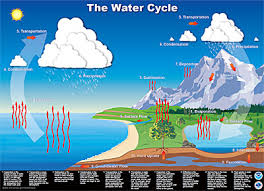
Which stage does ground water try to return to the ocean or soak into the ground?
a)
condensation
b)
evaporation
c)
precipitation
d)
run off
64.
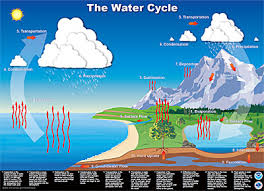
Which stages does liquid water from the ocean turn into water vapor?
a)
condesantion
b)
evaporation
c)
precipitation
d)
run off
65.
Snow, sleet, hail, and rain are all examples of ________________.
a)
evaporation
b)
condensation
c)
accumulation
d)
precipitation
66.
From where does most water evaporate?
a)
puddles
b)
lakes
c)
rivers
d)
oceans
67.
What are three stages of the water cycle?
a)
evaporation, condensation, precipitation
b)
condensation, precipitation, hibernation
c)
precipitation, dehydration, evaporation
d)
transpiration, dehydration, condensation
68.
What follows evaporation during the water cycle? How does this occur?
a)
Water evaporates into water vapor
b)
Water vapor condenses and forms a cloud
c)
Water precipitates to the ground
d)
Water runs down into the hydrosphere
69.
causes evaporation
a)
shaking water
b)
rain
c)
Monster drinks
d)
energy from the Sun or heat
70.
The supply of freshwater under the Earth's surface.
a)
watershed
b)
mouth
c)
headwaters
d)
groundwater
71.

What is the hydrosphere?
a)
Water on the earth's surface
b)
Oceans of the Earth
c)
Rivers, oceans and lakes of the Earth
d)
None of the above
72.
Evaporation of water from the leaves of a plant gives of purified water to be evaporated.
a)
precipitation
b)
concentration
c)
transpiration
d)
evaporation
100 %

